

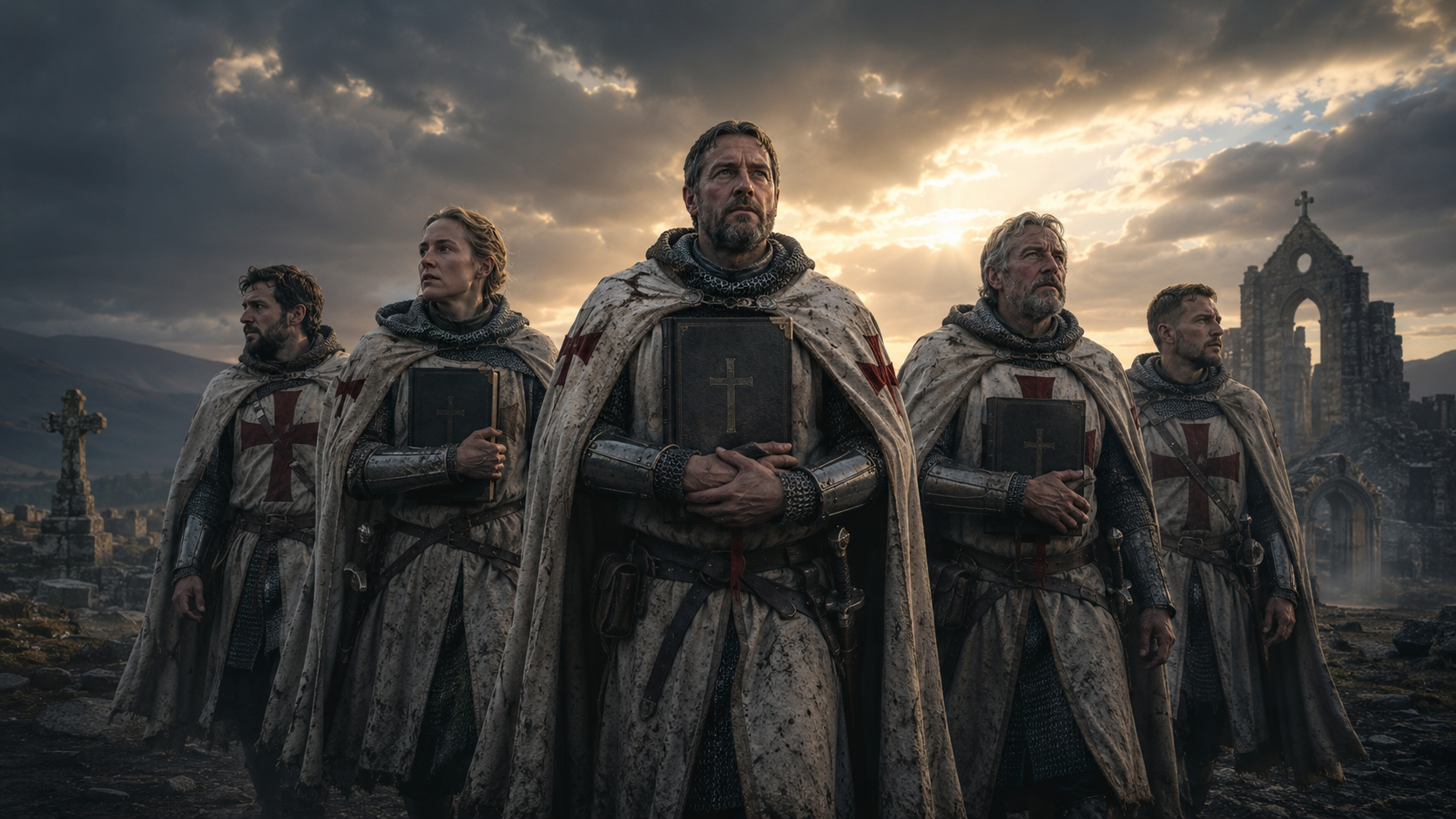
An intramural sports day is a contest inside one institution. The teams wear different colors, but they accept the same field, the same rule book, the same referees, and the same purpose. When the whistle blows, everybody goes home under the same roof. Nothing essential has been placed in jeopardy.
That picture does not describe the present controversy over the text of Holy Scripture.
The phrase intramural debate sounds charitable. In this case it often functions as a sedative. It tells ministers and laymen that the dispute is technical, limited, and safely contained among fellow Christians. It encourages them to watch from the sideline while specialists discuss manuscripts, methods, and probabilities. It implies that no foundational commitment is at stake and that, whatever the result, the church will possess the same Bible in the same sense.
That implication is false.
The dispute concerns the identity of the church’s written rule, the nature of God’s providence toward it, and the court before which disputed readings are finally tried. These are not decorations around the Christian faith. They concern the foundation upon which the church hears her Lord, proves her doctrine, corrects her officers, and teaches her children. “If the foundations be destroyed, what can the righteous do?” (Psalm 11:3).
Christ himself is the church’s only saving foundation and chief corner stone. Yet the Christ of faith is not a figure detached from his own revelation. The household of God is “built upon the foundation of the apostles and prophets, Jesus Christ himself being the chief corner stone” (Ephesians 2:20). The prophetic and apostolic Word does not replace Christ; it is the divinely appointed testimony by which the church knows him and submits to him. To unsettle that testimony as the church’s present and identifiable rule is therefore to strike at the church’s foundation.
This is therefore a battle to the death. The death in view is not the death of men. “For the weapons of our warfare are not carnal” (2 Corinthians 10:4), and “we wrestle not against flesh and blood” (Ephesians 6:12). No threat, cruelty, or physical violence belongs to this cause. The combatants are rival principles. One principle must govern, and the other must be overthrown. Either the church receives an authentic text preserved by God and judges evidence ministerially under that Word, or the church submits the identity of the text to an ongoing work of scholarly reconstruction. Both principles cannot occupy the throne.
The Question Beneath the Questions
There are real historical and philological questions in textual study. Manuscripts must be read. Variants must be collated. Scribal habits, ancient versions, citations, printing histories, and editorial decisions must be examined with patience and skill. Confessional bibliology does not fear such work. It requires more of it, not less.
The decisive question is what that work is allowed to do.
Ministerial criticism serves a text already given to and received by the church. It gathers evidence, exposes printing errors, compares witnesses, explains variations, and helps the church attend more carefully to the Word in her possession. Magisterial criticism assumes the right to reconstruct the text by principles that remain open to revision. Its current edition is useful, learned, and provisional. Tomorrow’s committee may alter what today’s committee printed because the operative court is not the church receiving God’s providentially preserved Word, but the critic weighing surviving evidence by a changing method.
The difference is not between study and ignorance. It is between ministry and mastery.
The Westminster Confession identifies the Hebrew Old Testament and the Greek New Testament as immediately inspired, “by his singular care and providence, kept pure in all ages,” and therefore authentic.1 The order matters. God inspired the Scriptures. God preserved them. Therefore the church possesses authentic Scripture to which she may appeal. The Confession does not direct the church toward an indefinitely deferred original text, nor does it make authenticity the future result of an improving scholarly process.
Confessional bibliology identifies that received text with the Hebrew Masoretic Text in its received Bomberg tradition and the Greek Textus Receptus. It does not place an English translation above the originals. The Authorized Version is honored and used because it faithfully translates those texts; like every translation, it remains answerable to them. The controversy is therefore not a defense of English against Hebrew and Greek. It is a defense of the authentic Hebrew and Greek Scriptures against perpetual reconstruction.
James Ussher likewise described Scripture as the Word of God written “for the perfect building and salvation of the Church.” He said that God provided the written Word so that the churches in every age might possess “a certain rule” by which to judge sound doctrine.2 A rule that cannot yet be identified is not a certain rule. A standard whose wording is always answerable to a higher, revisable tribunal cannot perform the office assigned to Scripture.
William Whitaker stated the Protestant issue with equal clarity. Rome treated the Latin Vulgate as authentic. The Reformed churches, he answered, held the Hebrew Old Testament and Greek New Testament to be “the sincere and authentic scripture of God,” so that versions were approved only as they agreed with those originals. Whitaker called the standard of the original text “the grand hinge upon which this whole controversy turns.”3 The particular adversary has changed, but the hinge remains. Where is the authentic text, and who judges whom?
“Intramural” Is Already a Judgment
Calling the controversy intramural does not suspend judgment. It renders judgment before the argument begins. It declares that both governing principles are legitimate Christian options and that neither can threaten the church’s foundation. It then treats anyone who denies that verdict as needlessly divisive.
We should distinguish carefully between a doctrine and every person who holds it. A genuine believer may adopt an inconsistent principle without following it to its end. Christians can inherit bad arguments from trusted teachers. They can confess more truth than their method permits them to justify. Patience, brotherly affection, and hope are therefore duties. Nothing in this article licenses reckless declarations about the spiritual state of every textual critic or every Christian who uses a modern critical edition.
But charity toward persons cannot turn falsehood into a household liberty. Peter belonged to Christ when Paul “withstood him to the face” because his conduct compromised the truth of the gospel (Galatians 2:11–14). The churches of Galatia were visible churches when Paul told them that a corrupted gospel was no gospel (Galatians 1:6–9). Personal profession did not make the error harmless. Fellowship did not erase the duty of rebuke.
The same distinction applies here. We may treat a man as a brother according to his credible profession while judging one of his principles to be destructive. Indeed, brotherly love may require that judgment. “Charity rejoiceth not in iniquity, but rejoiceth in the truth” (1 Corinthians 13:6). A peace purchased by concealing the nature of an error is not Christian peace.
This is why the habitual reduction of the issue to an intramural disagreement is sinful. It misnames a dispute about the rule of faith as though it were a choice of tactics within an agreed game. It dulls the watchman’s trumpet. It reassures the sheep before the danger has been examined. It places the comfort of the conversation above the truth under discussion.
Sin includes failure to perform a commanded duty. Ministers must hold fast the faithful Word, stop the mouths of gainsayers, and protect the flock from harmful doctrine (Titus 1:9–11). The church must “earnestly contend for the faith which was once delivered unto the saints” (Jude 3). When a foundational principle is attacked, studied quietness may be prudent for a time; permanent neutrality is not. “They have healed also the hurt of the daughter of my people slightly, saying, Peace, peace; when there is no peace” (Jeremiah 6:14).
What Must Die
The language of death should be used soberly. It names the unavoidable end of the controversy. One of two claims must cease to rule the church.
The first claim is that God gave his Word in the Hebrew and Greek Scriptures, preserved it by singular providence, and brought that authentic text through the ages for the church’s use. On this account, textual scholarship has a real but subordinate office. It does not create the object of faith. It serves the church in recognizing, comparing, defending, printing, and translating what God has kept.
The second claim is that the original wording must be reconstructed from the surviving evidence by the best available critical method. The reconstructed text remains provisional because new discoveries, new weightings of evidence, new genealogical models, and new editorial judgments may change it. Even where the current result agrees almost entirely with the received text, the relation of authority has been reversed. The church’s text stands before the scholar’s court.
These claims may coexist uneasily in one person. They cannot coexist coherently as the church’s rule. If the first is true, the second has usurped an authority it does not possess. If the second is true, the confessional claim that the inspired originals were kept pure in every age no longer describes an identifiable text possessed by the church. It becomes a general assurance that God preserved enough material somewhere among the witnesses for experts eventually to approximate the lost original.
That is not a small adjustment. It changes preservation from a completed providential gift into a continuing scholarly project. It changes reception from the church’s grateful recognition into a stage in the history of evidence. It changes textual criticism from a servant that answers to the Word into a court whose judgments determine the Word’s present wording.
The issue cannot be settled by repeating that no major doctrine is affected. First, the claim is too broad. Individual readings can affect the directness, precision, and exegetical basis of doctrine even when a teaching may be proved elsewhere. Second, Scripture is not valuable only where a verse is needed to preserve a doctrinal minimum. “Every word of God is pure” (Proverbs 30:5). The church has no permission to treat words as expendable because the remaining words still support an orthodox summary. Third, the authority of Scripture is itself doctrine. A method that alters the relation between the Word, the church, and the scholar affects doctrine before a single variant is counted.
Nor can the controversy be dissolved by praising scholarship. Learning is a gift, and careful scholars may perform valuable work. The question is jurisdiction. A gifted servant remains a servant. Expertise does not authorize a man, a committee, or a guild to exercise a power Christ has not granted. The Westminster Confession says that the supreme judge in religious controversies is the Holy Spirit speaking in Scripture.4 The scholar may give evidence. He may not become the voice by which Scripture receives permission to speak.
How Christians Fight
Because this is a battle, Christians must fight it as Christians.
We fight by reading the Scriptures, not by repeating slogans. We define the opposing claims exactly and follow each to its necessary consequences. We examine manuscripts and editions honestly. We acknowledge difficult evidence instead of hiding it. We correct our own errors. We refuse personal slander, manufactured quotations, and careless accusations. We pray for those whom we oppose, and we remain ready to receive correction proved from the Word.
We also refuse the counterfeit virtue of studied vagueness. A courteous tone cannot compensate for an undefined proposition. An impressive list of credentials cannot replace a biblical warrant. A claim does not become safe because it is popular in seminaries, printed in a critical apparatus, or defended by a Christian scholar. The question remains: what hath God said?
The armor for this battle is the armor of God. The sword is “the word of God” (Ephesians 6:17). The required courage is the courage to stand, speak plainly, endure reproach, and keep one’s own spirit under discipline. The goal is not the humiliation of opponents. It is their recovery, the protection of the church, and the public vindication of the truth. The Lord’s servant must not strive carnally, but must be gentle, patient, and able to teach while correcting those who oppose themselves (2 Timothy 2:24–26). Gentleness governs the manner; it does not erase the conflict.
On this first day of August, let the terms be clear. We are not gathering for an intramural sports day. We are not choosing jerseys while accepting a common field and a common referee. We are contending over whether the church receives her authentic Scriptures from the providence of God or awaits them from the judgments of an ever-revising discipline.
No Christian should desire such a conflict. No faithful Christian may pretend that it does not exist.
Take the Bible into the battle. Read it in your home. Teach it to your children. Require ministers and scholars to prove their governing principles from it. Study the historical evidence without granting that evidence a throne. Confess without embarrassment that the God who inspired his Word also kept it. Pray for courage without malice, conviction without vanity, and charity without surrender.
Then stand. If the foundations be destroyed, the righteous cannot repair them by calling the demolition a game.
Notes
Bibliography
The Holy Bible, Containing the Old Testament and the New. Authorized Version.
Ussher, James. A Body of Divinitie, or, The Summe and Substance of Christian Religion. London, 1645.
Westminster Assembly. The Confession of Faith. London, 1647.
Whitaker, William. A Disputation on Holy Scripture. Translated and edited by William Fitzgerald. Cambridge: Cambridge University Press, 1849.
- Westminster Assembly, The Confession of Faith (1647), 1.8. ↩
- James Ussher, A Body of Divinitie, or, The Summe and Substance of Christian Religion (London, 1645), “Of Christian Religion and the Grounds Thereof.” ↩
- William Whitaker, A Disputation on Holy Scripture, trans. and ed. William Fitzgerald (Cambridge: Cambridge University Press, 1849), First Controversy, Question II, chapter 1. ↩
- Westminster Assembly, The Confession of Faith (1647), 1.10. ↩
Comments
Share a question or response to this article.