

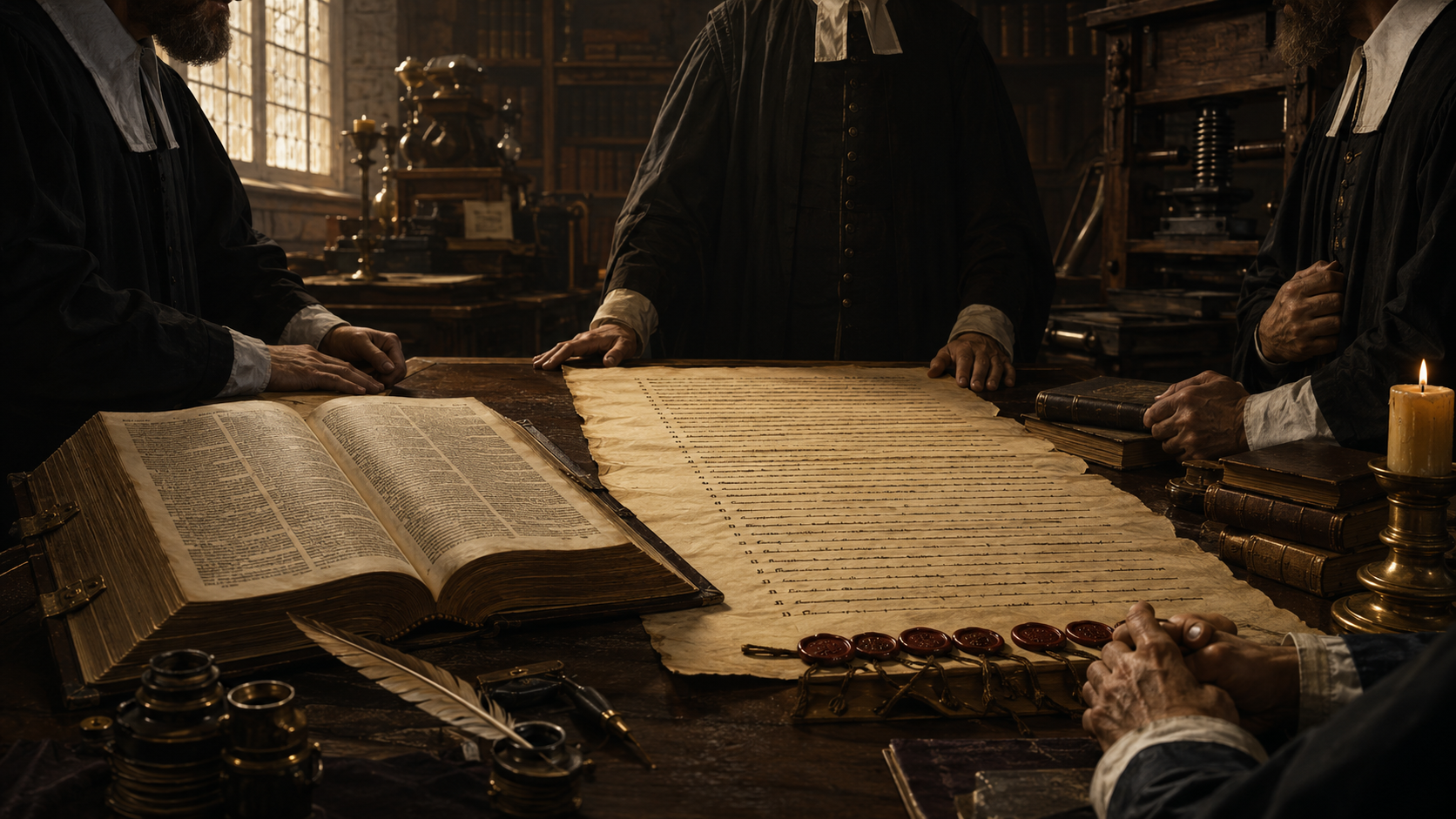
Twenty-Five Theses Gathered into One Confession
“The grass withereth, the flower fadeth: but the word of our God shall stand for ever.”
—Isaiah 40:8
The doctrine of Scripture begins with God.
It does not begin with a manuscript, an archaeological discovery, a printed edition, an ecclesiastical decree, or the conclusions of a scholarly committee. It begins with the living God who knows all things, governs all things, and cannot lie.
This God speaks.
Because God speaks, his Word carries his own authority. Because God is truth, his Word cannot deceive. Because God is sovereign, his purpose in giving Scripture cannot fail. Because God rules history, the transmission of Scripture does not occur outside his providence. Because Christ gathers and governs his church, his people have not been left without the written voice of their Shepherd.
The modern textual controversy frequently begins at the opposite end. It begins with surviving artifacts, observed differences, probabilities, and reconstructed histories. It then attempts to reason upward from the evidence toward whatever confidence may still be possible.
Confessional bibliology begins from above.
It begins with God’s own testimony concerning his Word and then interprets manuscripts, editions, versions, translations, and ecclesiastical history within that revelation.
This difference is not an excuse to ignore evidence. It determines what the evidence is evidence of.
A manuscript is not an autonomous religious artifact. It is a witness within the providential transmission of Scripture. A variant is not proof that God has failed. It is a local difference among fallible witnesses to a preserved text. An edition is not the Word made authoritative by an editor. It is a presentation of a text whose authority precedes the press. A translation does not become Scripture through literary prestige or ecclesiastical affection. It possesses derivative authority insofar as it faithfully renders the authentic Hebrew and Greek Scriptures.
Throughout these twenty-five theses, one question has governed every other:
Has God successfully preserved the Word he inspired for the church to which he gave it?
Confessional bibliology answers without hesitation:
Yes.
“The mouth of the LORD hath spoken it”
Isaiah’s declaration concerning the perpetuity of God’s Word is grounded in the identity of the speaker:
“For the mouth of the LORD hath spoken it” (Isaiah 40:5).
The contrast in Isaiah 40 is between the frailty of man and the permanence of divine speech.
“All flesh is grass.” Men rise and fall. Empires flourish and disappear. Libraries burn. Languages change. Copyists die. Printing houses close. Universities revise their judgments. Critical theories achieve dominance and are later displaced.
God’s Word stands.
Its permanence does not arise from the strength of its human custodians. It does not depend upon the church’s institutional perfection. It does not rest upon the exceptional skill of one copyist, printer, or editor.
The Word stands because God has spoken it.
Peter applies Isaiah’s promise directly to the gospel proclaimed in the church:
“Being born again, not of corruptible seed, but of incorruptible, by the word of God, which liveth and abideth for ever. For all flesh is as grass, and all the glory of man as the flower of grass. The grass withereth, and the flower thereof falleth away: but the word of the Lord endureth for ever. And this is the word which by the gospel is preached unto you” (1 Peter 1:23–25).
Peter does not direct Christians toward an inaccessible original behind the preached Word. The enduring Word is the Word proclaimed to them. The incorruptible seed produces new birth through its continuing presence and power.
The perpetuity of Scripture is therefore not merely archival. God preserves his Word so that it continues to accomplish his purpose.
It is preached.
It is heard.
It creates faith.
It converts sinners.
It sanctifies saints.
It governs the church.
It judges the thoughts and intentions of the heart.
It remains living and powerful because its divine author remains living and powerful.
The argument of the series
The twenty-five theses have developed one integrated doctrine. They should not be treated as isolated propositions from which a reader may select whichever claims appear congenial.
The doctrine of preservation rests upon the doctrine of God. The identification of the text rests upon preservation. The use of evidence rests upon textual identity. The legitimacy of textual criticism rests upon its submission to Scripture. The church’s practical duties rest upon all that precedes them.
If the order is reversed, the position becomes unstable.
One cannot begin with an autonomous critical method and then add providence as an explanation of its results. One cannot make preservation mean whatever the surviving manuscript situation happens to permit. One cannot confess the authority of Scripture while leaving the identity of Scripture dependent upon an indefinitely continuing reconstruction.
The confessional order must be maintained:
- God speaks.
- His Word possesses intrinsic divine authority.
- He inspired definite words.
- He gave those words to his covenant people.
- He promised their continuance.
- He preserved them through history.
- The church received them in an identifiable textual inheritance.
- Manuscripts and editions witness to that text.
- Translations derive authority from it.
- Scholarship serves beneath it.
That is the architecture of confessional bibliology.
The twenty-five theses in compressed form
The full argument of the series may now be restated as one unified confession.
1. God’s Word possesses authority because God is its author
Scripture’s authority does not depend upon the church, the scholar, the believer, or the quality of the surviving evidence. It depends wholly upon God, who is truth itself.
2. Scripture is self-authenticating
The Bible bears the marks of its divine origin within itself. It does not require a higher authority to certify it, for no authority higher than God exists.
3. The Holy Spirit produces full persuasion by and with the Word
The inward testimony of the Spirit does not add authority to Scripture or communicate private revelation alongside it. The Spirit enables believers to recognize and receive the divine voice already speaking in Scripture.
4. Ecclesiastical and historical evidence remains subordinate
The church’s testimony, the antiquity of manuscripts, the agreement of witnesses, the majesty of doctrine, and the transforming power of Scripture all have genuine evidential value. They minister to faith but do not constitute its ultimate ground.
5. Inspiration extends to the words of Scripture
God did not merely inspire religious concepts later expressed imperfectly by human writers. Through the organic agency of those writers, he gave the words he intended to give.
6. The original Scriptures were infallible because they were immediately inspired
The Hebrew and Greek words first given through the prophets and apostles were the very words of God and therefore wholly true.
7. The authority of Scripture did not perish with the autographs
The loss of the first physical documents did not remove inspired words from the church. Those words continued through faithful copies.
8. God preserved Scripture by singular care and providence
Preservation is not merely the general providence by which God permits ancient writings to survive. It is his special government of the transmission of the Word appointed to rule his church.
9. Preservation extends to the words, not merely the message
God did not promise to preserve only enough religious content to maintain the central doctrines of Christianity. The object of preservation corresponds to the object of inspiration.
10. Preservation has continued through all ages
The authentic text was not lost for centuries and recovered by modern scholarship. It remained substantially available to the covenant people throughout the history of the church.
11. The preserved text remains extant
The church possesses Scripture in present textual forms. Preservation cannot be restricted to inaccessible autographs or relocated into a hypothetical text lying behind all surviving witnesses.
12. The authentic Old Testament is found in the Hebrew Masoretic tradition
The Hebrew text publicly transmitted, received by the Reformation churches, and represented in the Bomberg–Ben Chayyim tradition is the authentic Old Testament—not merely one witness to a Hebrew text requiring reconstruction from competing sources.
13. The authentic New Testament is found in the Greek Received tradition
The Greek text broadly transmitted through the church and given printed form in the editions of Erasmus, Stephanus, Beza, the Elzevirs, and their successors constitutes the received New Testament textual inheritance.
14. Canon and text are related acts of providential reception
The church did not create the canonical books, nor did she create their text. She received both under the providence of the Christ whose sheep hear his voice.
15. The church’s reception is ministerial, not magisterial
Ecclesiastical use and confessional recognition are important historical witnesses, but they do not confer divine authority. The church receives because God has spoken.
16. Translations possess derivative authority
A faithful translation is truly the Word of God insofar as it accurately represents the inspired Hebrew and Greek text. No translation possesses authority independently of those sources.
17. The Authorized Version is not superior to the original languages
The King James Bible should be honored as a faithful and enduring English translation of the preserved texts. It must not be treated as re-inspired English or as a corrective authority over Hebrew and Greek.
18. Confessional bibliology is not KJV-onlyism
Its final appeal is to the authentic Hebrew and Greek Scriptures, not to one English translation. Its preference for the Authorized Version arises from textual and translational fidelity rather than the canonization of English wording.
19. The Received Text must not be reduced to one immaculate printed edition
Erasmus, Stephanus, Beza, the Elzevirs, Scrivener, and other editors were learned but uninspired men. Their editions may contain differences or printing errors without destroying the identity of the text they present.
20. The text, its witnesses, and its editions must be distinguished
The text is the verbal object inspired and preserved by God. Manuscripts witness to it. Editions present it. Confusing these categories creates both skepticism and false claims of editorial perfection.
21. Textual criticism is legitimate when it remains ministerial
Manuscript comparison, edition collation, the identification of scribal and printing errors, and the construction of apparatuses can serve the church. Such work is lawful when it begins with a text already given and preserved.
22. Textual criticism becomes magisterial when it constitutes the text
The reconstructionist model treats the original or initial text as absent and makes its present identity dependent upon an evolving scholarly process. The critic then stands logically before the text he is supposed to serve.
23. The traditional text must be evaluated as a providential whole
The Hebrew Masoretic and Greek Received texts possess historical continuity, public accessibility, ecclesiastical use, confessional recognition, and substantial stability. These cumulative marks must not be fragmented into thousands of isolated contests.
24. Difficult variants must be resolved within the Received Text
Genuine editorial questions require honest examination. Evidence may be weighed, readings documented, and uncertainty acknowledged without reopening the identity of Scripture or admitting conjecture into the sacred text.
25. The church must receive, confess, and use the preserved Word
Churches, ministers, seminaries, translators, scholars, publishers, missionaries, parents, and believers each possess duties toward the Word God has entrusted to them. Confessional bibliology must become ecclesiastical practice.
These twenty-five affirmations form one doctrine.
Remove divine authority, and preservation becomes mere historical survival.
Remove verbal inspiration, and preservation may be reduced to a message.
Remove preservation, and textual identity becomes reconstruction.
Remove textual identity, and criticism becomes magisterial.
Remove ecclesiastical duty, and the doctrine remains barren.
What confessional bibliology does not claim
A strong position should be stated not only positively but with careful denials. Several caricatures have followed confessional bibliology, sometimes because critics have misrepresented it and sometimes because its defenders have spoken imprecisely.
The position does not claim that every surviving manuscript is perfect.
It does not claim that copyists were inspired.
It does not deny the existence of genuine variants.
It does not teach that one printed edition descended from heaven free from every compositor’s mistake.
It does not identify the authority of Scripture with the authority of Erasmus, Beza, Scrivener, or the translators of the Authorized Version.
It does not place the King James Bible above the original languages.
It does not teach that ecclesiastical use creates inspired readings.
It does not forbid the examination of manuscripts, ancient versions, patristic citations, or the history of editions.
It does not require scholars to conceal difficulties.
It does not make every intra-Received-Text difference a test of fellowship.
It does not rest upon the numerical majority of manuscripts as an independent inspired canon.
It does not treat age as irrelevant, though it denies that age possesses automatic authority.
It does not reject scholarship.
It rejects the autonomy of scholarship.
It does not fear evidence.
It denies that evidence may sit in judgment upon the God who gives evidence its meaning.
One text, many fallible witnesses
A central achievement of the series has been the distinction between the perfection of preservation and the fallibility of transmission’s human instruments.
Critics often treat these as contradictory. If copyists made mistakes, they argue, then the text was not kept pure. If printed editions differ, no one can identify the Received Text. If editorial judgment remains necessary, the church must depend upon reconstruction.
The conclusion does not follow.
God’s providence ordinarily accomplishes infallible purposes through fallible means.
The preaching of a fallible minister may truly communicate an infallible Word. A fallible translation may faithfully render inspired Scripture. A fallible church may rightly confess the canonical books. Fallible copyists may transmit an authentic text through a plurality of mutually correcting witnesses.
Preservation never required God to transform every scribe into a temporary prophet.
Instead, God multiplied the witnesses. Errors in one were exposed through others. The text remained substantially stable across transmission. It continued to be read publicly and recognized ecclesiastically. The invention of printing further stabilized and distributed the textual inheritance already present.
The existence of variants therefore proves the fallibility of witnesses. It does not prove the failure of preservation.
The very ability to identify a variant presupposes a field of substantial agreement. If every word were uncertain, no difference could be classified as a difference. Variants are visible because the textual tradition is stable enough to expose them.
Certainty without editorial infallibility
Confessional bibliology permits certainty without pretending to omniscience.
This balance is difficult for modern thought because it tends to imagine only two possibilities.
Either an editor must possess infallible certainty concerning every local question, or the whole text must remain provisional.
But the church’s certainty does not rest upon an editor.
It rests upon God’s testimony.
The Christian can know that God has preserved his Word while acknowledging that two received editions differ at a limited number of places. The editor can retain a base reading, record an alternate reading, explain the evidence, and confess that his own resolution remains fallible.
This is not the same as saying that Scripture is unknown.
An unresolved difference between two witnesses within an identified tradition is categorically different from a theory in which the text itself is an indefinitely revised scholarly product.
The former acknowledges a local limitation in editorial knowledge.
The latter places the identity of Scripture under permanent reconstruction.
Confessional certainty is therefore both firmer and humbler.
It is firmer because it begins with the promise and faithfulness of God.
It is humbler because it refuses to ascribe divine authority to human editorial judgment.
The real location of the controversy
The textual controversy is often framed as a dispute over manuscripts.
At its deepest level, it is a dispute over religious authority.
Who speaks first?
Does God’s revelation establish the principles by which textual history is understood? Or does a reconstruction of textual history determine what may be confessed concerning providence?
The reconstructionist begins with an absent text and surviving evidence. He employs critical methods to produce a proposed original or initial text. He may then describe the survival of sufficient evidence as providential preservation.
The confessional Christian begins with the self-attesting Scripture. From Scripture he learns that God inspired words, entrusted them to his people, and preserved them for perpetual use. He then approaches the historical evidence expecting to find the fulfillment of those promises.
Both positions interpret evidence within prior commitments.
The difference is that confessional bibliology acknowledges its ultimate authority.
It makes no pretense of neutrality.
The Christian does not meet the unbelieving critic upon autonomous ground. He does not temporarily set aside divine revelation in order to establish the Bible by supposedly common historical reason. Such an undertaking has already surrendered the question of authority.
All facts belong to God.
Every manuscript exists under his providence.
Every act of reasoning depends upon the mind he created.
Every historical judgment assumes the intelligibility of a world he governs.
The critic cannot escape God’s revelation in order to judge it. He can only reason obediently within that revelation or suppress it while continuing to depend upon it.
Confessional bibliology is therefore necessarily presuppositional.
The Holy Spirit speaking in Scripture is not one consideration placed alongside manuscript age, geographical distribution, or transcriptional probability. He is the supreme judge by whom every controversy is determined.
The work that remains
Completion of the series does not complete the work.
The theses establish a theological foundation. That foundation should support a substantial program of historical, editorial, pastoral, and ecclesiastical labor.
Primary-source recovery
The early printed Hebrew and Greek editions should be catalogued, digitized, transcribed, and compared from primary artifacts. Existing secondary collations should be verified rather than repeated uncritically.
Libraries contain manuscripts, correspondence, annotations, proof sheets, and other materials capable of clarifying the textual sources and editorial judgments of the Reformation era. These materials deserve sustained examination.
A critical edition of the Greek Received Text
A full critical edition of the Textus Receptus would be a particularly valuable contribution.
Scrivener’s 1881 text provides a natural base for an edition intended to correspond to the Greek underlying the Authorized Version. But it should be accompanied by a comprehensive apparatus documenting the readings of the principal Erasmus, Stephanus, Beza, and related editions; the Elzevir tradition; relevant manuscript evidence; and materials connected with the Authorized Version translators that were unavailable or unknown to Scrivener.
Such an edition should appear in several forms:
- a readable Greek text for pastors and students;
- a full scholarly edition with a comprehensive apparatus;
- a digital edition with searchable witnesses and transparent revision history;
- and an edition keyed directly to the Authorized Version’s textual decisions.
The project would not seek to reconstruct an absent New Testament. It would document, clarify, and strengthen access to the received textual inheritance.
Further study of the Hebrew text
The same careful attention should be given to the Masoretic tradition, the Bomberg–Ben Chayyim text, marginal traditions, printed editions, and the relationship between the Hebrew text and Reformation-era translations.
Confessional commitment should never become an excuse for historical vagueness.
Translation and missionary work
Faithful translations from the authentic Hebrew and Greek texts are needed in both established and underserved languages. Translation should be accompanied by transparent source-text policies, ecclesiastical oversight, and long-term revision practices.
Pastoral education
Ministers and congregations need accessible resources explaining preservation, variants, editions, and translations without unnecessary technicality. The ordinary believer should not first learn about textual criticism from a skeptical professor, an internet controversy, or a footnote that casts doubt upon a familiar passage.
Detailed examination of variants
The general doctrine must also be applied to particular passages. Each variant should be examined according to the confessional order of evidence developed in the series.
This work will be extensive. It will require careful treatment of the Gospels, Acts, Pauline Epistles, General Epistles, and Revelation—book by book and passage by passage.
The task may span years or generations.
That should not discourage it.
The church received her textual inheritance across centuries. She may labor patiently to understand and transmit it more faithfully.
The danger of winning the argument and losing the Word
There remains one final warning.
A man may become skilled at defending Scripture while neglecting to read it.
He may insist upon verbal preservation while refusing to obey the words preserved. He may argue fiercely for the Received Text while showing little of the charity, humility, purity, patience, or self-control commanded in that text. He may expose the autonomy of modern criticism while allowing pride to govern his own mind.
Such a defense contradicts itself.
The purpose of Scripture is not exhausted by textual identification. God preserved his Word so that the church might live by every word proceeding from his mouth.
The defender of Scripture must therefore submit to Scripture.
He must allow it to reprove him before using it to reprove others. He must seek holiness as earnestly as historical accuracy. He must love the brethren while opposing error. He must distinguish ignorance from rebellion and confusion from deliberate unbelief.
Truth must not be softened.
But truth must be spoken in obedience to the truth.
The same Scripture that condemns false doctrine condemns pride, slander, impatience, partiality, and dishonest argument. A confessional bibliology defended through violations of Scripture’s moral law has not honored the Word it claims to preserve.
The Bible in the believer’s hand
The practical end of the doctrine is wonderfully ordinary.
A Christian opens his Bible.
He does not possess the original parchment upon which Paul wrote. He does not need it. The apostolic words have not died with the parchment.
He may not know the names of the manuscripts behind his New Testament. He may never collate an edition, study a critical apparatus, or read a patristic citation.
Yet he possesses the Word of God in a faithful translation of the authentic text.
When he reads, God speaks through the written Word.
When a minister preaches it faithfully, Christ addresses his church.
When a mother teaches it to her child, the covenantal transmission of divine truth continues.
When a missionary translates it, another people hears the wonderful works of God in its own language.
When a persecuted believer memorizes it, no confiscation can remove it from his heart.
When the dying saint hears its promises, he rests not upon the probability of critical conclusions but upon the faithfulness of the God who cannot lie.
This is what is at stake.
Not a hobby for specialists.
Not nostalgia for an old translation.
Not loyalty to a printer.
Not fear of manuscripts.
The question is whether Christ has kept his promise to speak to his sheep through a Word they can possess.
He has.
The Word stands because God stands
Human glory fades.
Scholarly fashions pass.
Critical editions are revised.
Institutions rise and fall.
Manuscripts decay.
Languages change.
Heaven and earth shall pass away.
But Christ’s words shall not pass away.
The preservation of Scripture does not finally rest upon the church’s grip upon the Bible. It rests upon God’s grip upon his church and his Word.
He spoke through the prophets.
He spoke through the apostles.
He caused those words to be written.
He distinguished the canonical books by his own authority.
He preserved their text through the ordinary and extraordinary workings of providence.
He caused that text to be received, copied, preached, translated, confessed, and transmitted.
He continues to illuminate it by his Spirit.
He will use it until every purpose for which he sent it has been accomplished.
The confession of providential preservation is therefore an act of worship.
It ascribes the success of revelation to God rather than man. It refuses to praise the critic for recovering what God supposedly failed to preserve. It refuses to praise the church as though she created the authority she merely received. It refuses to praise an editor as though he perfected the Word by printing it.
The glory belongs to the speaker.
Confessional bibliology ultimately says only what faith must say whenever God promises:
“Let God be true, but every man a liar” (Romans 3:4).
The grass withers.
The flower fades.
The critic passes away.
The manuscript returns to dust.
But the Word of our God shall stand forever.
A final confession
We confess that the living and true God has spoken in Holy Scripture; that the authority of Scripture depends wholly upon him; that the Hebrew and Greek words he inspired have, by his singular care and providence, been kept pure in all ages; that the church possesses those words in the authentic Hebrew Masoretic and Greek Received texts; that faithful translations truly communicate the Word derivatively; that manuscripts, editions, versions, ecclesiastical testimony, and scholarship serve ministerially beneath Scripture; and that the Holy Spirit speaking in Scripture remains the supreme judge in every controversy. We therefore receive the Word God has given, confess the Word God has preserved, and commit ourselves to reading, preaching, translating, defending, and transmitting it faithfully until the Lord returns.
Series complete: 27 of 27 posts—prologue, twenty-five theses, and epilogue.
Comments
Share a question or response to this article.