

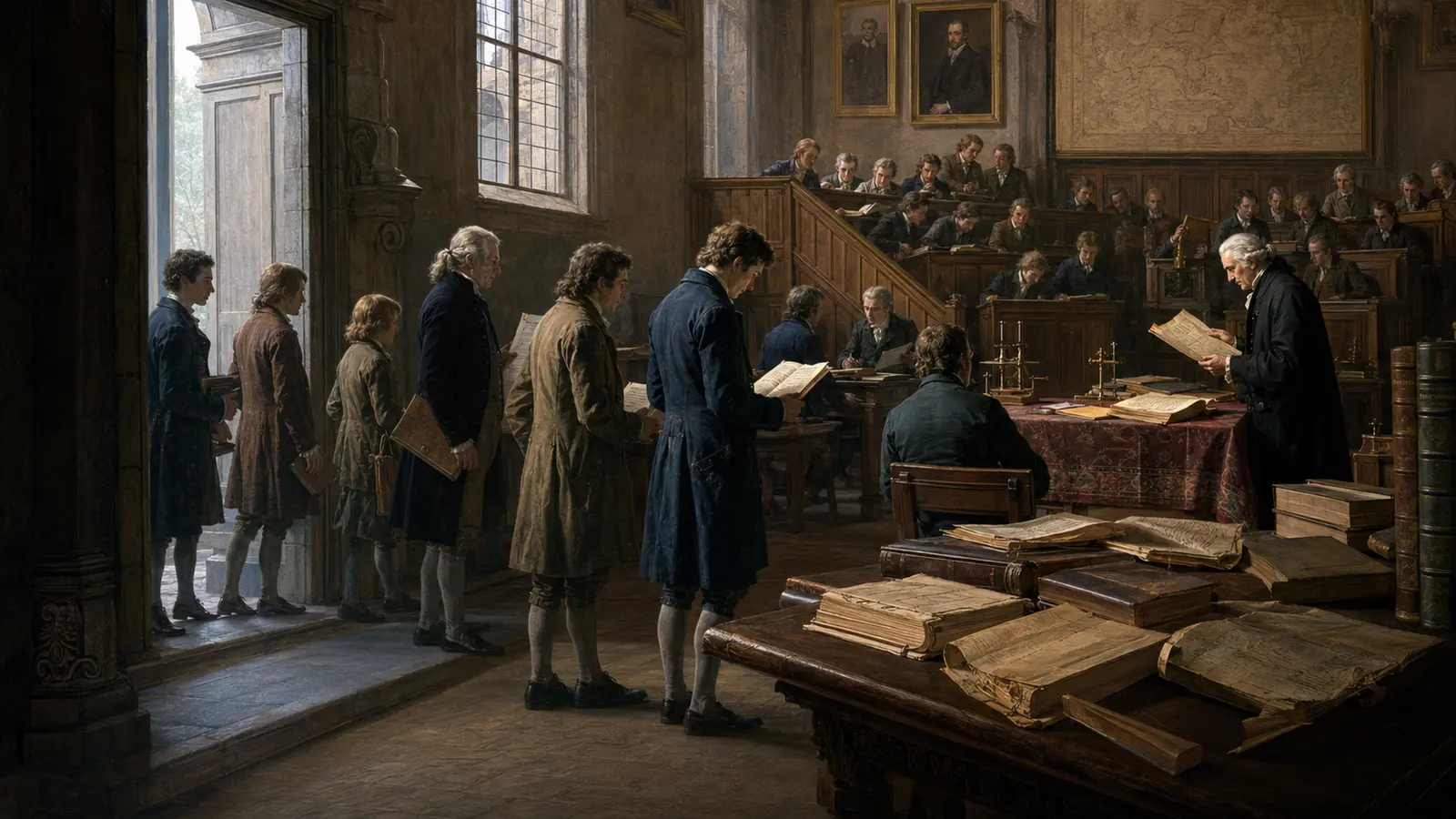
Revision note: Revised July 20, 2026. The historical argument and qualifications have been retained; two malformed links were repaired, headings normalized, and nine citations converted into functional footnotes. The essay identifies a historical development and theological tendency, not a conspiracy or a claim about hidden motives.
“Beware lest any man spoil you through philosophy and vain deceit, after the tradition of men, after the rudiments of the world, and not after Christ.” — Colossians 2:8
The first three articles in this series identified the academy game, showed why its method loses the battle before the first variant is examined, and stated the positive doctrine of Scripture’s self-attestation. A historical question now demands an answer. If the Reformed churches once confessed that the Hebrew and Greek Scriptures had been kept pure in all ages by God’s singular care and providence, how did restorationist textual criticism become the ordinary position in Reformed and evangelical institutions?
It did not become normal because one manuscript was discovered which disproved providential preservation. Nor did the church simply advance from ignorance to knowledge. The change occurred through a long alteration in first principles. Ecclesiastical controversy made textual uncertainty useful. Enlightenment habits made autonomous historical judgment respectable. Nineteenth-century critics turned reconstruction into a specialized science. Evangelical theologians then protected that science from confessional criticism by relocating infallibility to the lost autographs and reducing preservation to the possession of a text sufficiently accurate for doctrine.
The result was a new normal. Scripture could still be praised as inspired while the identity of its words was determined within a framework that treated it, methodologically, as one more ancient book. The academy game became normal when this framework ceased to appear like a theological choice and began to appear like scholarship itself.
Normality Is a Historical Achievement
What an age calls “neutral method” is often the residue of earlier victories. Assumptions once disputed become embedded in textbooks, institutions, professional vocabulary, and standards of competence. Later students encounter the settlement rather than the controversy that produced it. They are taught which questions may be asked, what counts as evidence, and which conclusions identify a person as serious before they learn that another order of knowledge ever existed.
This is especially powerful in textual criticism because the discipline deals with real artifacts and requires genuine technical learning. Manuscripts must be dated. Hands must be distinguished. Versions must be analyzed. Scribal habits, quotations, lectionaries, book production, and transmission histories must be studied. The reality of this labor lends authority to the philosophical framework within which the labor is performed.
But technical competence and theological neutrality are not the same thing. A scholar can identify the ink, date the parchment, and collate the reading accurately while misunderstanding the providence in which that manuscript exists. Historical facts do not interpret themselves. The question is not whether Christians should examine manuscripts. The question is whether manuscripts will be examined as witnesses to a Word already given and preserved by God, or as remains from which an absent and possibly lost text must be reconstructed.
The movement from the first question to the second is the history of how the academy game became normal.
The Confessional Starting Point
The Westminster Confession of Faith established a definite order of authority. Scripture is to be believed because God, who is truth itself, is its author (1.4). Its divine qualities abundantly evidence it to be God’s Word, while full persuasion comes from the Holy Ghost bearing witness by and with the Word (1.5). The inspired Hebrew and Greek Scriptures were kept pure in all ages and are therefore authentic, so that the church is finally to appeal to them in controversy (1.8). Scripture is its own infallible interpreter (1.9), and the supreme judge is the Holy Ghost speaking in Scripture (1.10).1
This order did not eliminate textual study. Reformed scholars knew of scribal mistakes, variant readings, defective copies, printing errors, ancient versions, and difficult passages. They compared witnesses and corrected editions. Yet correction occurred within a prior confession: God had preserved his whole Word for his church in the authentic Hebrew and Greek Scriptures. The church was not attempting to recover an object which providence might have allowed to disappear. It was using subordinate witnesses to distinguish the preserved reading from errors in particular copies.
That distinction is the hinge of the controversy. One method corrects a copy by appeal to the preserved Word witnessed across the copies. The other reconstructs a lost authorial text from surviving remains. The outward acts may sometimes look alike. Both compare manuscripts. Their objects, expectations, and possible conclusions are fundamentally different.
Owen and Walton: The Fault Line Appears
The 1659 controversy between John Owen and Brian Walton displays the fault line before the modern settlement had hardened.
Walton’s Biblia Polyglotta was a monumental scholarly achievement. It placed the original texts beside ancient versions and supplied a large apparatus of variant readings. Owen did not oppose the study of languages, versions, or manuscripts. He expressly commended the learning, diligence, and usefulness represented by the work. His concern was directed at claims in the Prolegomena and at the possible theological use of the apparatus.
In Of the Integrity and Purity of the Hebrew and Greek Text, Owen stated his governing thesis: God’s whole Word, as originally given, had been preserved entire in the original languages. He acknowledged variant readings and mistakes in individual copies. He urged learned men to examine them carefully. But he denied that conjectures should be promoted into readings, that alleged defects in all known copies could be repaired by an ancient translation, or that a mass of indiscriminate differences should be permitted to overthrow confidence in the providentially preserved rule.2
Owen’s concern was epistemological as well as pastoral. If the Hebrew and Greek text itself could be judged corrupt at a place where all its extant witnesses agreed, and if a critic could replace it through conjecture or a retroversion from a translation, the final court had moved. The church no longer possessed the rule by which versions were corrected. The critic now stood above the extant text and inferred what an unavailable text must once have said.
Walton’s Considerator Considered must be represented fairly. He denied teaching gross corruption. He affirmed the supreme authority of the original texts, defended God’s special providence, described scribal errors as matters of little consequence, and rejected correction by mere conjecture. He also argued that genuine readings could sometimes be recovered by comparing copies and ancient translations. In his own account, this was a defense of the text, not its destruction.3
Walton therefore should not be turned into a nineteenth-century rationalist born two centuries early. Much of what he defended belongs to legitimate textual scholarship. The word restore by itself does not establish modern restorationism. A damaged copy may be restored to the reading preserved in other copies without implying that the church has lost the Word.
Nevertheless, the disagreement exposed two different tendencies. Owen made the preserved, self-attesting Word the controlling reality and restricted criticism accordingly. Walton placed greater explanatory weight upon comparative criticism while continuing to surround it with strong affirmations of providential purity. In Walton those elements remained joined. Later criticism retained the comparative operation while progressively loosening the confessional restraints.
Owen was not merely frightened by the existence of variants. He perceived a possible transfer of jurisdiction. Once “restoration” no longer means removing the mistake of a particular witness by appeal to the preserved text, but recovering words absent from the church’s extant textual inheritance, criticism has assumed a new office. It no longer serves the rule; it produces the rule.
Richard Simon: Textual Uncertainty Acquires a Theological Use
Richard Simon made that transfer more visible. His Histoire critique du Vieux Testament appeared in French in 1678 and in English translation in 1682. Simon was a Roman Catholic Oratorian, not a simple unbeliever. He opposed Spinoza, defended a form of inspiration, and attempted to answer skeptical objections. Historical fairness requires saying so.
But Simon’s criticism served a Roman ecclesiology. He argued that the biblical books had passed through editorial processes, that differences between the present Hebrew text and ancient versions could reveal earlier forms, and that the Hebrew reading was in places uncertain. He compared the Jewish correction of the Bible to the editing of other good books. He also argued that Scripture alone could not provide the certainty Protestants claimed and directed the reader toward the church and tradition as necessary religious authorities.4
This combination is crucial. Simon did not first establish a neutral body of textual facts and then happen to add Roman conclusions. His account of textual history and his doctrine of authority reinforced one another. A Scripture whose present wording is textually uncertain cannot function as the Protestant final court. The less certainty found in the extant originals, the more work must be done by an authoritative church and inherited tradition.
The lesson is not that a proposition is false because a Roman Catholic employed it. That would be the genetic fallacy. The lesson is that textual theories have never existed in an epistemological vacuum. Simon understood that a doctrine of the text bears directly upon a doctrine of authority. Modern evangelicals often display less theological awareness when they accept Simon’s kind of textual uncertainty but suppose it has no necessary relation to the rule of faith.
Owen had warned that principles which unsettle the extant originals would send troubled souls either toward skepticism or toward an allegedly infallible ecclesiastical guide. Simon’s work showed why the warning was not imaginary.
From Collating Witnesses to Reconstructing an Absent Text
During the eighteenth and nineteenth centuries, textual criticism increasingly became a trans-confessional republic of specialists. Bentley, Wettstein, Griesbach, Lachmann, Tischendorf, Tregelles, and others did not all share one theology or one method. Their work cannot honestly be compressed into a conspiracy. They collated evidence, corrected inherited errors, classified witnesses, and made information available that the church should gratefully study.
Yet the discipline’s regulative question changed. The received text ceased to function as an ecclesiastically given standard subject to ministerial correction. It became one late witness among others, and eventually a presumptively inferior one. The critic’s goal was increasingly to construct a text directly from the documentary evidence according to historical and internal canons.
Westcott and Hort’s own historical survey presents Griesbach as the culmination of preparatory criticism and Karl Lachmann’s 1831 edition as the first text founded directly upon documentary authority. Tischendorf and Tregelles then extended the project with additional witnesses and editions.5 Whatever the differences among these men, the direction was plain: the church’s received textual history possessed no controlling theological status. It could be explained, revised, or displaced by the specialist’s reconstruction.
At this stage a major philosophical change could hide beneath undeniable scholarly gains. Paleography could advance while providence receded. Collations could become more accurate while the identity of Scripture became more uncertain. Because the new method knew more facts, it appeared necessarily to possess better first principles. But an increase in historical information cannot prove that autonomous history is the proper judge of revelation.
Westcott and Hort: The New Method Matures
The 1881 Greek New Testament of B. F. Westcott and F. J. A. Hort, followed by their 1882 Introduction, gave the reconstructionist model its most influential nineteenth-century form.
Their starting description is revealing. The New Testament, they wrote, had “shared the fate of other ancient writings” by passing through repeated copying after the loss of the autographs. Transcription multiplies error; earlier copying was comparatively free; later texts may preserve accumulated corruption. The task of criticism is therefore to detect and remove error through internal evidence, documentary character, textual groups, and genealogical relations.6
Their achievement was not a simplistic rule that the oldest manuscript always wins. They carefully distinguished the age of a manuscript from the age and character of its text. They warned against counting manuscripts as votes. They sought to explain the history behind groups of readings. These remain important insights, and confessional criticism need not deny them.
The governing framework, however, was restorationist. Their methodological outline described trustworthy restoration as the study of the history of corrupted texts. It admitted the possibility of “primitive” corruption antecedent to all extant witnesses and reserved conjectural emendation for such cases, though they believed the New Testament needed it only slightly. Their theory could set aside the characteristic readings of the great mass of later Greek manuscripts as products of a supposed Syrian revision and assign exceptional weight to the text represented especially by Vaticanus and, with qualifications, Sinaiticus.7
Westcott and Hort did not deny that providence had preserved the substance of Scripture. They believed the amount of substantial variation to be very small. Their work must not be answered by tales about secret unbelief or by pretending that they thought the Bible hopelessly lost.
The decisive problem lies elsewhere: providence supplied comfort after the method had completed its work; it did not govern what the method was permitted to assume. The history of the church’s use of the text could be interpreted as the triumph of a late editorial revision rather than as an aspect of God’s preserving care. A reading confessed, preached, copied, and translated throughout many generations could be removed because a reconstructed genealogy assigned it a late origin. The critic’s history judged the church’s text; the confession did not judge the critic’s history.
That is the academy game in mature form.
Hodge and Warfield: Restorationism Becomes Evangelically Safe
The academy game could not become normal in conservative American Protestantism merely through the prestige of European criticism. It required a theological settlement by which evangelicals could embrace restorationist method while continuing to make the strongest possible claims for inspiration. A. A. Hodge and B. B. Warfield supplied an influential form of that settlement.
In their 1881 article “Inspiration,” Hodge and Warfield located absolute infallibility in “the original autograph.” The church’s doctrine, they argued, concerns the affirmations of Scripture once the exact words of those autographs have been ascertained and properly interpreted. When apparent conflicts arise, one possible explanation is that “the original reading may have been lost” from the copies available to us.8
They also prescribed an apologetic order. When dealing with skeptics, they said, Christians should not begin with inspiration but first establish theism, the historical credibility of Scripture, and the divine origin of Christianity. Inspiration then appears as a final, crowning attribute of books whose general religious authority has already been established. Whatever distinctions Hodge and Warfield intended, this architecture made the accommodation explicit: Scripture’s own supreme testimony was not permitted to govern the argument from the beginning. Its inspiration was defended only after allegedly prior standards had certified enough of Christianity to make inspiration credible.
This formulation created a powerful division of labor. Dogmatics could assert complete inerrancy of the original autographs. Textual criticism could treat the extant text as a fallible historical problem. The doctrine protected an absent object; the critic governed the available objects. So long as scholarship promised a highly accurate reconstruction and assured believers that no cardinal doctrine had disappeared, the arrangement seemed to preserve everything essential.
Warfield made the methodological bargain explicit in his 1886 Introduction to the Textual Criticism of the New Testament. The same kinds of internal and external evidence, he argued, apply whether the writing is a newspaper, Shakespeare, Homer, or the Bible. By applying those kinds of evidence, the critic knows what is corrupt and what is correct. Compared with a modern printed book, the current New Testament could be called extremely corrupt; compared with other ancient writings, it was marvelously correct. Providence had preserved a “competently exact” text, and criticism might hope to restore God’s book to the church word for word.9
Warfield’s reverence for Scripture is not in question. He defended plenary inspiration, resisted liberalism, affirmed providence, emphasized the extraordinary quality of the New Testament’s transmission, and believed no article of faith or moral command had been lost. His orthodoxy in these respects explains his influence.
But his position was not Westminster 1.8 restated in modern vocabulary. Westminster confesses the inspired Hebrew and Greek Scriptures as kept pure and therefore presently authentic for final appeal. Warfield described the church as possessing a competently exact text from which criticism would restore the autographic text. The Confession locates the authentic rule in the providentially preserved originals—that is, the Hebrew and Greek Scriptures as extant in the church. Warfield’s construction locates perfect textual identity in the vanished autographic documents and gives criticism the task of recovering their words.
The difference is not between seventeenth-century ignorance and nineteenth-century knowledge. It is between two doctrines of what providence has given the church.
How a Concession Becomes a Curriculum
Once the Hodge–Warfield synthesis gained authority, the academy game could reproduce itself without every professor consciously rejecting confessional preservation. Normalization occurred through several connected habits.
First, the vocabulary of preservation was redefined. “Kept pure in all ages” came to mean that the Bible was transmitted with remarkable general accuracy, that its doctrines remained intact, or that enough evidence survived to permit eventual restoration. A confessional claim about the authentic text was converted into a statistical claim about textual reliability.
Second, theology and criticism were placed in separate rooms. In systematic theology, the student affirmed inerrant autographs. In textual criticism, he was instructed to begin with no textual conclusion that his unbelieving colleague could not share. Preservation might inspire confidence, but it could not eliminate the possibility that an authentic reading had vanished from every extant witness.
Third, the burden of proof was reversed. The church’s received reading became the defendant; the academy’s preferred reconstruction became the presumptive text. Ecclesiastical reception was treated as evidence of lateness, harmonization, or institutional success unless it could first pass the court of the critical method.
Fourth, professional competence became associated with submission to the settlement. The confessional objection could be dismissed as fear of evidence, ignorance of Greek, KJV-onlyism, or hostility to scholarship. Because some defenders of the received text have indeed argued carelessly, their errors could be used to avoid the stronger confessional case.
Fifth, probability was renamed humility. The scholar who perpetually suspended judgment was thought modest; the believer who confessed that God had preserved an infallible rule was thought presumptuous. Yet Christian certainty rests not upon the critic’s omniscience but upon God’s testimony. It is not humility to refuse the certainty God gives.
Finally, the church was reassured with the claim that no doctrine is affected. That assurance has pastoral value, but it answers the wrong question. The issue is not merely whether a minimally sufficient Christianity can be extracted from every manuscript. The issue is whether God kept the words he inspired as the church’s authentic and final rule.
Through these habits, a disputed theological accommodation became an academic instinct.
What This History Does—and Does Not—Prove
History does not settle a doctrine merely by identifying its ancestry. Modern textual criticism is not false because Roman Catholics, rationalists, or unbelievers contributed to it. Nor is every reading favored by a modern edition thereby wrong. Evidence must be examined, and arguments must be answered.
This history proves something more limited and more necessary: the modern framework is neither timeless nor neutral. It arose through controversies over authority, changing accounts of providence, new definitions of the text, and institutional judgments about who may identify Scripture. Its assumptions must therefore be tested by Scripture rather than smuggled past Scripture under the name of method.
The history also destroys the false choice between modern restorationism and obscurantism. Owen was a formidable linguist and theologian. Walton was a great scholar. The older debate occurred among men who took manuscripts, versions, variants, and philology seriously. The question was never learning versus ignorance. It was the theological order within which learning must serve.
Recovering the Confessional Order
The answer is not to pretend that the last three centuries of manuscript study never happened. It is not to canonize every editorial decision in one printed edition, identify the authority of Scripture with an English translation, or refuse correction when a copy or printing is demonstrably defective.
The answer is to restore the order of authority that the academy game reversed.
Scripture must first be permitted to testify concerning its own inspiration, authority, purity, and continuance. The confession must summarize that testimony rather than be rewritten to fit a method developed on other premises. The church’s historical reception, use, copying, preaching, and translation of the text must be treated as meaningful providential evidence. Manuscripts, versions, and patristic citations must be weighed as real but subordinate witnesses. Internal evidence must be used ministerially, with Scripture interpreting Scripture. No conjectured reading absent from the church’s extant inheritance can be imposed as the Word of God.
This order does not give the critic a mechanical answer to every variant. It gives him something more fundamental: the identity of the object he serves, the history in which the evidence exists, and the authority before which his conclusions must bow.
The academy game became normal through centuries of accumulated concessions. It will not be overcome merely by preferring a different manuscript or revising a critical canon. It must be challenged at the point where the transfer of jurisdiction occurred.
God did not appoint the academy to restore a Word which his providence failed to keep. He appointed his church to receive, guard, proclaim, translate, and defend the Word which he inspired and preserved. Scholarship is honorable when it serves that task. It becomes rebellion when it claims the authority to decide, on alien terms, whether God has succeeded in giving his church a Bible.
Notes and Further Reading
- Westminster Confession of Faith 1.4–5 and 1.8–10; see the 1647 text with Scripture proofs. ↩
- John Owen, Of the Integrity and Purity of the Hebrew and Greek Text of the Scripture (Oxford, 1659), especially chapters 2–4. ↩
- Brian Walton, The Considerator Considered (London, 1659), chapters 1 and 4–8. ↩
- Richard Simon, <a href="https://archive.org/details/bimearly-english-books-1641-1700a-critical-history-of-thsimon-richard1682_0″>A Critical History of the Old Testament, trans. from the French (London, 1682), author’s preface and books 1 and 3. ↩
- B. F. Westcott and F. J. A. Hort, The New Testament in the Original Greek: Introduction and Appendix (New York: Harper, 1882), §§15–18. ↩
- Ibid., §§5–14 and 23–84. ↩
- Ibid., §§85–96, 130–166, 205, and 384–386. ↩
- A. A. Hodge and B. B. Warfield, “Inspiration”, The Presbyterian Review 2, no. 6 (April 1881): 225–260. ↩
- B. B. Warfield, An Introduction to the Textual Criticism of the New Testament (London: Hodder and Stoughton, 1886), 8–20. Warfield is treated here as an influential opposing historical source, not as the controlling Reformed witness. ↩
Comments
Share a question or response to this article.