

This is Part 2 of “The Line That Vanished.”
No one can understand the dispute at 1 Timothy 3:16 merely by placing the printed words θεός and ὅς side by side. In a modern Greek font they look comfortably distinct. In a majuscule manuscript employing sacred contractions, their visible difference can be almost vanishingly small.
The received reading says:
ΘΕΟΣ ΕΦΑΝΕΡΩΘΗ ΕΝ ΣΑΡΚΙ
God was manifest in the flesh.
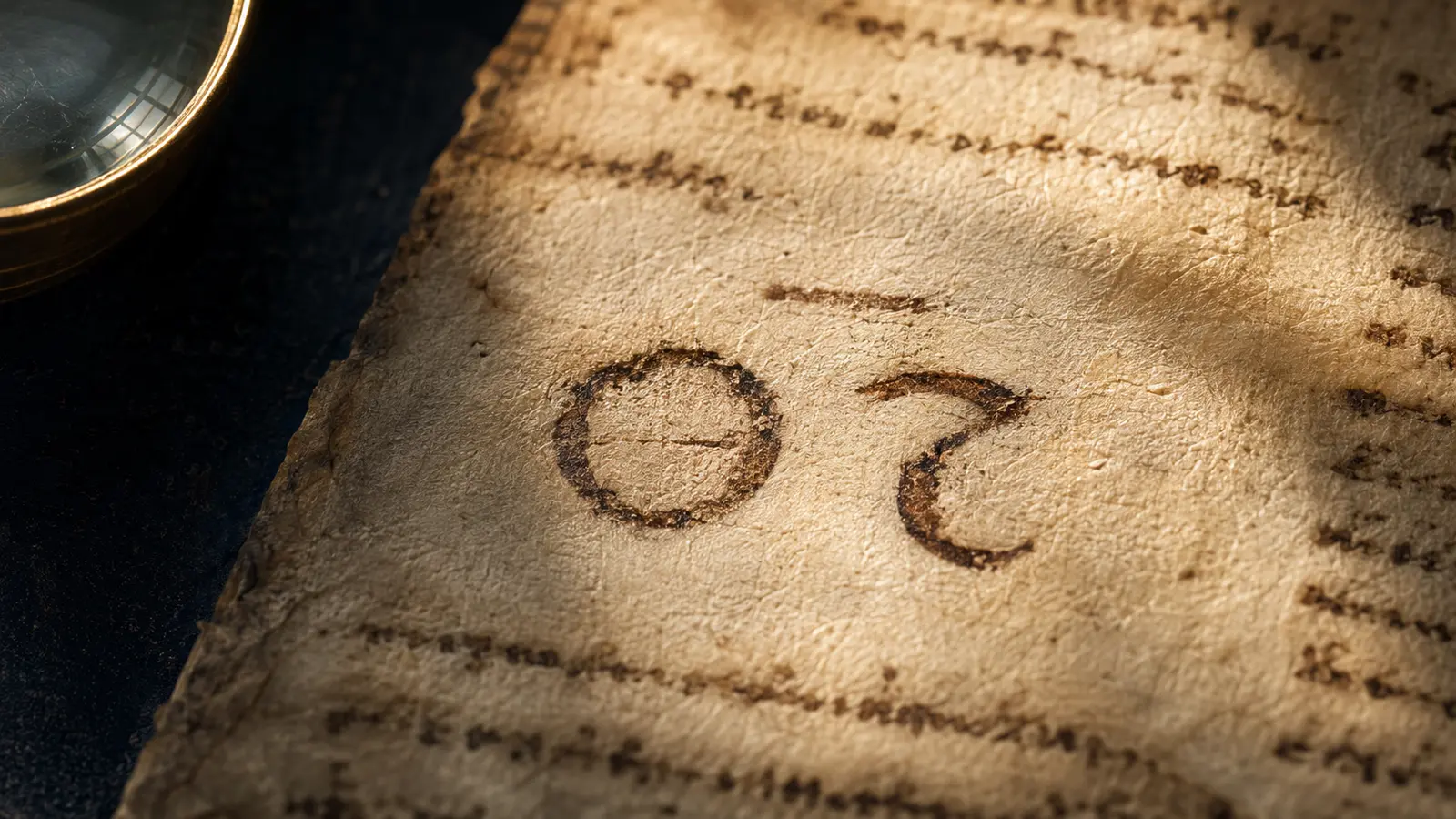
But θεός was commonly written as a nomen sacrum: the first and last letters, ΘΣ, with a bar above them. In uncial script, sigma often has the form C. The written result therefore resembles ΘC with an upper stroke.
The rival pronoun ὅς is written ΟC. Its first letter is omicron rather than theta, and it normally lacks the sacred overbar.
The difficulty is therefore not that ancient Greek lacked a distinction between “God” and “who.” The words are grammatically and lexically distinct. The difficulty is that Christian scribal convention concentrated the distinction into two light marks: the stroke within the first letter and the bar above the contraction. When those marks are strong, the reading is plain. When they are faint, renewed, abraded, or confused with writing from the other side, the reconstruction becomes historical as well as visual.
This concentration of meaning is the reason the dispute can look incredible to a modern reader. Four Greek letters seem too substantial to disappear into a pronoun. On the page, however, θεός was not necessarily written in full. The sacred contraction reduced it to its outer letters. Once that convention is understood, the controversy ceases to be a story about scholars imagining whole words and becomes a question about the survival of strokes.
The material anatomy
Reduce the forms to their visible elements:
| Reading | Uncial form | Internal transverse line | Sacred overbar |
|---|---|---|---|
| θεός, “God” | ΘC | Present | Present |
| ὅς, “who” | ΟC | Absent | Absent |
The internal line turns Ο into Θ. The upper line signals that the word is contracted as sacred. If thin ink fades, if parchment becomes translucent, if later hands retrace some marks more heavily than others, or if a leaf is rubbed by generations of inspection, the initial reading can become genuinely difficult to reconstruct.
This is not special pleading created for one verse. It is the ordinary physical consequence of contracting a four-letter word into two letters and letting small strokes carry lexical meaning.
The table simplifies one feature that deserves explanation. In many Greek majuscules the sigma is lunate, shaped like the modern letter C. Thus ΘC and ΟC better imitate what the eye meets on the parchment than ΘΣ and ΟΣ do. Transcriptions normally use sigma because they represent the Greek letters, not the exact graphic form. A popular presentation should explain the convention once so that readers do not mistake the crescent for an unrelated letter.
The supralinear mark must also be distinguished from an accent or breathing. In the nomen-sacrum system it announces contraction. The form ΘC with a bar is read as θεός in the appropriate case, just as ΚC can represent κύριος and ΧC can represent Χριστός. The reader supplies the omitted inner letters because the convention is regular and the context identifies the word.
At 1 Timothy 3:16, then, four layers of description should be kept apart:
- the lexical reading θεός or ὅς;
- the conventional transcription ΘΣ or ΟΣ;
- the approximate uncial appearance ΘC or ΟC;
- the actual surviving ink on a particular piece of parchment.
Confusion begins when a statement from one layer is treated as a statement from another. “The lexical reading is θεός” does not tell us the color of the surviving transverse stroke. “The visible heavy line is later” does not yet tell us whether that line altered the lexeme or restored it. The physical object must be interpreted through the scribal convention.
Contraction was normal, not exceptional
The contracted form does not need to be explained as an emergency measure taken because a line was crowded. Sacred contractions appear as a regular feature of Christian manuscript culture. God, Lord, Jesus, and Christ form the early central group, with other words joining the repertoire in different manuscripts and periods. The forms inflect: the first and final letter appropriate to the case are retained, while the supralinear bar marks the omission.1
This regularity matters to the variant. A scribe encountering ΘC would not have been puzzled that two letters represented a four-letter word. He would have met the convention throughout the biblical text. He might, however, be puzzled if the fine indicators of contraction were damaged. A round form followed by lunate sigma could then be taken at face value as ΟC.
The convention also explains why the two lines can differ in execution from the main letters. A scribe may form the large letters with one motion and add the internal or upper strokes with another. The ink load, pressure, angle, or timing can differ. Even when the same pen and ink are used, a thin finishing stroke can age differently from the heavier circumference of an uncial letter. The argument does not require that this always happened; it requires only that the decisive marks were materially capable of fading sooner, which the historical reports concerning Alexandrinus explicitly allege.
Nor does “line” mean a modern, mechanically even rule. Manuscript strokes can rise, fall, taper, break, or extend beyond the circumference. Their position must be compared with the scribe’s other thetas, nomina-sacra bars, and habits on the same leaf. A reconstruction that isolates the disputed glyph from the hand’s ordinary formation loses an important control.
Why darker ink does not answer the whole question
Modern descriptions commonly distinguish the first hand of Alexandrinus, A*, as reading ὅς and a corrector, Aᶜ, as producing θεός. The darker transverse and upper strokes are treated as later additions. That is a possible reconstruction. It is not the only historical reconstruction compatible with darker ink.
Suppose an original scribe wrote the letters and fine bars with ink of unequal density. As the thinner strokes faded, a custodian retraced them. The retraced marks would then be later ink, but the word they restored could still be the original word. In that case, “the visible stroke is later” would not entail “the reading θεός is later.”
Alternatively, suppose the first hand wrote ΟC. A later corrector could add the internal line and overbar to create ΘC. In that case, the darker ink would represent a genuine change of reading.
The material evidence must decide between two stories:
- Alteration: ΟC was changed into ΘC.
- Restoration: fading ΘC was strengthened so it would remain legible.
The existence of a later hand does not by itself choose between them.
The distinction can be stated formally. Let the proposition L be “the presently prominent transverse line was written later than the main circle.” Let O be “the first scribe intended ΟC,” and T be “the first scribe intended ΘC.” Evidence for L does not by itself entail O, because L is compatible with both a correcting and a restorative action. To infer O, one must add evidence that no earlier transverse stroke existed and that the later hand changed rather than preserved the reading.
This is an instance of the Martin Rule of Exact Doctrinal Entailment applied to material evidence: state the proposition actually shown and refuse to import an indispensable premise. A difference in ink proves a difference in execution. It does not prove the semantic intention of the earlier layer unless the earlier layer can itself be reconstructed.
The same discipline restrains the received-text advocate. If a thin mark can be discerned beneath or beside the later stroke, the existence of that mark is evidence for an earlier diameter. It does not automatically prove that the mark was ink from the first hand. It could be a scratch, stain, show-through, or another accidental feature. The identity, alignment, color, depth, and relationship of the mark to other writing must be considered.
The disagreement is therefore not between people who accept what they see and people who deny it. Both sides see a compound artifact. They differ over the history that best explains its layers.
The overbar and the transverse line
The two strokes should not be confused. The disputed “line through the omicron” is the transverse diameter within the round letter—the feature that makes theta. The upper bar belongs to the system of nomina sacra. Reports sometimes discuss both because both were subject to retracing and both bear on whether the word was intended as sacred contraction.
The internal stroke is lexically decisive. If it vanishes, ΘC becomes ΟC to the eye. The upper bar is interpretively important. Its survival, trace, or retracing may reveal that ΟC was not meant as an ordinary relative pronoun.
The bar cannot be treated as an infallible independent witness. Ancient scribes used supralinear strokes for more than one purpose, and editors must examine the particular hand. A later corrector who wished to transform ΟC into ΘC would naturally add both the diameter and the bar. Conversely, a custodian who saw a fading sacred contraction would naturally renew both. Their conjunction intensifies the question but does not answer it.
The reports about Alexandrinus reflect this two-mark problem. Mill believed that the line above had been thickened by a later hand and that a coarse later diameter ran through the round letter, yet closer inspection led him to report older traces of the diameter. Berriman likewise distinguished the fuller new stroke from a finer older one. Their case did not depend on pretending that all surviving ink was contemporaneous. It depended on discerning an earlier feature beneath the restoration.2
Wettstein’s later explanation attacked precisely that discernment. The fine appearance near the left, he argued, belonged to an epsilon on the reverse side showing through the thin parchment. If correct, the earlier observers had mistaken verso writing for an original diameter. If incorrect, the verso epsilon became a reason to dismiss a genuine but badly surviving trace. The question is materially exact; slogans about “added ink” do not resolve it.
What fading and show-through look like in argument
Three different phenomena are sometimes gathered under the word fading. Ink can lose optical density while remaining chemically present. It can flake or abrade from the surface. Or the parchment can become so thin and polished that marks from the reverse compete with the recto. These processes can operate together. A once-visible recto stroke may weaken while a verso stroke becomes more conspicuous.
That combination helps explain why observers under different light might disagree. Raking light emphasizes surface relief and texture. Transmitted light emphasizes what passes through the leaf and can make reverse writing dominant. Magnification enlarges both genuine traces and misleading fibers. A bright sun and a glass, Berriman’s reported aids, are not neutral instruments that automatically reveal the truth; they alter which physical features become visible. Yet his description of the conditions lets later historians understand what he believed he saw.
Modern multispectral imaging might distinguish substances or recover patterns unavailable to the naked eye, but even sophisticated imaging would address the present artifact. It could test the alignment and composition of surviving marks. It could not directly restore material already abraded in the eighteenth century. Historical reports remain evidence because the object changed.
This does not mean that every old observer is preferred to every modern technique. Earlier witnesses may have had poorer optics, less conservation knowledge, and stronger confessional expectations. Later examiners may have better methods but less surviving ink. The evidential task is to weigh temporal proximity, descriptive specificity, competence, possible bias, and the physical plausibility of the reported change.
A variant made for material ambiguity
The variant is unusually susceptible to physical confusion because it requires neither a wholly new word nor a long omission. From θεός to ὅς, the copyist need only fail to perceive one thin line and treat another as absent or irrelevant. From ὅς to θεός, a corrector need only add those marks.
Silvia Castelli’s detailed history of the controversy shows that John Mill initially took the manuscript for ΟC, then on careful inspection reported “marks and almost certain traces” of the transverse stroke, particularly at the left edge.3 The importance of that sequence is easily missed. Mill did not simply approach the codex determined to see θεός. His first impression favored the other reading. Closer physical examination changed his judgment.
The phrase “material ambiguity” should not be confused with textual indifference. The apostolic text had one reading. The scribes wrote determinate marks, even if those marks are now difficult to reconstruct. Ambiguity belongs to our access to the artifact, not to the divine author’s meaning.
It is also possible for a physically simple variation to have a complex textual history. One damaged exemplar could generate ΟC; a later grammatically attentive copyist could change it to the neuter Ο; another corrector could restore ΘC from a different exemplar. Independent instances of the same confusion could occur because the graphic conditions recur wherever θεός is contracted. The genealogy need not consist of one dramatic alteration from which all witnesses descend.
That is why the physical mechanism should be treated as a family of possible events rather than a single universal story. It tells us how a reading could arise and why the internal evidence is less one-directional than it first appears. It does not replace the comparison of manuscripts, versions, fathers, grammar, and reception.
Paleography is not a verdict
It is tempting for both sides to turn possibility into proof. Defenders of ὅς may say that a corrector could easily add the strokes and therefore did. Defenders of θεός may say that strokes could easily fade and therefore every ὅς descended from a faded ΘΣ. Neither inference follows automatically.
Paleography supplies possible mechanisms. History supplies observations. Genealogical judgment must join the two without confusing them.
What can be said with confidence is already significant:
- θεός in contracted form is only minimally different from ὅς.
- the disputed marks were described as faint or deteriorating;
- later retracing could preserve an original reading or create a new one;
- therefore the present contrast between light and dark ink does not interpret itself.
The controversy turns on two strokes because the early Christian scribal convention placed so much meaning upon them. Before asking which printed edition is right, we must follow those strokes through time.
Following them requires a disciplined vocabulary. The diameter is not the bar. Later ink is not necessarily a later word. A trace is not necessarily original ink. A present image is not the original state. Physical possibility is not historical proof. These distinctions may appear cautious, but together they make the received-text argument stronger. They permit the evidence to be stated without depending on an exaggeration that one contrary observation could overturn.
The immediate conclusion is modest and consequential. The word θεός, when written as a nomen sacrum, can lose the visible features that distinguish it from ὅς. Alexandrinus was reported to exhibit exactly such failing features. The manuscript dispute is therefore materially intelligible. The next question is chronological: before the famous inspections began, how did the earliest English custodians and collators understand the page?
- Isabella Bonati, “Digging into Lives: Christians and Christianity in the Greek Papyri from Egypt,” In die Skriflig 57.1 (2023), article a2938, https://indieskriflig.org.za/index.php/skriflig/article/view/2938/7870. Bonati defines the limited sacred repertoire, contraction and suspension, and the horizontal stroke. ↩
- Castelli, Wettstein’s Principles, 116–18, reproducing Berriman’s account of the fine old line at the ends of the fuller stroke and his own inspection with glass and sunlight. ↩
- Silvia Castelli, Johann Jakob Wettstein’s Principles for New Testament Textual Criticism: A Fight for Scholarly Freedom (PhD diss., Vrije Universiteit Amsterdam, 2019), 113–20, https://research.vu.nl/ws/portalfiles/portal/85088628/complete%20dissertation.pdf. ↩
Comments
Share a question or response to this article.