

This is Part 8 of “The Line That Vanished.”
Why did Christian scribes write sacred names in contracted form?
Two explanations are commonly proposed. One is practical: the abbreviations conserved writing space and labor. The other is religious: the scribes marked certain words with special reverence.
The first describes a real effect. The second better explains the system.
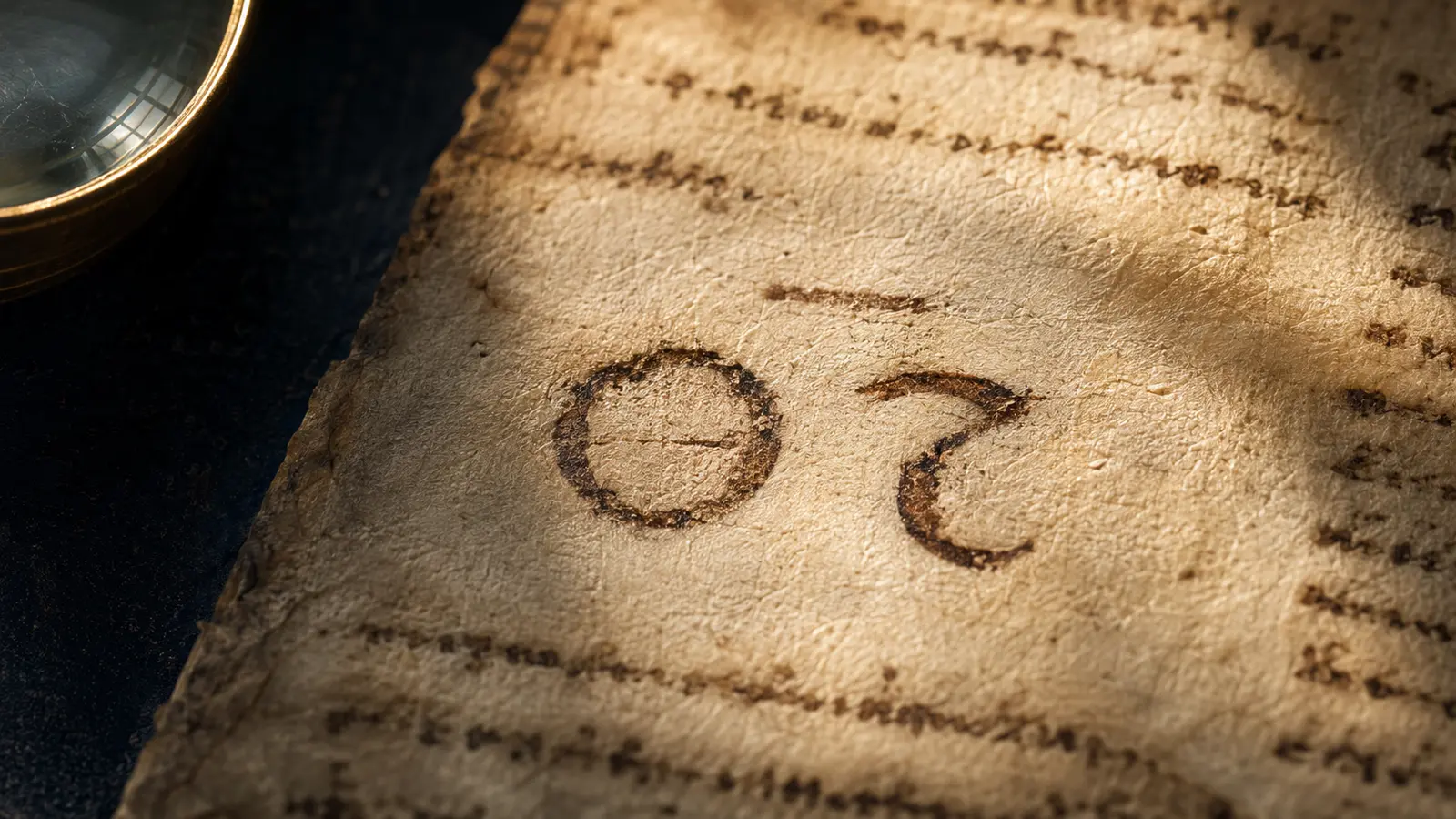
The distinction matters twice at 1 Timothy 3:16. Materially, the contraction created the small difference between ΘC and ΟC that made visual confusion possible. Theologically, the practice reveals an early Christian habit of distinguishing a sacred vocabulary on the written page. Any account that calls the abbreviations merely economical misses their selectivity; any account that calls them simply magical projects later abuses backward into their origin.
The historical description should therefore proceed in three stages. First, count what the contractions save. Second, ask why these words were selected. Third, judge when reverence attaches an unwarranted sanctity or power to the sign itself.
The economy is visible
The practical saving can be counted. In the nominative case:
| Full word | Sacred contraction | Letters saved |
|---|---|---|
| ΘΕΟΣ, God | ΘΣ | 2 |
| ΚΥΡΙΟΣ, Lord | ΚΣ | 4 |
| ΙΗΣΟΥΣ, Jesus | ΙΣ | 4 |
| ΧΡΙΣΤΟΣ, Christ | ΧΣ | 5 |
The contractions were inflected, normally retaining the first and last letters appropriate to the case and adding an upper bar. Across a complete biblical codex, thousands of saved letters would mean less pen movement, somewhat less ink, and some reduction in occupied line length.
At 1 Timothy 3:16 specifically, ΘΣ takes two letter positions rather than the four of ΘΕΟΣ. The form is economical by construction. To deny this would be pointless.
But an effect is not necessarily an origin.
The table actually understates the cumulative saving because sacred words recur in multiple cases and numbers throughout biblical books. A two- or four-letter saving repeated hundreds of times reduces pen movement and line occupation. In a large codex, even modest reductions accumulate.
Material production was costly. Parchment required prepared animal skins; papyrus had to be manufactured and acquired; copying demanded skilled labor and time. Scribes employed many abbreviations in documentary and literary culture. It would be historically artificial to imagine that Christian copyists were indifferent to economy.
Yet the economic claim can be made too large. The saved space within one occurrence seldom determines whether a line or page can be completed. Scribes could vary letter size and spacing, use margins, or continue words across lines. Larry Hurtado’s analysis of spacing in early papyri cautions against reconstructing missing text through rigid character counts, since scribes varied the dimensions and intervals of letters.1 Economy was real but elastic.
The upper bar itself also costs a stroke. If raw speed were the sole goal, a consistent two-letter contraction without an added mark would be still faster. The bar makes the special form visible and intelligible. Its presence points beyond simple omission toward convention and signification.
What makes a contraction sacred?
Not every shortened word is a nomen sacrum. The term applies to a limited repertoire treated by a characteristic Christian convention, usually contraction with a supralinear bar. Bonati distinguishes contraction, in which middle letters are omitted, from suspension, in which the end is omitted, and identifies κύριος, θεός, Ἰησοῦς, and Χριστός among the central sacred names.2
The category is historical, not magical. A modern editor may call ΘC a nomen sacrum because it belongs to the conventional repertoire and form, without deciding that the written marks possess holiness. Likewise, a scribe could inherit the convention as normal orthography without consciously performing a devotional act at every occurrence.
This distinction guards against two errors. The first calls every ancient abbreviation a sacred name and thereby empties the term of specificity. The second assumes that every use reveals an identical inner motive. Manuscript practice can carry inherited meaning even when individual practitioners vary in awareness.
The selective repertoire is the crucial evidence. Christian scribes did not simply abbreviate the longest or most frequent words. They grouped names and titles central to Christian confession. As the system expanded, terms such as Spirit, Father, Son, cross, heaven, Israel, and Jerusalem could receive special treatment in varying manuscripts. The pattern remained theological rather than merely quantitative.
Why economy does not govern the selection
Ordinary space-saving abbreviation follows practical pressure. It clusters where space runs out, applies broadly to recurring words, or follows administrative convention. The earliest Christian nomina sacra behave differently.
They select a theological core: God, Lord, Jesus, and Christ, with the repertoire expanding over time to include such terms as Spirit, Son, Father, cross, and others. They occur in manuscripts whose margins, line spacing, and general execution show no desperate economy. They can be used where the scribe has ample room. The upper bar advertises the contraction rather than merely squeezing it into a line.
Larry Hurtado summarized the dominant scholarly judgment: the practice is distinctively early Christian and best understood as a scribal expression of devotion to the referents, especially God and Jesus.3 Isabella Bonati likewise notes that the system cannot be reduced to saving space; its selectivity marks an act of reverence.4
The mechanism is economical. The selection is theological.
Bonati’s formulation is especially direct: the practice “was not a space-saving method, but an act of reverence.” That sentence should not be read as denying every material saving; her surrounding definition makes the contraction obvious. It identifies the rationale that distinguishes nomina sacra from ordinary shorthand.5
Jewish scribal treatment of the divine name supplies an important analogy. The Tetragrammaton could be handled with distinctive reverence, and Jewish manuscripts sometimes employed special scripts or substitutions. Early Christians inherited the Scriptures and a consciousness that divine names were not ordinary vocabulary.
Analogy is not derivation. The Greek Christian system’s particular forms and its inclusion of Jesus and Christ cannot be explained simply as a mechanical borrowing from either Greek administrative abbreviation or one Jewish convention. Hurtado and the tradition of scholarship he summarizes treat it as a distinctively Christian scribal innovation, even while debating its precise origin and earliest extent.6
The combination of inherited reverence and Christian innovation fits the evidence. The church did not discover that abbreviations save parchment and then accidentally choose a Christological list. Its scribes visually linked the God of Israel, the Lord, Jesus, and Christ within one marked repertoire.
A written confession in miniature
The grouping of God, Lord, Jesus, and Christ within one scribal convention is itself significant. The scribe does not merely shorten long nouns. He places the divine titles and the name of Jesus within a shared visual register.
This does not mean that every scribe who copied a bar could articulate a complete doctrine of the Trinity or the hypostatic union. Scribal habits are inherited. Yet the inherited habit came to embody a Christian confession: the names and titles were not being treated as ordinary words.
At 1 Timothy 3:16, the convention is therefore doubly relevant. First, it creates the physical conditions in which fading ΘC can look like ΟC. Second, if ΘC is original, its very form places “God” inside the early Christian system of visual sacralization.
The phrase “confession in miniature” must not be made to prove more than it can. The contraction of Jesus and God within the same repertoire supports the high place of Jesus in early Christian devotion. It does not by itself establish every indispensable proposition of Nicene or Chalcedonian doctrine. Identity, personal distinction, unity of essence, relation, and the two natures of Christ require the teaching of Scripture, not the shape of a bar.
This is an application of exact doctrinal entailment. The visual convention entails that the terms were specially grouped and treated. It supports reverential association. It does not entail that every user consciously confessed “one essence in three persons” or understood the communicatio idiomatum. Importing those conclusions would turn a significant artifact into an overloaded proof.
At the disputed verse, however, the contracted form and lexical reading converge in a striking way. If ΘC is original, the confession begins by naming God as the one manifested in flesh, and the name is written in the marked sacred form customary among Christian scribes. The graphic form does not create the doctrine; it serves the word that states it.
Where “superstition” belongs
Historical description should use the word reverence. That is what the selective pattern warrants. We cannot inspect the inward motive of every anonymous second-century scribe, and paleography cannot prove the theological category superstition.
A confessional assessment may go further. Scripture nowhere commands Christians to abbreviate particular Greek words or to mark them with a special bar. If the mark is regarded as intrinsically holy, spiritually protective, or more acceptable to God than writing the full word, reverence has exceeded divine warrant. In classic Protestant usage, such invented religious necessity may properly be called superstition.
That judgment should be framed conditionally:
The nomen sacrum is a reverential convention capable of becoming superstitious when sanctity or power is attributed to the graphic sign itself.
- Hurtado, “P52 and the Nomina Sacra,” 11–13, on variable letter size and spacing and the resulting limits of simple character counts. ↩
- Bonati, “Digging into Lives,” section “Christian papyri between literature and documents.” ↩
- Larry W. Hurtado, “Nomina Sacra: The Continuing Debate,” 22 September 2010, https://larryhurtado.wordpress.com/2010/09/22/nomina-sacra-the-continuing-debate/; Hurtado, “P52 (P. Rylands Gk. 457) and the Nomina Sacra: Method and Probability,” Tyndale Bulletin 54.1 (2003): 1–14, https://www.tyndalebulletin.org/article/30221-p52-p-rylands-gk-457-and-the-nomina-sacra-method-and-probability.pdf. ↩
- Isabella Bonati, “Digging into Lives: Christians and Christianity in the Greek Papyri from Egypt,” In die Skriflig 57.1 (2023), article a2938, https://indieskriflig.org.za/index.php/skriflig/article/view/2938/7870. ↩
- Ibid., quoting Colin H. Roberts’s description of the forms as a compact theological outline. ↩
- Hurtado, “Nomina Sacra: The Continuing Debate”; Bonati, “Digging into Lives,” which describes the system as a distinctively Christian innovation while noting Jewish analogies. ↩
This is both firmer and more accurate than claiming that the entire practice was invented as magic.
A Reformed use of superstition requires a norm. The problem is not that a material sign evokes reverence. Scripture itself appoints visible signs, commands careful treatment of holy things, and gives divine names to be confessed. The problem arises when human invention binds the conscience or assigns spiritual efficacy where God has not promised it.
Three situations should be distinguished:
- A scribe uses the conventional contraction as inherited orthography.
- A scribe uses it deliberately to express reverence for the referent.
- A user believes the marked form itself conveys protection, healing, or sacred power.
The first is a scribal habit, the second a devotional act, and the third may be superstitious. Context determines which description is warranted. The same graphic device can move among them over centuries.
Even the second category calls for theological evaluation. Reverence may be sincere and yet unwarranted if it is made a religious necessity. The Protestant objection is not that early Christians should have been irreverent toward God’s name; it is that the Word of God regulates worship and the conscience. No supralinear bar can be required as though the full spelling of θεός were less holy.
Evidence of superstitious use
Later material shows that sacred contractions did enter explicitly protective and magical settings. Catalogues of Greek amulets and formularies identify nomina sacra for κύριος and θεός within Christian and syncretistic texts intended for healing, protection, or other ritual effects.7 In such artifacts, the sacred form is not merely a space-saving device. It operates within an amuletic environment where written holy names may be treated as bearers of power.
This later use does not establish the origin of the convention. A devotional practice can precede its magical appropriation. It does establish that concern about superstition is not imaginary.
De Bruyn and Dijkstra’s catalogue is careful about classification. The appearance of a Christian feature does not automatically make an artifact exclusively Christian, and nomina sacra for κύριος and θεός appear in syncretistic magical texts.8 The material can combine Christian, Jewish, Greek, and Egyptian elements. That complexity is precisely why “amuletic setting” is a better historical description than a sweeping claim that every contraction was magical.
An amulet is intended to be carried, worn, folded, suspended, or otherwise used for protection or effect. In such a context, written names, crosses, scriptural quotations, and character signs can function as more than ordinary text. The user may treat the object or inscription as bearing power.
The convention’s appearance in these settings establishes capacity for superstitious use. It does not tell us that the scribe of Alexandrinus held the same belief, much less that the earliest inventor of the system did. Chronological and contextual distance must be respected.
This restraint also prevents polemical reversal. A critic of confessional bibliology might try to portray any defense of ΘC as dependence on magical scribal practice. That does not follow. The reading of a word and the later misuse of its graphic abbreviation are different propositions. God can preserve his Word through ordinary scribes whose customs are mixed, just as the truth of a biblical sentence does not depend on every copyist’s theology.
A threefold conclusion
The evidence permits three propositions:
- Conservation: Nomina sacra save letters, strokes, time, and space. This is a real material benefit.
- Reverence: selective treatment of sacred vocabulary, even in spacious manuscripts, is the best explanation of the practice’s governing rationale.
- Superstition: where Christians assign sanctity or protective power to the written form without divine warrant, the reverential convention becomes superstitious; later amuletic use supplies historical examples.
These propositions are not rivals. They operate at different levels: material effect, historical motive, and theological evaluation.
The contractions conserve space. They were not selected merely to conserve space. They express reverence. Reverence itself must remain under the judgment of the Word of God.
The three levels also correct the initial formulation of this research project. It is too strong to say without qualification that nomina sacra were “done for superstition” and “to conserve space.” Conservation is a demonstrable effect. Reverence is the best-supported governing rationale. Superstition is a theological category warranted in particular uses, especially where the written form is treated as protective or intrinsically powerful.
That correction does not blunt the argument. It gives each claim the support it can bear. Readers can see why the contraction existed, how it made the variant possible, and where a Reformed criticism of unwarranted sacralization properly enters.
The article has also shown why the practice cannot decide the textual reading by itself. Both an original ΘC and a later correction to ΘC would use the same sacred convention. The history of nomina sacra explains the form and its vulnerability; the dated evidence must determine whether the form stood in Alexandrinus from the first hand.
The series will now turn from scribal culture to the sentence itself. The question is not whether the relative reading can be given an orthodox referent—it can—but what each Greek form says, how it relates to the preceding “mystery,” and why canonical harmony is relevant without becoming a license to insert doctrine into disputed ink.
- Hurtado, “P52 and the Nomina Sacra,” 11–13, on variable letter size and spacing and the resulting limits of simple character counts. ↩
- Bonati, “Digging into Lives,” section “Christian papyri between literature and documents.” ↩
- Larry W. Hurtado, “Nomina Sacra: The Continuing Debate,” 22 September 2010, https://larryhurtado.wordpress.com/2010/09/22/nomina-sacra-the-continuing-debate/; Hurtado, “P52 (P. Rylands Gk. 457) and the Nomina Sacra: Method and Probability,” Tyndale Bulletin 54.1 (2003): 1–14, https://www.tyndalebulletin.org/article/30221-p52-p-rylands-gk-457-and-the-nomina-sacra-method-and-probability.pdf. ↩
- Isabella Bonati, “Digging into Lives: Christians and Christianity in the Greek Papyri from Egypt,” In die Skriflig 57.1 (2023), article a2938, https://indieskriflig.org.za/index.php/skriflig/article/view/2938/7870. ↩
- Ibid., quoting Colin H. Roberts’s description of the forms as a compact theological outline. ↩
- Hurtado, “Nomina Sacra: The Continuing Debate”; Bonati, “Digging into Lives,” which describes the system as a distinctively Christian innovation while noting Jewish analogies. ↩
- Theodore de Bruyn and Jitse H. F. Dijkstra, “Greek Amulets and Formularies from Egypt Containing Christian Elements: A Checklist of Papyri, Parchments, Ostraka, and Tablets,” Bulletin of the American Society of Papyrologists 48 (2011): 163–216, https://ruor.uottawa.ca/bitstreams/accb3e20-3da1-4f58-a55a-fcd477818808/download. ↩
- De Bruyn and Dijkstra, “Greek Amulets and Formularies,” 170–74, especially their caution that individual Christian elements are not by themselves sufficient to classify a whole text and their discussion of nomina sacra in syncretistic magical texts. ↩
Comments
Share a question or response to this article.