

Revision note: Substantially revised July 20, 2026. The argument has been reordered according to the classical rhetorical movement, compressed where necessary, and given one consolidated Notes and Further Reading section.
“Answer not a fool according to his folly, lest thou also be like unto him. Answer a fool according to his folly, lest he be wise in his own conceit.” — Proverbs 26:4–5
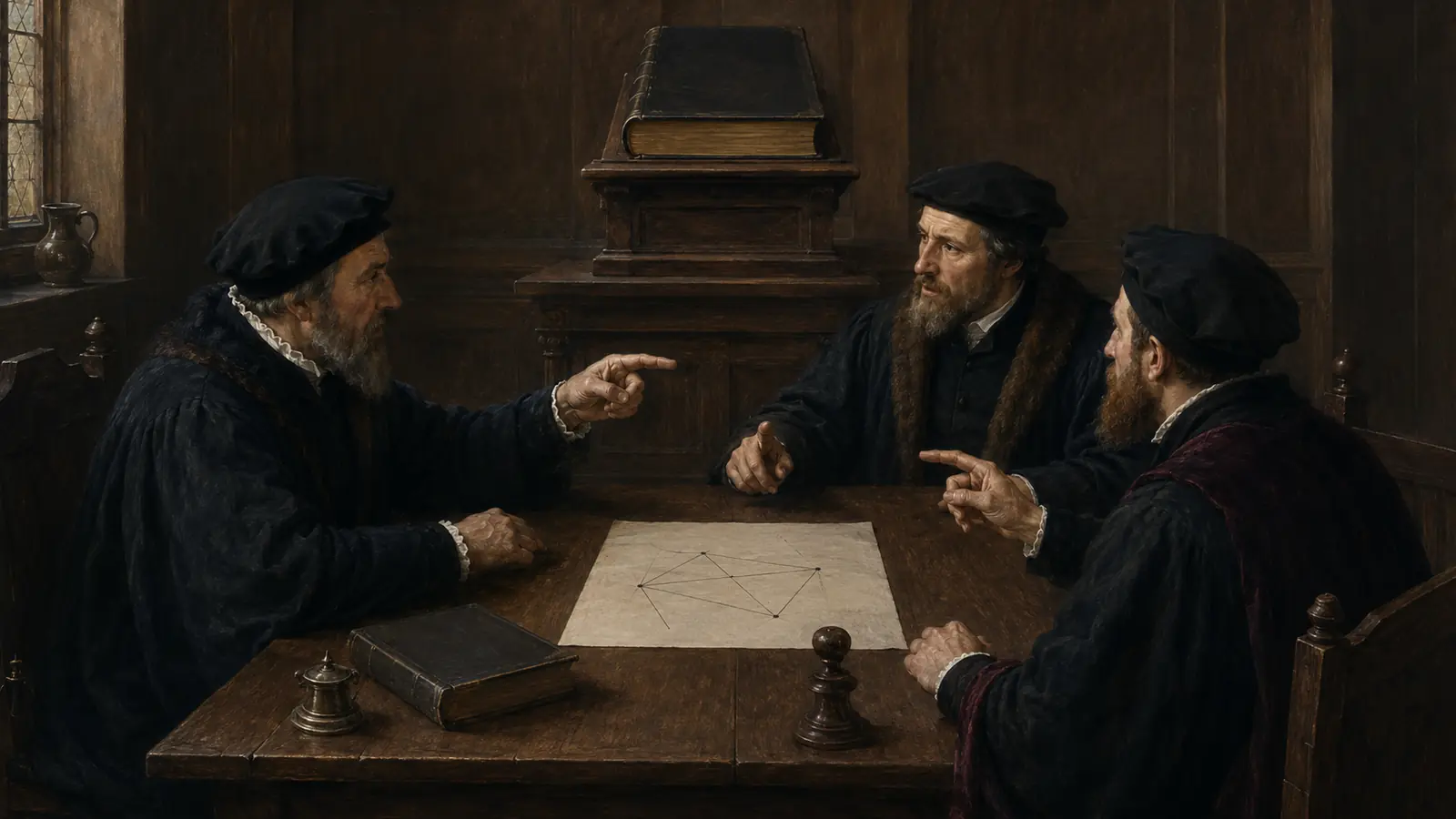
The Christian must reason with unbelievers and heretics. He must answer objections, expose contradictions, present evidence, and call men to repent and believe. He is not permitted to hide from difficult manuscripts, unfamiliar arguments, or learned opponents. Yet neither is he permitted to purchase a hearing by pretending that Christ’s authority is irrelevant to the controversy.
This is the difficulty: the Christian must enter the argument without entering the unbeliever’s court.
Part Six stated this principle as one element of leaving the academy game. The present article develops it as a method. The question is not whether Christians and non-Christians can discuss the same manuscripts or recognize many of the same facts. They can. The question is whether the meaning of those facts, the rules by which they are weighed, and the verdicts that may be reached can be determined in a religiously neutral tribunal.
They cannot. The dispute over the text of Scripture is never merely a disagreement among technicians about ink, dates, and scribal habits. It is also a controversy about who God is, whether he has spoken, what he has promised, what sin has done to the mind, how providence governs history, and which authority possesses the right to judge every other claim. The Christian who conceals these questions has not made the conversation fair. He has allowed the opposing answer to govern without being named.
Faithful reasoning therefore requires four things at once: genuine attention to public evidence, explicit submission to Scripture, an internal criticism of the rival framework, and a moral summons to the person who reasons within it. Remove evidence, and presuppositional argument degenerates into assertion. Remove Scripture, and evidence is enthroned as an autonomous judge. Remove internal criticism, and the unbeliever’s pretended neutrality goes unchallenged. Remove the summons to repentance, and intellectual rebellion is treated as an innocent shortage of information.
The Christian must do all four.
The Court Is Part of the Controversy
Every controversy operates like a court. There is evidence to be admitted, a standard by which it is interpreted, a judge authorized to render a verdict, and a jurisdiction limiting which conclusions may be entertained. In textual criticism, manuscripts, versions, patristic citations, quotations, scribal habits, grammar, and ecclesiastical reception supply various kinds of testimony. But none announces its own weight. The court decides what the witnesses are permitted to prove.
The modern academy commonly presents its court as neutral. Historical inquiry, it says, must proceed by standards available to believer and unbeliever alike. Divine inspiration, special providence, self-attestation, and the Spirit’s witness may be confessed after the historical work is completed, but they cannot govern the public argument. Only considerations that remain intelligible without faith may be admitted as properly critical evidence.
That proposal has already decided the principal question. It has ruled that God’s testimony concerning his own Word is inadmissible until authenticated by another authority. It has ruled that the history of Scripture must first be construed without the promises that distinguish Scripture from every merely human book. It has ruled that the unbeliever’s refusal to receive divine testimony imposes an intellectual duty upon the believer to silence it. The court calls this fairness because both parties are forbidden to begin with Christian revelation. Yet the restriction burdens only one party. Unbelief loses nothing when God’s voice is excluded; Christianity loses its first principle.
The Westminster Confession refuses this jurisdiction. The authority of Scripture depends “wholly upon God (who is truth itself) the author thereof,” and the supreme judge in religious controversy is “the Holy Spirit speaking in the Scripture.” The church’s testimony, the excellencies of the Word, and other evidences have real ministerial use, but none constitutes a higher bench from which God’s testimony is certified.1
To reason faithfully, then, the Christian must make the court itself an object of argument. He should ask: Why may God’s testimony not govern the inquiry? What authorizes the rule that special providence must be methodologically ignored? Why should the surviving text of Scripture be interpreted according to an account of history developed for uninspired literature? If the proposed standard is independent of Scripture and must certify Scripture before Scripture may speak, has that standard not become the actual supreme judge?
These questions do not evade textual evidence. They prevent a philosophical decision from masquerading as a mere examination of textual evidence.
Common Ground Is Not Neutral Ground
Refusing a neutral court does not leave Christians and unbelievers with nothing to discuss. They possess profound common ground. They inhabit the same world, encounter the same artifacts, employ intellectual powers given by the same Creator, and remain bound by the same laws of truth and morality. The unbelieving scholar may date a manuscript accurately, identify a scribal hand, recognize homoeoteleuton, explain a grammatical construction, and correct a Christian’s factual mistake. Sin does not erase the image of God, dissolve the created order, or prevent every true judgment.
But this common ground belongs to God. It is not an independent territory jointly owned by Christ and the rebel.
Romans 1 explains both the commonality and the antithesis. The unbeliever knows God through his revelation, yet suppresses the truth in unrighteousness. He does not begin with a religiously empty mind. He lives upon knowledge he cannot escape while seeking to interpret the world as though he were not accountable to its Maker. The problem is therefore not absolute ignorance but ethical suppression. Ephesians 4 likewise describes the darkening of understanding in connection with alienation from the life of God and hardness of heart. The disorder is intellectual because it is moral and covenantal.
This yields three distinctions.
First, there is ontological common ground: one God, one created world, one history, and therefore one set of textual artifacts. Second, there is epistemic contact: unbelievers are image-bearers who know God and can know many truths about his world. Third, there is ethical antithesis: belief receives facts under God, while unbelief attempts to interpret them under human autonomy.
Neutrality falsely converts the first two into a denial of the third. It argues that because both parties can see the same ink, they must interpret its significance according to a standard that makes no reference to God. But shared access to an artifact does not entail a shared ultimate authority. A Christian and materialist may agree that a man has died without agreeing what man, death, moral evil, or history finally mean. So also two critics may agree that a fourth-century codex omits a clause without agreeing whether age establishes authority, whether early corruption is possible, whether the church’s reception has providential significance, or whether God promised the continued possession of his words.
The Christian should therefore seek every genuine point of contact. He should not surrender the interpretation of that contact to an imagined neutral realm. Common ground is the place where the unbeliever’s dependence upon God becomes visible; neutral ground is the fiction by which that dependence is concealed.
Two Answers to the Fool
Proverbs 26:4–5 places two commands side by side. “Answer not a fool according to his folly,” lest the answerer become like him. “Answer a fool according to his folly,” lest the fool remain wise in his own eyes. The apparent tension disappears when we distinguish adoption from exposure.
The Christian must not answer according to folly by adopting its governing principle. He must not reason as though autonomous man may decide whether God is allowed to speak, whether divine promises may govern history, or whether Scripture is guilty until certified by the guild. To grant that court, even temporarily as a common court, is to become like the fool at the point under dispute.
The Christian must answer according to folly by exposing what follows from it. He may enter the opponent’s system for the sake of argument, not as a convert to its authority but as a critic displaying its consequences. If every textual judgment is a provisional result of fallible historical reconstruction, then what within that system can produce an infallible present rule? If every extant witness may be corrupt and the authentic reading may be unattested, what distinguishes a conjecture about Scripture from Scripture itself? If the critic’s method must authorize the text before the text may bind the critic, why is the method not the functional final authority?
This is an internal critique. It need not prove that every conclusion reached by an unbelieving critic is false. The unbeliever may reach true conclusions inconsistently. The critique asks whether his announced first principles can account for what he claims to know and for the normativity he assigns to his verdict. A scholar may correctly identify a reading while possessing no adequate autonomous account of why logical inference is binding, why testimony should be trusted, why intellectual honesty is obligatory, or why the contingent history before him is intelligible. The Christian may accept the local observation while challenging the court that claims to make sense of it without God.
Nor is the internal critique the whole argument. A reductio can show that a rival system fails; it does not by itself proclaim the God who speaks. The Christian must also present the positive account: the truthful God created man to know him, governs history by providence, inspired determinate words, promised their abiding preservation, gave them to the church, and commands that reason and evidence serve their proper offices beneath revelation. The Christian worldview does not merely survive the evidence. It supplies the conditions under which evidence, truthful testimony, rational obligation, and historical knowledge are possible.
Know Whom You Are Answering
“Unbeliever,” “heretic,” and “erring brother” are not interchangeable terms. Carelessness here produces both injustice and bad argument.
The unbeliever does not confess Scripture as the self-attesting Word of God. His opposition is open at the level of first principles, even if his personal manner is respectful. The Christian should not be surprised when he excludes inspiration and preservation from the method. The proper response is apologetic and evangelistic: expose the impossibility of autonomy, present the Christian account, and call him to repent before the God whose truth he suppresses.
The formal heretic commonly appeals to Christian language while denying or corrupting an essential article of the faith. He may cite Scripture but subordinate it to another authority, mutilate its teaching, or redefine its terms. The Christian must identify the precise doctrinal denial rather than using heretic as a synonym for “a person with a bad textual conclusion.” The argument should reveal how the heretical position depends selectively upon the very Scripture whose authority it attacks. Correction remains inseparable from a call to repentance.
The erring Christian brother may confess inspiration, preservation, and Scripture’s supreme authority while employing a textual method inconsistent with those doctrines. His case requires fraternal candor. One should expose the contradiction without pretending that inconsistency proves conscious apostasy. Warfield’s restorationist method, for example, may be criticized as a serious departure from the confessional doctrine of the extant authentic text without alleging that Warfield secretly disbelieved Christianity. A man may sincerely confess more truth than his method permits him consistently to use.
This distinction also proportions moral language. Every act of intellectual autonomy is sinful in principle, but personal culpability, knowledge, office, influence, and obstinacy vary. A seminary professor who trains generations to bracket divine revelation bears a different public responsibility from a layman who repeats what he was taught. Error should be called error, methodological sin should be called sin, and formal heresy should be called heresy—but only when the evidence warrants each description.
Refusing neutrality never authorizes indiscriminate denunciation. It intensifies the duty to judge righteous judgment.
A Seven-Movement Method of Engagement
The following procedure is not a neutral algorithm. It is an ordered practice of Christian reasoning.
1. State the opponent’s position in its strongest form
Before refuting a claim, demonstrate that it has been understood. Quote accurately. Preserve qualifications. Distinguish an author’s explicit statement from conclusions others draw from it. If several schools of textual criticism differ, do not refute a crude composite that none actually holds. The ninth commandment governs polemics.
This is not mere etiquette. Misrepresentation prevents the true presupposition from being located. A weak caricature may be easily defeated while the serious argument remains untouched.
2. Establish the public facts
Identify the artifact, reading, date range, provenance, witnesses, and relevant history as accurately as the evidence permits. A Christian should be the first to correct an exaggerated claim made on his own side. He loses no biblical doctrine by admitting a scribal error, a late manuscript, an uncertain date, or an awkward fact. Providence includes the facts as they are, not as an advocate wishes them to be.
Agreement at this stage is possible and desirable. It shows that rejecting neutrality is not rejecting observation.
3. Separate fact, inference, framework, and motive
Suppose a codex from the fourth century omits a disputed phrase. The date and omission are facts, subject to ordinary historical qualification. The claim that the omission represents the second-century form is an inference. The rule that the earliest reconstructable form must override later ecclesiastical reception belongs to a framework. The claim that an editor chose the omission because he hates the doctrine expressed by the phrase concerns motive.
These categories demand different proofs. Public facts may be demonstrated. Inferences may be strong or weak. Frameworks must be defended at the level of first principles. Motives ordinarily remain hidden unless words or conduct supply evidence. Confusing the categories creates the illusion that a presuppositional criticism has licensed mind-reading.
4. Identify the governing authority
Ask what permits one consideration to outweigh another. Why should age control? Why should brevity control? Why should an unrepresented ancestor postulated by a genealogy outweigh a reading publicly received across centuries? Why may every extant witness be judged corrupt? Why is conjecture admissible? Why is special providence inadmissible?
The aim is not to ask an endless series of skeptical questions. It is to locate the authority that terminates the opponent’s reasoning. At some point every method reaches commitments it does not prove by a higher standard. The Christian should make that terminus visible.
5. Perform the internal critique
Grant the rival’s first principles for the limited purpose of tracing their consequences. Show where the method cannot secure the object it promises, contradicts another of its commitments, or borrows truths its worldview cannot justify. In restorationist criticism, the decisive questions concern identity and verification: How can a method whose every result remains revisable deliver the church’s irreformable rule? How may a reconstruction be verified against an autograph that is unavailable by definition? How can a merely probable method pronounce an unattested conjecture to be inspired Scripture?
The criticism should be exact. Do not claim that probability is useless; claim that probability cannot become divine self-attestation. Do not claim that unbelievers know no facts; claim that autonomy cannot account for their knowledge. Do not claim that all critical conclusions are wrong; claim that true conclusions do not validate false first principles.
6. Present the evidence ministerially within the Christian account
Now make the positive case. Compare manuscripts and transmission lines. Examine scribal habits. Use grammar, authorial usage, canonical coherence, versions, citations, and ecclesiastical reception. Explain how the evidence fits a history governed by inspiration and singular providence. The presuppositionalist should not fear detailed evidence; he should refuse only the demand that evidence be interpreted as though it existed outside God’s world.
This is where the Christian proves that confession is not a substitute for labor. The doctrine of preservation does not tell him by immediate revelation which of two readings is authentic. It tells him what object he is examining, where it has been preserved, and which conclusions are forbidden by God’s promise. Ministerial criticism still requires competence and may expose the Christian’s earlier judgment as mistaken.
7. Press the moral claim
The controversy cannot end with “our model explains the data better.” The God who preserved Scripture commands every reader. The unbeliever must abandon autonomy. The heretic must cease twisting divine testimony. The inconsistent Christian must bring his method into obedience to the doctrine he confesses. The call should be explicit without becoming theatrical: repent, receive God’s Word because it is God’s Word, and use every intellectual gift as a servant of Christ.
Only the Holy Ghost grants full persuasion, but the Spirit works by and with the Word. The apologist does not regenerate his opponent through a perfect technique. He bears truthful witness and refuses to conceal the moral nature of unbelief.
Do Not Turn Romans 1 into Mind-Reading
Romans 1 gives a universal diagnosis of fallen man: he suppresses known truth in unrighteousness. It does not give the polemicist exhaustive knowledge of the psychological route by which a particular scholar reached a particular textual verdict.
Greg Bahnsen’s philosophical analysis of self-deception is useful here. He describes self-deception as motivated rationalization in which a person manages adverse evidence, directs attention, or misconstrues its force in order to avoid an unwelcome truth.2 This helps explain why the presentation of more facts does not automatically cure unbelief. Evidence is never processed by a morally unconditioned intellect.
But the doctrine must first be applied to ourselves. Christian scholars also rationalize, protect reputations, follow parties, and resist evidence. Confessing sound presuppositions does not make every subordinate inference sound. A man may say “preservation” while defending his preferred edition through special pleading. The noetic effects of sin are not a weapon owned by one side.
In public controversy, therefore, establish the opponent’s argument from public evidence and criticize its stated or necessary implications. Say, “This premise excludes God’s promise,” when it does. Say, “This conclusion cannot follow with certainty from this method,” when it cannot. Do not say, “You selected this reading because you hate Christ,” unless unusually clear evidence makes motive relevant and demonstrable. God knows the heart; the critic ordinarily does not.
This restraint does not weaken the charge of autonomy. It makes the charge precise. The sin may be identified in the public act of subjecting Scripture to an independent court without pretending to know every inward desire accompanying that act.
Meekness Before God, Boldness Before Men
First Peter 3:15 does not begin with technique. It begins, “Sanctify the Lord God in your hearts.” Only then does it command readiness to give an answer, and it joins that answer with meekness and fear. The fear is first the fear of God. The apologist speaks carefully because Christ, not the audience, is Lord. His meekness is not uncertainty about divine authority but humility about himself as its servant.
Second Timothy 2:24–26 adds that the Lord’s servant must not strive, but must be gentle, apt to teach, patient, and meekly instruct those who oppose themselves. The reason is theological: God must give repentance to the acknowledging of the truth. Harshness cannot produce the spiritual change required. Neither can flattery. The same passage that commands gentleness describes the opponent as captive to the devil. Biblical courtesy is fully compatible with a severe diagnosis.
This combination is especially necessary in academic controversy. Some Christians become timid before credentials and aggressive toward ordinary believers. Others despise learning and mistake belligerence for courage. Both postures serve pride. The faithful critic listens without servility, speaks without bluster, corrects facts without embarrassment, and refuses to hide his first principles to gain professional approval.
He can say to an unbelieving scholar: “You have correctly described this manuscript, and your reconstruction of its scribal history may teach me. But your accuracy does not establish the autonomy of your court.”
He can say to a heretic: “Your appeal to this variant already depends upon the authority and intelligibility of the canon you selectively deny.”
He can say to a Christian brother: “Your confession says that the Hebrew and Greek were kept pure and remain authentic for final appeal; your method must be reformed until it can use that truth as a premise.”
And he must be willing to hear: “Your account of this witness is factually wrong.” Submission to Scripture includes repentance for careless scholarship.
The Court Must Be Surrendered to Christ
Reasoning with unbelievers and heretics is neither a neutral partnership nor a refusal to converse. It is the public exercise of reason under the lordship of Christ. It welcomes every fact because every fact is God’s fact. It tests every inference because human judgment is fallible. It challenges every autonomous standard because no creature possesses jurisdiction over the Creator. It calls every hearer to repentance because the suppression of truth is moral rebellion, not merely intellectual misfortune.
The academy game offers a seductive bargain: conceal the authority of Scripture for the duration of the argument, and Scripture may perhaps be admitted as the verdict. The Christian must refuse. A court competent to silence God at the beginning is already supreme at the end. Even a favorable verdict from that court leaves the rebellion intact.
We do not defend the Word by asking autonomous man to make it credible. We expose the impossibility of his autonomy, display the truth and coherence of the Christian account, and use historical evidence in its lawful ministerial office. We answer the fool without becoming like him, and we answer him so that he cannot remain wise in his own conceit.
The manuscripts may be opened on the same table. The facts may be examined in the same room. The arguments may be stated in terms every hearer can understand. But the court cannot be shared, because the court belongs to Christ.
Reason with every man. Misrepresent none. Conceal no fact. Fear no evidence. Retract every factual error. But never surrender the Judge in order to discuss his Word.
Notes and Further Reading
- The Westminster Confession of Faith 1.4–5 and 1.10; see also 1.8 on inspiration, providential preservation, continuing authenticity, and the church’s final appeal. A public text is available from the Orthodox Presbyterian Church. ↩
- Greg L. Bahnsen, The Apologetic Implications of Self-Deception, 145–55, 193–95, supplied dissertation. The Bahnsen Institute describes the related lecture series. ↩
Comments
Share a question or response to this article.