

Revision note: Substantially revised July 20, 2026. The article has been reduced below 4,000 words, material repeated from the January 5–6 declarations removed, the governing distinction placed first, and the objections and sources consolidated.
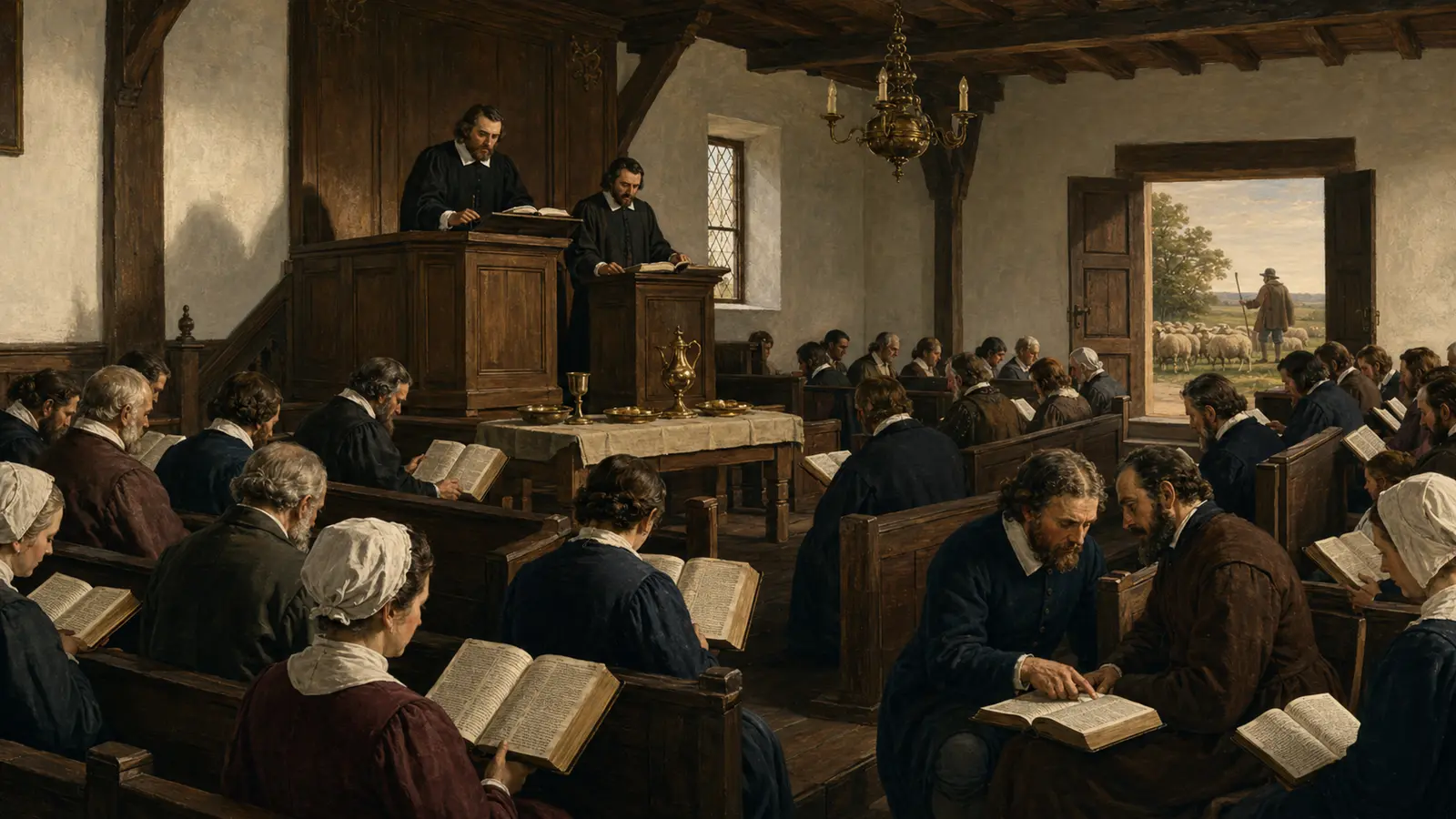
A shepherd does not honor his office by breaking the legs of the sheep. Neither do the sheep honor the shepherd by refusing to hear his voice.
That image captures the two errors which surround this controversy. One error empties ecclesiastical office of its authority, as though ordination were merely professional recognition and every Christian were a church court unto himself. The other expands office beyond Christ’s commission, as though the appointment of pastors relieved ordinary believers of the duty to confess truth, test doctrine, and warn one another of error.
Scripture permits neither error.
Christ appoints officers to govern, teach, and shepherd his church. Their authority is real, delegated, spiritual, and ministerial. The same Christ commands all his people to confess him, search the Scriptures, prove doctrine, admonish one another, give reasons for their hope, and contend for the faith. Those duties are also real. They do not become acts of church government merely because they are exercised carefully, publicly, or in writing.
The question is therefore not whether office exists, but where its jurisdiction ends and the common duties of Christians begin.
State the Question Precisely
The wrong question is, “May a layman exercise the authority of an elder?” No. A layman may not appoint himself to preach in the stated worship of the church, administer the sacraments, exercise the keys, ordain officers, or pronounce ecclesiastical censure.
The actual questions are narrower:
- May an ordinary Christian confess revealed truth publicly?
- May he test a minister’s published doctrine by Scripture?
- May he expose a contradiction or demonstrate an unconfessional consequence?
- May he use public evidence to warn other Christians of serious error?
- May he publish theological work without pretending that his article is a sermon or church judgment?
To answer these questions only by saying, “He is not an elder,” confuses office with truth and jurisdiction with argument. An ecclesiastical court renders a judgment over persons and cases committed to it. A theological publication offers an argument about propositions and evidence. The court may impose censure. The article can only persuade—or fail—according to the truth of its claims.
This distinction restrains both parties. It forbids the layman to counterfeit a court, and it forbids the officer to use his office as a substitute for an answer.
Christ Alone Is Lord of the Conscience
The most basic authority in the church belongs neither to the minister nor to the individual. It belongs to Christ speaking in his Word.
The Westminster Confession says that God alone is Lord of the conscience. It does not thereby release Christians from lawful human authority. God commands submission to parents, magistrates, and church officers; obedience within their proper commission is obedience to him. But no creaturely authority is original, unlimited, or self-authenticating. It is derived from God, defined by his appointment, and accountable to his law.1
Ecclesiastical obedience is therefore neither optional nor absolute. It is not optional because Christ truly governs his church through officers. It is not absolute because those officers are servants of Christ, not legislators over his conscience. Paul could teach with apostolic authority while saying that he did not have dominion over the Corinthians’ faith. Peter could command elders to oversee the flock while forbidding them to lord it over God’s heritage.2
This is why Reformed doctrine refuses to make councils, teachers, or private persons the final judge of controversy. Councils may err. Ministers may err. Laymen may err. All must be examined by the Holy Ghost speaking in Scripture.3
The limitation does not weaken office. It identifies it. An ambassador is not dishonored because he must deliver the king’s message faithfully. His dignity lies in the commission, not in a power to revise the king’s words.
What Belongs to Ecclesiastical Office
Christ’s appointment of elders is part of his continuing government of the church. Elders oversee the flock, labor in Word and doctrine, refute gainsayers, guard against wolves, and watch for souls as men who must give account. Christians owe faithful officers knowledge, esteem, imitation, and lawful obedience.4
Their authority has five marks.
It is delegated: Christ remains the only King and Head of the church.
It is ministerial: officers declare and apply a rule given by another.
It is spiritual: its instruments are the Word, sacraments, prayer, admonition, and discipline appointed by Christ.
It is jurisdictional: officers govern within relations and courts recognized by Christ. Being a pastor does not make a man the immediate ecclesiastical superior of every Christian in the world.
It is accountable: office increases responsibility before the Chief Shepherd; it does not create immunity from examination.
These marks explain why a website cannot ordain, suspend, depose, or excommunicate. They also explain why a website may still examine a published argument. To identify a false premise is not to seize the keys. To show that a doctrine contradicts a confession is not to render the church court’s final judgment about the teacher’s office.
If criticism advances from doctrine to a formal allegation of censurable conduct, it must be carried to the proper court and proved under biblical rules. A public response must not disguise itself as a judicial sentence.
What Belongs to Every Christian
The common duties of confession and discernment are addressed to the church as a body.
Christ says, “Whosoever therefore shall confess me before men, him will I confess also before my Father which is in heaven.” Peter commands believers to be ready always to give an answer for their hope. Jude exhorts the beloved to contend for the faith once delivered to the saints.5
Confession is broader than preaching. Preaching is an official ecclesiastical ordinance. Confession includes truthful acknowledgment of Christ and his doctrine in the believer’s lawful station: within a family, before a magistrate, among neighbors, in private admonition, in apologetic conversation, and in writing. Reserving preaching to lawfully called men does not reserve every articulate statement of theology to them.6
The duty to test doctrine is equally general. “Prove all things; hold fast that which is good.” “Beloved, believe not every spirit, but try the spirits whether they are of God.” The Bereans received Paul’s preaching readily and searched the Scriptures daily to see whether those things were so. Luke calls them noble for combining readiness with examination.7
Nor is admonition a one-way stream. Paul tells believers to teach and admonish one another. He tells the Romans that they are able to admonish one another, and Hebrews commands daily exhortation against the deceitfulness of sin.8
John Owen maintained both order and mutual duty. He distinguished authoritative, fraternal, and friendly or occasional reproof. Ministerial reproof bears special authority within a pastor’s charge; fraternal reproof arises from the relation of church members; occasional reproof may arise where circumstances warrant it. Elsewhere he expressly said that private believers, in their places and capacities, used mutual watchfulness and writing for the preservation and propagation of the church’s faith.9
Owen did not turn every believer into an officer. He placed every believer under a duty suited to his calling, relation, ability, and opportunity.
Public Teaching May Be Answered Publicly
Private offenses and public doctrine should not be confused.
Matthew 18 gives an orderly approach to a brother’s sin in a matter properly addressed between the persons concerned. It is not a universal rule forbidding any answer to a published book, sermon, lecture, or accusation until the author grants a private audience. Public teaching has already passed beyond a private relation and begun to influence others.
Scripture sometimes answers public error publicly. Paul withstood Peter before them all because Peter’s conduct endangered the truth of the gospel. The apostles identify public teachers and refute public doctrines. Public correction remains governed by charity, evidence, and proportion, but courtesy cannot become a teacher’s veto over examination of what he chose to publish.10
Contacting an author is often wise. It may clarify an ambiguity, uncover a qualification, prevent needless controversy, or secure a correction. Wisdom, however, must not be transformed into an invented law.
First Timothy 5:19 also requires care. A formal accusation against an elder must satisfy the church’s evidentiary process. Quoting and analyzing a minister’s public theological claim is not by itself the judicial reception of such an accusation. When the matter concerns alleged secret conduct, abuse, or an offense warranting discipline, it belongs before the proper ecclesiastical court.
Four Things a Critic Must Distinguish
The right to criticize is not a license to misrepresent. A faithful argument distinguishes at least four things:
- Fact: what the person actually said or did. This requires accurate quotation and adequate context.
- Necessary consequence: what validly follows from the stated premises. This requires demonstration.
- Probable tendency: what may naturally follow in practice. This requires evidence and proportionate language.
- Motive: why the person acted. This ordinarily requires direct evidence and must not be invented from disagreement.
A man may sincerely deny a conclusion which nevertheless follows from his principles. The critic should then say both things: he denies the conclusion, and his stated premises appear unable to sustain that denial. Such fairness does not blunt polemics. It makes the argument harder to evade.
The ninth commandment governs silence and speech alike. The Westminster Larger Catechism condemns slander, rash judgment, exaggeration, and speaking truth maliciously or to a wrong end. It also condemns concealing truth, undue silence in a just cause, and holding one’s peace when iniquity calls for reproof or complaint.11
The moral question is therefore not simply, “Did a layman criticize an officer?” It is whether he told the truth, proved his conclusions, observed proper jurisdiction, used proportionate language, and sought the good of the church.
Five Objections Answered
“Obey them that have the rule over you.” Hebrews 13:17 commands real submission to lawful ecclesiastical oversight. It does not say that every assertion of an officer is true or that obedience includes receiving doctrine contrary to Scripture. Submission and discernment must be practiced together.
“Against an elder receive not an accusation, but before two or three witnesses.” First Timothy 5:19 protects elders from unsupported judicial charges. It does not make their public words unquotable. The published words are evidence of what was publicly taught; allegations about life or office require the church’s process.
“Judge not.” Matthew 7 condemns hypocritical judgment. It cannot forbid all discernment, for the same chapter commands the recognition of false prophets by their fruits.
“Be not many masters.” James 3:1 should make every theological writer sober and correctable. It warns against presumptuous teaching; it does not repeal commands to confess, answer, and admonish.
“Laymen may cause division.” They may. So may ministers, professors, and councils. The possibility of abuse requires biblical safeguards, not the abolition of lawful duty. Division is judged by truth, purpose, order, and conduct—not by lay status alone.
The Limits of This Publication
Confessional Bibliology must accept the boundaries of the duty it claims.
It must not imitate a church court, announce censure, or command obedience to its author’s person. It must not encourage contempt for faithful pastors or use private judgment as a cloak for isolation from the church.
It must speak within actual competence. Zeal does not supply evidence; confidence does not repair logic. Where languages, history, or technical disciplines are relevant, the work must be done or the conclusion qualified.
It must honor the fifth and ninth commandments. Quotations must preserve relevant context. The strongest form of the position supported by the record must be answered. Mistake, inconsistency, sin, heresy, apostasy, disqualification, and censurability must not be used as synonyms. Corrections and retractions must be conspicuous.
Finally, the publication must receive the same scrutiny it gives. It cannot demand arguments instead of status and then hide behind its mission when an argument is brought against it.
Shepherds and Sheep Under One Word
Christ gives officers to equip the saints, not to render them permanently incapable of discernment. The purpose of ministry is a mature body whose members are no longer carried about by every wind of doctrine, but speak the truth in love according to their measure.12
A faithful shepherd need not fear sheep trained to hear the Shepherd’s voice in Scripture. A faithful layman need not counterfeit the shepherd’s office in order to confess what the Chief Shepherd has said.
Where the layman is wrong, refute him. Where he is careless, correct him. Where he is factious, admonish him. Where he intrudes into jurisdiction not given to him, restrain him according to biblical order. But where he has quoted accurately, reasoned validly, and confessed the truth, his lack of ordination cannot make the conclusion false.
The church is neither a clerical monopoly upon truth nor an egalitarian dissolution of office. It is an ordered body under one Head. Officers govern and teach with delegated authority. Believers hear, learn, test, confess, admonish, and serve in their several stations. Every member stands under the Word, and no member becomes the Word’s master.
Notes and Further Reading
- Westminster Confession of Faith 20.2 and Westminster Larger Catechism 105. See the Orthodox Presbyterian Church’s text of the Westminster Standards. ↩
- 2 Corinthians 1:24; 1 Peter 5:1–4; compare Matthew 20:25–28. ↩
- Westminster Confession of Faith 1.10 and 31.3; Belgic Confession, article 7. ↩
- Acts 20:28–31; 1 Timothy 3:1–7; 5:17; Titus 1:5–9; Hebrews 13:7, 17; 1 Thessalonians 5:12–13. ↩
- Matthew 10:32–33; Romans 10:9–10; 1 Peter 3:15–16; Jude 1–4. ↩
- Westminster Larger Catechism 156 and 158 distinguish the common duty to read Scripture from the special calling to public preaching. ↩
- 1 Thessalonians 5:21; 1 John 4:1–3; Acts 17:10–12; Galatians 1:8–9. ↩
- Colossians 3:16; Romans 15:14; Hebrews 3:12–13; 10:24–25. ↩
- John Owen, “How We May Bring Our Hearts to Bear Reproofs,” in The Works of John Owen, ed. William H. Goold, vol. 16 (Edinburgh: Johnstone and Hunter, 1850–53), 28–35; Owen, Christologia, chapter 2, in Works, vol. 1, 29–30. Owen’s threefold distinction appears in the former; his statement about private believers using “mutual watchfulness, preaching, or writing” appears in the latter. ↩
- Galatians 2:11–14; 1 Timothy 1:19–20; 2 Timothy 2:16–18; 3 John 9–10. ↩
- Westminster Larger Catechism 144–145; see also Leviticus 19:16–17; Proverbs 24:11–12; 31:8–9. ↩
- Ephesians 4:11–16. ↩
Comments
Share a question or response to this article.