

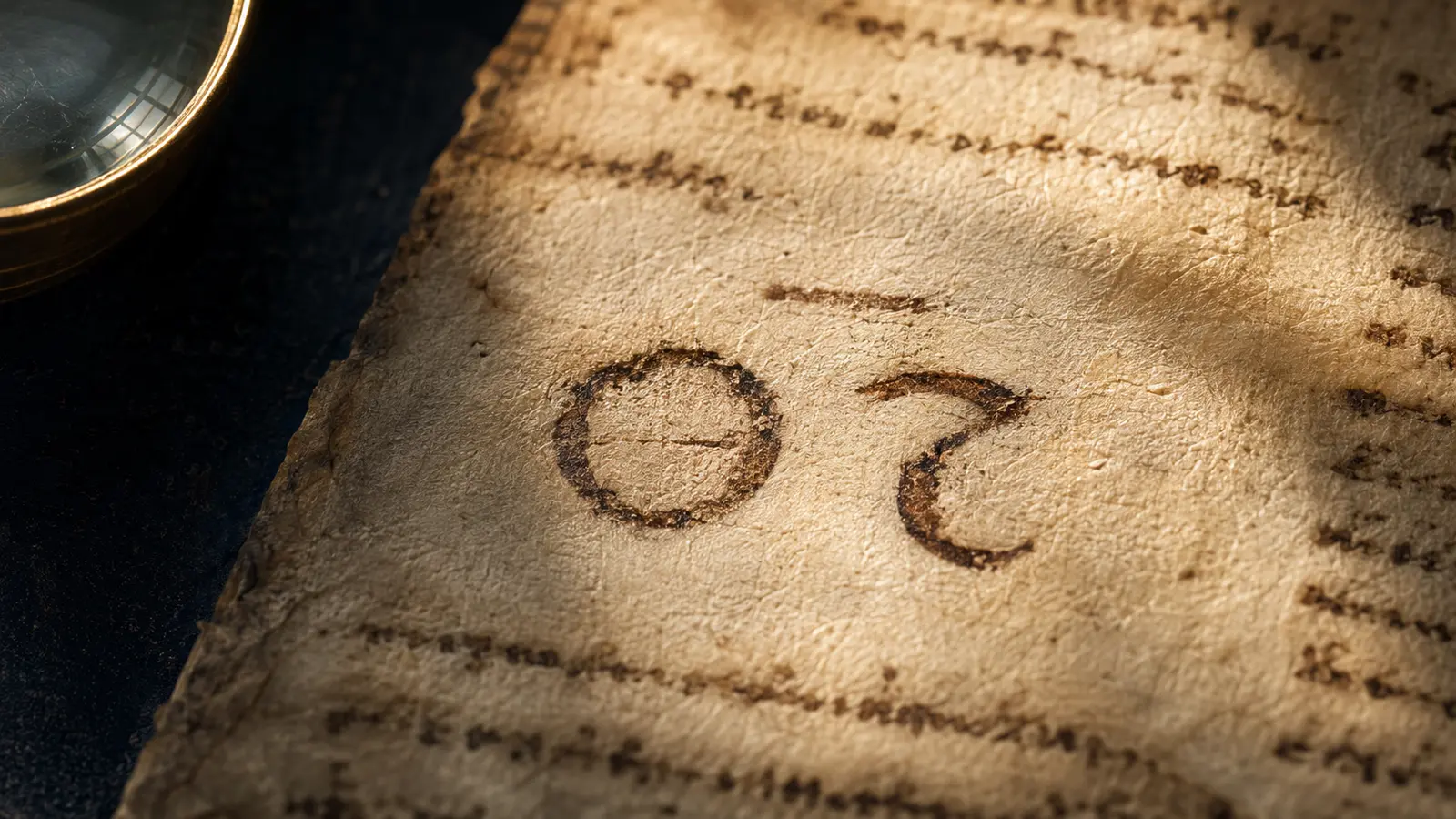
This is Part 4 of “The Line That Vanished.”
The case for a fading stroke in Alexandrinus does not rest on a pious imagination staring at a modern photograph. It rests most strongly on examiners who described the stroke while it was still in the process of disappearing.
John Mill and Henry Berriman are central because each tells us not merely what reading he preferred, but how the physical inspection proceeded.
Their reports deserve close treatment because they occupy the point where early reception becomes described observation. Huish, Pearson, and Fell show that Alexandrinus was treated as a witness for θεός. Mill and Berriman claim to have seen the material feature that justified that treatment: a fine remnant of the diameter of theta distinct from the heavier later stroke.
The proposition to be tested is exact. It is not that Mill and Berriman supplied modern chemical analysis, nor that their judgment cannot be mistaken. It is that two eighteenth-century investigators, under stated conditions and before the leaf reached its later state of abrasion, reported an older transverse trace. Any history of the verse must either accept that observation or explain it.
Mill’s first impression
When John Mill examined Alexandrinus for his monumental Greek New Testament of 1707, his first impression favored ΟC. That fact deserves emphasis. A witness who begins by seeing the form preferred by the opposing case and changes his mind upon closer inspection cannot fairly be dismissed as someone who saw only what he wished to see.
Mill then examined the place more carefully. He reported remnants of the transverse line within the omicron—“marks and almost certain traces”—especially toward the left side.1 He also distinguished the older fine trace from heavier later ink, which he understood as an attempt to restore the sacred contraction.
The sequence is evidentially valuable:
- unaided or initial appearance: ΟC;
- closer examination: residual transverse stroke;
- historical judgment: original ΘC, later strengthened.
This is exactly what a fading-theta hypothesis would predict. It would first look like omicron; remnants would remain where ink bit more deeply or suffered less abrasion; later repair would be darker than the original.
It does not prove that hypothesis beyond every objection. It gives it observational content.
Mill’s account is unusually useful because it preserves the movement of his judgment. He says that the transverse line was so thin and evanescent that at first sight he did not doubt that the manuscript had ΟC. He had even placed that conclusion among the variants. Only after a more attentive examination did he believe that he detected “marks and almost certain traces” of the line, particularly where it met the left circumference.2
This self-correction cuts against a simplistic account of orthodox bias. Mill’s initial inclination was not to protect θεός at all costs. He was prepared to register ΟC. His later preference arose, at least in his own testimony, from closer inspection. A critic may still say that the second look produced confirmation bias, but that explanation must account for the direction of the change and the specificity of the reported location.
Mill also recognized that a later hand had intervened. He criticized the crude heavier line and the thickening of the upper mark. His case for ΘC did not depend on identifying those conspicuous strokes as original. He believed that the later intervention nearly concealed the fine earlier diameter it was intended to preserve. This is precisely the distinction modern summaries often lose when they say only that “the theta strokes are later.”
The history behind his 1707 publication matters as well. Mill had spent decades collecting variant readings and produced an apparatus of unprecedented extent. The appearance of thousands of variants unsettled some readers, but his work did not abandon the received text. At this verse he was perfectly capable of distinguishing the printed reading, the visible later marks, and his reconstruction of the first hand. His conclusion may be challenged; it cannot be reduced to ignorance of textual variation.
The evidential value of changing one’s mind
A change of mind is not automatically a mark of reliability. People abandon sound first impressions for poor reasons. Yet a documented reversal can reveal that the final judgment was not merely the reflex of prior expectation. Mill gives the historian access to both stages of his perception.
The sequence also supplies a physical prediction. If an original diameter had faded except at its edges and was later retraced across the center, an observer might first notice the coarse restoration, discount it as secondary, and see only ΟC beneath. On closer inspection he might find fine remnants where the new line did not perfectly cover the old. Mill says that this is what occurred, particularly on the left.
The rival model can reproduce the same perceptual sequence. An observer might first correctly see ΟC, then under prolonged scrutiny mistake a scratch or reverse-side line for an old diameter. Mill’s changed mind therefore discriminates less between the models than defenders sometimes suppose. Its value lies in establishing the reported phenomenon, not in rendering error impossible.
This is why the evidence must be cumulative. Mill’s left-edge trace becomes more significant when Berriman later reports an old line toward the left and another observer perceives it on the right. It becomes less decisive when Wettstein later attributes the left-side appearance to the epsilon on the reverse. No single inspection can bear the entire case.
Berriman brings glass and sunlight
In 1741 Henry Berriman published an extended defense of “God was manifested in the flesh.” He personally examined Alexandrinus “by the aid of a Glass and the advantage of the Sun shining on the Book.”3 He reported seeing part of the older transverse line at the left of the stronger mark.
Berriman did not rely solely on his own vision. Two gentlemen examined the place with him. One perceived the old line on one side, and another reportedly perceived it at both ends. Their degree of independence can be debated, and Berriman was openly defending θεός. But these facts do not make the observation disappear. The proper response to partisan testimony is scrutiny, not automatic nullification.
Berriman’s Critical Dissertation grew out of the Lady Moyer lectures he delivered in 1737–38. The book was not a neutral conservation log; it was a learned defense of the reading θεός. That declared purpose should make the reader attentive to selection and rhetoric. It also makes the report publicly accountable. Berriman named the means of observation, described what unaided eyes failed to see, and stated that others present perceived the remnant.
The detail about the naked eye is particularly instructive. Berriman says he could not perceive the old line without assistance, nor could companions whose eyesight he considered better. With a glass and sunlight, he believed he could see part of it. This is not the language of a bold, obvious theta. It is the language of a feature already close to the threshold of visibility.
His companions do not amount to a controlled blinded trial. They stood with an advocate who was looking for a specific mark, and their reports reach us through him. Suggestion may have influenced what they perceived. Yet corroboration under shared observation remains more than a solitary impression. A fair assessment notes both facts.
Castelli’s historical study is valuable here because it reproduces the relevant portion of Berriman’s account and locates it within the controversy surrounding Wettstein. Her reconstruction shows that Berriman also reported Wettstein’s earlier acknowledgment of a fine stroke at the ends of the fuller correction. The source chain must be marked: Berriman is a direct witness to his own inspection and a mediated witness to what Wettstein allegedly said to another man.4
That distinction prevents a common inflation. We may say, “Berriman inspected the manuscript and reported the old line.” We should say, “According to Berriman’s account of a conversation preserved through an intermediary, Wettstein initially recognized a fine stroke.” The first is autoptic. The second is historical testimony about another observer.
Berriman’s warning to later readers
Berriman understood that a faint trace might soon cease to be visible. His argument anticipated a common error: a later examiner could fail to see what an earlier examiner saw and then treat the later absence as proof that the earlier observation never occurred.
Parchment and ink are material objects. They age. A page subjected to unusual curiosity does not improve with every touch. If the old line was already difficult in 1707 and 1741, its later disappearance would be evidence of continued deterioration, not necessarily evidence against Mill and Berriman.
This point is elementary but often neglected. Textual criticism reconstructs earlier states from surviving evidence; it cannot assume that the latest observable state is automatically the earliest.
Berriman’s warning was remarkably specific. He anticipated that the old line might become altogether undiscoverable and argued that its disappearance should not be used to deny the earlier testimony. He interpreted the darker new strokes as an attempt “to preserve and perpetuate” a reading threatened by time.5 His conclusion belongs to his advocacy, but the forecast of further loss would acquire force when Woide later reported that a trace visible in 1765 could no longer be seen in 1785.
Prediction is not proof of the underlying interpretation. If Berriman mistook verso show-through for a recto trace, the feature might appear and disappear with changing illumination without ever being original theta ink. Still, the later deterioration of the page confirms his general material premise: the evidence available to one generation was not guaranteed to survive for the next.
This has consequences for modern image-based confidence. A digital facsimile may let thousands of readers examine the current surface without touching it, a great conservation benefit. It also tempts them to believe that whatever cannot be seen in the image was never present. Berriman’s warning exposes the temporal assumption behind that inference.
Historical sciences regularly depend upon records of vanished states. An inscription may be known from an early squeeze after the stone has weathered. A painting’s earlier condition may be known from restoration photographs. A manuscript reading may be known through a collation after pigment has flaked. Such testimony can be false or mistaken, but it cannot be ruled out merely because the object has changed.
The difference between trace and retracing
Both Mill and Berriman distinguished an older, thin remnant from stronger ink. That distinction creates the decisive question: was the stronger ink a correction from ΟC to ΘC, or was it a retracing of an original ΘC whose central portion had faded?
The received-text case does not need to deny that later ink is present. It needs to show that later ink can be restorative. Mill and Berriman believed they saw the physical basis for that conclusion in the older remnant.
The critical case can reply that they misidentified show-through, a scratch, or the edge of the later stroke. That reply is possible. It must, however, confront their descriptions and not merely cite the present classification of A*.
Four questions help evaluate the claim:
- Did the fine remnant occupy the position expected for the diameter of theta?
- Was it visually distinguishable from the heavier later ink?
- Did it extend to places not explained by the reverse-side epsilon?
- Did more than one competent observer describe it before severe abrasion?
Mill and Berriman answer the first, second, and fourth questions in the affirmative. Wettstein’s later account contests the third by assigning the left-side appearance to verso writing. Burgon and Scrivener later argued that the reverse epsilon did not coincide with enough of the theta’s diameter and crossed too high to explain the reports. The present series will not pretend to settle that geometry from rhetoric. It will state where the accounts collide.
The word trace should also be used carefully. It does not mean a complete line. Mill describes marks and vestiges; Berriman describes some part of the old line. Their language is compatible with a broken, fading feature. A modern paraphrase that says they “clearly saw the original theta” loses this restraint and gives critics an easy target.
Likewise, retracing describes an action, not its justification. A later hand can retrace what it believes was present and still be wrong. A custodian might regularize a damaged ΟC into ΘC because the context or received text suggested θεός. The existence of good faith would not make the restored reading original. The received-text case requires not merely an innocent motive but evidence of the older diameter.
That evidence is exactly what Mill and Berriman claim to provide.
What the observations establish
Mill and Berriman establish neither a universal genealogy nor an infallible autopsy. They establish something more measured:
- the reading in Alexandrinus was materially ambiguous by the early eighteenth century;
- more than one observer reported remnants of a fine transverse stroke;
- the remnant was distinguished from heavier restoration;
- the fading-line explanation predates modern confessional controversy;
- subsequent loss of visibility was anticipated while some trace could still be seen.
The reading θεός therefore cannot be dismissed as a late dogmatic stroke imposed upon a plainly original ΟC. The history is older and the page more complicated.
Mill first saw “who.” Then he looked more closely.
Berriman knew the old line was vanishing. He brought glass, sunlight, and other eyes.
Any modern judgment that omits those inspections has not yet accounted for the manuscript. It has accounted only for what remained after them.
The conclusion can be stated without rhetorical excess. The direct early observations make an original ΘC materially credible. They raise the burden for anyone who calls A* an indisputable witness to ὅς. They do not compel every historian to accept theta, because the possibility of show-through and misperception remains.
Their strongest feature is convergence in detail across time: a coarse later intervention, a finer earlier-looking remnant, special visibility near the left circumference, and a mark so weak that closer conditions were necessary. Their principal weakness is the absence of modern imaging and the doctrinal interest of the observers. Both features belong in the judgment.
A confessional article should resist the urge to turn “strong” into “infallible.” The Word of God is infallible; an eighteenth-century inspection is not. Ministerial criticism may nevertheless conclude that the inspection is credible and that it supports the received reading. Such a conclusion is historical and revisable in its account of the artifact, even while the church’s doctrine of Scripture rests upon a higher ground.
The next article will place the strongest contrary witness beside Mill and Berriman. Wettstein did not merely fail to see their line. He offered a physical explanation for it, and his own judgment changed over time. The fading case is worthy of confidence only if it can survive that objection in its strongest form.
- Castelli, Wettstein’s Principles, 113–15, translating and analyzing Mill’s report. ↩
- Castelli, Wettstein’s Principles, 116–17, quoting and translating Mill’s 1707 account; Scrivener, Plain Introduction, 2:390–95, note 428. ↩
- Henry Berriman, ΘΕΟΣ ΕΦΑΝΕΡΩΘΗ ΕΝ ΣΑΡΚΙ: or, A Critical Dissertation upon I Tim. iii. 16 (London, 1741), 155–56, https://books.google.com/books?id=lJnBDhxU8C. ↩
- Castelli, Wettstein’s Principles, 117–18. Castelli notes the mediated character of Berriman’s report about Wettstein and discusses the possible identification of the intermediary as the Reverend John Kippax. ↩
- Berriman, Critical Dissertation, 156; the warning is also reproduced in Burgon, Revision Revised, 433–34. ↩
Comments
Share a question or response to this article.