

Matthew’s crossing contains a crowd of small variants: many crowds or one, his disciples or disciples, the ship or a ship, Gergesenes or Gadarenes, and “permit us to go” or “send us.” They do not form one textual event, so they should not receive one stock answer.
“And when he was entered into a ship, his disciples followed him.” — Matthew 8:23
Verse 18 reads “great multitudes”—literally many crowds—in the Textus Receptus. The critical form has one crowd. Matthew often uses the fuller expression, which can invite addition; similar endings can also drop one word.
Verse 21 calls a hesitant follower “another of his disciples.” The pronoun sharpens the irony: a man already within the disciple circle delays obedience.
At verse 23 the received Greek has the article, the ship, even though the Authorized Version naturally says “a ship.” The critical text also prints the article, despite omission in Sinaiticus and Vaticanus. English articles cannot be forced backward into a Greek apparatus.
The country across the water
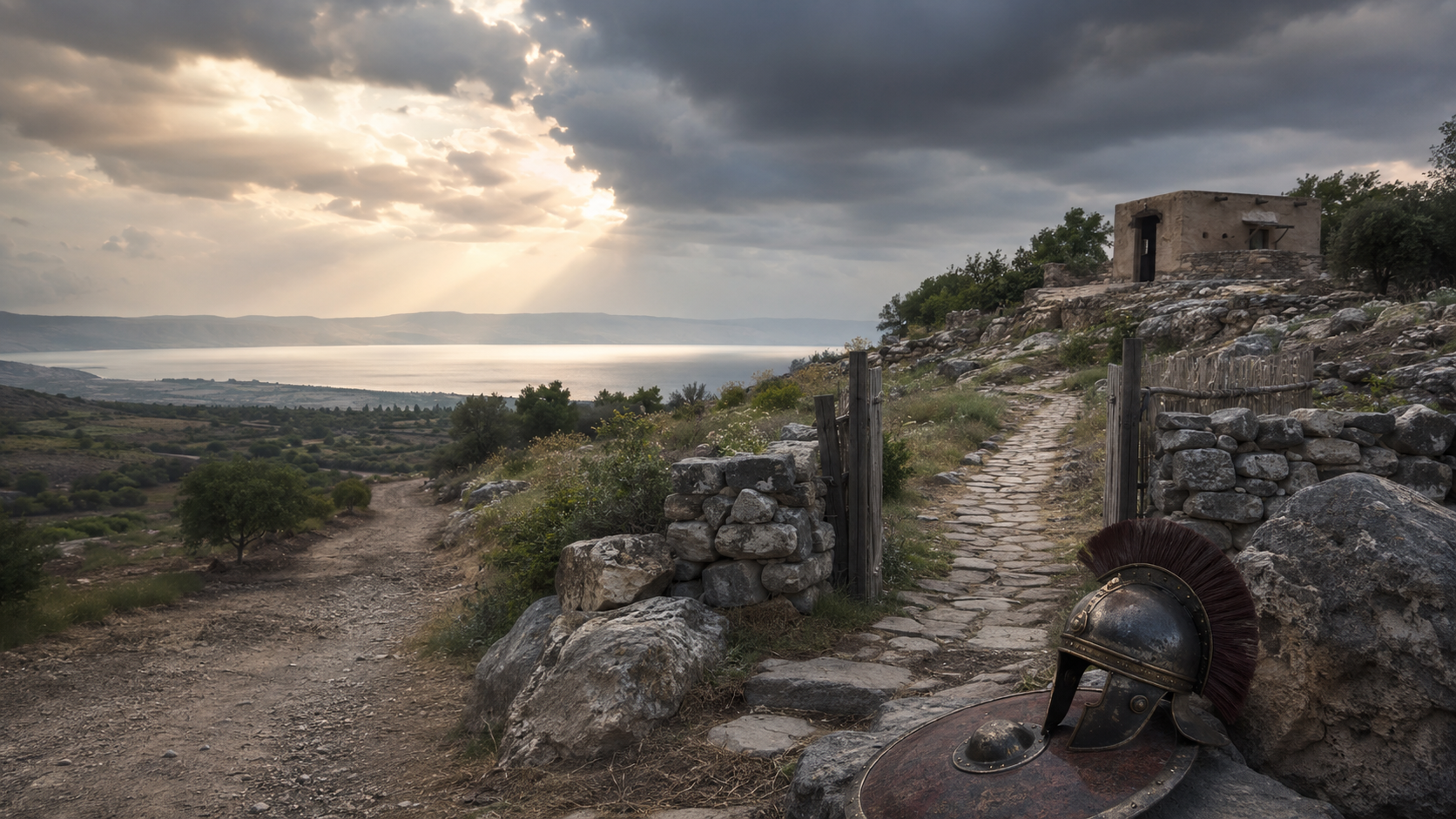
The Textus Receptus reads Gergesenes; the critical text usually Gadarenes; Mark and Luke have further variation around Gerasenes. Gadara was a known city whose territory could reach the lake. Gergesa was associated in Christian memory with a shore site suited to tombs and a steep descent.
The exact ancient boundaries are not fully recoverable from a modern map. The received Gergesenes has geographic sense and long ecclesiastical use. Gerasa, far inland, likely reflects the pull of a more famous regional name.
What the demons ask
The received text gives “suffer us to go away into the herd of swine.” The critical form is the shorter “send us into the herd.” Both confess that the demons cannot move without Christ’s leave. The fuller request may be accused of expansion; the shorter imperative may arise from compression toward Mark and Luke.
Across the cluster, Christ remains the fixed actor. Disciples follow him, waves obey him, demons beg him, and the herd moves only when he says “Go.” The received details give Matthew’s own cadence without pretending that every article or place name carries a separate doctrine.
The place-name problem is made harder because ancient writers could name a district by its chief city, a nearby town, or a local village. “Country of the Gadarenes” need not place the event inside Gadara’s walls. Gergesa can identify the shore location while a broader regional name remains intelligible. Modern precision should not be imposed upon ancient territorial speech.
The famous objection about one demoniac in Mark and Luke also lies outside this textual cluster. Matthew says two; the other Evangelists concentrate on the one who speaks and later bears witness. Mentioning one does not deny a companion. The manuscripts of Matthew do not need to be rewritten to solve a contradiction the sentences do not assert.
The demons’ fuller request exposes their dependence. They cannot choose the herd as an escape route and merely notify Jesus. They ask permission. The final command is one word, “Go,” and the whole violent company obeys. Whatever small wording is weighed, that authority dominates the shore.
Sources and further reading
- Matthew 8:18–34; Mark 4:35–5:20; Luke 8:22–39.
- Bruce M. Metzger, A Textual Commentary on the Greek New Testament, notes on Matthew 8.
- Historical geography of Gadara and the eastern shore of Galilee.
Comments
Share a question or response to this article.