

Second edition
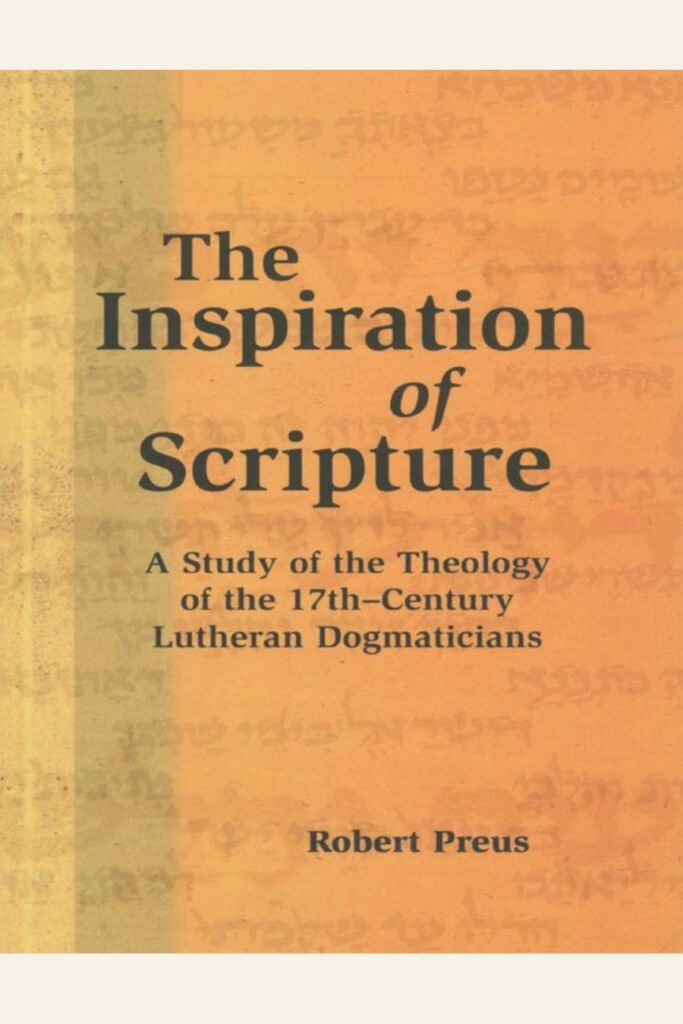
The Inspiration of Scripture
Robert D. Preus · 1957
Robert D. Preus, The Inspiration of Scripture, 2nd ed. (St. Louis: Concordia Publishing House, 1957).
Overview
Preus investigates seventeenth-century Lutheran dogmaticians on inspiration, authority, and canon. The preface establishes a representative selection of orthodox Lutheran writers and identifies the book’s historical purpose: to correct later accounts that depict the period as merely sterile or mechanical.
The study is valuable source-conscious historical theology. Its historical conclusion must be distinguished from the theological truth of the position described, and its Lutheran confessional framework must not be merged carelessly with Reformed formulations. It nevertheless provides important evidence that Protestant orthodoxy commonly connected verbal inspiration, sola Scriptura, canon, and theological method.
Overview
Preus investigates seventeenth-century Lutheran dogmaticians on inspiration, authority, and canon. The preface establishes a representative selection of orthodox Lutheran writers and identifies the book’s historical purpose: to correct later accounts that depict the period as merely sterile or mechanical.
The study is valuable source-conscious historical theology. Its historical conclusion must be distinguished from the theological truth of the position described, and its Lutheran confessional framework must not be merged carelessly with Reformed formulations. It nevertheless provides important evidence that Protestant orthodoxy commonly connected verbal inspiration, sola Scriptura, canon, and theological method.
Editorial Evaluation
Purpose Fulfillment
Does the work accomplish what it claims to accomplish?
Brief assessment
Preus fulfills the announced task of presenting representative Lutheran orthodox teaching on Scripture against dismissive historiography.
Full rationale and supporting references
Purpose Fulfillment: Preus fulfills the announced task of presenting representative Lutheran orthodox teaching on Scripture against dismissive historiography. This is a source-controlled preliminary editorial rating. It evaluates the supplied edition and the stated source loci, not the author’s motives and not every possible edition or response. Evidence reviewed: Supplied second edition, copyright and preface pp. 1–20; historical-theological chapters on inspiration, authority, and canon.
Editorial Evaluation
Source Quality
Does it use the appropriate primary and secondary sources?
Brief assessment
The study is built around historic dogmaticians and displays serious attention to primary theological material.
Full rationale and supporting references
Source Quality: The study is built around historic dogmaticians and displays serious attention to primary theological material. This is a source-controlled preliminary editorial rating. It evaluates the supplied edition and the stated source loci, not the author’s motives and not every possible edition or response. Evidence reviewed: Supplied second edition, copyright and preface pp. 1–20; historical-theological chapters on inspiration, authority, and canon.
Editorial Evaluation
Citation Accuracy
Are quotations, references, and claims verifiable and in context?
Brief assessment
Its scholarly documentation is substantial, though individual primary quotations still require edition-level checking.
Full rationale and supporting references
Citation Accuracy: Its scholarly documentation is substantial, though individual primary quotations still require edition-level checking. This is a source-controlled preliminary editorial rating. It evaluates the supplied edition and the stated source loci, not the author’s motives and not every possible edition or response. Evidence reviewed: Supplied second edition, copyright and preface pp. 1–20; historical-theological chapters on inspiration, authority, and canon.
Editorial Evaluation
Evidence Coverage
Does it address the relevant evidence, including contrary evidence?
Brief assessment
It offers a focused historical-theological record rather than an exhaustive interconfessional history of all Protestant bibliology.
Full rationale and supporting references
Evidence Coverage: It offers a focused historical-theological record rather than an exhaustive interconfessional history of all Protestant bibliology. This is a source-controlled preliminary editorial rating. It evaluates the supplied edition and the stated source loci, not the author’s motives and not every possible edition or response. Evidence reviewed: Supplied second edition, copyright and preface pp. 1–20; historical-theological chapters on inspiration, authority, and canon.
Editorial Evaluation
Historical Accuracy
Are people, dates, editions, events, and settings handled correctly?
Brief assessment
The treatment is careful and corrective, but its representative selection and later scholarly debates require continued scrutiny.
Full rationale and supporting references
Historical Accuracy: The treatment is careful and corrective, but its representative selection and later scholarly debates require continued scrutiny. This is a source-controlled preliminary editorial rating. It evaluates the supplied edition and the stated source loci, not the author’s motives and not every possible edition or response. Evidence reviewed: Supplied second edition, copyright and preface pp. 1–20; historical-theological chapters on inspiration, authority, and canon.
Editorial Evaluation
Subject Competence
Does the author demonstrate competence in the relevant disciplines?
Brief assessment
Preus demonstrates strong competence in Lutheran dogmatics and historical theology.
Full rationale and supporting references
Subject Competence: Preus demonstrates strong competence in Lutheran dogmatics and historical theology. This is a source-controlled preliminary editorial rating. It evaluates the supplied edition and the stated source loci, not the author’s motives and not every possible edition or response. Evidence reviewed: Supplied second edition, copyright and preface pp. 1–20; historical-theological chapters on inspiration, authority, and canon.
Editorial Evaluation
Logical Coherence
Do the conclusions follow from the premises and evidence?
Brief assessment
The historical thesis follows coherently from the selected primary sources, while theological adoption requires a further confessional argument.
Full rationale and supporting references
Logical Coherence: The historical thesis follows coherently from the selected primary sources, while theological adoption requires a further confessional argument. This is a source-controlled preliminary editorial rating. It evaluates the supplied edition and the stated source loci, not the author’s motives and not every possible edition or response. Evidence reviewed: Supplied second edition, copyright and preface pp. 1–20; historical-theological chapters on inspiration, authority, and canon.
Editorial Evaluation
Methodological Transparency
Are the method and controlling assumptions identifiable and consistent?
Brief assessment
The preface explains why particular theologians are included or excluded.
Full rationale and supporting references
Methodological Transparency: The preface explains why particular theologians are included or excluded. This is a source-controlled preliminary editorial rating. It evaluates the supplied edition and the stated source loci, not the author’s motives and not every possible edition or response. Evidence reviewed: Supplied second edition, copyright and preface pp. 1–20; historical-theological chapters on inspiration, authority, and canon.
Editorial Evaluation
Strongest-Form Engagement
Does the work address the strongest opposing case rather than a caricature?
Brief assessment
It counters caricatures of orthodoxy but offers less extensive engagement with every modern historical-critical account.
Full rationale and supporting references
Strongest-Form Engagement: It counters caricatures of orthodoxy but offers less extensive engagement with every modern historical-critical account. This is a source-controlled preliminary editorial rating. It evaluates the supplied edition and the stated source loci, not the author’s motives and not every possible edition or response. Evidence reviewed: Supplied second edition, copyright and preface pp. 1–20; historical-theological chapters on inspiration, authority, and canon.
Editorial Evaluation
Clarity and Research Usefulness
Is it intelligible, navigable, and useful for further study?
Brief assessment
It is an important bridge to primary Lutheran orthodox sources for readers studying inspiration and sola Scriptura.
Full rationale and supporting references
Clarity and Research Usefulness: It is an important bridge to primary Lutheran orthodox sources for readers studying inspiration and sola Scriptura. This is a source-controlled preliminary editorial rating. It evaluates the supplied edition and the stated source loci, not the author’s motives and not every possible edition or response. Evidence reviewed: Supplied second edition, copyright and preface pp. 1–20; historical-theological chapters on inspiration, authority, and canon.
Scripture Passage Coverage
2 Peter 1:21
Substantial treatment · dogmaticians’ doctrine
Defends the readingA principal proof text for prophetic inspiration.
2 Timothy 3:16
Substantial treatment · dogmaticians’ doctrine
Defends the readingA principal proof text for inspiration.
John 10:35
Brief treatment · dogmaticians’ doctrine
Defends the readingUsed for Scripture’s authority.