

Revision note: Substantially revised July 20, 2026. The argument has been reordered according to the classical rhetorical movement, compressed where necessary, and given one consolidated Notes and Further Reading section.
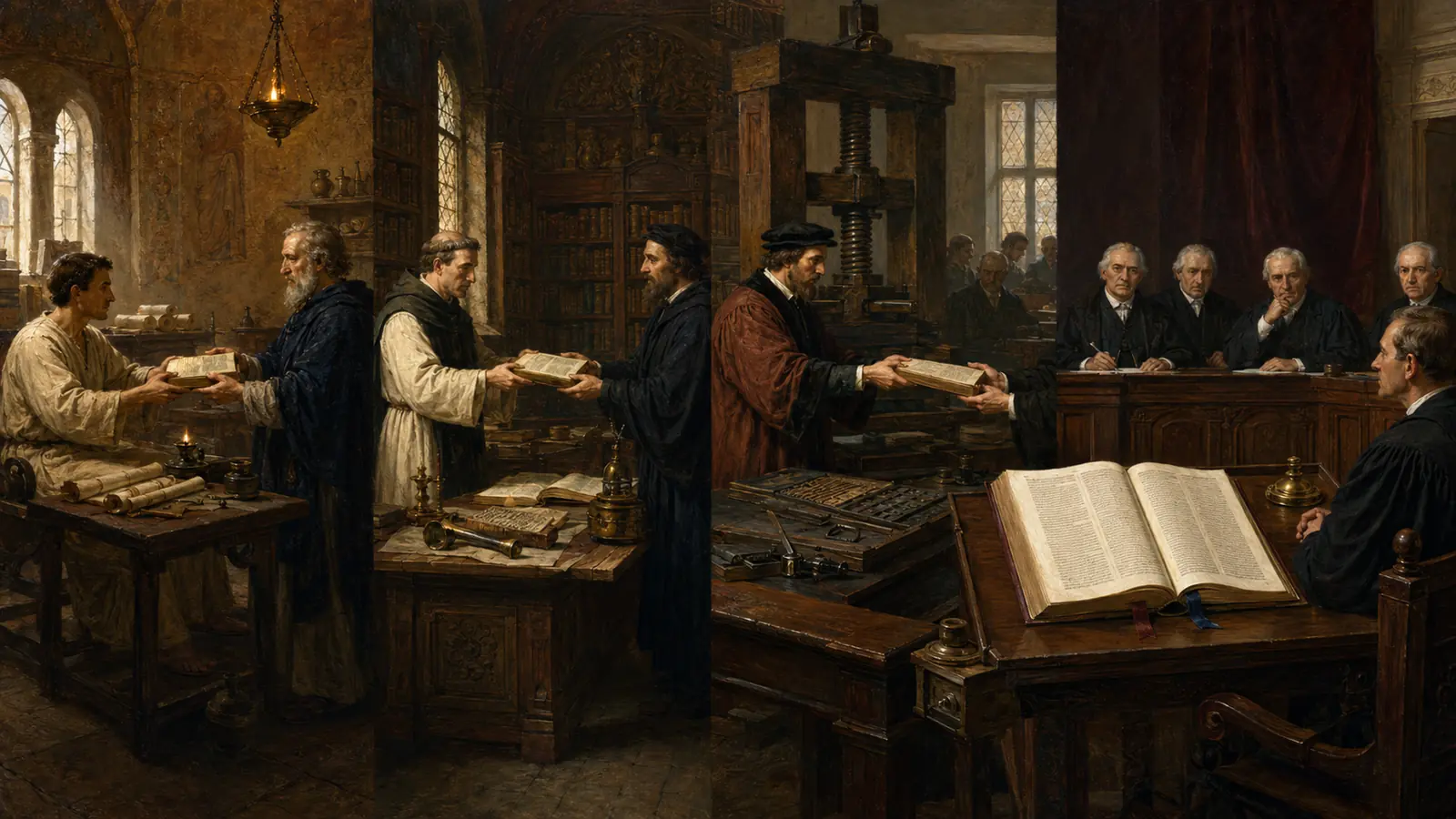
Westminster does not confess a lost standard, a contradictory manuscript aggregate, or a text awaiting modern reconstruction. It confesses preserved Hebrew and Greek Scriptures that are therefore authentic and presently available for the church’s final appeal.
Lane Keister has helpfully identified the standard by which his doctrine of preservation should be tested. In his answer to criticism from this site, he emphatically affirmed that God preserved the original text of both Testaments by special providence through the manuscripts. He then distinguished individual Reformed opinions from the confessional standard of his church: the Westminster Standards.1
We should accept that standard and apply it carefully.
The question is not whether Westminster Confession of Faith 1.8 contains the words Textus Receptus, names a particular edition of the Hebrew Bible, or canonizes the King James Version. It does none of those things. Nor is the question whether every surviving manuscript is faultless. The Westminster divines knew that copyists and printers made mistakes.
The question is more basic: What kind of preservation does Westminster actually confess? Does it teach that the inspired wording survives somewhere among all extant variants and must be reconstructed by probabilistic criticism? Or does it teach that God has continuously maintained the Hebrew and Greek Scriptures as an authentic text possessed by the church and capable of serving as her final court of appeal?
The grammar, history, and theological function of section 1.8 point decisively to the second answer.
The Argument of Westminster 1.8
The confession’s eighth section is one connected argument. Its clauses should not be separated from one another.2
| Clause | Function | What it excludes |
|---|---|---|
| Hebrew Old Testament and Greek New Testament | Identifies the Scriptures in view | A translation as supreme textual standard |
| Immediately inspired | Names their divine origin | Merely human religious literature |
| Preserved by singular care and providence | Names the cause of continuance | Survival by accident alone |
| Kept pure in every age | Names continuity and quality | Total corruption, loss, or textual interregnum |
| Therefore authentic | Draws the normative consequence | A merely recoverable or indefinitely provisional text |
| Final appeal in controversy | States ecclesiastical use | An autograph, translation, church, or critic as final judge |
| Translation into every nation’s language | Gives the people access | A text reserved for a scholarly caste |
The word therefore is pivotal. The Hebrew and Greek Scriptures are authentic because God kept them pure. Preservation is not a general providential backdrop from which scholars may eventually construct an authentic text. It is the divine action that accounts for the text’s continuing authenticity.
This sequence gives Westminster’s doctrine its shape:
inspiration → providential preservation → continued purity → present authenticity → final appeal → public translation
- Lane Keister, “An Answer to Chris Thomas”, Green Baggins, November 26, 2024. ↩
- Westminster Confession of Faith 1.8, read within 1.1–10, Orthodox Presbyterian Church. ↩
Remove continued purity, and the inference to authenticity fails. Replace the preserved text with a contradictory archive, and the object of final appeal disappears. Move authenticity into an editorial product obtained only after expert reconstruction, and the critic’s judgment assumes a role the confession assigns to the Scriptures.
The Subject Is the Hebrew and Greek Scriptures
The grammatical subject of section 1.8 is neither the autographic sheets nor the total manuscript archive. It is “the Old Testament in Hebrew” and “the New Testament in Greek.” Those Scriptures are described successively as inspired, kept, authentic, and finally appealed to.
This does not mean that the physical manuscripts copied in later centuries were immediately inspired. Inspiration belongs properly to the prophetic and apostolic act of inscripturation. Copyists were not inspired, and a scribal error does not become God-breathed because it appears inside a manuscript. Yet the confession maintains the identity of the writings across their history. The Scriptures originally given by God did not become a different object when the autographic materials perished. Their textual identity continued in the apographs.
That distinction is indispensable:
- the autograph is the first physical inscription of a biblical writing;
- an apograph is a copy derived from that inscription;
- the text is the verbal content communicated through both.
The parchment can perish while the text continues. A copy can contain a local defect while the text is preserved in the church’s broader transmissional possession. Neither fact requires us to relocate the inspired wording into an inaccessible past.
Westminster 1.8 therefore does not make two unrelated assertions—first, that pristine autographs once existed, and second, that a mixed manuscript mass later survived. It traces one canonical object from divine origin to present ecclesiastical use. The Scriptures that God inspired are the Scriptures he kept; the Scriptures he kept are consequently authentic; the Scriptures thus authentic are those to which the church appeals.
“Immediately Inspired” Fixes the Kind of Thing Preserved
Westminster begins with inspiration because preservation must correspond to what God inspired. The canonical writings are the rule of faith and life, and their authority depends wholly upon their truthful author. Section 1.8 explains why those writings remain available as the church’s rule.
God did not inspire a bare message while leaving its words indeterminate. He inspired writings whose meaning is expressed in Hebrew and Greek words standing in determinate relations. Not every spelling difference carries equal exegetical weight, and no later copyist reproduces every typographical feature by inspiration. Yet preservation concerns the verbal text, not merely the survival of orthodox ideas. A doctrinal summary can preserve sound teaching; it cannot decide whether a disputed clause belongs to Matthew, Paul, or John.
“Singular Care and Providence” Is Not Bare Survival
Keister and defenders of the Received Text agree that preservation occurred through providence and through manuscripts. No responsible confessional position requires a perpetual miracle, an inspired printing press, or one indestructible codex. God ordinarily works through means: copyists, churches, lectionaries, translations, quotations, printers, editors, and ministers.
But the confession does not speak merely of ordinary historical continuance. It attributes the preservation of Scripture to God’s singular care and providence. Chapter 5 says that providence extends to all creatures and events, yet takes special care of the church. Section 1.8 applies that special government to the church’s foundational rule.
This adjective matters. Everything that survives history survives under providence in the broad sense. Heretical books, corrupt translations, forged documents, and scribal mistakes also persist under God’s sovereign government. If Westminster meant only that God allowed a mass of manuscript evidence to survive, its language would not distinguish the preservation of Scripture from the survival of textual corruption.
Singular care identifies a divinely intended result: the church is not deprived of the Word committed to writing for her establishment and comfort. Manuscripts are the providential means; the preserved Scriptures are the object and outcome.
That distinction also prevents a common equivocation. One may say that God preserved every extant variant providentially, since no artifact exists outside his government. It does not follow that every variant is part of the text kept pure. Providence preserves evidence of error without authenticating the error. A correction, an omission, and an addition may all survive as historical facts; they cannot all be the same inspired wording.
“Kept” Describes Continuity, Not Eventual Recovery
Westminster says the Scriptures were kept. The verb describes continuing divine maintenance, not merely future recoverability.
An heirloom kept by a family may pass through many hands, acquire scratches, and require local repair while remaining the family’s possession. It is not “kept” in the relevant sense if it disappears for centuries, loses its identity, and must later be reconstructed from an assortment of incompatible descriptions. Likewise, the church’s copies may contain local defects without the church losing the text as a whole. But if the authentic wording exists only as an unknown set of readings hidden among contradictions until modern experts reassemble it, the claim has moved from preservation to restoration.
This does not mean that every manuscript or every authentic reading must have been equally visible in every region and century. A codex may lie unused. A genuine reading may be less widely represented than another. Manuscripts may perish after their text has been copied. New evidence may illuminate the history of a reading. Westminster does not provide a simplistic rule that only artifacts with an unbroken chain of documented public use may be considered.
It does mean that the church was never left without the authentic Scriptures as her rule. Evidence may be newly discovered; the canonical text is not newly constituted. Scholarship may clarify a preserved text; it may not create the first age in which the church can finally possess one.
The distinction can be put simply:
What is kept may be examined and locally corrected. What is lost must be restored. Westminster confesses the former, not the latter.
- Lane Keister, “An Answer to Chris Thomas”, Green Baggins, November 26, 2024. ↩
- Westminster Confession of Faith 1.8, read within 1.1–10, Orthodox Presbyterian Church. ↩
“Pure” Does Not Mean a Perfect Physical Artifact
Keister’s strongest objection is that no single manuscript corresponds perfectly to the printed Received Text and that Received Text editions themselves differ. The factual premise is correct. The inference is not.
Westminster does not say that one manuscript was kept free from every copying mistake. It says that the Hebrew and Greek Testaments were kept pure. A manuscript is a witness to a text, not the text considered simply. A local scribal defect may be exposed and corrected by comparison with other copies, the usage of the church, grammatical evidence, parallel passages, ancient versions, and the whole transmissional history.
The Reformed orthodox openly acknowledged such defects. William Whitaker’s Disputation on Holy Scripture defended the Hebrew and Greek originals while admitting that canonical books may sometimes be copied incorrectly by transcribers. John Owen likewise denied that scribes were inspired and discussed variant readings at length. Neither man inferred that the authentic original-language standard had ceased to exist.
In his vindication of the Hebrew and Greek texts, Owen argued that the church retained a preserved rule by which defective translations and particular readings could be rectified. His position required neither a flawless codex nor an inspired edition. Copying errors remained corrigible under a text already possessed; they were not incorporated into the definition of the authentic text.3
Purity is therefore neither artifact perfection nor an undifferentiated average of witnesses. It is the integrity of the canonical text under God’s providential preservation, notwithstanding accidental defects in particular copies.
“In All Ages” Excludes a Necessary Textual Interregnum
The temporal phrase is deliberately comprehensive. God did not preserve Scripture in the apostolic age, allow its identity to collapse, and resume preservation after the invention of modern textual criticism. Nor did he begin preserving the New Testament when the first printed Greek edition appeared. The text was kept through the manuscript era, the Reformation, the age of print, and the present.
This is one reason Westminster 1.8 cannot be reduced to a defense of one commercial edition. The confession identifies the Hebrew and Greek Scriptures across ages and media. Erasmus, Stephanus, Beza, the Elzevirs, and the King James translators did not bring a lost New Testament back into existence. Their editions and translation participated in the editing, reception, and propagation of a text already transmitted in the church.
But the same words also resist the modern reconstruction model. If significant portions of the authentic text were unavailable to the church for a millennium and a half, and if their identity became available only through the recovery and critical elevation of previously unused or marginal witnesses, then those portions were not kept pure in all ages in the ecclesiastically meaningful sense required by the paragraph. A reading may survive materially in a monastery and still fail to function as part of the church’s received rule. Material survival and confessional preservation are not automatically identical.
Westminster does not require that every generation settle every variant with equal precision. It does require continuity of the authentic rule. “All ages” denies an interregnum in which the church possesses merely an adequate theological message while awaiting the restoration of the words by which controversies are finally judged.
“Therefore Authentical” Names a Present Standard
The historical word authentical is not decorative. In the sixteenth- and seventeenth-century controversy, authenticity concerned the authoritative source text that could judge copies, translations, interpretations, and disputes.
The Council of Trent’s fourth session ordered that the old Latin Vulgate be held as authentic in public lectures, disputations, sermons, and expositions. That decree did not merely call the Vulgate useful or substantially faithful. It assigned the version a privileged public status.4
The Protestant response appealed above the Latin translation to the Hebrew and Greek sources. This history must be stated accurately. Trent did not formally abolish the original languages, and Roman Catholic scholars continued to study them. The sharper controversy arose as Roman polemicists privileged the Vulgate and, in various ways, alleged corruption or uncertainty in the Hebrew and Greek texts.
Whitaker described the standard of the original text as the “grand hinge” of the dispute. He argued that a translation not immediately given by the Holy Ghost could not displace the inspired sources, and that the church had preserved and commended the Hebrew and Greek Scriptures to succeeding generations. Westminster 1.8 gives confessional form to that Protestant judgment: the sources are authentic because God preserved them.
The same language passed almost unchanged into the Savoy Declaration of 1658. The doctrine was not an isolated Presbyterian curiosity but a broader Reformed and Congregational conviction that the church possessed an authoritative original-language rule.5
An authentic text may contain places requiring careful ministerial judgment. Authenticity is not omniscience in every reader or unanimity among all editors. But the word cannot mean “the correct reading is probably somewhere in an apparatus.” An apparatus contains authentic readings, corruptions, conjectures, omissions, additions, harmonizations, and accidents. It is evidence about the text. It is not itself the authentic text.
Final Appeal Requires a Text That Can Answer
Westminster does not stop at authenticity. It states the purpose: in controversies of religion, the church must finally appeal to the Hebrew and Greek Scriptures.
A final court of appeal must be able to render judgment. A lost autograph cannot be consulted. A translation cannot finally judge its own fidelity. A manuscript aggregate containing mutually exclusive readings cannot determine which member of the aggregate is authoritative. An apparatus can display the dispute but cannot decide it.
The critic may perform a real and valuable ministerial task. He can collate witnesses, identify scribal habits, compare versions, study grammar, and expose errors in an edition. But his judgment does not become the supreme authority. The church does not finally appeal to the critic’s probability estimate; the critic must appeal to the Scripture he is attempting to read faithfully.
The architecture of chapter 1 confirms this order. Scripture was committed to writing for the preservation and propagation of truth (1.1). The canonical books are the inspired rule (1.2). Their authority comes wholly from God (1.4), and saving assurance of that authority comes through the Spirit bearing witness by and with the Word (1.5). The preserved Hebrew and Greek Scriptures are authentic and judicially final (1.8). Scripture interprets Scripture (1.9), and the supreme judge is the Holy Spirit speaking in Scripture (1.10).
This is a theology of a present divine voice, not an absent original approximated by an autonomous discipline. The Spirit does not speak in the abstract idea of an autograph. He speaks in the Scriptures God gave and kept for his church.
The Translation Clause Protects Both Authority and Access
Westminster moves immediately from the authentic Hebrew and Greek text to translation because all God’s people have a right and interest in Scripture. This protects authority and access at once. A faithful English Bible truly communicates God’s Word, yet remains accountable to the Hebrew and Greek. Ministers serve the church through the languages; they do not become a magisterium standing between the people and an inaccessible Word.
Confessional Bibliology is therefore not KJV-onlyism. It neither inspires a translation nor forbids revision and comparison. It subjects every translation and edition to the preserved original-language rule.
Testing Keister’s Manuscript Aggregate
Keister’s clearest explanation appears in a 2022 Puritan Board discussion. Asked which manuscript represented the pure text before the printed Received Text, he answered that “all of them put together are the apographs in which the autographs are to be found.”6
The strongest form of this claim contains an important truth. No single surviving manuscript need contain every original reading without error. Providence may distribute useful evidence across many witnesses, including witnesses outside the dominant ecclesiastical tradition. Confessional preservation does not authorize historical incuriosity.
But Keister’s conclusion changes the object confessed by Westminster.
All manuscripts considered together contain contradictions. At one location they include and omit a clause. At another they name different persons. At another they use different verbs, pronouns, or word orders. The aggregate preserves the authentic reading and its rivals. It therefore cannot, as an aggregate, be called pure in the formal sense or function as the church’s final appeal.
The problem is not solved by saying that the autograph is “in” the apographs. That may mean only that the original reading survives somewhere among them. The decisive question remains: Which reading is Scripture? Once that decision is made, the selected reading—not the contradictory aggregate—is treated as authentic.
Keister’s model consequently requires another operation. The archive supplies possibilities; critical judgment selects among them; the editorial result becomes the functional text. Since the judgment remains revisable, today’s final text may be displaced tomorrow.
Westminster’s order runs the other way. God kept the Scriptures pure; therefore they are authentic; therefore the church appeals to them. The critic ministers under that antecedent authenticity. He does not produce it from a collection that is impure precisely at the points requiring judgment.
“Which Received Text?” Does Not Reverse the Confession
The familiar challenge should still be answered directly. Which Received Text edition is perfect? Which pre-print manuscript exactly matches it?
No particular Received Text edition needs to be immediately inspired. Erasmus, Stephanus, Beza, and the Elzevirs differ locally; the King James translators weighed alternatives; and Scrivener’s later text reconstructs the Greek readings underlying the KJV. Confessional Bibliology should state these facts without evasion.
None of this proves that the authentic text is the manuscript aggregate. Demanding one flawless physical witness confuses text with copy. Local differences require ministerial judgment; they do not prove that the church lacked a stable textual tradition within which those differences could be corrected.
Westminster 1.8 by itself does not adjudicate every variant or prove every reading of one printed Received Text edition. A confession supplies doctrinal boundaries, not a complete critical apparatus. Yet those boundaries are substantial. Any proposed textual method must account for continuous purity, consequent authenticity, ecclesiastical availability, and final appeal. It may not redefine preserved as recoverable, authentic as provisional, or the Hebrew and Greek Scriptures as every contradictory witness taken together.
The “which TR?” question exposes work the Received Text position must do. It does not license a doctrine that dissolves the text into its variants.
What Westminster Actually Confesses
Westminster 1.8 can be summarized without claiming too much or surrendering what it says:
God immediately inspired the canonical Hebrew and Greek Scriptures and, by special providence, continuously maintained their textual identity through the apographic transmission of the church. Particular copies, editions, and translations remain fallible and corrigible; nevertheless, the church in every age possesses the authentic original-language rule by which those witnesses are judged and to which controversies are finally appealed.
- Lane Keister, “An Answer to Chris Thomas”, Green Baggins, November 26, 2024. ↩
- Westminster Confession of Faith 1.8, read within 1.1–10, Orthodox Presbyterian Church. ↩
- John Owen, Of the Divine Original, Authority, Self-Evidencing Light, and Power of the Scriptures, “Of the Integrity and Purity of the Hebrew and Greek Text.” A digitized 1659 edition is available through the University of Michigan. Compare William Whitaker, A Disputation on Holy Scripture. ↩
- Council of Trent, Fourth Session, “Decree Concerning the Edition, and the Use, of the Sacred Books,” full text. ↩
- Savoy Declaration of Faith and Order 1.8 (1658), transcribed by GraceNet UK. ↩
- Lane Keister, “Chapter-by-Chapter Review of Why I Preach from the Received Text”, The Puritan Board, 2022. For the wider argument critiqued here, compare the earlier article in this series, “No Doctrine Hangs on a Variant”. ↩
This doctrine is stronger than the claim that no essential doctrine was lost. It is stronger than the claim that every original reading remains somewhere in the surviving evidence. It is stronger than the claim that scholars can probably reconstruct the autograph. It is also more careful than the claim that one copy, printer, edition, or translation was inspired.
It confesses providence without magic, purity without artifact perfection, ecclesiastical possession without papal authority, and textual judgment without critical autonomy. Keister is right that preservation occurred through manuscripts and that the Received Text must answer questions about editions and pre-print history. But a collection containing a reading and its corruption cannot itself be the pure and authentic standard. It is a body of witnesses requiring judgment.
Westminster’s standard is not the witness box. It is the Scripture to which the witnesses testify.
The church does not finally appeal to an absent autograph, a Latin or English translation, a manuscript majority considered merely as a majority, an eclectic apparatus, or the present consensus of critics. She appeals to the Hebrew and Greek Scriptures God inspired, kept pure, and made authentic for that very purpose.
That is what Westminster Confession 1.8 actually confesses.
Notes and Further Reading
- Lane Keister, “An Answer to Chris Thomas”, Green Baggins, November 26, 2024. ↩
- Westminster Confession of Faith 1.8, read within 1.1–10, Orthodox Presbyterian Church. ↩
- John Owen, Of the Divine Original, Authority, Self-Evidencing Light, and Power of the Scriptures, “Of the Integrity and Purity of the Hebrew and Greek Text.” A digitized 1659 edition is available through the University of Michigan. Compare William Whitaker, A Disputation on Holy Scripture. ↩
- Council of Trent, Fourth Session, “Decree Concerning the Edition, and the Use, of the Sacred Books,” full text. ↩
- Savoy Declaration of Faith and Order 1.8 (1658), transcribed by GraceNet UK. ↩
- Lane Keister, “Chapter-by-Chapter Review of Why I Preach from the Received Text”, The Puritan Board, 2022. For the wider argument critiqued here, compare the earlier article in this series, “No Doctrine Hangs on a Variant”. ↩
Continue beyond this introduction
Follow the guided path, examine controlled research records, or work directly with the primary and historical sources.
Comments
Share a question or response to this article.