

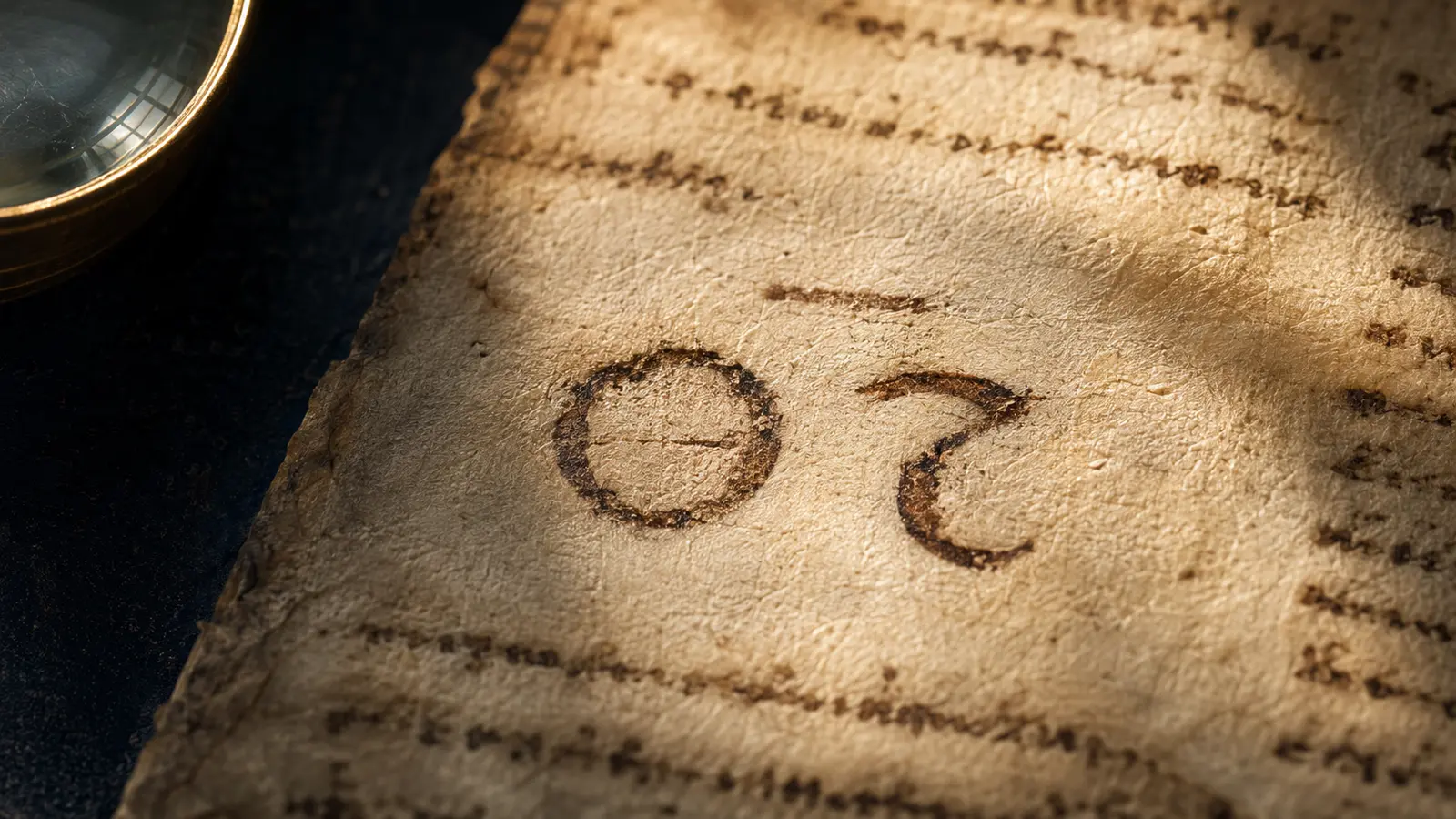
This is Part 3 of “The Line That Vanished.”
Codex Alexandrinus did not arrive in England as a modern critical apparatus. It arrived as a book: old parchment, ancient ink, and letters that had to be inspected by eye. Its earliest English readers encountered the disputed place before two centuries of controversy drew fingers, lenses, chemicals, and polemical attention to it.
That circumstance gives their testimony value. It does not make every early silence conclusive.
The distinction is essential because the earliest stage of the English record contains more reception than description. Patrick Young, Alexander Huish, John Pearson, and John Fell did not leave us a modern conservation report on the disputed letter. Their work nevertheless reveals how the manuscript was read before Mill’s 1707 edition made the fading diameter a celebrated controversy. Historical reasoning must learn to use this evidence without transforming it into something it is not.
The central proposition of this article is therefore limited: the earliest English custodians and collators consistently treated Alexandrinus as supporting θεός, and they did so before the later public dispute and severe abrasion. That creates a significant presumption in favor of the received reading. It does not supply a dated microscopic description of first-hand pigment.
The first custodians
The codex was presented to Charles I in 1627. Patrick Young, royal librarian and a competent Greek scholar, became its early custodian and collator. Later writers alleged that Young strengthened fading strokes at 1 Timothy 3:16. If so, he believed he was restoring ΘC, not inventing a reading he knew to be absent. Yet the allegation comes to us through later debate and should not be treated as a signed confession from Young.
Alexandrinus had travelled far before it entered the royal collection. Its name reflects its association with Alexandria, and its presentation to Charles I gave English scholars access to a biblical manuscript of extraordinary antiquity. That access was neither digital nor casual. A custodian handled a unique object whose text had to be read leaf by leaf, often in difficult script and without the aid of a comprehensive modern catalogue.
Young’s importance lies partly in this proximity. As an early custodian, he saw the manuscript before generations of visitors concentrated their attention upon one round letter. Later writers said that he strengthened the thin lines. The claim is plausible in an age before modern conservation ethics, when retracing a fading sacred text could be understood as preservation rather than vandalism. But plausibility is not documentation. We possess no memorandum from Young saying, “I found an original theta and renewed its diameter.” The historical case should not pretend otherwise.
The more defensible inference is narrower. If Young or another early custodian renewed the marks, the act by itself is semantically ambiguous. A restorer can preserve an existing reading; a corrector can change one. The intention must be inferred from the prior appearance, later descriptions of old and new ink, and the way early collations classified the verse.
The Alexandrian readings supplied for Brian Walton’s Polyglot in 1657 did not register a departure from θεός at the verse. John Pearson appealed to the codex in 1659, and John Fell’s 1675 edition likewise gave no Alexandrian variant there.1 These witnesses precede Mill, Berriman, and the mature controversy.
Why does that matter? A collator normally records departures from the base text. If the base text read θεός and the codex plainly read ὅς, the absence of a note is evidence that the collator did not perceive such a departure.
But it is evidence by implication.
The Walton Polyglot appeared in six volumes between 1654 and 1657 and brought together biblical texts and scholarly aids on a scale that made its apparatus influential. The Alexandrian collation associated with Huish was meant to identify readings of the newly available codex. At 1 Timothy 3:16 it did not present Alexandrinus as departing from θεός. The omission is most naturally explained if the collator read the manuscript in agreement with the printed text at that point.
Pearson’s testimony is related but rhetorically more pointed. In his exposition of the Creed, he could appeal to the verse and to manuscript evidence without treating Alexandrinus as an exception for ὅς. Fell’s Oxford Greek New Testament likewise failed to register an Alexandrian departure. Scrivener and Burgon later assembled these early notices as part of the case that ΘΣ was the recognized Alexandrian reading before the leaf was badly worn.2
These sources are not equally independent. A later editor may rely on an earlier collation; a theological writer may know the codex through reports; silence may reflect the design of an edition rather than fresh autopsy. The cumulative value therefore cannot be calculated by simply counting four names as four independent inspections. What they establish is an early pattern of reception, not four identical laboratory observations.
What silence can and cannot say
A responsible argument distinguishes three propositions:
- The early collators did not report ὅς.
- They understood Alexandrinus to support θεός.
- They personally saw every original stroke clearly and documented its condition.
The first two are supported. The third does not follow merely from silence.
Collators can overlook readings. They can depend upon an assistant. They can silently normalize a form. They can see a retraced stroke without deciding whether it is original. An argument that turns the absence of an apparatus note into a detailed eyewitness affidavit asks too much of the source.
The early reception nevertheless creates a historical presumption that cannot simply be erased. Alexandrinus was not first identified with θεός after the disputed strokes became notorious. It was treated that way from the earliest period of its English custody.
The logic of collational silence can be expressed without inflating it. Let the editor’s base text read θεός. A collator’s task is to record differences in the manuscript. If he sees a clear ΟC and works accurately, he should report a difference. His failure to report one makes it more probable that he did not see a clear ΟC. Yet the probability is conditional upon the completeness of the collation, the competence of the collator, the transmission of his notes, and the editorial policy governing publication.
Silence is strongest when a source had both reason and opportunity to speak. It is weaker when the document is selective or derivative. That is why a direct statement—“I saw the old line under magnification”—is evidentially different from the absence of a variant in an apparatus. Historical writing should preserve that difference even when both kinds of evidence point toward the same conclusion.
The same rule should be applied symmetrically. If an early collation omitted θεός from its report, that would not by itself prove that the manuscript visibly read ὅς. If a modern apparatus places A* beside ὅς, that notation does not become an eyewitness statement merely because it is explicit. The genre and source of every claim matter.
This careful grading avoids two opposite errors. The first dismisses silence as worthless, as though a collator’s failure to record a conspicuous variant conveyed no information at all. The second treats silence as a detailed sworn deposition. Between them lies ordinary historical reasoning: the absence of an expected report is evidence, but evidence of limited type and weight.
Was the reading already retraced?
The possibility of early retracing introduces a harder question. Suppose Huish and the other early readers saw a clear ΘC because Young had already renewed it. Would their agreement then tell us nothing about the first hand?
It would tell us less than a pristine pre-restoration inspection, but not nothing. A conspicuous new diameter and overbar could be read as a correction, a restoration, or merely the form present on the page. Unless the collator distinguished ink layers, his lexical report cannot decide which. The later observers’ claim that fine older traces survived at the edges is therefore indispensable: it supplies the proposed link between the restored form and the first hand.
The early record and the later autopsies perform different work. Early reception shows that Alexandrinus entered English scholarship as a θεός witness. Mill and Berriman later claimed to see why: beneath or beside the heavier marks lay remnants of an older diameter. If either strand is isolated, the case is weaker. Together they form a chronological argument: received as theta, described as containing an old fading trace, and later worn until the trace could no longer be confidently seen.
The rival history is equally intelligible. On that account, the first hand wrote ΟC; an early custodian supplied the diameter and bar; early collators reported the corrected visible form; and Mill and Berriman misidentified show-through or the margins of the correction as original trace. The question between these narratives cannot be answered by invoking early reception alone. It must await the described inspections.
Wotton’s more explicit argument
Henry Wotton’s 1718 discussion moves beyond silence. Responding to Wettstein’s early inspection, Wotton argued that Alexandrinus had always read ΘC despite Patrick Young’s later strengthening of both relevant strokes.3 On the restorative reading of the evidence, this explains the mixed appearance: older faint ink at the extremities, heavier restoration across the middle.
Wotton’s reconstruction may be challenged, but it addresses the material facts rather than ignoring them. It also shows that the restoration hypothesis was not invented by nineteenth-century defenders of the Textus Receptus. It was in circulation while men who knew the first custodial generation were still comparatively close to it.
Wotton wrote after Mill had published his changed judgment and near the time of Wettstein’s first encounter with the codex. His argument belongs to an eighteenth-century conversation, not to a late reaction against Westcott and Hort. This chronological location matters. It refutes the suggestion that “restoration rather than correction” was invented only after modern critical editions had classified A* as ὅς.
It does not, however, free Wotton from polemical interest. The verse was already doctrinally charged. Writers knew that θεός gave an explicit incarnation confession and that the alternative relative reading weakened that explicitness. Wotton’s theological commitments may have sharpened his attention to evidence favoring theta. The same possibility applies to critics attracted to the harder relative reading. Bias is not a solvent that dissolves testimony; it is a circumstance that calls for corroboration and exact quotation.
Wotton is valuable because he states an explanatory model. He does not merely cite the codex for θεός. He acknowledges later strengthening and argues that it renewed an earlier form. That model can be tested against Mill’s account, Berriman’s glass-and-sunlight inspection, and Wettstein’s later appeal to the verso epsilon.
A page already becoming evidence
The history before 1707 establishes four modest but important points:
- the codex was received in England as supporting θεός;
- early collations did not advertise ὅς as an Alexandrian variant;
- later tradition associated Patrick Young with the strengthening of fading marks;
- the restoration explanation was articulated early, before the leaf reached its later state of wear.
None of this proves the original fifth-century ink by itself. It sets the stage for the stronger evidence that follows: observers who described what they saw.
By 1707 the page was no longer simply a carrier of the biblical text. It had become evidence in a controversy about the biblical text. That change in social use affected its material history. Scholars sought the disputed letter, brought it to light, viewed it through lenses, touched or held the leaf, and argued about what they saw. Griesbach would later report that curious hands had worn the place so badly that certainty was impossible.
This does not mean the early record is pure while the later record is corrupted. Early custodians could retrace; later observers could describe with greater precision. It means that the history of observation is also a history of intervention. The manuscript did not stand outside the argument.
The chronological sequence therefore has evidential shape:
- before public controversy, the codex is collated and received as θεός;
- as controversy begins, scholars distinguish older fine marks from heavier renewed ones;
- rival explanations develop for the fine appearance;
- repeated inspection contributes to physical loss;
- later editions summarize the damaged artifact through first-hand and corrector sigla.
A responsible apparatus may still conclude that the first hand wrote ΟC. But it should be understood as adjudicating this sequence, not simply reading an untouched fifth-century word.
Why honesty strengthens the received reading
Confessional defense is not helped by inflating weak evidence. If every silence becomes an eyewitness, an opponent can discredit the entire case by exposing one category mistake. The better method is cumulative.
Early collational reception is one strand. Direct physical inspection is another. Canonical coherence is another. The public and ecclesiastical reception of θεός is another. Each should bear its proper weight.
The earliest English history of Alexandrinus does not allow us to say, “We have a microscopic report from 1657.” It does allow us to say, “Before the famous line was publicly debated and progressively abraded, the codex was consistently received as a witness to θεός.”
That is not everything. It is not nothing. And it is precisely the kind of historical fact that disappears when an apparatus compresses two centuries into A* and Aᶜ.
The confessional use of this history should be ministerial. It does not ask early collators to create the authority of the received text. It asks what their work reveals about a manuscript later enlisted against that text. If the evidence is indirect, it should be called indirect. If a later report mediates an earlier inspection, the chain should be named. Such candor prevents the historical case from becoming a collection of inherited assertions.
The “market rule” applies here as well: an article should provide the reader with a real argumentative gain rather than repeating the series thesis in new language. The gain of this installment is an evidence classification. Young and the early English scholars establish prior reception. Wotton supplies an early restorative explanation. Neither category can replace the direct inspections that follow.
This classification also makes the next article possible. Mill and Berriman did not encounter a neutral page without history. They encountered a manuscript already read as θεός and apparently already retouched. Their special contribution was to say that a finer, older trace remained. If their observation is credible, the early reception receives a material foundation. If it is mistaken, the rival reconstruction gains force.
The early record also fixes the burden of historical explanation. A writer who assigns A’s first hand to ΟC must explain why the manuscript entered English collation as ΘC and why the restorative account appeared so early. The answer may be that a correction preceded all English witnesses and controlled their reports. That is coherent, but it is an argument, not a fact supplied by the siglum. Stating the burden this way keeps the debate at the level of dated evidence.
The case now moves from silence to sight.
- Scrivener, Plain Introduction, discussion of 1 Timothy 3:16; Burgon, Revision Revised, same discussion. Both assemble the early English collational record. ↩
- Scrivener, Plain Introduction, 2:390–95; Burgon, Revision Revised, 432–37 in the 1883 pagination. Burgon’s rhetoric should be distinguished from the underlying early collational facts he cites. ↩
- Castelli, Wettstein’s Principles, 113–16, for Wotton’s 1718 response and the early dispute. ↩
Comments
Share a question or response to this article.