

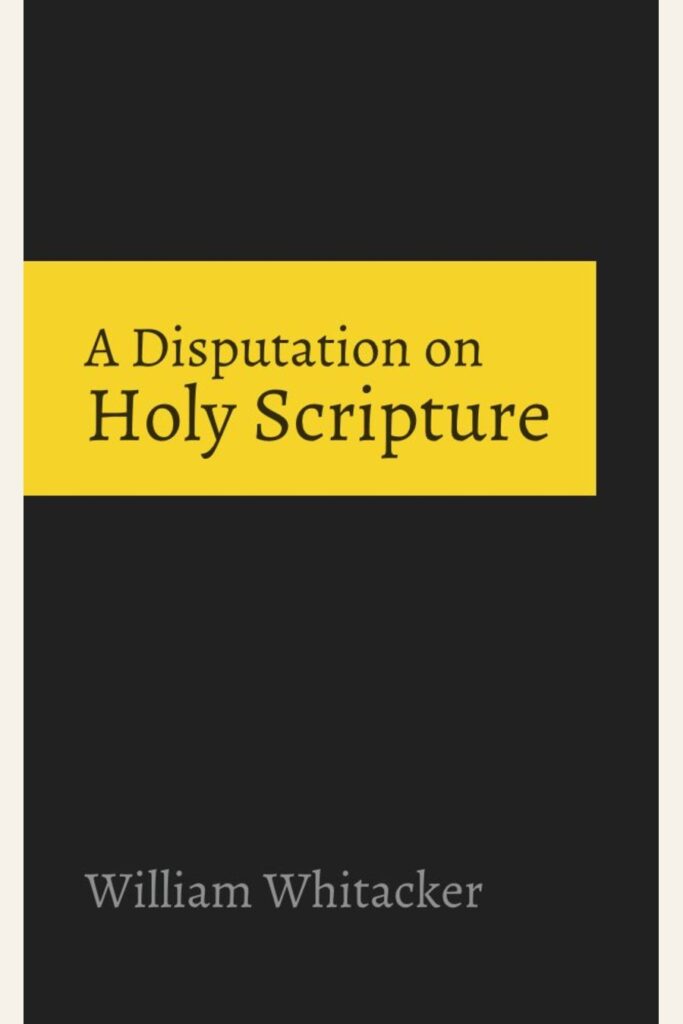
Titus Books digital edition of Fitzgerald’s English translation
A Disputation on Holy Scripture
Against the Papists, Especially Bellarmine and Stapleton
William Whitaker; translated by William Fitzgerald · 2013
William Whitaker, A Disputation on Holy Scripture, trans. William Fitzgerald; Titus Books digital edition, 2013.
Overview
Whitaker’s classic Reformation disputation answers Roman arguments on canon, authentic editions, authority, perspicuity, interpretation, and traditions. His central claims are that Scripture’s authority does not arise from the church, that Hebrew and Greek originals must not be confused with translations, and that the church’s office is ministerial and testimonial.
The work supplies a grammar for Protestant bibliology rather than a modern textual apparatus. Its early-modern polemic, patristic citations, and particular historical judgments require source control, but it remains a foundational primary source for understanding the Reformed doctrine of Scripture against Roman claims of ecclesiastical authorization.
Overview
Whitaker’s classic Reformation disputation answers Roman arguments on canon, authentic editions, authority, perspicuity, interpretation, and traditions. His central claims are that Scripture’s authority does not arise from the church, that Hebrew and Greek originals must not be confused with translations, and that the church’s office is ministerial and testimonial.
The work supplies a grammar for Protestant bibliology rather than a modern textual apparatus. Its early-modern polemic, patristic citations, and particular historical judgments require source control, but it remains a foundational primary source for understanding the Reformed doctrine of Scripture against Roman claims of ecclesiastical authorization.
Editorial Evaluation
Purpose Fulfillment
Does the work accomplish what it claims to accomplish?
Brief assessment
Whitaker directly and comprehensively fulfills the announced Protestant disputation against Roman claims concerning Scripture.
Full rationale and supporting references
Purpose Fulfillment: Whitaker directly and comprehensively fulfills the announced Protestant disputation against Roman claims concerning Scripture. This is a source-controlled preliminary editorial rating. It evaluates the supplied edition and the stated source loci, not the author’s motives and not every possible edition or response. Evidence reviewed: Supplied Titus Books edition, especially Disputations I–VI; II.1–18, III.1–11, V.8–13, and VI.1–17.
Editorial Evaluation
Source Quality
Does it use the appropriate primary and secondary sources?
Brief assessment
He ranges across Scripture, Fathers, councils, Roman controversialists, and early-modern scholarship, while his citations require modern source checking.
Full rationale and supporting references
Source Quality: He ranges across Scripture, Fathers, councils, Roman controversialists, and early-modern scholarship, while his citations require modern source checking. This is a source-controlled preliminary editorial rating. It evaluates the supplied edition and the stated source loci, not the author’s motives and not every possible edition or response. Evidence reviewed: Supplied Titus Books edition, especially Disputations I–VI; II.1–18, III.1–11, V.8–13, and VI.1–17.
Editorial Evaluation
Citation Accuracy
Are quotations, references, and claims verifiable and in context?
Brief assessment
The treatise identifies authorities extensively, though historical editions and patristic attributions must be verified rather than assumed.
Full rationale and supporting references
Citation Accuracy: The treatise identifies authorities extensively, though historical editions and patristic attributions must be verified rather than assumed. This is a source-controlled preliminary editorial rating. It evaluates the supplied edition and the stated source loci, not the author’s motives and not every possible edition or response. Evidence reviewed: Supplied Titus Books edition, especially Disputations I–VI; II.1–18, III.1–11, V.8–13, and VI.1–17.
Editorial Evaluation
Evidence Coverage
Does it address the relevant evidence, including contrary evidence?
Brief assessment
Its theological and historical case is broad, but its form is a controversy rather than a neutral history of every position.
Full rationale and supporting references
Evidence Coverage: Its theological and historical case is broad, but its form is a controversy rather than a neutral history of every position. This is a source-controlled preliminary editorial rating. It evaluates the supplied edition and the stated source loci, not the author’s motives and not every possible edition or response. Evidence reviewed: Supplied Titus Books edition, especially Disputations I–VI; II.1–18, III.1–11, V.8–13, and VI.1–17.
Editorial Evaluation
Historical Accuracy
Are people, dates, editions, events, and settings handled correctly?
Brief assessment
The work is a first-rate primary witness to the Reformation debate, though particular historical claims reflect its polemical context.
Full rationale and supporting references
Historical Accuracy: The work is a first-rate primary witness to the Reformation debate, though particular historical claims reflect its polemical context. This is a source-controlled preliminary editorial rating. It evaluates the supplied edition and the stated source loci, not the author’s motives and not every possible edition or response. Evidence reviewed: Supplied Titus Books edition, especially Disputations I–VI; II.1–18, III.1–11, V.8–13, and VI.1–17.
Editorial Evaluation
Subject Competence
Does the author demonstrate competence in the relevant disciplines?
Brief assessment
Whitaker displays exceptional command of Reformation-era theology, Scripture, and controversial method.
Full rationale and supporting references
Subject Competence: Whitaker displays exceptional command of Reformation-era theology, Scripture, and controversial method. This is a source-controlled preliminary editorial rating. It evaluates the supplied edition and the stated source loci, not the author’s motives and not every possible edition or response. Evidence reviewed: Supplied Titus Books edition, especially Disputations I–VI; II.1–18, III.1–11, V.8–13, and VI.1–17.
Editorial Evaluation
Logical Coherence
Do the conclusions follow from the premises and evidence?
Brief assessment
The distinction between divine authority and ministerial ecclesiastical testimony is repeatedly and coherently maintained.
Full rationale and supporting references
Logical Coherence: The distinction between divine authority and ministerial ecclesiastical testimony is repeatedly and coherently maintained. This is a source-controlled preliminary editorial rating. It evaluates the supplied edition and the stated source loci, not the author’s motives and not every possible edition or response. Evidence reviewed: Supplied Titus Books edition, especially Disputations I–VI; II.1–18, III.1–11, V.8–13, and VI.1–17.
Editorial Evaluation
Methodological Transparency
Are the method and controlling assumptions identifiable and consistent?
Brief assessment
The six-disputation structure and explicit states of question make the method unusually visible.
Full rationale and supporting references
Methodological Transparency: The six-disputation structure and explicit states of question make the method unusually visible. This is a source-controlled preliminary editorial rating. It evaluates the supplied edition and the stated source loci, not the author’s motives and not every possible edition or response. Evidence reviewed: Supplied Titus Books edition, especially Disputations I–VI; II.1–18, III.1–11, V.8–13, and VI.1–17.
Editorial Evaluation
Strongest-Form Engagement
Does the work address the strongest opposing case rather than a caricature?
Brief assessment
Whitaker regularly presents and answers Roman arguments, though later Catholic scholarship requires separate engagement.
Full rationale and supporting references
Strongest-Form Engagement: Whitaker regularly presents and answers Roman arguments, though later Catholic scholarship requires separate engagement. This is a source-controlled preliminary editorial rating. It evaluates the supplied edition and the stated source loci, not the author’s motives and not every possible edition or response. Evidence reviewed: Supplied Titus Books edition, especially Disputations I–VI; II.1–18, III.1–11, V.8–13, and VI.1–17.
Editorial Evaluation
Clarity and Research Usefulness
Is it intelligible, navigable, and useful for further study?
Brief assessment
It is indispensable for historic Reformed bibliology when read with source verification and historical context.
Full rationale and supporting references
Clarity and Research Usefulness: It is indispensable for historic Reformed bibliology when read with source verification and historical context. This is a source-controlled preliminary editorial rating. It evaluates the supplied edition and the stated source loci, not the author’s motives and not every possible edition or response. Evidence reviewed: Supplied Titus Books edition, especially Disputations I–VI; II.1–18, III.1–11, V.8–13, and VI.1–17.
Scripture Passage Coverage
2 Timothy 3:16
Substantial treatment · Disputation III
Defends the readingCentral to Scripture’s divine authority.
John 10:35
Substantial treatment · Disputation III
Defends the readingUsed for Scripture’s inviolability.
Matthew 5:18
Brief treatment · Disputation III
Defends the readingUsed in arguments on permanence and authority.
Romans 3:2
Substantial treatment · Disputation II
Defends the readingUsed in discussing the Hebrew oracles.