

This is Part 7 of “The Line That Vanished.”
Can the critical reading ὅς have arisen because ink faded?
Yes. That is a physically simple and historically grounded possibility.
Can we prove that every manuscript reading ὅς descends from one faded theta?
No. The evidence does not carry us that far.
The distinction between those answers is the difference between an argument and a slogan.
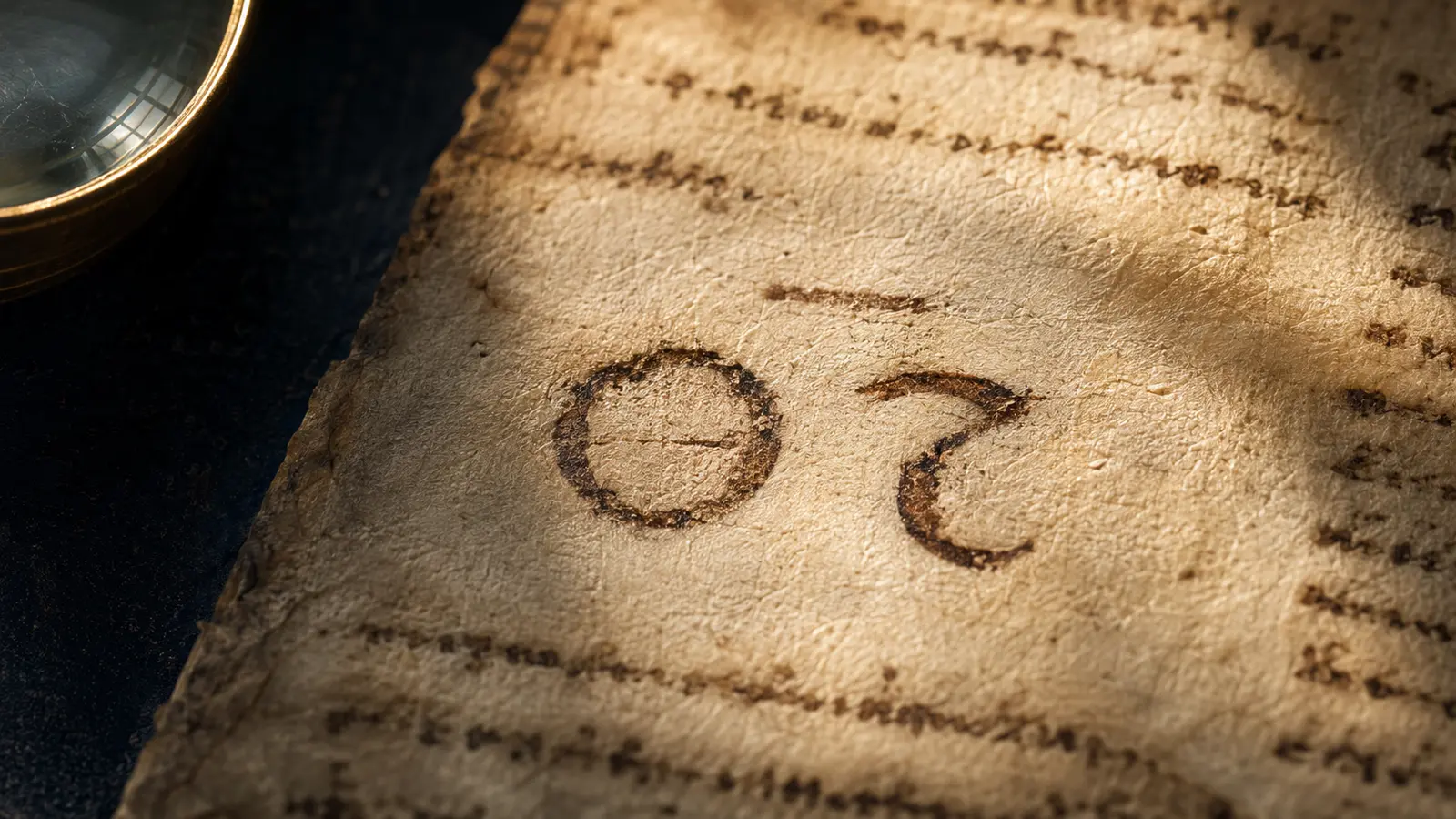
The temptation to move from the first answer to the second is understandable. Alexandrinus supplies a vivid model: a contracted ΘC can become visually ΟC when the transverse stroke and upper bar fail. Once that process is seen, it can appear to explain the entire relative-pronoun tradition at a stroke. But a mechanism and a genealogy are different things. A mechanism states what can happen; a genealogy identifies what did happen in the ancestry of particular witnesses.
This article will defend the mechanism strongly and the universal genealogy not at all. That restraint does not weaken the received reading. It prevents a credible physical explanation from being burdened with a historical claim the surviving manuscripts cannot prove.
The immediate problem and the genealogical problem
Two questions are often blended:
- What did Alexandrinus originally read?
- How did ὅς enter the wider manuscript tradition?
In Alexandrinus, the question is immediate and material. Was its darker theta-stroke an alteration of original ΟC, or a restoration of a fading ΘC?
Across the tradition, the question is genealogical. Could a scribe copying another manuscript have encountered a sacred contraction whose decisive strokes had faded and therefore copied ΟC?
The Alexandrinus controversy makes the second process credible because it documents the very ambiguity the process requires. A reader first sees omicron; closer inspection reveals a remnant; still later the remnant disappears. If that can happen under the eyes of modern scholars, it could happen under the eyes of an ancient copyist.
The immediate question about A can, in principle, be answered through examination of one artifact and the record of its condition. The wider genealogical question requires relations among many artifacts, versions, citations, and reconstructed ancestors. It therefore bears a heavier burden.
Suppose an imaging study established tomorrow that Alexandrinus originally contained ΘC. That result would strengthen the early external support for θεός and confirm the fading mechanism at this verse. It would not prove that the ΟC in Sinaiticus was copied from a faded theta. The two codices could descend from different exemplars, and the relative reading could have arisen through another visual or editorial event.
Conversely, suppose imaging established that Alexandrinus originally contained ΟC and that every apparent old line is verso show-through. The physical mechanism would remain possible in other manuscripts because ΘC and ΟC still differ by small strokes. What would disappear is the strongest documented instance of that mechanism operating at the disputed location.
Keeping the questions distinct allows new evidence to change the appropriate conclusion without collapsing the whole case.
A simple transmissional sequence
The pathway needs no elaborate theory:
- An exemplar contains ΘC with a fine internal stroke and overbar.
- One or both small strokes fade, flake, or become obscured.
- A copyist reads the remaining ΟC as the relative pronoun ὅς.
- A later copyist finds the masculine relative grammatically abrupt after the neuter μυστήριον, “mystery.”
- Some witnesses regularize the form to the neuter ὅ, “which.”
This sequence explains all three principal readings by ordinary visual and grammatical processes. It does not require a copyist to deny Christ’s deity. It requires him to copy what he can see and, at a later stage, to smooth what he finds.
Stephen W. Frary, though not arguing from a received-text premise, recognizes the transmissional viability of defective or faded strokes and concludes that the internal evidence is less decisive than confident appeals to a hymn fragment often suggest.1
Each step deserves qualification. The exemplar in step one need not be Alexandrinus itself. It could be any earlier manuscript employing the same sacred contraction. The loss in step two could involve fading, abrasion, incomplete pen contact, flaking, or damage to the supralinear bar. The copyist in step three need not notice ambiguity; ΟC may simply be what the remaining marks present.
The transition from ὅς to ὅ is different in kind. It is not primarily the loss of a stroke within a letter but a grammatical regularization. The preceding noun μυστήριον is neuter, while ὅς is masculine. A copyist could alter the relative to the neuter ὅ so that it agrees formally with “mystery.” The resulting clauses still describe personal actions, making the reading exegetically awkward, but the local agreement becomes smoother.
This sequence has explanatory economy because it uses familiar scribal behaviors: visual misreading and grammatical correction. It does not require an organized doctrinal conspiracy. It also accounts for direction. A full lexical subject is reduced to a masculine relative through damaged graphics; the masculine relative is then reduced to a neuter relative through syntactic pressure.
Yet explanatory economy does not prove historical occurrence. Several sequences can explain the same extant forms. A critic may begin with ὅς, derive ὅ through grammatical attraction, and derive θεός through doctrinal or syntactic clarification. The task is to compare total explanatory power, not merely to identify one plausible path.
How much ink must disappear?
Popular accounts sometimes speak as though an entire word must vanish. The contraction makes the actual loss smaller. If ΘC is clearly written with its upper bar, a copyist sees “God.” If the diameter becomes weak but the bar survives, the bar may still signal that a sacred contraction was intended even though the first letter resembles omicron. If both small strokes fail, ΟC appears complete as a pronoun.
The failure need not be uniform. An internal line may survive only at the left circumference, precisely the kind of remnant Mill and Berriman described. A bar may be broken or confused with a mark from another line. Parchment fibers can interrupt thin strokes. The copyist’s distance, light, eyesight, speed, and familiarity with the exemplar all influence what is perceived.
An ancient scribe was not performing forensic reconstruction. His task was to produce a new copy. Where the exemplar presented a familiar grammatical word, he might copy it without pausing to search for nearly vanished pigment. The same uncertainty that drew generations of scholars to Alexandrinus could pass unnoticed in routine transcription.
This makes fading a credible source of error even if the scribe was careful. It explains the reading without assuming theological hostility or unusual incompetence. The most dangerous errors are often those in which damaged marks yield another real and contextually possible word.
The reverse pathway
Fairness requires the rival sequence:
- An exemplar contains ΟC, “who.”
- A copyist or corrector finds the construction unusual or wishes to make the subject explicit.
- He adds the internal line and sacred overbar.
- ΟC becomes ΘC, “God.”
This process is equally easy at the level of pen strokes. It can be described as grammatical clarification, liturgical expansion, or doctrinal strengthening.
The physical ease of alteration therefore does not decide direction. Direction must be inferred from the distribution of readings, early citations and versions, the condition of particular manuscripts, scribal tendencies, grammar, and reception.
The reverse pathway may be described without accusing the corrector of fraud. A reader facing “the mystery of godliness, who was manifested” may believe that the masculine relative lacks an antecedent or that the intended subject has been damaged. Adding a diameter and bar could be a conjectural restoration prompted by context and tradition. Even if the first hand had written ΟC, the corrector might sincerely believe he was repairing an error.
Doctrinal motive is also possible. Because θεός states Christ’s deity explicitly, an orthodox scribe or corrector might prefer it. But possibility is not evidence of a particular act. The same theological context can produce conservative resistance to changing a received θεός or suspicious removal of an explicit reading. Motive arguments are weak unless connected to a hand, correction pattern, or historical circumstance.
The paleographical symmetry is one reason simple versions of lectio difficilior do not settle the verse. Critics may say that the harder ὅς was likely altered into the smoother and more orthodox θεός. Defenders may answer that contracted θεός was likely damaged into ΟC and then grammatically repaired. Both invoke common transmissional forces. Internal evidence must be argued, not announced.
Sinaiticus must be allowed to testify
Codex Sinaiticus reads ὅς. That fact should be stated without evasion. Its letters are not the same disputed and retraced marks as Alexandrinus. A defense that insists Sinaiticus visibly says θεός destroys its credibility.
The fading-exemplar hypothesis instead asks how the Sinaiticus reading, or an ancestor of it, may have arisen. That is a possible genealogy, not an autoptic claim about Sinaiticus itself.
Sinaiticus proves that ὅς is ancient. It does not prove that ὅς is original. An early error is still early; an early correction is still a correction. Age is an important feature of evidence, not an oracle.
The fourth-century date places an upper bound on the presence of the relative reading in that line of transmission. It does not date the first occurrence. The reading could be older than Sinaiticus by many generations. That antiquity gives it real evidential weight and prevents a facile late-corruption narrative.
At the same time, textual age and textual correctness are not identical properties. Every early manuscript contains scribal errors, and every later manuscript may preserve early readings. The comparison must ask how witnesses relate, whether their support is independent, and which reading best accounts for the others.
Confessional argument is damaged when it treats candor about Sinaiticus as surrender. The received-text case does not rest on denying visible ink. It rests on a doctrine of preservation joined to the public transmission and on a ministerial evaluation of the evidence. That evaluation can acknowledge an early rival without granting it magisterial authority.
The same candor should govern patristic and versional evidence. A father’s phrase “who was manifested” may be a loose reference rather than an exact quotation; a version may require a grammatical form not identical to the Greek; a citation of “God was manifested” may reflect the text or the writer’s paraphrase. Each witness must be assessed in its own linguistic and literary setting.
External evidence is not a single number
Modern critical discussions often emphasize the age and diversity of witnesses for ὅς. The received reading θεός dominates the later Greek tradition and is represented in ancient witnesses, corrections, versions, and patristic use, though the interpretation of individual early witnesses is disputed.
The question cannot be settled by saying either “the oldest manuscripts” or “the majority” as though one phrase performs the analysis. A manuscript’s age, ancestry, correctness, material condition, and relation to other witnesses are different considerations.
Alexandrinus matters unusually because its classification sits near the center of the external argument. If A originally read ΘC, the early Greek evidence for θεός is stronger than a modern apparatus that assigns A* to ὅς suggests. If it originally read ΟC, it joins Sinaiticus as a major early witness for ὅς. That is why the disappearing line bears so much argumentative weight.
The numerical predominance of θεός in the later Greek manuscript tradition is not a trivial datum. It reveals the reading received and copied across the Byzantine church. The antiquity of ὅς in Sinaiticus and in other evidence is likewise not a trivial datum. A sound judgment must resist the reduction of either fact to a slogan.
“Oldest” can conceal genealogical dependence. Several old witnesses may descend from a shared erroneous ancestor. “Majority” can conceal the multiplication of one branch. These cautions do not abolish age or number; they explain why both require interpretation.
The received-text position adds ecclesiastical reception and providence to the inquiry. That addition must be stated correctly. Providence is not an invisible manuscript cited to fill every external gap. It is God’s governance of the church’s reception and use of Scripture through ordinary means. The confessional conclusion concerns the authentic text given to and kept by the church; it does not transform every proposed scribal history into an article of faith.
Thus one may believe θεός to be the preserved reading while judging the fading origin of every ΟC unproved. The doctrinal conclusion does not borrow the missing genealogical premise.
The exact claim
The fading hypothesis should be stated in a form that can survive scrutiny:
The loss of the transverse and supralinear strokes in a sacred contraction is a demonstrated mechanism capable of producing the visual form ΟC. The documented deterioration of Alexandrinus shows that this mechanism is historically real at the disputed verse. It is therefore a credible explanation for some part of the transmission of ὅς, although the surviving evidence does not prove that every ὅς witness shares that origin.
- Stephen W. Frary, “‘Who Was Manifested in the Flesh?’ A Consideration of Internal Evidence in Support of a Variant in 1 Tim 3:16a,” Filología Neotestamentaria 16 (2003): 3–18, https://www.bsw.org/filologia-neotestamentaria/vol-16-2003/who-was-manifested-in-the-flesh-a-consideration-of-internal-evidence-in-support-of-a-variant-in-1-tim-3-16a/395/article-p6.html. ↩
That conclusion is less spectacular than a universal assertion. It is also much harder to refute.
“Who” may begin with faded ink. Alexandrinus shows us how. What it does not give us is permission to replace critical dogmatism with our own.
The exact claim has four components:
- Graphic capacity: ΘC can become visually ΟC through loss of small strokes.
- Historical exemplification: observers of Alexandrinus reported deterioration consistent with that loss.
- Transmissional plausibility: an ancient copyist could reproduce the visible ΟC without perceiving the failed contraction.
- Genealogical restraint: no surviving evidence identifies that process as the origin of every relative-reading witness.
Removing any component distorts the argument. Without graphic capacity, fading is fantasy. Without historical exemplification, it is merely abstract. Without transmissional plausibility, it does not explain copying. Without genealogical restraint, it becomes an unfalsifiable universal story.
This proportionate form also answers the strongest objection fairly. A critic may reject the Alexandrinus old-trace reports and still grant the graphic capacity. He may accept the capacity and judge the external evidence for ὅς stronger. The dispute then occurs at identifiable premises. That is preferable to a clash of totalizing claims in which each side accuses the other of denying what is “obvious.”
The distinction has a practical editorial consequence. The series should never illustrate a photograph of Sinaiticus with an added faded diameter, because that would visually assert a genealogy the argument has not proved. Nor should it label every ΟC as “damaged ΘC.” The one shared image may symbolize the mechanism, but its caption must identify it as illustration. Evidence and explanatory model must remain visibly separate.
The article’s gain is therefore not a verdict about every manuscript. It is a disciplined possibility with direct relevance to internal and external evidence. The next article will examine why the physical vulnerability existed in the first place: Christian scribes chose to contract sacred names, saving space while marking reverence, and the convention sometimes entered settings that a Reformed theology must call superstitious.
- Stephen W. Frary, “‘Who Was Manifested in the Flesh?’ A Consideration of Internal Evidence in Support of a Variant in 1 Tim 3:16a,” Filología Neotestamentaria 16 (2003): 3–18, https://www.bsw.org/filologia-neotestamentaria/vol-16-2003/who-was-manifested-in-the-flesh-a-consideration-of-internal-evidence-in-support-of-a-variant-in-1-tim-3-16a/395/article-p6.html. ↩
Comments
Share a question or response to this article.