

Revision note: Substantially revised July 20, 2026. The argument has been reordered according to the classical rhetorical movement, compressed where necessary, and given one consolidated Notes and Further Reading section.
Holy Scripture as the Supreme External Principle of Theological Knowledge
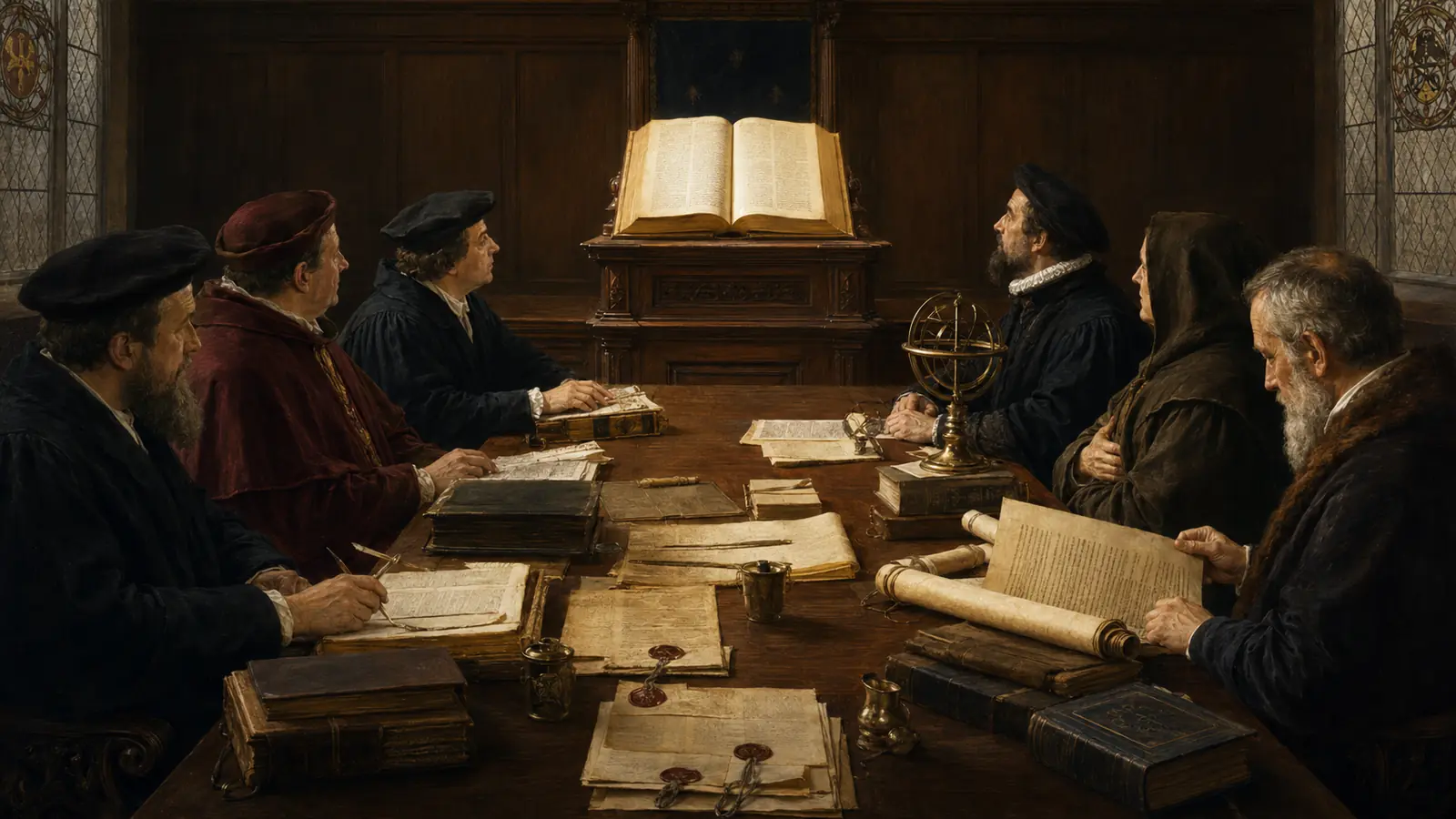
Thesis 2: Holy Scripture is the principium cognoscendi externum, the supreme external principle by which God makes himself and his saving will known to the church. Scripture is not one religious authority among several coordinate authorities. It is the divinely appointed rule by which traditions, councils, confessions, experiences, philosophies, historical claims, and scholarly conclusions must be judged. The church does not stand over Scripture as its certifier. Scripture stands over the church as its covenant constitution and final court of appeal.
The first thesis established the triune God as the foundation of truth and knowledge. The second asks how the church receives authoritative knowledge of him.
The answer is Holy Scripture.
God reveals himself in creation, providence, and conscience. The heavens declare his glory, the world manifests his power, and the moral law is written on the human heart. Yet fallen man suppresses that truth, and general revelation does not announce the saving mysteries of Christ with the fullness required for the church’s faith.
God has therefore spoken in a special, covenantal, and redemptive manner. He spoke through prophets and apostles, caused his revelation to be written, and gave those writings to the church as its permanent rule.
Scripture does not stand beside church, tradition, reason, experience, or scholarship as one authority among peers. These may serve, summarize, interpret, defend, and apply Scripture. None may judge it from above.
The final authority is not the church speaking about Scripture. It is the Holy Ghost speaking in Scripture.
An External Word and an Internal Witness
Reformed theologians call Scripture the principium cognoscendi externum: the external principle of knowing. The phrase identifies the objective source and norm from which Christian theology receives its authoritative content.1
External does not mean lifeless or separated from God. It means that the Word comes to us from outside our minds, feelings, and religious consciousness. Scripture speaks before we agree. It judges thoughts we would keep, condemns sins we would excuse, and reveals truths we could never discover independently.
This objective Word must be distinguished from the Holy Ghost’s internal work. The Spirit illumines the mind, renews the heart, and enables believers to recognize and embrace Scripture. He does not create new doctrines within the soul. He brings the sinner to receive the revelation already given.
External Word and internal illumination must neither be divided nor confused. Word without Spirit becomes the imagined study of a dead document by unaided reason. Spirit without Word dissolves into private impressions. The Spirit who inspired Scripture is the Spirit who illumines the believer; he does not lead the church away from the Word he authored.
John Owen states the order succinctly. “Whence is all truth concerning God and ourselves to be learned?” His catechism answers, “From the holy Scripture, the Word of God.” When he asks how we know Scripture to be God’s Word, he appeals to the Spirit producing faith to embrace the heavenly majesty and clear divine truth shining in it.2
The Word possesses divine majesty and truth. The Spirit overcomes our blindness so that we receive it. He does not supply an authority Scripture lacks.
Why God Committed Revelation to Writing
God could have governed the church through an endless succession of immediate revelations. He chose instead to commit his revelation wholly to writing. Westminster says this was necessary for the better preservation and propagation of truth and for the church’s establishment and comfort against the flesh, Satan, and the world.3
Writing gives revelation a stable public form. Memory fades, oral reports change, teachers err, and institutions decay. A written covenant may be read, copied, compared, translated, preached, and appealed to across generations.
Writing also tests religious claims. A person claiming to speak for God may be examined by what God has already spoken. No private spirit is immune from the written standard. The church rests not upon a changing stream of opinion but upon an objective Word given for its faith and hope.
This inscription is not an incidental stage in religious history. It is a divinely appointed means of covenant government. The church lives beneath a written constitution.
Scripture Judges Every Rival Claim
Isaiah directs a people tempted by mediums and familiar spirits “to the law and to the testimony.” If the claimants do not speak according to this Word, “there is no light in them” (Isaiah 8:19–20).4 The contrast is not between supernatural religion and neutral reason. It concerns the source and standard of knowledge. A spiritual, ancient, or popular claim does not authenticate itself. The claim is tested by the Word; the Word is not tested by the claim.
Christ teaches the same order in the rich man’s request that Lazarus return from the dead. Abraham answers, “They have Moses and the prophets; let them hear them.” When the rich man insists that a spectacular sign would be more persuasive, the answer is decisive: “If they hear not Moses and the prophets, neither will they be persuaded, though one rose from the dead” (Luke 16:29–31).5
Christ does not despise miracles. His resurrection is central to the gospel. He exposes the supposition that unbelief is caused by a deficiency in God’s Word. Historical evidence may answer objections and expose falsehood, but it cannot improve upon God’s authority or produce faith in a heart determined not to hear him.
Paul identifies both origin and sufficiency: the sacred writings are able to make Timothy wise for salvation through faith in Christ; all Scripture is God-breathed and profitable for teaching, reproof, correction, and training, so that the man of God is complete and furnished for every good work (2 Timothy 3:15–17). Scripture does not merely introduce the church to Christ and then surrender its government. It continues to teach, reprove, correct, and furnish.
Peter likewise directs the church to the prophetic Word as a lamp shining in darkness. Prophecy did not arise from the prophet’s autonomous will; holy men spoke as they were carried by the Holy Ghost (2 Peter 1:19–21).6 A creed may summarize that Word, a sermon may expound it, and a commentary may illuminate it. None is God-breathed as Scripture is. Derived authorities remain beneath the authority from which they derive their truth.
The Supreme Judge
Westminster Confession 1.10 brings the doctrine to its judicial point:
“The supreme judge by which all controversies of religion are to be determined, and all decrees of councils, opinions of ancient writers, doctrines of men, and private spirits, are to be examined, and in whose sentence we are to rest, can be no other but the Holy Spirit speaking in the Scripture.”7
- Francis Turretin distinguishes the external and internal principles of theological knowledge in Institutes of Elenctic Theology, topic 2. For a related Reformed formulation, see Richard Muller, Post-Reformation Reformed Dogmatics, vol. 2. ↩
- John Owen, “Two Short Catechisms,” in The Works of John Owen, vol. 1, available through the Internet Archive. ↩
- Westminster Confession of Faith 1.1, Orthodox Presbyterian Church. ↩
- Isaiah 8:19–20. Compare Deuteronomy 13:1–5, where even a sign is judged by prior revelation. ↩
- Luke 16:19–31. ↩
- 2 Timothy 3:14–17 and 2 Peter 1:16–21. ↩
- Westminster Confession of Faith 1.10; compare 1.4–9 and 31.3, Orthodox Presbyterian Church. On Scripture as final judge in the Reformed orthodox tradition, see Turretin, Institutes, topic 2, questions 20–21. ↩
The judge is not the bare letter imagined apart from God, nor an inward voice operating independently of the text. The judge is the Spirit speaking in Scripture. Word and Spirit are inseparable.
The confession also names several subordinate authorities. Councils matter, but their decrees are examined. Ancient writers bear valuable testimony, but age does not create infallibility. Teachers formulate doctrine, but expertise does not place them beyond correction. Private spirits claim illumination, but conviction cannot authenticate itself.
These authorities are not useless. They are ministerial and derivative. The church may speak truly, but only God speaks with underived authority.
Subordinate Standards Are Truly Subordinate
Scripture’s supremacy does not require rejecting confessions or historical theology. Properly understood, it requires them. The church must confess the faith, teach sound doctrine, guard the deposit, and transmit truth. Creeds expose equivocation, preserve doctrinal memory, and guide instruction and discipline.
But a confession is a subordinate standard—a norm itself normed by Scripture. Scripture is the norma normans non normata, the norm that norms but is not normed by human authority; a confession is a norma normata, a norm that has been normed.
Confessional Bibliology therefore does not put Westminster above Scripture. It argues that Westminster faithfully summarizes Scripture and supplies the principal subordinate grammar for this project. The confession must be proved from the Word. Once adopted as an ecclesiastical standard, however, it should not be quietly redefined whenever its doctrine conflicts with a favored method. It may be corrected, but the correction must be made openly from Scripture.
Subordination does not mean practical irrelevance. A minister also possesses real authority, but his authority is greatest when his teaching is most demonstrably governed by the Word. His office cannot transform falsehood into truth.
The Bereans show the order. They received apostolic preaching readily and searched the Scriptures daily to see whether these things were so (Acts 17:11). Their appeal to Scripture was not rebellion against teaching but the proper response to teaching presented as God’s truth.
Sola Scriptura is therefore not solo Scriptura. Christians need teachers, creeds, commentaries, linguistic study, church history, and lawful oversight. We should not act as though the Spirit ceased assisting the church after the apostles and resumed when we personally opened a Bible. Yet the church remains witness and minister of the Word, never the source of its authority.
Reason Serves; It Does Not Reign
Scripture’s supremacy does not require irrationality. Reading itself requires language and reason. Theology properly employs logic, comparison, inference, historical investigation, and conceptual distinction.
The question is jurisdiction.
Ministerial reason receives God’s Word as its supreme norm. It draws necessary consequences, compares passages, answers objections, and corrects its errors. Magisterial reason establishes an independent criterion and permits Scripture to speak only within that criterion’s boundaries. It rejects miracles because autonomous nature allows none, prophecy because autonomous history excludes foreknowledge, morality because contemporary judgment objects, or preservation because current textual theory finds a publicly identifiable text implausible.
In each case, reason has ceased to serve revelation and has become its judge. Christianity does not command us to stop thinking. It commands every thought to obey Christ.
Textual Criticism before the Court
A textual critic compares manuscripts, versions, lectionaries, citations, and editions. He studies copying errors, scribal habits, relationships, and disputed readings. Such work can serve the church excellently.
But the discipline cannot establish the theology within which it operates. To begin by treating the biblical text as an absent object reconstructed from conflicting witnesses is already a theological position. To assume that no doctrine of preservation may restrict possible conclusions is to subordinate bibliology to critical method. If Scripture’s wording remains perpetually dependent upon changing scholarly verdicts, the critic has assumed practical authority over the authority he studies.
This does not mean every textual judgment comes from an explicit Bible verse. Scripture gives no manuscript sigla or inspired apparatus. Historical questions require historical investigation. Yet that investigation occurs within the world God reveals: Scripture tells us what his Word is, why it was written, how providence governs history, what preservation accomplishes, and what the text must do in the church.
Evidence may correct our inaccurate account of how God preserved the text. It cannot prove that God failed to do what he promised.
Is the Argument Circular?
The obvious objection asks how Scripture can be final when we must first determine which words belong to Scripture. The question often assumes a false beginning. The church did not appear before a pile of unidentified fragments. God gave writings to a covenant people, caused them to be read, copied, circulated, preached, and received, and preserved them through history. The church heard the Word long before producing a modern critical edition.
Textual questions arise within that prior possession. A local uncertainty does not make the entire textual object unknown, any more than a damaged copy of a law proves that the law never had a public identity.
Nor can ultimate circularity be avoided by transferring finality to criticism. If historical criticism must certify Scripture before Scripture speaks, what certifies historical criticism—more criticism, present consensus, autonomous reason? No finite method can establish its own final authority without appeal to what it already treats as authoritative.
Confessional Bibliology states its commitment openly: God identifies his Word; Scripture attests divine authority; the Spirit enables the church to receive it; and historical evidence serves within that relation. This is not an arbitrary claim repeating itself. It is the recognition that God’s authority cannot depend upon something more ultimate than God.
Does Disagreement Defeat Finality?
Christians disagree about Scripture, but disagreement does not abolish authority. Citizens dispute laws, judges constitutions, scientists evidence, and historians documents. The existence of disagreement proves human fallibility, not the absence of a standard.
Perspicuity does not mean that every passage is equally simple or every reader correct. It means that the things necessary for salvation are clear enough that ordinary believers, using proper means, may understand them. Controversy demonstrates the need for a final standard; it does not justify replacing Scripture with an allegedly infallible interpreter.
Make an institution final, and disputes move to the meaning of its decrees. Make scholarly consensus final, and the guild continues to disagree while consensus changes. No human authority escapes interpretation. The Reformed answer is not that interpretation disappears but that every interpreter remains accountable to the Word.
The Covenant Constitution of the Church
The church does not constitute Scripture. Scripture constitutes the church. The Word calls the church through the gospel and defines its faith, worship, government, sacraments, discipline, and mission. It identifies Christ’s officers, limits their authority, and supplies their message.
A church that places itself above Scripture denies its own constitution. Councils can err, denominations drift, seminaries adopt methods contrary to their confessions, ministers demand submission beyond their office, and scholars treat consensus as immune from theological judgment. The answer is not contempt for the church but reformation according to the Word.
Ecclesiastical authority is preserved, not diminished, when it remains inside Christ’s boundaries. A minister loses no rightful dignity by confessing that Scripture judges him. The church is safest beneath the authority it did not create.
In Whose Sentence We Rest
God has not required his people to build faith on private impressions, institutional claims, changing probabilities, or inaccessible revelation. He has caused his Word to be written and appointed it as the church’s supreme external principle of knowledge.
Tradition must be heard, councils respected, confessions maintained, reason exercised, experience examined, and historical claims investigated. Yet each remains before the same court. The final judge is neither the autonomous person, the institution, nor the guild. It is the Holy Ghost speaking in Scripture.
Confessional Bibliology therefore confesses:
God has spoken in a public and permanent Word.
That Word possesses authority because God is its author.
The church receives the Word but does not create it.
Every human authority remains subordinate to it.
In every controversy of religion, Scripture is the final court of appeal.
In its sentence the church must rest.
- Francis Turretin distinguishes the external and internal principles of theological knowledge in Institutes of Elenctic Theology, topic 2. For a related Reformed formulation, see Richard Muller, Post-Reformation Reformed Dogmatics, vol. 2. ↩
- John Owen, “Two Short Catechisms,” in The Works of John Owen, vol. 1, available through the Internet Archive. ↩
- Westminster Confession of Faith 1.1, Orthodox Presbyterian Church. ↩
- Isaiah 8:19–20. Compare Deuteronomy 13:1–5, where even a sign is judged by prior revelation. ↩
- Luke 16:19–31. ↩
- 2 Timothy 3:14–17 and 2 Peter 1:16–21. ↩
- Westminster Confession of Faith 1.10; compare 1.4–9 and 31.3, Orthodox Presbyterian Church. On Scripture as final judge in the Reformed orthodox tradition, see Turretin, Institutes, topic 2, questions 20–21. ↩
Notes and Further Reading
- Francis Turretin distinguishes the external and internal principles of theological knowledge in Institutes of Elenctic Theology, topic 2. For a related Reformed formulation, see Richard Muller, Post-Reformation Reformed Dogmatics, vol. 2. ↩
- John Owen, “Two Short Catechisms,” in The Works of John Owen, vol. 1, available through the Internet Archive. ↩
- Westminster Confession of Faith 1.1, Orthodox Presbyterian Church. ↩
- Isaiah 8:19–20. Compare Deuteronomy 13:1–5, where even a sign is judged by prior revelation. ↩
- Luke 16:19–31. ↩
- 2 Timothy 3:14–17 and 2 Peter 1:16–21. ↩
- Westminster Confession of Faith 1.10; compare 1.4–9 and 31.3, Orthodox Presbyterian Church. On Scripture as final judge in the Reformed orthodox tradition, see Turretin, Institutes, topic 2, questions 20–21. ↩
Comments
Share a question or response to this article.