

This is Part 10 of “The Line That Vanished.”
A critical apparatus is one of the most useful tools in textual study. It tells the reader, in a compact system of symbols, which witnesses editors assign to each reading. Without it, much serious comparison would be prohibitively slow.
But an apparatus is not an eyewitness.
At 1 Timothy 3:16, the distinction is decisive. When an edition assigns Alexandrinus in its first hand to ὅς and its correction to θεός, it reports an editorial reconstruction of layers of ink. It does not transport the reader to the fifth century or even to the codex’s arrival in England.
This final article is therefore not an argument against apparatuses. It is an argument against confusing map and terrain, conclusion and datum, or editorial authority and divine authority. A good apparatus makes disciplined study possible. A magisterial use of it asks the compressed notation to rule over evidence and reception without exposing the judgments by which the notation was formed.
Alexandrinus is an unusually clear test. The symbol A* looks precise. Behind it stand a retraced form, a thin leaf, verso show-through, reports of a fine old diameter, later abrasion, and observers who disagreed across two centuries. The notation may summarize a responsible conclusion. It cannot abolish the history it summarizes.
Three things that must not be collapsed
The Alexandrinus question contains three distinguishable objects:
- The present material state: what surviving ink, parchment, show-through, retracing, and damage can now be observed.
- The historical observation record: what Mill, Berriman, Wettstein, Woide, Griesbach, Scrivener, and others said at particular dates.
- The reconstructed initial reading: the editor’s judgment about what the first scribe wrote.
The third is inferred from the first two, together with broader textual evidence. It is not identical to either.
Once these categories are kept distinct, the confidence often attached to A* becomes less magisterial. The designation may be correct. It may also underweight reports of an older fading transverse stroke and interpret restorative ink as substantive correction.
A fourth category can be added: the adopted ecclesiastical text. The text read, preached, translated, confessed, and handed down in the churches has its own history and theological significance. It is not identical to the current state of one manuscript, the aggregate of all extant manuscripts, or the text printed by a committee.
The confessional dispute arises partly because modern criticism often moves from the first three categories to a reconstructed text and then presents that reconstruction as the controlling object to which ecclesiastical reception must yield. Confessional bibliology reverses the magisterial relation. Historical tools minister to the text received under providence; they do not create Scripture by probabilistic vote.
This reversal does not permit historical laziness. If a received reading lacks credible evidence, the defender must confront that fact. If a manuscript has been misdescribed, the description must be corrected. The ministerial principle governs authority, not accuracy by fiat.
At this verse, the four categories can be stated plainly. The present artifact is damaged and retraced. The historical record contains competing autoptic reports. Modern editors commonly reconstruct ΟC for the first hand. The Greek text received and overwhelmingly transmitted in the later tradition reads θεός. A responsible judgment must say how these facts relate without pretending that any one of them is all the others.
What a siglum leaves unsaid
The superscript star conventionally identifies the first hand, while later corrections are assigned other designations. Such labels are indispensable when ink layers can be distinguished. Yet the word first is inferential whenever an earlier feature has faded or been covered.
At Alexandrinus the prominent diameter and bar are later than the main letter forms. That observation supports the designation of a correction. It does not settle whether the later hand introduced the lexical reading or renewed small features already present. The apparatus must choose a model; the siglum rarely narrates the alternatives.
The siglum also leaves the date and conditions of observation unsaid. Mill’s 1707 account, Berriman’s 1741 inspection, Wettstein’s 1746 reinspection and 1751 publication, Woide’s two dates, Griesbach’s damage report, and Scrivener’s repeated examinations cannot fit beside one lemma. A reader who sees only A* may never learn that the page’s legibility changed.
This is not a fault unique to a particular edition. It is a limitation of compression. The proper response is a linked dossier, not contempt for the apparatus. Digital publication makes that disclosure easier than it was in a pocket Greek Testament.
What the series has established
The investigation has produced ten conclusions:
- Vaticanus is irrelevant as a direct witness because it lacks 1 Timothy.
- Sinaiticus is a genuine early witness to ὅς and should not be misrepresented.
- Alexandrinus is the codex at the center of the fading-stroke controversy.
- Contracted ΘC can become visually ΟC when small strokes fail.
- Early English collators consistently received Alexandrinus as supporting θεός, though their silence is indirect evidence.
- Mill and Berriman described remnants of a fine transverse stroke.
- Wettstein’s later show-through explanation is a serious objection, not a final erasure of prior observations.
- Woide, Griesbach, and Scrivener attest a page undergoing progressive abrasion and ambiguity.
- Fading supplies a credible path from θεός to ὅς, but not a demonstrated origin for every ὅς manuscript.
- Θεός is grammatically intelligible and harmonizes directly with the canonical confession of Christ as God incarnate.
These conclusions do not require contempt for textual scholarship. They require textual scholarship to remember that manuscripts have histories.
The list is cumulative, and its items carry different evidential force. The absence of the Pastorals from Vaticanus and the visible ΟC in Sinaiticus are certain facts about extant contents. The reported trace in Alexandrinus is strong historical testimony contested by an alternative explanation. The wider fading genealogy is plausible rather than proved. Canonical harmony is certain as theology but does not by itself determine the ink.
That grading prevents a common argumentative collapse. A writer may move from “fading can happen” to “fading produced every relative reading,” or from “θεός agrees with Scripture” to “therefore Alexandrinus must contain theta.” The first imports an unproved genealogy; the second imports a material conclusion from theological consistency. This series refuses both moves.
Its positive case remains substantial. The received reading is not a late form without external support, a grammatical repair with no physical explanation, or a dogmatic sentence alien to Paul. It is the overwhelmingly transmitted Greek reading, was assigned to Alexandrinus by early collators and multiple direct observers, explains the relative through a simple graphical loss, and states a doctrine native to the canon.
The principal contrary case also remains substantial. Sinaiticus reads ὅς early; versions and fathers offer complex support for relative forms; later ink visibly created or renewed the theta features in A; and Wettstein supplied a plausible show-through explanation for the supposed old trace. A fair verdict must judge comparative explanatory power, not deny the existence of the rival evidence.
The received reading and providence
Confessional bibliology does not begin with the autonomous critic standing over a heap of religious artifacts. It receives Holy Scripture as God’s Word, preserved and given to the church in his providence. That confession does not abolish collation, paleography, grammar, or history. It orders them.
The received Greek text reads θεός. The Byzantine tradition overwhelmingly transmits θεός. The Authorized Version faithfully renders it “God.” The reading is not isolated from the early record, incapable of scribal explanation, grammatically violent, or doctrinally alien. Alexandrinus, when its full observational history is heard, remains credible evidence on its behalf.
One need not claim an impossible degree of paleographic proof to retain it. Confessional judgment often operates where historical evidence is real but finite. It refuses to let a conjectured reconstruction of a damaged letter exercise a magisterium over the church’s received text.
Westminster Confession of Faith 1.8 says that the Old Testament in Hebrew and the New Testament in Greek, being immediately inspired by God and by his singular care and providence kept pure in all ages, are authentic.1 The confession does not identify authenticity with the oldest surviving parchment or with an editor’s reconstruction of an initial hand. It locates preservation in God’s providential keeping of the inspired originals through time.
That doctrine supplies the governing premise of confessional bibliology. It does not tell the paleographer what color a stroke has. It tells the church what kind of object Scripture is and where ultimate authority lies. Collation, grammar, and manuscript history are means by which the received text is studied and defended, not a court capable of making the Word more or less inspired.
The distinction between ministerial and magisterial criticism is therefore practical. Ministerial criticism asks whether a proposed reading coheres with the preserved textual tradition and uses evidence to clarify anomalies. Magisterial criticism treats the current reconstruction as the norm by which the church’s text must be continually corrected, even when the reconstruction rests on damaged and disputed artifacts.
The use of conjectured in this context should not be misunderstood. The critical reading ὅς is not a conjectural emendation without manuscript support; Sinaiticus and other witnesses attest it. The conjectural element concerns the classification of Alexandrinus’s first hand and the historical explanation of its layered marks. Precision requires that distinction.
Providence also rules out panic. If one manuscript remains ambiguous, the church is not left without Scripture. The reading θεός stands in the received Greek text and the broad Greek tradition and has been confessed in translation. Alexandrinus is important because it affects the account of early evidence, not because the Word of God hangs from one failing fiber.
What must not be claimed
The defense is strongest when it refuses four exaggerations:
- Do not say Vaticanus reads θεός at this verse; it has no verse.
- Do not say Sinaiticus visibly reads θεός; its first hand reads ὅς.
- Do not say fading is proved as the cause of every ὅς witness; it is a credible mechanism.
- Do not say the earliest nomina sacra were proved to be magical; their origin is best explained as reverential, though the convention can become superstitious and did enter amuletic settings.
These concessions do not surrender the case. They remove its vulnerable overstatements.
Four positive rules correspond to the four prohibitions:
- Identify the manuscript before invoking its age.
- Describe visible rival readings honestly.
- Grade transmissional explanations by evidential force.
- Distinguish historical motive from theological judgment.
These rules make the series reusable beyond 1 Timothy 3:16. Every textual dossier should separate artifact, observation, reconstruction, and doctrinal entailment. A method that works only when the evidence favors one reading is not a method.
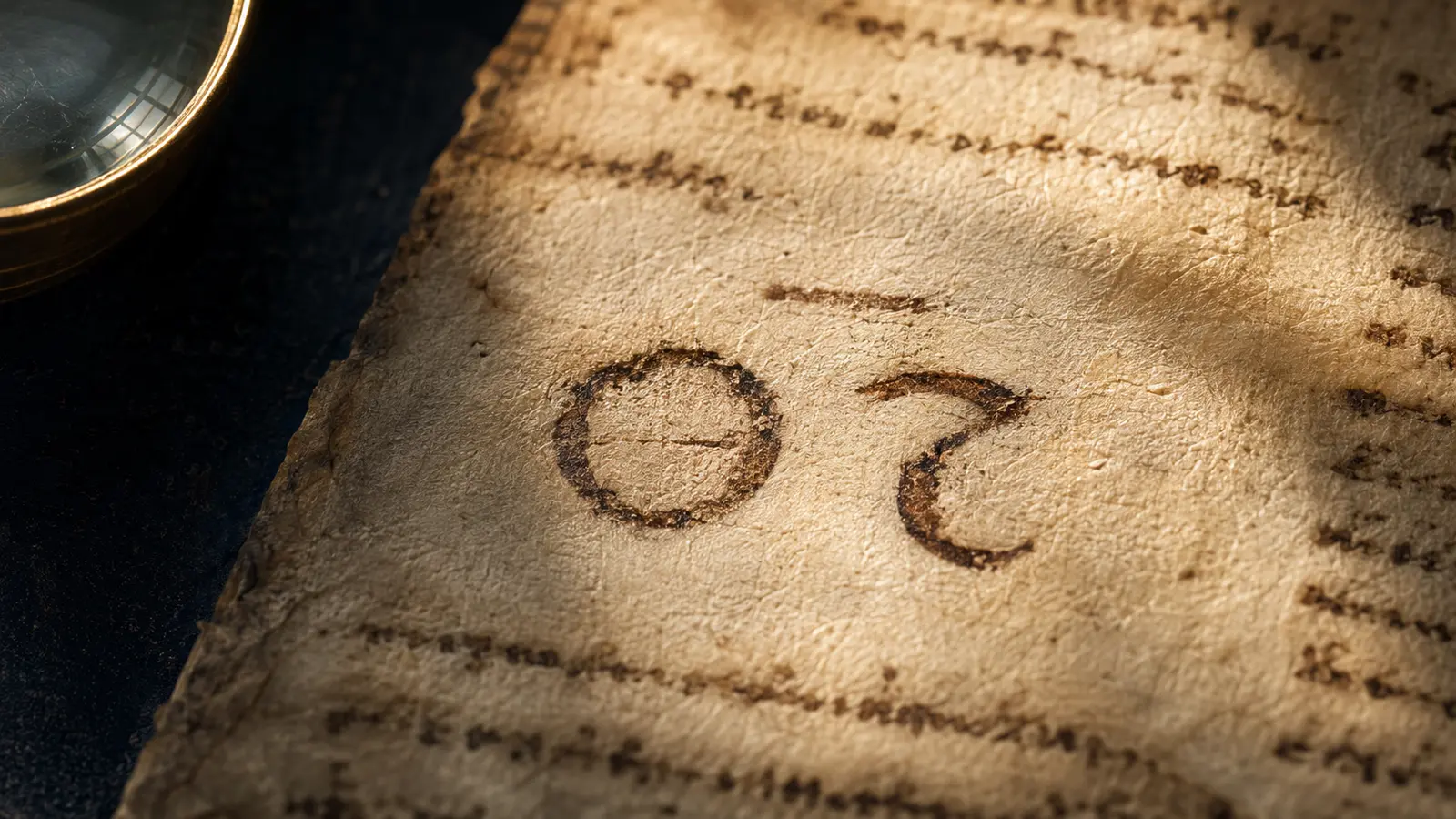
The rules also protect readers from visual manipulation. The shared series image is explicitly an editorial illustration. It may depict a fading diameter under a lens, but it must not be captioned as the disputed original stroke in Alexandrinus. The actual manuscript image, when used for evidence, requires its own provenance and an honest statement about what the reproduction can show.
A verdict proportionate to the evidence
What, then, should be said of the modern critical preference for ὅς?
It is possible. It has substantial early support. It is not the brute deliverance of an untouched Alexandrinus, and it is not compelled by an uncontested internal canon. Its dominance depends upon a set of editorial judgments: that the darker strokes are alteration rather than restoration, that earlier trace reports were mistaken or insufficient, that age and distribution outweigh received predominance, and that the abrupt relative is preferable.
Those judgments may be examined. They need not be obeyed as though they were the manuscript itself.
The burden of proof is often reversed. The church is told that the long-received reading must justify itself before the latest reconstruction, while the reconstruction is treated as a default requiring no theological warrant. Confessional bibliology rejects that asymmetry. A proposal to displace θεός must account for the received transmission, the early Alexandrinus history, the ordinary mechanism from ΘC to ΟC, and the doctrinal loss of an explicit predicate.
This does not mean that antiquity and diversity are irrelevant unless they agree with reception. It means that the case for displacement must be argued at every level. “The oldest and best manuscripts” is not an argument when one named codex lacks the verse, another clearly supports the rival, and a third is physically contested.
Nor is “the majority reads θεός” by itself the whole confessional case. Numerical dominance must be joined to the doctrine of preservation, the quality and independence of witnesses, patristic and versional evidence, internal coherence, and the history of ecclesiastical use. Reception is not a substitute for study; it is a governing fact that study must not erase.
The reading θεός also has a cumulative case: the received and majority transmission, early and repeated Alexandrinus reception, described remnants of the decisive stroke, a straightforward fading mechanism, clear syntax, and canonical harmony. The complete textual dossier at Confessional Bibliology may be consulted alongside this historical series.2
On that cumulative case, the received reading should remain. The conclusion does not depend upon claiming that every faint mark is certainly original or that every ὅς came from physical loss. It depends upon the convergence of transmission, historical testimony, scribal possibility, grammar, theology, and providential reception.
The material case can be stated in one sentence: Alexandrinus cannot responsibly be cited as an uncomplicated first-hand witness for ὅς without addressing the early reports of a fading diameter and the later damage to the leaf.
The doctrinal case can be stated in another: ὅς remains compatible with the deity of Christ but removes the explicit assertion that God was manifested in flesh, whereas θεός directly expresses that canonical truth.
The confessional case completes them: an editorial reconstruction of a disputed mark does not possess authority to overturn the authentic Greek text received and kept in the churches merely because it appears in a critical apparatus.
Future work can sharpen the material account without suspending the received text in the meantime. A responsible dossier should preserve high-resolution recto and verso images, a register of every dated inspection, exact quotations in their original languages, and a distinction between direct autopsy and mediated report. Such work would make both confessional argument and critical disagreement more accountable.
The line in Alexandrinus became faint. The testimony about it need not.
The apparatus is a learned map. It is not the terrain, not the earlier page, and not the voice of providence. On the evidence before us, the church has ample reason to continue confessing the received words:
God was manifest in the flesh.
- Westminster Confession of Faith 1.8. The importer’s editorial metadata should quote or paraphrase the original confessional text accurately rather than modernizing it. ↩
- “1 Timothy 3:16,” Confessional Bibliology, https://confessionalbibliology.com/textual-issues/1-timothy-3-16/. ↩
That confession is not maintained by hiding Sinaiticus, inventing a page in Vaticanus, or pretending that Wettstein never raised an objection. It is maintained by bringing every fact into the light and refusing to grant any inference more than its premises can bear.
The series therefore ends where sound textual work should begin: with the actual manuscript, the actual words, and a declared rule of authority. The apparatus remains on the desk, useful and honored. It does not sit on the throne.
- Westminster Confession of Faith 1.8. The importer’s editorial metadata should quote or paraphrase the original confessional text accurately rather than modernizing it. ↩
- “1 Timothy 3:16,” Confessional Bibliology, https://confessionalbibliology.com/textual-issues/1-timothy-3-16/. ↩
Comments
Share a question or response to this article.