

Revision note: Substantially revised July 20, 2026. Repetition concerning neutrality has been removed, recurring negative constructions reduced, the distinction between personal and autonomous judgment sharpened, and sources consolidated below.
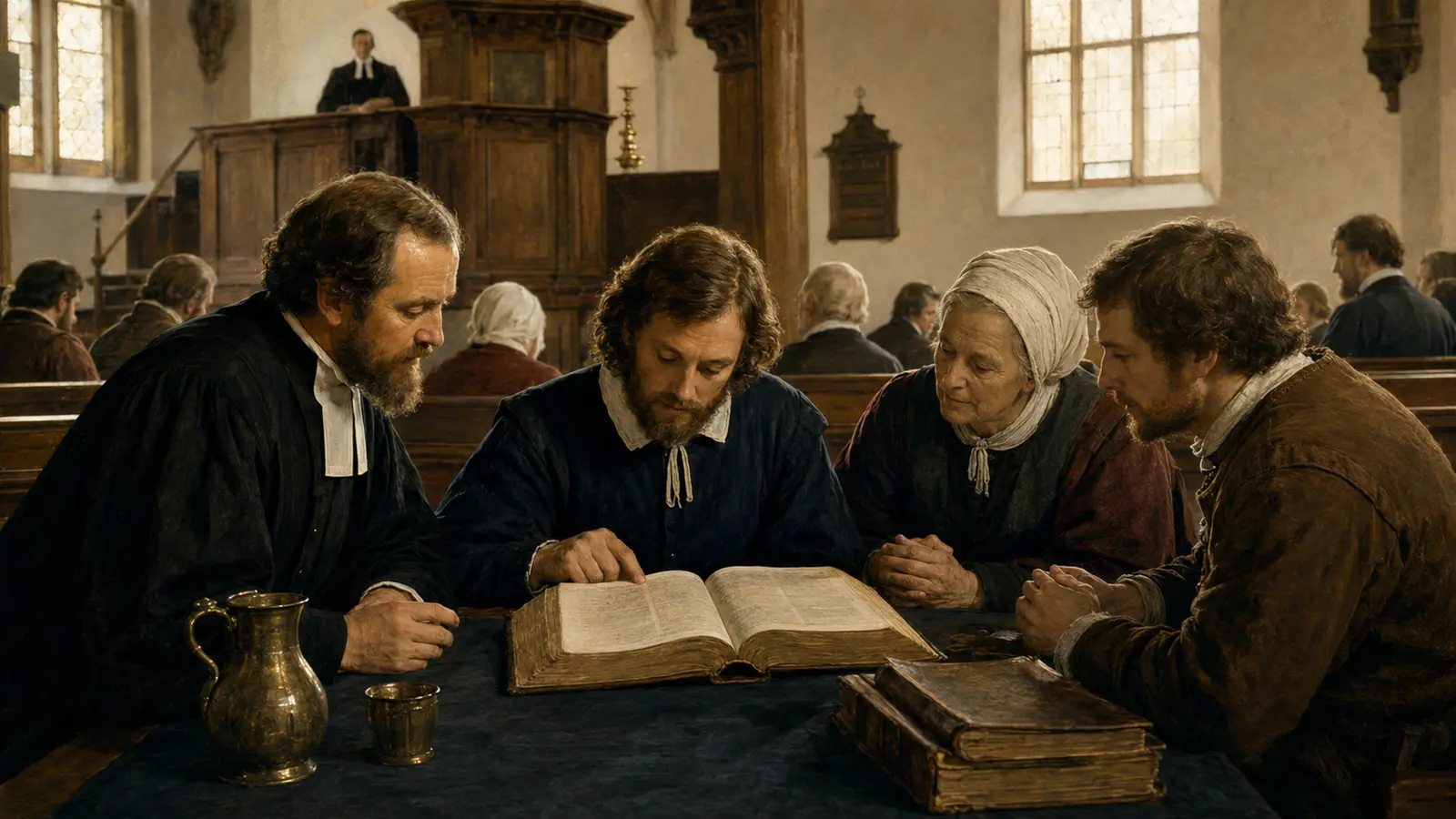
Few Protestant principles are more frequently invoked, more commonly misunderstood, or more easily abused than the right of private judgment.
To some ecclesiastical authorities, private judgment appears to be the seed of religious anarchy. If ordinary Christians are permitted to examine the teaching of ministers, councils, and scholars, then every person will become his own pope, every theological opinion will claim equal legitimacy, and the unity of the church will dissolve into endless individualism.
To the religious individualist, private judgment means almost the opposite. It becomes the right to believe whatever seems persuasive, to disregard the church’s confession, to ignore lawful elders, and to treat personal interpretation as beyond correction. “This is what the passage means to me” is presumed to settle the matter.
Both understandings are false.
The Reformed doctrine of private judgment does not mean that the individual is supreme. It means that every Christian must personally receive, understand, confess, and obey the Word of God and must therefore examine every human claim by that Word. The judgment is private because it is personally exercised by the believer; it is not autonomous because the believer does not create the standard by which he judges.
The Christian does not stand above Scripture and judge whether God has spoken truthfully. He stands beneath Scripture and judges whether human beings have represented God’s speech faithfully.
Private judgment is therefore not a declaration of independence from authority. It is the exercise of personal responsibility under the supreme authority of God.
Private Judgment Is Unavoidable
No person can completely surrender the exercise of private judgment, even when he claims to do so.
A man who says, “I will believe whatever the church teaches,” must first decide which institution is the true church. He must distinguish Rome from Constantinople, Canterbury from Geneva, and one Presbyterian denomination from another. He must determine which officers possess lawful authority over him and why their claims should be received.
A man who says, “I will defer to the scholars,” must decide which scholars are reliable, which academic discipline is relevant, which methodology is sound, and what to do when qualified experts disagree.
A man who says, “I will submit to my elder,” must recognize who is actually his elder, whether the elder is acting within the jurisdiction of his office, and whether the command given is lawful.
These are all acts of judgment.
A person does not escape private judgment by transferring his confidence to another human authority. He uses private judgment to select the authority to which he will defer. The question is never whether personal judgment will occur. The question is whether that judgment will be exercised faithfully and according to the proper standard.
Even implicit faith in a human institution requires an initial private decision to place implicit faith in that institution.
This is one reason the demand that a Christian simply submit his theological conclusions to a preselected gatekeeper cannot solve the underlying problem. If the gatekeeper has been chosen because he already agrees with one side of the controversy, then the Christian is not being relieved of private judgment. He is being required to exercise it once, in favor of that authority, and thereafter to treat the authority’s judgment as final.
The Christian does not escape autonomous judgment by transferring it to another man. He merely permits that other man to exercise autonomy on his behalf.
Faith Cannot Be Vicarious
Private judgment is also unavoidable because faith is personal.
No elder can believe for a church member. No parent can believe for a child. No theologian can repent, confess Christ, or stand before the judgment seat in place of another Christian. “Every one of us shall give account of himself to God” ().
A Christian may receive instruction from others. Indeed, he ordinarily comes to understand the faith through parents, pastors, teachers, books, confessions, and the communion of the saints. He does not invent Christianity for himself.
Nevertheless, the act of faith is his own. He must receive God’s testimony as true, rest upon Christ, confess His name, and obey His commandments. He cannot appear before God and say that he believed a false doctrine only because a respected elder required it.
This personal responsibility is visible throughout Scripture.
Moses did not tell Israel to accept every claimant to prophetic authority. Even ordinary Israelites were required to reject a prophet whose signs appeared impressive but whose teaching turned them away from the Lord (). The people could not answer, “The sign was convincing, and the prophet possessed religious authority.” They were responsible to judge the prophet by the revelation God had already given.
Christ repeatedly commanded His hearers to examine what had been written. “Have ye not read?” was not addressed exclusively to ecclesiastical scholars. His hearers were morally responsible for failing to understand and obey the Scriptures available to them.
The Bereans received Paul’s preaching with readiness of mind while searching the Scriptures daily to determine whether the things preached were so (). Their personal examination did not show contempt for teaching authority. It demonstrated submission to the higher authority by which all teaching must be tested.1
Paul instructed the Thessalonians to “prove all things” and hold fast that which was good (). John commanded Christians to “try the spirits whether they are of God” (). The church at Ephesus was commended because it tested men who claimed to be apostles and found them liars ().
None of these commands could be obeyed without personal judgment.
What “Private” Means
The word private can cause confusion because it may suggest something secret, isolated, or merely subjective. That is not the necessary meaning of private judgment in Protestant theology.
Private judgment is the judgment exercised by a person in his individual capacity, as distinguished from a public judgment rendered by a church court in its official capacity.
A session, presbytery, or synod may issue a public ecclesiastical judgment. Such a judgment has consequences within the government of the church. It may determine whether a doctrine conforms to the church’s confession, whether an officer remains qualified, whether an accusation has been proved, or whether discipline is required.
A private Christian cannot issue that kind of judgment by himself. He may argue that a doctrine is erroneous or unconfessional, but his article does not become an ecclesiastical verdict. He may believe that an elder has disqualified himself, but he cannot depose that elder. He may present evidence to the church, but he cannot personally exercise the keys of discipline.
The limitation concerns jurisdiction, not rational competence.
A church court may possess authority to render a binding ecclesiastical decision, while a layman may nevertheless understand the theological question more accurately than the members of the court. Conversely, a layman may possess the right to examine a matter while reaching an entirely mistaken conclusion.
The authority to render a public judgment and the correctness of the judgment rendered are related but distinct questions.
Private judgment therefore does not mean that a layman’s conclusions become authoritative for the church. It means that he remains personally responsible to test doctrine, hold fast to truth, reject falsehood, and present his case through lawful means when necessary.
What Autonomous Judgment Means
Autonomous judgment is not simply the act of thinking for oneself. The Christian is commanded to think, reason, understand, compare, infer, and discern. Scripture addresses the mind and repeatedly requires its proper use.
Autonomy arises when human reason treats itself as a law unto itself. It assumes that thought can operate independently of God and that man may establish the standards by which God’s revelation will be accepted or rejected.
The autonomous thinker does not merely ask what Scripture teaches. He asks whether Scripture is entitled to teach it. He does not merely use logic to understand revelation. He employs principles supposedly independent of God to determine whether revelation is credible. He does not receive the world as God has interpreted it. He constructs an allegedly neutral interpretation and then requires God’s Word to satisfy it.
This is the essence of the serpent’s temptation: God’s statement becomes one possible claim among others, and man assumes the position of judge over it.
The Reformed rejection of autonomy is therefore not anti-intellectual. It is the restoration of reason to its proper creaturely function.
Human reason is a gift of God. The laws of logic are not hostile to faith. Historical evidence, grammatical analysis, comparison, deduction, and careful argument are necessary to theology. But these tools are ministerial. They serve the God who created the mind, the world, language, and history.
Reason is not a light existing independently of God. “In thy light shall we see light” (). The fear of the Lord is the beginning of knowledge (). Every thought must be brought “into captivity to the obedience of Christ” ().
The choice is not between reasoning and refusing to reason. It is between reasoning in conscious submission to God and reasoning according to the fiction of human independence.
Ministerial Judgment
The proper alternative is ministerial judgment.
A ministerial judgment begins by receiving God’s Word as the supreme and self-attesting authority. It then uses every legitimate means God has provided to understand and apply that Word.2
The Christian reads Scripture grammatically because God spoke through human language. He studies historical circumstances because revelation entered real history. He compares passages because the Spirit who inspired one portion of Scripture does not contradict Himself elsewhere. He consults pastors, theologians, creeds, confessions, lexicons, and commentaries because Christ gives teachers to His church and distributes gifts among His people.
But none of these instruments becomes the final judge.
The Christian’s reason serves revelation. Historical evidence is interpreted within God’s providence. The confession serves as a subordinate summary. The church bears witness to the Word it has received. The internal testimony of the Spirit produces recognition and assurance without supplying new revelation.
Ministerial judgment is therefore neither credulous nor skeptical. It does not accept every claim made in the name of tradition, scholarship, or spirituality. Neither does it suspend belief until autonomous reason has granted its approval.
It receives what God has spoken and then tests all human claims according to it.
The Necessity of the Spirit’s Illumination
Private judgment cannot be exercised faithfully by unaided fallen reason.
The natural man does not receive the things of the Spirit of God, “for they are foolishness unto him: neither can he know them, because they are spiritually discerned” (). This does not mean that unbelievers are incapable of understanding the grammar of a biblical sentence or identifying facts about manuscripts and history. It means that they do not receive and understand divine truth rightly in its spiritual character and relation to God.
Sin is not merely a deficiency in available information. It is an ethical rebellion that affects the mind. Fallen man does not lack evidence of God; he suppresses the truth in unrighteousness.
The believer therefore requires the illuminating work of the Holy Ghost. Christ opened the understanding of His disciples so that they might understand the Scriptures (). Paul prayed that believers would receive the spirit of wisdom and revelation in the knowledge of Christ, the eyes of their understanding being enlightened ().3
Illumination must not be confused with inspiration. The Spirit does not give each reader new revelation or guarantee that every interpretation he reaches is correct. Illumination does not make private judgment infallible. It brings the believer into receptive submission to the Word, enables spiritual understanding, and progressively corrects the effects of sin upon his thinking.
Nor does illumination eliminate ordinary means. The illuminated Christian must still read carefully, learn vocabulary, consider context, compare Scripture with Scripture, and receive instruction. Depending upon the Spirit is not an excuse for intellectual carelessness.
The Spirit who inspired the Word also sanctifies the mind through diligent attention to that Word.
Private Judgment Is Personal but Not Solitary
The Reformed doctrine of private judgment has never required the Christian to interpret Scripture as though no other believer had ever read it.
Christ gives pastors and teachers “for the perfecting of the saints” and the edification of His body (). Christians are joined to a communion extending through history. They inherit creeds, confessions, catechisms, sermons, commentaries, and the testimony of generations of believers.
A Christian who refuses to listen to anyone else is not defending Scripture’s authority. He may be concealing pride beneath Protestant language.
The church’s historic witness matters. A doctrine never confessed by the church, unknown to prior generations, and discovered only by one contemporary individual should be approached with great suspicion. The collective judgment of faithful churches deserves considerably more weight than an isolated novelty.
Nevertheless, historical consensus remains ministerial rather than supreme. The church may err. Councils may err. Traditions may drift. The antiquity of an error does not transform it into truth, and the novelty of a rediscovered truth does not necessarily make it false.
Private judgment should therefore be ecclesial without becoming implicit. The Christian listens to the church because Christ has given gifts to His body. He tests the church because Christ governs His body by His Word.
Personal judgment and churchly humility are not enemies. Properly ordered, they require one another.4
Perspicuity and the Ordinary Christian
The right of private judgment would be meaningless if Scripture were fundamentally inaccessible to ordinary believers.
Westminster Confession 1.7 acknowledges that not everything in Scripture is equally plain in itself or equally clear to everyone. Difficult passages exist. Some questions require extensive learning. Not every Christian possesses equal gifts or reaches equal maturity.5
But the things necessary to be known, believed, and observed for salvation are so clearly propounded and opened in one place or another that both the learned and unlearned, through the ordinary use of means, may attain a sufficient understanding of them.
Perspicuity does not mean that every interpretation is obvious or that teachers are unnecessary. It means that Scripture is not an esoteric code whose meaning must be supplied by an infallible institution or academic elite.
The unlearned Christian is capable of real knowledge. He may need assistance with languages, history, or complicated arguments, but his lack of credentials does not make him incapable of understanding clear biblical doctrine.
This is especially important when credentials are used to avoid an argument. A scholar’s expertise may reveal that a layman has overlooked relevant evidence. If so, the evidence should be presented. But expertise cannot function as a substitute for presenting it.
“Trust me because I am the expert” may justify provisional confidence. It cannot bind faith.
Private Judgment and Necessary Consequences
A Christian’s duty of judgment includes more than repeating the explicit words of a teacher. It includes examining the logical consequences of what has been said.
Westminster Confession 1.6 recognizes that the whole counsel of God is either expressly set down in Scripture or may be deduced from Scripture by good and necessary consequence. Reformed theology therefore rejects the idea that only direct quotations can establish doctrine.6
The same principle applies to the examination of human arguments.
A teacher may expressly affirm the preservation of Scripture while employing a method that appears inconsistent with providential preservation. He may affirm scriptural authority while granting an academic procedure practical authority to determine what counts as Scripture. He may deny a conclusion while continuing to defend premises from which that conclusion necessarily follows.
A critic may identify such an inconsistency. But he must do so accurately.
He should not say that the teacher expressly denies what the teacher expressly affirms. He should say that the teacher’s operative principle appears to undermine his stated affirmation. The critic must then demonstrate the inference, consider possible distinctions, and permit the teacher to show why the consequence does not follow.
That is a legitimate exercise of private judgment. It is not mind-reading, provided the critic distinguishes statement, implication, and motive.
The fact that the critic is a layman does not change the validity of the inference. Logic does not become invalid when used by someone without ordination.
Private Judgment and Textual Criticism
The distinction between ministerial and autonomous judgment is especially important in textual criticism.
A Christian must sometimes compare readings, examine manuscripts, study grammar, consider quotations from early writers, and assess historical evidence. Such judgments do not cease to be necessary because God preserved His Word.
But the Christian approaches those questions under the prior authority of Scripture’s own doctrine. He does not begin by assuming that the Bible is textually equivalent to every other ancient book. He does not suspend the confession that God kept His Word pure in all ages until the academy permits him to restore it. He does not allow scholarly probability to become the supreme judge of whether the church possesses Scripture.
At the same time, the doctrine of preservation does not permit arbitrary preference. A Christian may not choose a reading merely because it is familiar, appears doctrinally convenient, or occurs in his preferred edition. Particular readings require ministerial examination by the authentic Hebrew and Greek Scriptures, the analogy of faith, the evidence of copies, and the Holy Ghost’s historical witness in the church.
Confessional bibliology is not the enthronement of private textual preference. It is the subordination of textual judgment to revelation.
The textual critic must judge readings, but he may not judge God. He may investigate copies, but he may not place the doctrine of preservation in suspense. He may use reason, but he may not reason as though Christ had abandoned His church to an unidentified and perpetually provisional text.
The Limits of Private Judgment
A right to judge does not guarantee a correct judgment.
Private Christians may misunderstand Scripture. They may reason badly, overlook evidence, follow personal resentment, or mistake stubbornness for courage. A person may become so preoccupied with the failings of authorities that he ceases to recognize his own.
Several limitations must therefore be maintained.
First, private judgment must be argued. “This is my conviction” cannot replace exegesis and evidence.
Second, private judgment must remain correctable. A Christian who invites scrutiny of others while refusing scrutiny of himself has made his own spirit supreme.
Third, private judgment must respect jurisdiction. A layman may reach a theological conclusion without pretending that his conclusion constitutes an ecclesiastical censure.
Fourth, private judgment must distinguish degrees of certainty. Some doctrines are explicit and foundational. Some conclusions rest upon necessary inference. Others are probable judgments concerning complicated evidence. Confidence should be proportionate to warrant.
Fifth, private judgment must obey the fifth and ninth commandments. It must honor lawful authority, represent opponents truthfully, avoid unwarranted suspicions, and refuse to turn criticism into personal reproach.
Finally, private judgment must aim at edification. Its purpose is not to demonstrate intellectual independence but to bring thought, speech, and church practice into obedience to Christ.
What This Means for Confessional Bibliology
Confessional Bibliology exercises private theological judgment. It does not exercise ecclesiastical jurisdiction.
The site may examine public arguments, compare them with Scripture and the Reformed confessions, analyze their historical claims, and trace their logical consequences. It may conclude that a method is inconsistent, unconfessional, or sinful. It may call public teachers to account for what they have publicly taught.
But its judgments remain ministerial and open to examination. The website must not treat its own conclusions as self-authenticating. It must document its claims, distinguish express statements from consequences, receive correction, and retract demonstrated errors.
The same standard applies to those who object to its existence.
An elder may not answer the site merely by invoking his office. A scholar may not answer by invoking his degree. A critic may not answer by saying that a layman has no right to reason through published arguments.
They must address the case.
This does not place the website above the church or its officers. It places the website, its author, its critics, church officers, and scholars beneath the same Word.
Conclusion
Private judgment is the unavoidable and commanded responsibility of every Christian to hear God’s Word personally and test every human claim by it. The Christian does not judge whether God is truthful; he judges whether men have spoken truthfully about God. He receives the church’s gifts without surrendering conscience to them, and he states theological conclusions without counterfeiting an ecclesiastical verdict.
The alternative to autonomous individualism is not blind submission to another autonomous man. It is the submission of every mind, teacher, court, scholar, and private Christian to the Holy Ghost speaking in Scripture. Private judgment is Christian only as judgment under the Word.
Notes and Further Reading
- ; ; ; ; . ↩
- Westminster Confession of Faith 1.4–6 and 1.10; see the 1647 text with Scripture proofs. ↩
- ; ; . Illumination enables reception of the public Word; it is neither new inspiration nor a guarantee of individual infallibility. ↩
- ; , 17; Westminster Confession of Faith 31.3. Councils and teachers are real gifts and fallible servants. ↩
- Westminster Confession of Faith 1.7. Compare John Calvin, Institutes of the Christian Religion, 1.7–9, on Scripture’s authority, the Spirit’s witness, and the church’s ministry. ↩
- Westminster Confession of Faith 1.6. Necessary consequence is objective logical entailment, not an invitation to attribute a denied conclusion without demonstrating the inference. ↩