

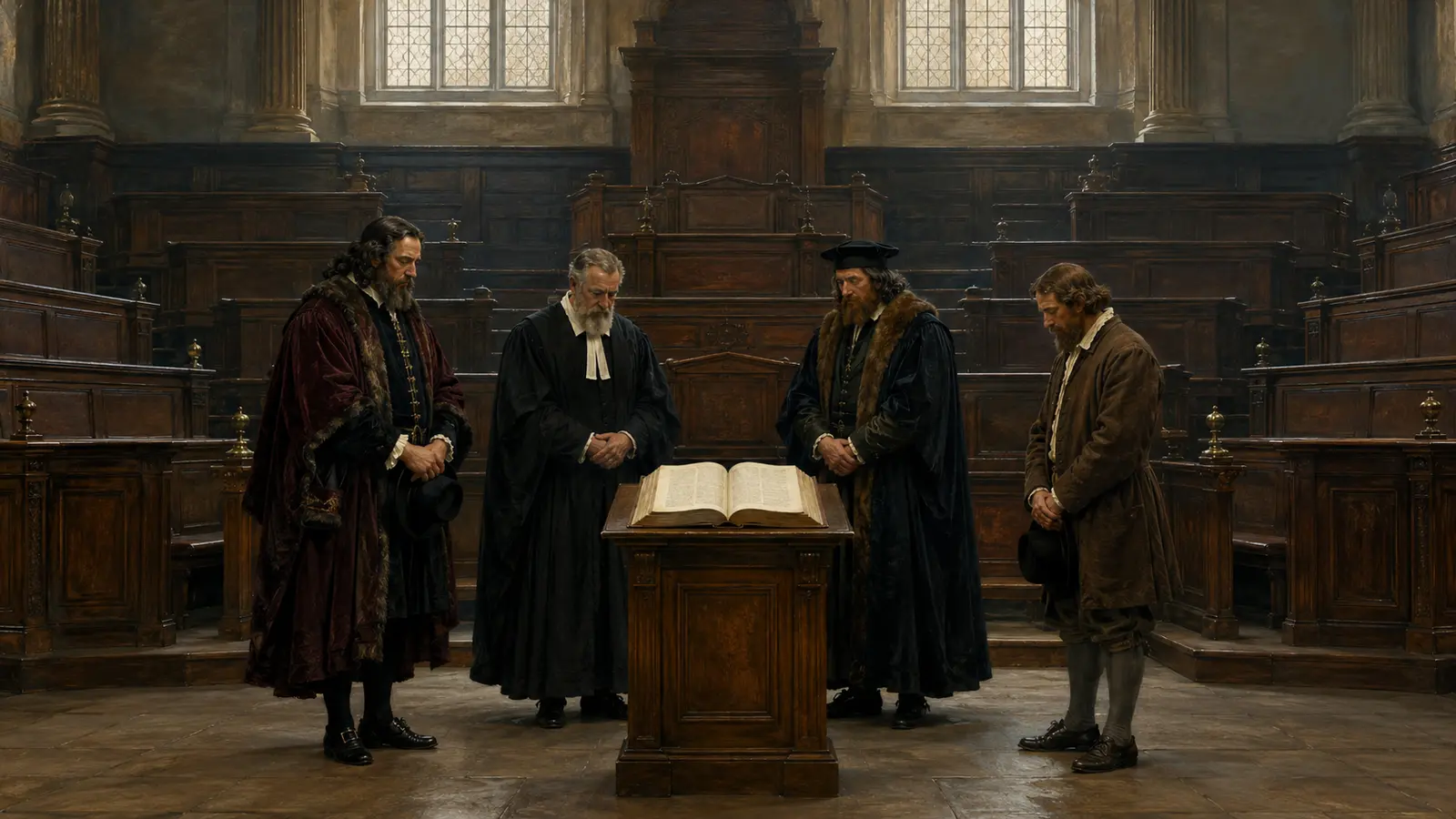
Revision note: Substantially revised July 20, 2026. The confessional proof and authority-recognition distinction have been compressed, a redundant subtitle removed, and Scripture, Calvin, Owen, Cosin, and the Reformed standards gathered in one notes section.
Every controversy concerning Scripture eventually becomes a controversy concerning authority. Men may begin by disputing a particular interpretation, doctrine, passage, textual reading, or translation. Beneath all these disagreements, however, lies a more fundamental question: Who possesses the right to render the final judgment?
Does the Word of God judge man, or does man judge the Word of God?
The question is not whether man will use his mind. Man cannot read, interpret, compare, translate, or teach Scripture without employing reason. The question is whether he employs reason as a creature receiving the speech of his Creator or whether he treats his reason as a supreme court before which God must appear and prove his truthfulness.
Neither is the question whether historical evidence, ecclesiastical testimony, manuscript evidence, linguistic knowledge, or logical argument possesses value. All these things may possess considerable value when employed in their proper place. The question is whether they serve the Word of God or whether the Word of God is made to serve them.
The Reformed doctrine of Scripture begins with an uncompromising answer. God is truth itself. Scripture is his inscripturated Word. Consequently, Scripture does not receive its authority from the church, the academy, the individual reader, the textual critic, or the collective judgment of mankind. Its authority proceeds wholly from God its author.
Man does not make Scripture authoritative by believing it. Man is obligated to believe Scripture because it is already the authoritative Word of God.
This distinction must be established before considering the qualifications of an elder. A man cannot be called to preach, teach, defend, and administer a Word whose truth he believes remains dependent upon human ratification. Before we can ask whether such a man is qualified to be a minister of Scripture, we must first understand what Scripture is.
The Question Beneath Every Other Question
Epistemology concerns the nature, source, and justification of knowledge. An epistemic authority is therefore an authority upon which one depends for knowing that something is true. An ultimate epistemic authority is the final standard beyond which no higher appeal can be made.
Every system of thought possesses such an authority, whether its adherents acknowledge it or not. Some appeal ultimately to human reason. Others appeal to sensory experience, scientific consensus, historical probability, ecclesiastical tradition, or some combination of these. A man may call himself a skeptic and insist that he possesses no ultimate authority, but even his skepticism depends upon standards by which he judges what may or may not be believed.
The Reformed Christian begins elsewhere. God is the source of all being, truth, and knowledge. Man knows because God first knows. Man reasons because God created him in his image as a rational and moral creature. The world is intelligible because it was created and is governed by the wisdom of God. There is no body of truth existing independently of God to which God and man are equally answerable.
God does not discover truth. He does not reason from ignorance to knowledge. He does not consult an external standard to determine whether his declarations are accurate. He knows himself and all his works perfectly, eternally, and exhaustively.
Scripture therefore declares that God “cannot lie” (), that it is “impossible for God to lie” (), and that he is not “a man, that he should lie” (). His truthfulness is not merely a habit he has adopted. It belongs necessarily to who he is.
When God speaks, his speech possesses the authority of the speaker. His Word is not an independent authority alongside him, as though the Christian worshipped both God and a book as two separate deities. Scripture possesses divine authority because it is the Word of the living God. To submit Scripture to a supposedly higher human tribunal is therefore to submit God’s speech to the judgment of the creature.
The objection that “God alone is ultimate, not Scripture” consequently fails. It attempts to separate God from his own speech. The Reformed confession does not identify paper, ink, or any particular physical volume with the divine essence. It does confess that what God has caused to be written carries his authority because he is its author.
The supreme authority is not an abstract book separated from God, nor is it a private spiritual experience separated from the written Word. The supreme judge is, as the Westminster Confession expresses it, “the Holy Spirit speaking in the Scripture.”
The Original Temptation to Judge God
The fundamental character of epistemic rebellion appears in the first temptation:
“Yea, hath God said?”
—
There was nothing sinful in seeking to understand God’s command. Adam and Eve were obligated to hear, remember, interpret, and apply what God had said. The serpent’s temptation did not invite them merely to clarify the divine command. It invited them to reconsider whether God’s Word was truthful and good.
God had already spoken. His command should have settled the matter. The serpent, however, placed the divine declaration on trial. He contradicted its warning—“Ye shall not surely die”—and suggested that God’s command was designed to deprive the woman of some desirable good.
Eve then treated God’s Word, the serpent’s claim, and her own evaluation as competing sources that could be weighed upon an apparently neutral scale. She saw that the tree was “good for food,” “pleasant to the eyes,” and “to be desired to make one wise.” The creature assumed the right to decide independently whether the Creator’s Word deserved obedience.
The Fall was not merely an intellectual mistake. It was moral, spiritual, and covenantal rebellion. Nevertheless, it included an epistemic revolt: the creature ceased receiving God’s Word as final and began judging that Word by an allegedly independent standard.
This pattern has repeated itself throughout history. Fallen man rarely wishes to announce openly that he intends to sit in judgment upon God. He may instead speak of intellectual honesty, critical distance, methodological neutrality, scholarly consensus, or the need to follow the evidence wherever it leads. None of these expressions is necessarily sinful by itself. But they become instruments of rebellion whenever they mean that God’s revelation will be accepted only after it has passed standards constructed independently of him.
The fundamental distinction is simple:
- The faithful creature asks, “What has God said?”
- The autonomous creature asks, “Shall I permit what God has said to count as true?”
The first question is necessary for obedience. The second is a claim to sovereignty.
Scripture Comes as the Speech of God
Scripture does not present itself as a collection of religious reflections from which the reader may extract whatever spiritual insights he considers credible. It comes with divine authority.
The prophets did not ordinarily introduce their messages by saying that prolonged reflection had led them to certain probable religious conclusions. They declared, “Thus saith the Lord.” Their authority did not rest in their intelligence, social position, literary power, or the willingness of their audience to receive them. The message possessed authority because God had spoken it.
The same identification of Scripture with divine speech continues in the New Testament. Paul writes:
“All scripture is given by inspiration of God.”
—
The expression translated “given by inspiration of God” means that Scripture is God-breathed. Paul does not say merely that Scripture is religiously uplifting, produced by unusually devout men, or subsequently approved by the church. Its origin is divine.
Peter likewise teaches that prophecy “came not in old time by the will of man,” but that “holy men of God spake as they were moved by the Holy Ghost” (). The human writers were genuine instruments who wrote according to their own vocabulary, circumstances, and literary character. Yet behind and through their activity stood the Holy Ghost, who ensured that what they wrote was the Word of God.
This explains the remarkable manner in which the New Testament cites the Old. In , a quotation from Psalm 95 is introduced with the words, “Wherefore (as the Holy Ghost saith).” The Psalm was written centuries earlier, but the Holy Ghost still speaks through the written text. Scripture is not treated merely as a historical record of something God once said. God presently addresses the church through his preserved Word.
Christ himself treated Scripture as possessing final and unbreakable authority. When tempted by Satan, he repeatedly answered, “It is written” (, 7, 10). He did not submit the written Word to Satan’s examination or enter into negotiations over whether its teaching was reasonable. The written Word settled the controversy.
In , Christ declares that “the scripture cannot be broken.” In , he prays, “Sanctify them through thy truth: thy word is truth.” He does not merely say that God’s Word happens to contain many true statements. God’s Word is truth. In , Christ declares that his spoken Word will judge the unbeliever at the last day. Man does not finally judge the Word; the Word judges man.
Paul commends the Thessalonians because, when they received the apostolic proclamation, they “received it not as the word of men, but as it is in truth, the word of God” (). Their reception did not transform a human word into a divine word. They rightly recognized what the message already was.
This is the order that must always be maintained:
- God speaks.
- His speech possesses divine authority.
- Man is obligated to receive it.
- Faith recognizes and submits to that authority.
- Unbelief rejects it but cannot nullify it.
The authority of revelation precedes its reception.
Why Scripture Must Be Self-Attesting
If Scripture is the supreme written authority, it cannot receive its authority from something above it. This is not an arbitrary theological preference. It follows necessarily from the meaning of ultimate authority.
Suppose a man says that he accepts Scripture because the church has authenticated it. The church then becomes the higher authority, for Scripture’s right to be believed depends upon the church’s verdict.
Suppose another says that he accepts Scripture because historical scholarship has demonstrated its reliability. Historical scholarship then becomes the higher authority, since Scripture may be received only after scholars have certified it.
Suppose another says that he accepts only those biblical teachings that agree with reason. His reason becomes supreme, and the Bible becomes merely one witness appearing before its tribunal.
An authority that depends upon a higher authority for permission to speak is not the ultimate authority.
Every system must eventually arrive at a final standard. If standard A is validated by standard B, and standard B by standard C, the process either continues endlessly or terminates in something accepted as possessing final authority. An infinite regress would make knowledge impossible, because no claim would ever reach an adequate foundation.
The Christian terminates this regress in the self-knowing and self-attesting God. Since there is none greater than God, God swears by himself (). His Word must possess the same finality because it is his speech.
This does not mean that Scripture is true merely because an arbitrary document makes an unsupported claim about itself. Self-attestation is not the same as bare assertion. Many false religious writings claim authority for themselves. Their claims do not become true simply because they have been made.
Scripture’s self-attestation encompasses the whole character of divine revelation: its unity, majesty, holiness, fulfilled prophecy, redemptive coherence, historical rootedness, doctrinal perfection, transforming power, and complete orientation toward the glory of God in Jesus Christ. These evidences do not create its authority. They manifest the character of the authority already present.
Nor does the necessary self-attestation of an ultimate authority mean that all ultimate claims are equally reasonable. The rationalist may use reason to defend the ultimacy of reason, and the empiricist must employ sensory experience to defend the reliability of sensory experience. The fact that every ultimate standard involves an unavoidable reference to itself does not establish the truth of every proposed standard.
The Christian claim is distinct because the God revealed in Scripture supplies the necessary foundation for knowledge itself. The Christian worldview explains why there is an orderly creation, why human minds can possess genuine knowledge, why laws of logic are universally applicable, why truth is objective, and why moral obligations bind human thought. Autonomous reason borrows these realities while refusing to acknowledge the God who makes them possible.
Scripture does not merely survive examination by a supposedly neutral reason. Scripture reveals the God without whom reason, evidence, meaning, and truth could not exist.
The Confessional Doctrine of Scripture’s Authority
The Westminster Confession states the matter with exceptional precision:
“The authority of the Holy Scripture, for which it ought to be believed, and obeyed, dependeth not upon the testimony of any man, or church; but wholly upon God, (who is truth itself,) the author thereof: and therefore it is to be received, because it is the Word of God.”
—Westminster Confession of Faith 1.4
The authority is doctrinal and moral: Scripture ought to be believed and obeyed. Human and ecclesiastical testimony may identify, translate, proclaim, and defend the books, but cannot constitute their authority. That authority depends wholly upon God, who is truth itself.1
The following section gives evidence its proper office. The church’s testimony may move men to reverent esteem. Scripture’s heavenly matter, efficacious doctrine, majestic style, canonical harmony, saving scope, incomparable excellencies, and perfection abundantly evidence its divine origin. Nevertheless, Westminster 1.5 concludes:
“Yet notwithstanding, our full persuasion and assurance of the infallible truth and divine authority thereof, is from the inward work of the Holy Spirit bearing witness by and with the Word in our hearts.”
- Westminster Confession of Faith 1.4–5; see the 1647 text with Scripture proofs. ↩
“By and with the Word” excludes a private voice beside Scripture. The Spirit does not make Scripture authoritative; He opens blind eyes to receive the authority already there. Calvin makes the church a creature of the prophetic and apostolic Word, Owen describes Scripture’s self-evidencing light and power, and the Belgic Confession joins the Spirit’s witness to the books’ own divine marks.2
The Reformed doctrine therefore refuses both ecclesiastical supremacy and autonomous reason. The Reformation did not free man from the church so that he might become an authority unto himself. It freed conscience from every merely human claimant so that it might be bound to God’s Word. Sola Scriptura is not the enthronement of private opinion but the dethronement of every creaturely supremacy.
Objective Authority and Subjective Recognition
Scripture remains God’s Word whether it is believed or rejected. Human recognition may be defective because man is defective; the authority recognized is not. The Spirit’s inward witness is necessary because the natural man suppresses and rejects divine truth, not because revelation lacks authority. Regeneration does not create truth. It restores the sinner to receive it.
The same distinction governs canon and text. The church did not make inspired books canonical by listing them. It recognized, received, preserved, and confessed books whose authority came “from God alone,” as John Cosin insisted.3 Nor does the church confer authenticity upon words by arbitrary choice.
Westminster 1.8 declares the immediately inspired Hebrew and Greek Scriptures “by his singular care and providence, kept pure in all ages” and “therefore authentical.”4 This does not make every copy, edition, or translation individually perfect. It confesses that God did not permit His inspired Word to disappear from the church’s possession. Copies and readings require ministerial examination within that promise. A rule unavailable to the church cannot function as its rule.
The Proper Place of Evidence
The self-attesting authority of Scripture does not render evidence useless. It determines how evidence must be used.5
Historical investigation may demonstrate the antiquity and reception of biblical books. Manuscripts may witness to the providential transmission of the text. Ancient translations and patristic citations may assist in tracing that transmission. Archaeology may confirm people, places, customs, and events. Linguistic study may clarify grammar and meaning. Theology may display the harmony of the whole.
These are genuine services.
But a servant is not a sovereign.
Evidence may answer objections, expose inconsistencies, strengthen believers, identify historical witnesses, and assist the church in its ministerial work. It cannot establish a neutral court in which the creature determines whether the Creator is credible.
There is a profound difference between saying, “These evidences manifest the truthfulness and providence of the God who has spoken,” and saying, “God’s Word may be believed only to the extent that our present evidence makes it probable.”
The first position receives evidence under revelation. The second receives revelation under evidence.
Even the interpretation of evidence depends upon prior commitments. A scholar who begins by assuming that divine inspiration and providential preservation cannot govern historical investigation has not adopted neutrality. He has excluded Christian doctrine from his method before examining the evidence. His subsequent conclusion that the evidence does not demonstrate preservation merely reproduces the unbelieving assumptions with which he began.
The Reformed Christian does not fear facts. Every fact is created, governed, and interpreted ultimately by God. But he refuses the fiction that facts can be properly understood while the God who gives them meaning is methodologically excluded.
There is no neutral ground upon which God and autonomous man meet as equals.
The Word Is the Judge
Westminster Confession 1.10 brings the doctrine to its necessary conclusion:
“The Supreme Judge, by which all controversies of religion are to be determined, and all decrees of councils, opinions of ancient writers, doctrines of men, and private spirits, are to be examined; and in whose sentence we are to rest; can be no other but the Holy Spirit speaking in the Scripture.”
- Westminster Confession of Faith 1.4–5; see the 1647 text with Scripture proofs. ↩
- John Calvin, Institutes of the Christian Religion, 1.7; John Owen, Of the Divine Original, Authority, Self-Evidencing Light, and Power of the Scriptures, chapters 1–4; Belgic Confession, article 5. ↩
- John Cosin, A Scholastical History of the Canon of the Holy Scripture, in The Works of John Cosin, vol. 3 (Oxford, 1849), especially the distinction between ecclesiastical recognition and authority from God alone. ↩
- Westminster Confession of Faith 1.8. The text joins inspiration, providential purity, present authenticity, translation, and final appeal in one paragraph. ↩
- Scripture itself places evidence and testimony beneath divine speech: ; ; ; ; ; . ↩
Councils must be examined. Ancient writers must be examined. The doctrines of respected men must be examined. Private interpretations must be examined. Academic conclusions must be examined. Textual theories must be examined. Confessions themselves possess authority only insofar as they faithfully summarize Scripture.
But the Holy Ghost speaking in Scripture is examined by no higher court.
This does not abolish interpretation, ecclesiastical authority, scholarship, or reason. It places every one of them in its proper creaturely position. The church possesses real authority, but it is ministerial. Teachers possess real authority, but it is derivative. Confessions possess real authority, but it is subordinate. Reason possesses genuine usefulness, but it is never autonomous.
The man who approaches Scripture faithfully does not approach as a judge preparing to pronounce sentence upon God. He approaches as one who is already being judged by the Word he reads.
This is why the question of Scripture’s epistemic authority cannot be treated as an abstract philosophical disagreement with no bearing upon church office. An elder is called to proclaim God’s Word, hold it fast, defend it against gainsayers, and govern the church according to it. If he reserves for himself, other men, or the academy the right to decide whether that Word is true, he has inverted the very order his office exists to uphold.
Before a man can stand in a pulpit as a minister of the Word, he must stand beneath that Word as a hearer.
The church must therefore recover the difference between asking what God has said and asking whether man will permit God’s speech to be true. The first question belongs to faithful interpretation. The second belongs to rebellion.
Man does not make Scripture authoritative by believing it. The church does not make Scripture canonical by receiving it. The academy does not make Scripture credible by approving it. Scripture is to be believed, received, obeyed, and confessed because it is already the Word of the God who is truth itself.
Every man may render his judgment concerning Scripture. But his judgment does not determine the truth of Scripture.
The Word will finally render judgment concerning him.
Notes and Further Reading
- Westminster Confession of Faith 1.4–5; see the 1647 text with Scripture proofs. ↩
- John Calvin, Institutes of the Christian Religion, 1.7; John Owen, Of the Divine Original, Authority, Self-Evidencing Light, and Power of the Scriptures, chapters 1–4; Belgic Confession, article 5. ↩
- John Cosin, A Scholastical History of the Canon of the Holy Scripture, in The Works of John Cosin, vol. 3 (Oxford, 1849), especially the distinction between ecclesiastical recognition and authority from God alone. ↩
- Westminster Confession of Faith 1.8. The text joins inspiration, providential purity, present authenticity, translation, and final appeal in one paragraph. ↩
- Scripture itself places evidence and testimony beneath divine speech: ; ; ; ; ; . ↩