

This is Part 6 of “The Line That Vanished.”
The page did not wait in a sealed room while scholars debated it. Every inspection occurred in time, and time changed the object being inspected.
The later history of Codex Alexandrinus at 1 Timothy 3:16 is not a sequence of identical observations. It is a record of progressive damage.
That fact alters the kind of question we may responsibly ask. We can ask what particular observers reported at particular dates. We can compare their competence, conditions, and explanations. We can inspect what survives. We cannot assume that each man encountered the same visible page.
Woide, Griesbach, and Scrivener are especially valuable because their accounts disclose loss. Woide reportedly ceased to see what he had earlier perceived. Griesbach described damage caused by curious handling. Scrivener found the leaf perilously thin and nevertheless remained persuaded by repeated examination. Together they make deterioration an evidential datum rather than an apologetic afterthought.
Woide: seen, then unseen
Carl Gottfried Woide prepared the great eighteenth-century facsimile of the New Testament portion of Alexandrinus. According to the accounts assembled by Scrivener and Burgon, Woide saw traces of the transverse line in 1765. When he examined the place again in 1785, he could no longer see what had been visible twenty years earlier.1
Woide nevertheless printed the sacred contraction in his 1786 facsimile and defended θεός. His judgment combined earlier observation, the manuscript’s reception, and his understanding of the retracing.
The change between 1765 and 1785 is important even if one questions Woide’s final conclusion. It tells us that non-perception at the later date cannot safely be projected backward. Something visible to the same examiner had ceased to be visible.
Woide’s role gives the report special interest. He was not an occasional visitor drawn to one sensational verse. As editor of the facsimile, he worked intimately with the codex and had reason to study the shapes and habits of its script across many pages. His 1786 publication represented an attempt to place the manuscript’s text before scholars with far greater fidelity than an ordinary collation could provide.
A facsimile, however, is itself an editorial artifact. It preserves the editor’s judgment about forms that may be faint, damaged, or overwritten. Woide printed ΘC. That choice records his conclusion; it is not equivalent to a color photograph of the leaf in 1765. The distinction parallels the one made throughout this series between artifact and reconstruction.
The two dates are more valuable than the printed form alone. If Woide saw the trace in 1765 and not in 1785, his own sensory record contains evidence of change independent of his final preference. A critic may suspect that the earlier perception was mistaken, but the later non-perception cannot simply be cited as proof that he had never seen anything.
Woide also recognized the force of preconception. As later quoted in the controversy, he allowed that some might think observers saw the line because they wished to see it, while noting that the same objection could be brought against Wettstein’s contrary wish. The point is sound even when detached from personalities. Expectation can guide perception on both sides, which is why convergence, chronology, and physical explanation matter.
Griesbach finds an injured page
Johann Jakob Griesbach examined the codex in 1785 and judged that the place had been so rubbed by the fingers of curious visitors that no certain determination could be made.2 This is not testimony for θεός or for ὅς. It is testimony against naïve certainty.
By the end of the eighteenth century, the disputed location had become an attraction. The very act of verification was destroying the evidence to be verified. A modern editor looking back at the page must account for that human history.
Griesbach’s report is one of the most sobering statements in the dossier because it names human curiosity as a conservation force. Observers apparently used not only their eyes but their fingers in an attempt to discover, almost to excavate, the first reading. The surface bearing the decisive mark was thereby polished or abraded further.3
Modern readers may find such handling shocking, but the anachronistic reaction should not obscure the evidence. Manuscript conservation developed over time. Eighteenth-century scholars who wished to know whether a line was ink, depression, or show-through might touch or manipulate the leaf in ways no present curator would permit. Their very zeal for autopsy changed the conditions of later autopsy.
Griesbach’s conclusion is methodologically restrained. He did not say that damage proved ΘC or ΟC. He said that the present state no longer permitted a mortal observer to discern anything certain. His own textual preference may be investigated elsewhere; this material observation limits the confidence that can be drawn from his date forward.
The statement also rebukes anachronistic appeals to “what the manuscript says.” A badly abraded location does not speak with the same directness as an intact one. It bears marks, absences, retracings, and damage from which an initial reading is reconstructed. Editors may reach a responsible conclusion, but they should not represent the conclusion as a simple act of looking.
Scrivener’s 1861 examination
On 7 February 1861, F. H. A. Scrivener inspected the place and discerned what Burgon described as a faint trace of the transverse stroke of theta. Scrivener did not base his mature opinion upon that visit alone. He said that repeated examination over approximately twenty years always left him convinced that Alexandrinus read ΘΣ.4
His judgment should be neither canonized nor dismissed.
Scrivener stood more than two centuries after the codex came to England and more than a century after Berriman warned that the old line was disappearing. He therefore saw less than Mill or Berriman claimed to see. Yet he was a practiced collator, knew the competing explanations, and returned to the object many times. His conclusion is a substantive item in the evidence.
The 1861 date comes from Burgon’s report, while Scrivener’s published fourth-edition discussion gives the repeated-inspection language. Separating the sources prevents an attractive anecdote from swallowing its documentation. Burgon is a partisan narrator and should be cited as such; Scrivener’s own judgment is available for comparison.
Scrivener’s paragraph is notable for its balance. He rejected the idea that inspection was wholly useless, declared his personal conviction for ΘΣ, and then acknowledged that Sinaiticus, versions, and patristic evidence inclined him toward the relative reading at the level of the wider textual question. He could distinguish what he thought Alexandrinus read from what other evidence might imply about the verse.5
That distinction is methodologically important. A scholar may judge A to support θεός without claiming that A alone settles the text. Conversely, an editor may prefer ὅς overall without rewriting the material history of A. The manuscript’s classification and the verse’s final adjudication are related but separable conclusions.
Scrivener’s repeated visits also introduce the possibility that different examinations yielded different visual impressions. His published statement compresses them into a settled conviction rather than a diary of each viewing condition. That limits how much we can reconstruct. It nevertheless rules out the picture of a man who glanced once, saw what he wanted, and never returned.
The codex as a changing witness
Modern textual discussion often treats a manuscript as a fixed data point. Materially, it is not. The Alexandrinus record can be represented as a sequence:
- early collators register no departure from θεός;
- Mill reports fine surviving traces;
- Berriman reports part of the older line under strong light;
- Wettstein changes from recognizing the trace to explaining it as show-through;
- Woide reports that a once-visible trace has disappeared;
- Griesbach reports serious abrasion;
- Scrivener still perceives a faint remnant and remains convinced of ΘΣ.
This is not the history of a page that always displayed a pristine ΟC until a dogmatist drew on it. Nor is it the history of a pristine ΘC preserved without ambiguity. It is the history of a damaged reading whose small decisive marks were failing.
Calling the codex a “changing witness” does not mean that its testimony changed in the personal sense. The first scribe wrote what he wrote. What changed was the accessibility of that act to later observers. Ink density, parchment thickness, retracing, abrasion, and viewing technology mediated the testimony.
The distinction can be represented as a time-indexed claim. “Observer X saw feature Y at date D under conditions C” is not equivalent to “feature Y is visible now,” nor does the present absence of Y falsify the earlier statement without additional argument. Historical reconstruction must preserve the date and conditions as part of the proposition.
This rule is familiar outside textual criticism. Conservators distinguish original material from later restoration; archaeologists compare excavation notes with artifacts since lost; historians use early transcriptions of monuments damaged after recording. Manuscript study belongs to the same material history.
At Alexandrinus the record is unusually rich because the line attracted controversy before it disappeared completely. The very polemic that damaged the page also produced descriptions of its earlier state. That irony should make us both grateful and cautious.
What a photograph cannot recover
High-resolution photography is invaluable. It can magnify color differences, surface texture, and alignment far beyond the unaided eye. But a modern image photographs the modern state. It cannot directly photograph ink that disappeared in 1785, much less in 1707.
Image analysis may test whether surviving marks align with the reverse-side epsilon. It may distinguish pigment. It may expose scraping or retouching. It must still be interpreted in the light of earlier testimony.
A modern imaging campaign could contribute significantly. Multispectral photography can sometimes reveal erased or faded ink by exploiting responses outside the visible spectrum. Reflectance transformation imaging can emphasize surface texture and distinguish a drawn stroke from a crease or abrasion. Registration of recto and verso images can test how precisely the epsilon overlaps the disputed circle.
None of these methods is a time machine. If pigment was physically removed by abrasion, no wavelength can photograph material that is no longer present. A chemical signature may survive in the parchment, but whether it can be recovered is an empirical question, not a promise. If the leaf’s surface was altered by retracing, the later pigment may obscure the earlier trace.
Historical testimony therefore does not become obsolete when technology improves. Its weight may change. Imaging could confirm that the supposed old remnant is entirely accounted for by verso ink, or it could reveal a distinct recto feature. Until then, the record remains a combination of present material analysis and dated verbal observation.
The historical record also disciplines defenders of θεός. Scrivener’s conviction is not equivalent to spectrographic proof. Burgon’s forceful rhetoric does not add pigment to the parchment. The claim should remain proportionate: competent observers at different dates reported a faint original-looking trace, while other competent observers disputed or could no longer see it.
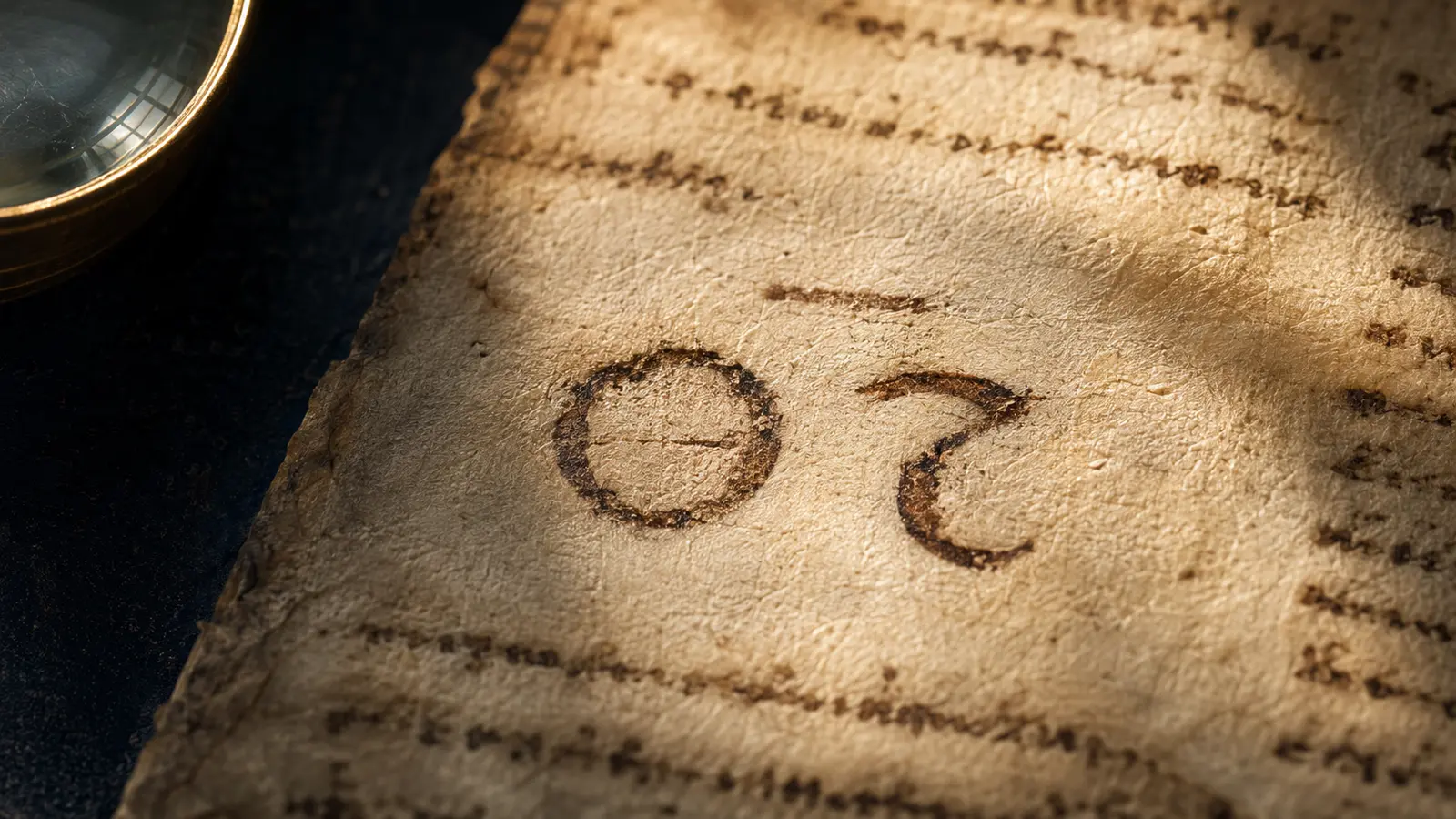
The generated image used for this series follows the same principle. It is an editorial illustration of the fading mechanism, not a facsimile of the codex. A caption must say so. Visual rhetoric is especially powerful in a controversy about sight; the image should help the reader imagine the material problem without being smuggled in as evidence.
Deterioration belongs in the apparatus
If A* is printed as ὅς, readers should know what that siglum means. It means that editors have reconstructed the first hand as ΟC beneath or before later strokes. It does not mean that the fifth-century manuscript has remained materially unchanged and transparently says “who.”
The page has a biography. Woide’s two inspections reveal change within one man’s lifetime. Griesbach describes the cause. Scrivener supplies the nineteenth-century testimony remembered at the beginning of this investigation.
The line did not vanish in theory. On the historical reports, it vanished in stages.
An apparatus cannot narrate that entire biography in every footnote. Compression is necessary. The problem arises when readers mistake necessary compression for exhaustive description. A siglum such as A* beside ὅς and Aᶜ beside θεός silently contains judgments about ink sequence, restoration, and the sufficiency of earlier reports.
A fuller digital apparatus could improve the situation by linking the classification to a condition note: “The location is retraced and severely abraded; early observers disagreed about a fine transverse trace; see dossier.” Such a note would not prejudge the reading. It would disclose the evidential conditions under which the editor’s assignment was made.
Confessional bibliology has a legitimate task here. It can preserve the documentary history that a compact apparatus omits, evaluate the editor’s inference, and refuse to let the conclusion become magisterial merely through typographic brevity. That task must remain historical in form. Providence does not excuse a careless citation; ecclesiastical reception does not make every early observer accurate.
The condition history also changes the burden of assertion. A writer who says, “Modern editors commonly reconstruct the first hand as ΟC,” reports a verifiable editorial fact. A writer who says, “The manuscript indisputably and always displayed ΟC until a later corrector changed it,” asserts far more: he has ruled out the early trace reports, classified the heavier ink as alteration, and projected a damaged modern state backward. Those additional propositions require additional evidence. The difference between them is not verbal caution for its own sake. It is the difference between describing a judgment and treating the judgment as the artifact.
The same burden applies to the defender of ΘC. “Several qualified observers reported an older transverse trace” is well supported. “The original diameter is still plainly visible to everyone” is not. The history gives the received reading a substantial case, but it does so through cumulative testimony and material plausibility, not through a pristine surviving letter. Precision on both sides keeps the debate attached to the page.
A condition-aware edition could also preserve dissent without confusing readers. It might assign A* to ΟC as its preferred reconstruction while adding a dagger or note directing the reader to the older trace reports. Another edition might classify the witness as uncertain. Either method would be more informative than allowing the first-hand siglum to imply a confidence the physical biography does not support.
The verdict of this article is therefore not “Scrivener proves theta.” It is that deterioration belongs to the evidence and limits the authority of later non-perception. Woide, Griesbach, and Scrivener show a leaf that became less legible as scrutiny increased. Any reconstruction of A’s first hand that ignores that change is incomplete.
The next stage moves from the damaged page to the wider transmission. If ΘC can become visually ΟC in Alexandrinus, could the same process have produced the relative reading in an exemplar copied elsewhere? The answer requires a distinction between a demonstrated mechanism and a demonstrated genealogy.
- Scrivener, Plain Introduction, discussion of Woide’s inspections; Burgon, Revision Revised, discussion of 1 Timothy 3:16. ↩
- Scrivener, Plain Introduction, summarizing Griesbach’s 1785 inspection. ↩
- Burgon, Revision Revised, 434–35, reproduces Griesbach’s Latin description of the handling damage; Scrivener gives the same material history in more restrained form. ↩
- Scrivener, Plain Introduction; Burgon, Revision Revised. ↩
- Scrivener, Plain Introduction, 2:390–93. Immediately after stating his conviction concerning A, he discusses the evidence of א, versions, and fathers for a relative reading. ↩
Comments
Share a question or response to this article.