

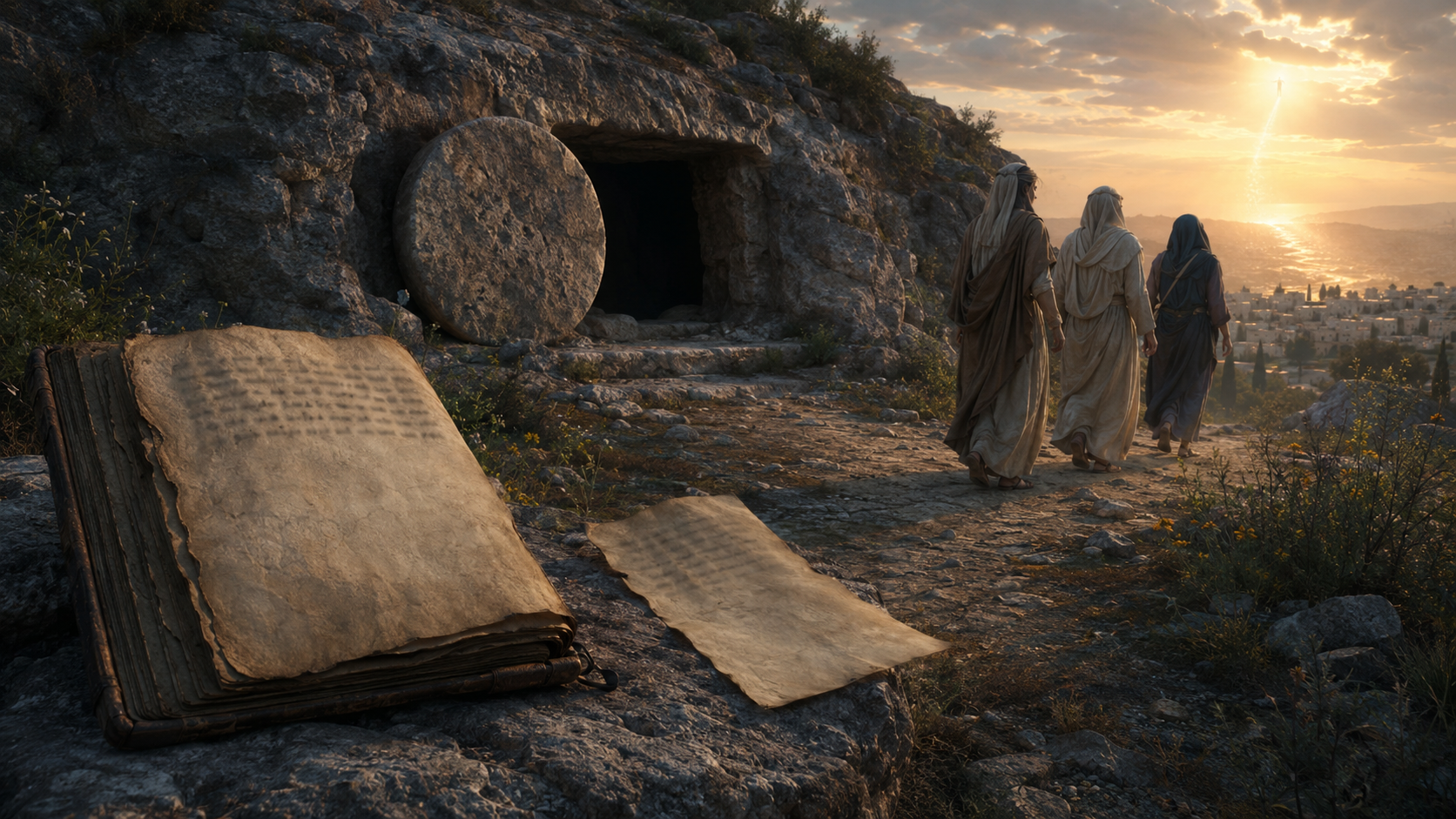
A reader reaches Mark 16:8 and finds the women fleeing the tomb. They tremble. They are amazed. They say nothing to anyone because they are afraid. Then, in many modern Bibles, a rule, bracket, or note interrupts the page. The next twelve verses remain in print, but the reader has been warned that the earliest witnesses do not contain them.
Wesley Huff places Mark 16:9–20 among the “extra passages” found in the Greek text followed by the King James translators but absent from older manuscripts. The description has the advantage of clarity. It also decides the case in the noun. An extra passage is not merely disputed; it is material beyond what the evangelist wrote. Before the evidence has been weighed, the canonical judgment has been made.1
There is no responsible way to defend the received ending by pretending the early omissions do not exist. Codex Sinaiticus and Codex Vaticanus end Mark at 16:8. Other witnesses transmit a shorter conclusion, the familiar longer conclusion, both conclusions, or the longer conclusion with additional material. The textual history is unusually visible. It cannot be answered by pointing to a verse number or by counting later copies without asking how their text is related.
But neither can the case be settled by converting two fourth-century codices into the memory of the whole church. Irenaeus cites Mark 16:19 as the conclusion of Mark in the second century. The longer ending is found across Greek, Latin, Syriac, Coptic, and other streams of transmission, and it became the ordinary ecclesiastical ending of the Gospel. Even those who judge it non-Markan generally acknowledge that it is ancient. The question is therefore not whether the passage appeared late enough to be dismissed as a medieval appendage. The question is whether this ancient, widely received ending belongs to Mark’s Gospel as given by God.
That question cannot be answered by reassurance. It requires a textual judgment, a canonical judgment, and a doctrinal judgment, each kept in its proper place.
Four endings and one unresolved history
The surviving witnesses do not present a simple contest between a universal eight-verse Gospel and a late twelve-verse supplement. They preserve several terminal forms.
The first form ends at verse 8: “for they were afraid.” Sinaiticus does this plainly, as its online transcription and image show. Vaticanus likewise closes Mark after verse 8 and leaves its following column blank, an unusual feature whose meaning remains disputed. The blank space proves that the scribe left a blank space. It may suggest awareness of a textual problem; it does not tell us which ending the scribe regarded as authentic.2
A second form adds a brief conclusion in which the women report to Peter and his companions, after which Jesus sends the proclamation of eternal salvation. This is commonly called the Shorter Ending. A third form contains Mark 16:9–20, the received Longer Ending. A fourth combines the Shorter and Longer Endings. Codex Washingtonianus contains the Longer Ending but expands it with the so-called Freer Logion after verse 14. These are not five equal candidates. They are evidence that the end of Mark was a place where copyists encountered, preserved, supplemented, or attempted to repair competing forms.
The early ending at verse 8 deserves its full force. Sinaiticus and Vaticanus are not imaginary witnesses, and the absence of verses 9–20 from both is not erased by calling them corrupt elsewhere. Eusebius knew copies that stopped at verse 8 and, in answering a harmonistic question, could appeal to that form. Jerome transmitted similar information. Modern critics also point to differences in vocabulary, transitions, and narrative presentation between verses 1–8 and verses 9–20.3
Yet the opposing evidence is not a bare medieval majority. Writing around the end of the second century, Irenaeus attributes verse 19 to Mark “towards the conclusion of his Gospel.” That citation is older than Sinaiticus and Vaticanus by well over a century. It does not prove what stood in the autograph merely by being earlier than our great codices; a writer may quote a secondary reading. It does prove that the Longer Ending was already circulating as Mark before the surviving fourth-century omissions. Any history that calls the passage an addition must place the addition early enough to account for Irenaeus and broad enough to account for its dissemination.4
John William Burgon made that positive, cumulative case at book length. He gathered manuscripts, versions, fathers, lectionary practice, scholia, and internal considerations in defense of the received ending. Some details in his nineteenth-century inventory require updating, and his confidence sometimes outruns what a modern reader will grant. His central objection remains unanswered by a slogan: omission from two eminent codices cannot be treated as though the rest of the ancient and ecclesiastical evidence were only repetition without history.5
The critical argument has a corresponding strength. Multiple endings are easier to explain if a stream of copies ended at verse 8 and later readers supplied conclusions than if the universally known authentic ending was independently replaced by several substitutes. That is a genuine explanatory argument. It is not direct observation of the first alteration. It must still explain why the Longer Ending was known so early, why it spread so widely, and why the received church treated it as Scripture.
The evidence thus establishes a divided early history. It supports competing explanations of that history with unequal probabilities. It does not permit the word extra to substitute for the argument.
The ending is part of the proposition
The attraction of ending at verse 8 is partly literary. Mark repeatedly portrays fear, failure, secrecy, and misunderstanding. The women’s flight can therefore be read as an intentionally disturbing conclusion that turns the command to tell the disciples toward the reader. On this account, the abruptness is art rather than damage.
That reading is possible. It is not demanded by the sentence. Verse 7 directs the women to tell the disciples and promises that they will see Jesus in Galilee. Verse 8 reports fear and silence. If the Gospel ends there, Mark narrates neither the women’s eventual report nor the promised meeting nor an appearance of the risen Christ. The angel’s announcement remains true within the story, but its announced fulfillment occurs beyond the story.
One may call that an open ending. One may also call it an interrupted narrative. The artifact does not choose between those literary judgments. Nor does the conjunction gar—“for”—make an ending impossible. Ancient works can end with a particle, though the construction is uncommon enough to remain part of the discussion. The proper conclusion is modest: verse 8 can function as an ending, but its ability to function as an ending does not prove that Mark intended it to be the ending.
The Longer Ending changes the completed shape of the book. It narrates appearances to Mary Magdalene, two travelers, and the eleven. It records Christ’s rebuke of unbelief, the worldwide commission, the relation of belief and baptism to salvation, promised apostolic signs, the ascension, the session at God’s right hand, and the disciples’ preaching with divine confirmation.
Most of those teachings appear elsewhere in the New Testament. Mary Magdalene encounters the risen Lord in John. Two disciples meet him on the road in Luke. Matthew supplies a worldwide commission and baptismal command. Luke and Acts narrate the ascension. The session at God’s right hand is taught throughout the apostolic writings. Acts records tongues, healings, exorcisms, and Paul’s survival of a serpent bite.
That canonical overlap is important, but it does not make the ending disposable. The proposition “the New Testament teaches Christ’s ascension” can be established without Mark 16:19. The proposition “Mark narrates Christ’s ascension” cannot. The proposition “apostolic signs accompanied the first preaching” survives elsewhere. The proposition “the risen Christ made the promises recorded in Mark 16:17–18” does not survive if those verses are not Mark.
The Martin Rule forbids a wider corpus from being used to conceal a local loss. It also forbids a local loss from being inflated into the destruction of a doctrine independently taught elsewhere. Mark 16 requires both restraints at once.
| Exact proposition | Result if Mark ends at 16:8 |
|---|---|
| Jesus was raised from the dead | Explicitly announced in Mark 16:6 |
| The disciples were promised a meeting with Jesus in Galilee | Explicitly stated in Mark 16:7 |
| Mark narrates a resurrection appearance | Not established |
| Mark records the worldwide preaching commission | Not established |
| Mark joins belief and baptism in the saying of 16:16 | Not established |
| Mark records the promised signs of 16:17–18 | Not established |
| Mark narrates the ascension and heavenly session | Not established |
| The New Testament as a whole teaches resurrection, commission, ascension, and session | Cumulatively established by other books |
| Mark intentionally concluded at verse 8 | Compatible with the shorter form, but not proved by its survival |
| Mark originally continued beyond verse 8 | Supported by narrative expectation and the ancient Longer Ending, but disputed by the terminal witnesses |
The table exposes the weakness of the phrase “no major doctrine is affected” when it is used without a stated object. If doctrine means the broad confession assembled from the entire critical corpus, the resurrection, ascension, and session remain. If it means everything taught by the disputed passage, then several propositions disappear from Mark. If it means the doctrine of inspiration, preservation, and canon, the question is larger still: twelve verses are either words breathed out by God and received in the church, or an ancient ecclesiastical composition placed beside them. That alternative is not made minor because much of the content has a parallel elsewhere.
What the two-codex argument cannot close
A critical reconstruction needs more than evidence against the Longer Ending. It needs closure against serious alternatives, beginning with the possibility that Mark wrote verses 9–20 and an early line of transmission lost them. Endings are materially vulnerable. A final leaf can disappear; a copy can be made from a damaged exemplar; liturgical stopping points can influence reproduction. The existence of the Shorter Ending and other supplements may then reflect attempts to repair a known defect. Burgon developed versions of this case, including the role of lectionary practice. Not every part of his reconstruction is equally persuasive, but the possibility cannot be excluded by pointing again to the copies that exhibit the loss.
The second alternative is that Mark wrote an ending now lost and that verses 9–20 are an ancient substitute. This is the common critical reconstruction when verse 8 is judged too abrupt. It explains both early omission and early circulation of the Longer Ending, but it purchases that explanation by positing a vanished original ending for which no wording survives. The hypothesis may be reasonable; it is not an artifact.
The third alternative is that Mark intended to stop at verse 8 and the church supplied one or more conclusions. That model avoids a lost autograph and explains the terminal diversity, but it must account for the speed with which the Longer Ending acquired Markan attribution and wide reception. Irenaeus leaves little time for an unnoticed supplement to become the conclusion of Mark across far-flung churches.
The fourth alternative is that the Longer Ending is authentic canonical material without being Mark’s first compositional ending. That proposal distinguishes authorial origin from canonical reception. It may appeal to an apostolic associate or an authorized completion. But a Protestant doctrine of immediate inspiration cannot rest content with an unnamed author and an unspecified act of authorization. The theory needs evidence that the church received a divinely authorized completion rather than merely an edifying one.
No model is free of inference. The critical model has significant early Greek support and a plausible explanation of the multiple endings. The received model has overwhelming ecclesiastical prevalence, ancient patristic attestation, and the advantage of preserving the Gospel’s received closure. The debate turns on the weight assigned to those kinds of evidence and on the doctrine by which the church recognizes an authentic text.
Huff’s popular account does not perform that work. By moving from “older manuscripts do not contain” to “extra passages,” it treats one conclusion of modern criticism as the description of the evidence itself. A fairer statement would say that two leading fourth-century Greek codices end at verse 8, that other early testimony knows the Longer Ending, that the manuscript tradition preserves several endings, and that modern critical editors judge verses 9–20 ancient but not original to Mark. The reader would then know which facts are artifacts and which conclusion belongs to the editors.
The same fairness is required of the received-text advocate. The Longer Ending cannot be defended merely because its removal would be alarming. The early omission, terminal diversity, and linguistic questions must be answered. Providential preservation is not permission to misstate the evidence. It is the theological framework within which all the evidence must be judged.
A Gospel does not end harmlessly
William Whitaker wrote before Sinaiticus was known to Europe, but he was not ignorant that the last chapter of Mark had been questioned. In his Disputation on Holy Scripture, he names it among passages rejected by Cajetan and then states the Protestant reception of the New Testament without conceding those doubts as the church’s rule. His testimony is not a fourth-century collation. It is evidence that the received ending belonged to the authentic New Testament confessed in the Reformed controversy.6
That historical location matters under the constitutional rule. Westminster’s later declaration that the Greek New Testament had been kept pure in all ages did not mean that the church possessed only enough readings to reconstruct an absent conclusion. It spoke within a church already reading Mark 16:9–20 as Scripture. A modern interpreter may reject that identification, but he may not quietly retain the confession’s words while giving them a meaning that accommodates their contrary.
The exact verdict at Mark 16 is therefore divided. The shorter form has formidable external support in Sinaiticus and Vaticanus, reinforcement from Eusebian testimony, and an explanatory advantage in accounting for multiple endings. A received-text defense that mentions only numerical majority has not met the case.
The Longer Ending is demonstrably ancient, explicitly attributed to Mark by Irenaeus, broadly transmitted, liturgically and ecclesiastically received, and deeply embedded in the Reformed text. A critical account that calls it simply an extra passage has not met that case either.
Doctrinally, ending at verse 8 does not erase the bodily resurrection from Mark; the empty tomb and angelic announcement remain. It does erase Mark’s narrated appearances, commission, ascension, session, and confirming signs. The wider critical corpus reconstructs most of the associated doctrines, but it cannot reconstruct the claim that Mark contains these words. The canonical and preservation consequences therefore remain even where systematic theology survives.
The evidence permits no declaration that nothing important changes, and it gives no license to ignore two old codices. The last twelve verses present a genuine contest between an early shorter form and an ancient, overwhelmingly received longer form. The history is too divided for a footnote to become an oracle and too consequential for “extra” to become a neutral adjective.
Mark must end somewhere. Where it ends determines not only the final sentence on the page but the final acts the evangelist places before the church. An abrupt flight and an ascended Lord are not interchangeable conclusions. Before one is removed from Mark, the burden is to prove more than that another ending once existed.
Notes and Further Reading
Series navigation: Previous: “Who Put John 5:4 into the Bible?” · Part 5 of 14 · Next: “The Woman They Put in Brackets”
- Wesley Huff, “One Bible, Many Versions”, October 13, 2020, under “History of the Text.” Huff groups Mark 16:9–20 and John 7:53–8:11 among “extra passages” included in the Greek manuscripts followed by the Authorized Version. ↩
- Codex Sinaiticus, Mark 16, official manuscript image and transcription. On the exceptional blank column in Vaticanus and competing interpretations of it, compare James Snapp Jr., “A Case for the Longer Ending of Mark”, with Peter M. Head, “A Case against the Longer Ending of Mark”. ↩
- Eusebius of Caesarea, Gospel Problems and Solutions, To Marinus 1, trans. David J. D. Miller, in the <a href="https://www.roger-pearse.com/weblog/wp-content/uploads/2015/12/EusebiusGospelproblemsandsolutions_2010.pdf”>complete English translation edited by Roger Pearse. Eusebius reports the shorter form while also discussing how the longer form may be read. ↩
- Irenaeus, Against Heresies 3.10.5, citing Mark 16:19 as the conclusion of Mark. ↩
- John William Burgon, The Last Twelve Verses of the Gospel According to S. Mark (Oxford: James Parker, 1871). Burgon’s work remains the major sustained traditional-text defense and should be weighed rather than invoked as a talisman. ↩
- William Whitaker, A Disputation on Holy Scripture, trans. William Fitzgerald (Cambridge: Parker Society, 1849), First Controversy, Question 1, chapter 16; and the discussion of passages once disputed in the following controversy. Whitaker identifies Cajetan’s rejection of “the last chapter of Mark” while maintaining the church’s reception of the New Testament. ↩