

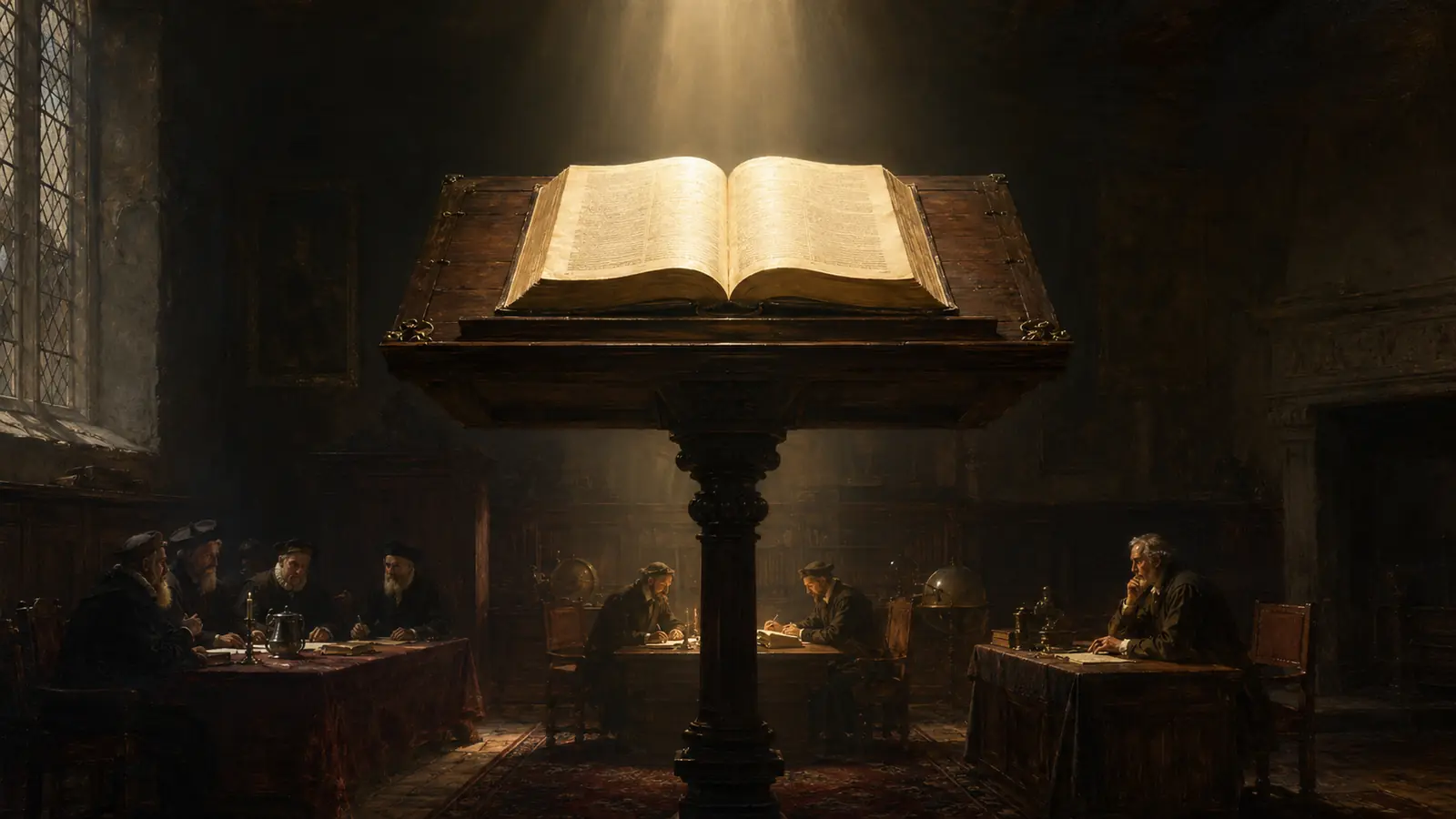
Revision note: Substantially revised July 20, 2026. The argument has been reordered according to the classical rhetorical movement, compressed where necessary, and given one consolidated Notes and Further Reading section.
Every doctrine of Scripture eventually confronts an epistemological question: How do we know that Scripture is the Word of God?
One answer says that Scripture must be authenticated by the church. Another makes historical scholarship the decisive court. Another appeals to religious experience, philosophical probability, or a supposedly neutral examination of the evidence. Each approach may acknowledge Scripture as an authority after its preferred tribunal has approved it. But in every case, the approving tribunal has become more ultimate than the authority it approves.
The Reformed confession begins elsewhere. Scripture is authoritative because God, who is truth itself, is its Author. Its authority does not depend upon the testimony of any man or church. The church’s testimony, Scripture’s public evidences, and rational argument all have important uses, but the full persuasion and assurance of Scripture’s infallible truth and divine authority arise from the inward work of the Holy Ghost bearing witness by and with the Word in the heart.1
This is the doctrine of the self-attesting Word.
It does not mean that a Christian closes his eyes, repeats that the Bible is true, and refuses to consider objections. It does not make private conviction infallible. It does not forbid historical evidence, logical argument, or the study of manuscripts. It identifies the proper order of authority: God’s speech carries God’s authority and must be received upon His testimony. Every creaturely means of knowing and defending that speech serves beneath it.
The doctrine also entails that religious neutrality is impossible. God is not one possible conclusion awaiting the independent judgment of autonomous man. He is the Creator in whom all men live, move, reason, interpret evidence, and possess knowledge. The person examining Scripture is already God’s creature, already surrounded by revelation, and already morally accountable for his response to it.
There is no view from nowhere. There is only faithful or unfaithful interpretation of the world God made and the Word He spoke.
What Self-Attestation Means
To say that Scripture is self-attesting is to say that God identifies and authenticates His Word through the Word itself, attended by the testimony of the Holy Ghost.
The authority is not created by the believer’s recognition. Scripture was God’s Word before we believed it and remains God’s Word when men reject it. Nor is its authority produced by an inward sensation. The believer does not feel intensely and then project divine authority upon a book. He encounters in Scripture the objective speech of God, and the same Spirit who inspired that speech enables him to recognize and receive it for what it is.
Several distinctions are necessary.
First, Scripture’s authority and our recognition of that authority are not identical. God’s authorship is the ground of authority. The Spirit’s illumination is the cause of our saving recognition. Confusing the two makes either the church or the individual the source of Scripture’s authority.
Second, self-attestation does not mean that every sentence bears an isolated declaration saying, “This sentence is inspired.” Scripture attests itself as a unified covenantal revelation. Its direct claims, divine qualities, redemptive unity, fulfilled promises, moral perfection, efficacy, historical acts, and presentation of Christ belong to one whole testimony. The parts mutually illuminate one another because one Spirit speaks through them.
Third, self-attestation is not self-authorization by a creature. A man cannot make his opinion ultimate merely by declaring himself trustworthy. Scripture’s self-attestation is the testimony of the self-existent, truthful God. The doctrine depends upon who God is, not upon the bare logical form of a claim referring to itself.
Fourth, the doctrine does not say that evidence is absent. It says that the evidence does not stand above God as a court with authority to grant or withhold His right to speak. Scripture bears abundant public marks of its origin, but those marks are the effects and expressions of divine authorship, not a collection of independent authorities from which divinity is manufactured.
God’s Word is therefore received because God speaks. That reception is rational, evidential, historical, spiritual, and moral, but it is never autonomous.
No Higher Authority Can Authenticate the Highest
The demand that Scripture be proved by a standard more certain than Scripture contains a contradiction. Whatever finally authenticates an alleged supreme authority has become more supreme than the authority it authenticates.
Suppose the church makes Scripture authoritative. The church is then the highest court, because Scripture rules only after the church confers jurisdiction upon it. Suppose autonomous reason decides which claims in Scripture are worthy of belief. Reason becomes supreme because God’s speech is restricted to what reason permits. Suppose a historical method determines whether God has spoken and whether He has preserved His Word. The method has become the judge of revelation and providence.
Attempting to authenticate each standard by another also produces an endless regress. If Scripture needs the church, what authenticates the church? If historical evidence authenticates the church, what authenticates the rules by which that evidence is interpreted? If reason authenticates those rules, what authenticates reason? At some point every system reaches commitments it treats as basic and through which it evaluates everything else.
The question is not whether there will be an ultimate standard. The question is which standard can bear ultimacy without contradiction.
The Christian answer is the triune God speaking in Scripture. God cannot appeal to a more truthful witness, a more comprehensive knower, or a more authoritative court. “For when God made promise to Abraham, because he could swear by no greater, he sware by himself.” His inability to appeal higher is not a defect in His testimony. It is the necessary consequence of His supremacy.2
The creature must reason from God rather than attempt to reason to a position above Him. This does not abolish demonstration. It establishes the foundation that makes demonstration, truth, language, logic, and evidence intelligible.
Scripture Claims the Prerogative of Divine Speech
The self-attesting character of Scripture is not a philosophical ornament later attached to the Bible. It follows from Scripture’s own account of revelation.
The prophets announce, “Thus saith the Lord.” They do not first ask Israel to authenticate God by an agreed religious method. God’s covenant people are commanded to hear because their covenant Lord speaks. Isaiah sends the people “to the law and to the testimony” and says that contrary speech has no light in it. The Lord’s own words distinguish the true prophet from the presumptuous one.3
Christ treats the written Word as possessing an authority that cannot be broken. He answers temptation with “It is written,” condemns tradition that nullifies God’s commandment, and resolves controversy by asking, “Have ye not read?” Scripture is not authenticated by the scribes who interpret it. Their teaching is judged by Scripture.4
The apostles speak in the same manner. Paul identifies Scripture as God-breathed and therefore sufficient to furnish the man of God completely. Peter grounds the prophetic word not in human will but in men speaking from God as they were carried by the Holy Ghost. The Thessalonians are commended for receiving the apostolic message “not as the word of men, but as it is in truth, the word of God.”5
These claims are not embarrassed attempts to escape external verification. A revelation that never identified itself as divine could not obligate its hearers to receive it as divine. God’s Word necessarily announces its source and authority.
Its testimony is also confirmed throughout redemptive history. Prophecies are fulfilled. Christ rises publicly from the dead. Apostolic witnesses distinguish sight from fable. The gospel transforms sinners and creates a church across nations. Scripture explains the world, the human conscience, sin, judgment, redemption, and history with a coherence no rival account can supply. Self-attestation includes rather than excludes these evidences, but it interprets them as works and marks of the God who speaks.
The Inward Testimony of the Holy Ghost
If Scripture possesses such evidence, why do all readers not believe it?
The Reformed answer is not that Scripture lacks clarity or authority until the Spirit adds a missing argument. The problem lies in the sinner. The same light that reveals also exposes, and fallen man does not welcome the verdict it renders concerning God and himself.
The Westminster Confession first acknowledges that the church’s testimony may move us to reverence Scripture and that the Word displays many excellencies: the heavenliness of its matter, efficacy of doctrine, majesty of style, agreement of all its parts, God-centered scope, revelation of the only way of salvation, and entire perfection. It then says that full persuasion of Scripture’s infallible truth and divine authority comes from “the inward work of the Holy Spirit bearing witness by and with the Word in our hearts.”6
The words by and with the Word are indispensable.
The Spirit does not whisper a second canon into the believer’s mind. He does not supply private information by which the public text may be corrected. He does not detach assurance from meaning, evidence, or exegesis. He works through and alongside the Scripture He inspired, opening the heart to attend to what God says, removing hostile blindness, and producing a well-grounded recognition of the divine voice.
Calvin therefore argues that Scripture exhibits its own evidence as clearly as white and black things exhibit their color, yet only those inwardly taught by the Holy Spirit truly rest in its authority. Scripture is self-authenticated, while the Spirit seals upon the heart the certainty that God speaks in it.7
This testimony is personal without being private in its object. Christians across nations and centuries hear the same canonical Word. It is spiritual without being irrational. The Spirit restores the sinner to right reason; He does not reward incoherence. It is certain without making the believer infallible. A Christian may possess settled assurance that Scripture is God’s Word while misunderstanding a verse, mishandling evidence, or defending a false textual conclusion.
Appeal to the Spirit can never end legitimate examination with the claim, “I feel certain, therefore I cannot be wrong.” The inward witness establishes Scripture’s authority, not the perfection of every interpretation made by an illuminated reader. Every claimed insight remains subject to the Spirit speaking in the whole of Scripture.
The Fear of the Lord Is the Beginning of Knowledge
The impossibility of neutrality follows from the created character of human knowledge.
“The fear of the Lord is the beginning of knowledge.” This does not mean that reverence for God is an advanced religious addition to an otherwise independent body of facts. It is the principial beginning—the governing orientation—of knowledge. In Christ “are hid all the treasures of wisdom and knowledge.” Paul therefore warns against a philosophy ordered according to human tradition and the elements of the world “and not after Christ.”8
Every fact and every human mind is created. Logic does not form an independent realm above God; it belongs to the ordered world upheld by the God of truth. Neutrality would require the creature to suspend this relation while deciding whether it exists. Yet a man cannot cease being God’s image-bearer, step outside creation, and then judge impartially whether the Creator deserves acknowledgment.
Genesis 3 displays the contrary posture. “Yea, hath God said?” invites the creature to place God’s truthfulness and threatened judgment before her own imagined jurisdiction.9 Christian knowledge reverses that rebellion. It begins not with omniscience or immunity from correction, but with repentance: God is God, His Word is true, and every thought must be brought captive to Christ.10
The Knower Is Morally Involved
Modern discussions often describe unbelief as though the unbeliever were an innocent observer who lacked sufficient information. Scripture gives a more searching account.
Romans 1 says that what may be known of God is manifest because God has shown it. His invisible attributes are clearly perceived in the created order. All men know God, yet they do not glorify Him as God or give thanks. They suppress the truth in unrighteousness, become vain in their reasonings, and exchange the truth of God for a lie.11
The unbeliever therefore lives within revelation while resisting its Author. This explains how he may perform valid calculations, preserve historical facts, and identify copying errors while remaining foolish at his foundation. The image of God remains, common grace restrains sin, and creation still discloses its Maker; but a governing principle of independence falsifies the meaning of what he knows.12
Bahnsen’s analysis of self-deception describes the mechanism without replacing the biblical diagnosis. Adverse evidence may be distorted, overemphasized, suppressed, or misconstrued to protect a desired conclusion.13 Romans 1 identifies the deepest instance: fallen man enlists reasoning in the suppression of what God manifests.
This must not be used to declare that every disagreement is conscious dishonesty. We cannot ordinarily know the precise motives operating within another person. Christians themselves engage in rationalization and require correction. The doctrine identifies the covenantal condition of fallen reasoning; it does not authorize us to invent psychological accusations against particular opponents.
No Neutrality Does Not Mean No Fairness
The denial of neutrality is sometimes abused as an excuse for partisanship. A writer assumes that because every person has presuppositions, accuracy no longer matters or contrary evidence may be ignored. That conclusion is the opposite of biblical reasoning.
There is no neutrality because every person owes allegiance to God. That universal obligation increases rather than diminishes our duty to speak truth. The ninth commandment still forbids false quotation, selective evidence, exaggeration, and the imputation of unproved motives. The laws of valid inference do not become optional because logic is God’s gift.
Christian objectivity is not the absence of covenantal commitment. It is the disciplined attempt to see and report things as they truly are before God. A Christian should be more willing to acknowledge an inconvenient fact because truth belongs to God. He should present the strongest form of an opponent’s case because a victory over a caricature does not defend the faith. He should distinguish observation, inference, consequence, and motive because God does not need confusion to vindicate His Word.
Likewise, identifying an opponent’s governing presupposition does not answer his subordinate argument automatically. A scholar may begin from a false account of Scripture and still state a manuscript’s reading accurately. A Christian may confess preservation and still misread the same page. Worldview analysis and detailed evidence must both be performed.
Non-neutrality explains the moral and epistemic setting of the controversy. It never relieves us of the obligation to do the work.
Common Ground Without Neutral Ground
If believer and unbeliever have opposing principles, can they reason together?
They can because they inhabit the same world, bear the same divine image, encounter the same revelation, and use intellectual capacities given by the same God. There is abundant common ground in creation and providence. There is no religiously neutral interpretation of that common ground.
The unbeliever knows many true things because he cannot live consistently with professed independence. When he trusts memory, demands logical consistency, condemns injustice, or expects nature to exhibit order, his practice is better than his ultimate theory. The Christian may therefore appeal to facts, expose contradictions, and reason patiently—not to transport both parties to an autonomous platform, but to address an image-bearer already standing in God’s world.
Evidence Is Necessary but Never Sovereign
Self-attestation is sometimes confused with fideism—the idea that faith requires an irrational leap without evidence. Scripture permits no such retreat.
Luke writes an orderly account grounded in eyewitness testimony so that Theophilus may know the certainty of the things taught. Paul identifies witnesses of Christ’s resurrection, many still living when he writes. Peter distinguishes apostolic eyewitness from cunningly devised fables. John appeals to what the apostles heard, saw, looked upon, and handled. The prophets identify fulfilled words as confirmation that the Lord spoke.14
Christian faith concerns public acts in history. Evidence matters because God acted. Reason matters because God communicates truth in meaningful propositions and commands His people to understand. Historical investigation matters because Christianity does not announce a timeless myth.
The ministerial use of evidence asks: What has God revealed, what has He done, and how do the facts display His truth? The magisterial use asks: What portion of God’s claimed revelation will an independent standard permit us to retain? The same artifact may be placed within either order.
This distinction is especially important for textual evidence. Manuscripts, versions, citations, lectionaries, and editions are not obstacles to faith. They are providential witnesses to be examined accurately. But their meaning is not self-interpreting. A manuscript cannot tell the scholar what doctrine of preservation to hold, whether the church’s historical reception is relevant, what level of certainty Christians may possess, or which criteria ought to govern competing readings. Those judgments arise within a broader account of revelation and knowledge.
Evidence can correct our factual mistakes. It can expose a reading we attributed to the wrong witness, a historical claim unsupported by the record, or an inference our doctrine never required. It cannot occupy a throne from which God’s promise of preservation is placed on probation.
The issue is not evidence versus faith. It is evidence interpreted faithfully or faithlessly.
Is Self-Attestation Viciously Circular?
The most common objection is that the Christian uses Scripture to prove Scripture.
If the argument were merely, “The Bible is true because the Bible says the Bible is true,” with no account of God, revelation, evidence, or rival standards, the objection would identify a shallow presentation. But that is not the Reformed case.
Every ultimate standard must be involved in its own defense. The rationalist uses reason to defend reason; the empiricist uses interpreted experience to defend empiricism; the ecclesiastical infallibilist relies upon the church’s claimed authority to identify the infallible church. Employing a superior standard would surrender finality.
The distinction is between an arbitrary circle and the necessary self-attestation of the ultimate authority. A private claimant’s assertion lacks Scripture’s divine identity, public revelation, historical action, coherence, moral perfection, and explanatory power. Rival books remain open to examination. Their claims, history, view of God, account of salvation, and capacity to make knowledge intelligible must be tested.
Scripture reveals the triune God who guarantees truth, makes the world knowable, accounts for both the dignity and corruption of reason, and reveals the historical Christ. This does not place a neutral proof above Scripture. It shows that attempted proof already depends upon the world Scripture reveals: God is the foundation of every fact and inference.
The False Neutrality of “Treating the Bible Like Any Other Book”
The consequences become concrete in textual criticism.
A common proposal says that the Bible should initially be treated like any other ancient text. Inspiration and preservation are to be bracketed while the critic reconstructs the earliest attainable wording by ordinary historical methods. Theology may be applied afterward to whatever text the process delivers.
That procedure is not neutral. Classifying Scripture as an ordinary text for purposes of determining its identity already makes a theological judgment about Scripture. Bracketing providence does not leave the evidence uninterpreted; it interprets the evidence as though God’s promises and the church’s reception could have no governing significance. Restricting knowledge to the conclusions permitted by a reconstructionist method makes that method the operative authority.
Confessional Bibliology does not answer by inventing a separate set of paleographical facts or refusing technical methods shared with other disciplines. A manuscript’s date does not change according to the examiner’s confession. Ink remains ink, and an omission remains an omission. Christians may learn much from the accurate work of scholars who reject their doctrine.
The disagreement concerns the identity and total history of the object, the principles by which facts are related, and the authority assigned to conclusions. Scripture must be examined as what it is: God’s inspired, preserved, ecclesiastically received Word. A method that requires the Christian to deny or suspend that identity as the price of admission has not achieved impartiality. It has required methodological unbelief.
The faithful alternative is ministerial inquiry. It brings every technical skill to the evidence while confessing the God who governs it. It permits evidence to correct the critic without permitting the critic to constitute Scripture. It recognizes particular readings through exegesis, textual history, and ecclesiastical reception under the prior certainty that God has spoken and kept His Word.
What This Requires of Confessional Bibliology
This publication does not ask readers to accept its arguments because the phrase self-attesting Word appears in them. The doctrine governs the site and also judges it.
Every principal doctrinal claim must be grounded in Scripture. The Reformed confessions serve as subordinate standards. Historical and textual claims must be supported by public evidence. Arguments must be valid, opposing qualifications acknowledged, and demonstrated errors corrected.
The site will not pretend to approach Scripture from outside Christian commitment. Its controlling allegiance is explicit. But explicit commitment does not predetermine every factual conclusion, excuse weak scholarship, or make the writer’s present interpretation infallible. Because God is truth, submission to Him requires readiness to abandon any claim shown to be false.
Nor will institutional standing be treated as an epistemic substitute. An officer or scholar may speak truly and deserve careful hearing; a layman may speak falsely and require correction. Yet credentials cannot authenticate Scripture, and status cannot refute an argument. Every participant remains a creature beneath the Word.
The Christian does not place Scripture in the dock and offer God a fair hearing. He receives the Judge’s sentence, examines every other claim in its light, and uses reason and evidence as gifts belonging to Him.
Notes and Further Reading
- Westminster Confession of Faith 1.4–5. ↩
- Hebrews 6:13–18. See also Titus 1:2 and Hebrews 6:18 concerning the impossibility of falsehood in God. ↩
- Isaiah 8:20; Deuteronomy 18:18–22; Jeremiah 1:9; 23:28–32. ↩
- Matthew 4:4, 7, 10; 15:1–9; 19:4–6; 22:29–32; John 10:34–35. ↩
- 2 Timothy 3:16–17; 2 Peter 1:19–21; 1 Thessalonians 2:13. ↩
- Westminster Confession of Faith 1.5; see the linked original text in note 1. ↩
- John Calvin, Institutes of the Christian Religion 1.7.4–5. ↩
- Proverbs 1:7; 9:10; Colossians 2:3, 8. ↩
- Genesis 3:1–6. ↩
- 2 Corinthians 10:4–5; Romans 12:1–2. ↩
- Romans 1:18–25, 28–32. ↩
- Ephesians 4:17–19; Romans 8:5–8; 1 Corinthians 2:12–16. ↩
- Greg L. Bahnsen, The Apologetic Implications of Self-Deception, chapter 5, especially 145–50. Bahnsen describes self-deception as motivated rationalization in which adverse evidence is distorted, overemphasized, suppressed, or misconstrued to avoid an unwelcome truth. ↩
- Luke 1:1–4; Acts 1:1–3; 1 Corinthians 15:3–8; 2 Peter 1:16–19; 1 John 1:1–4; Deuteronomy 18:21–22. ↩
Continue beyond this introduction
Follow the guided path, examine controlled research records, or work directly with the primary and historical sources.
Comments
Share a question or response to this article.