

Part I: The Revision That Changed Its Object · Article 3 of 6
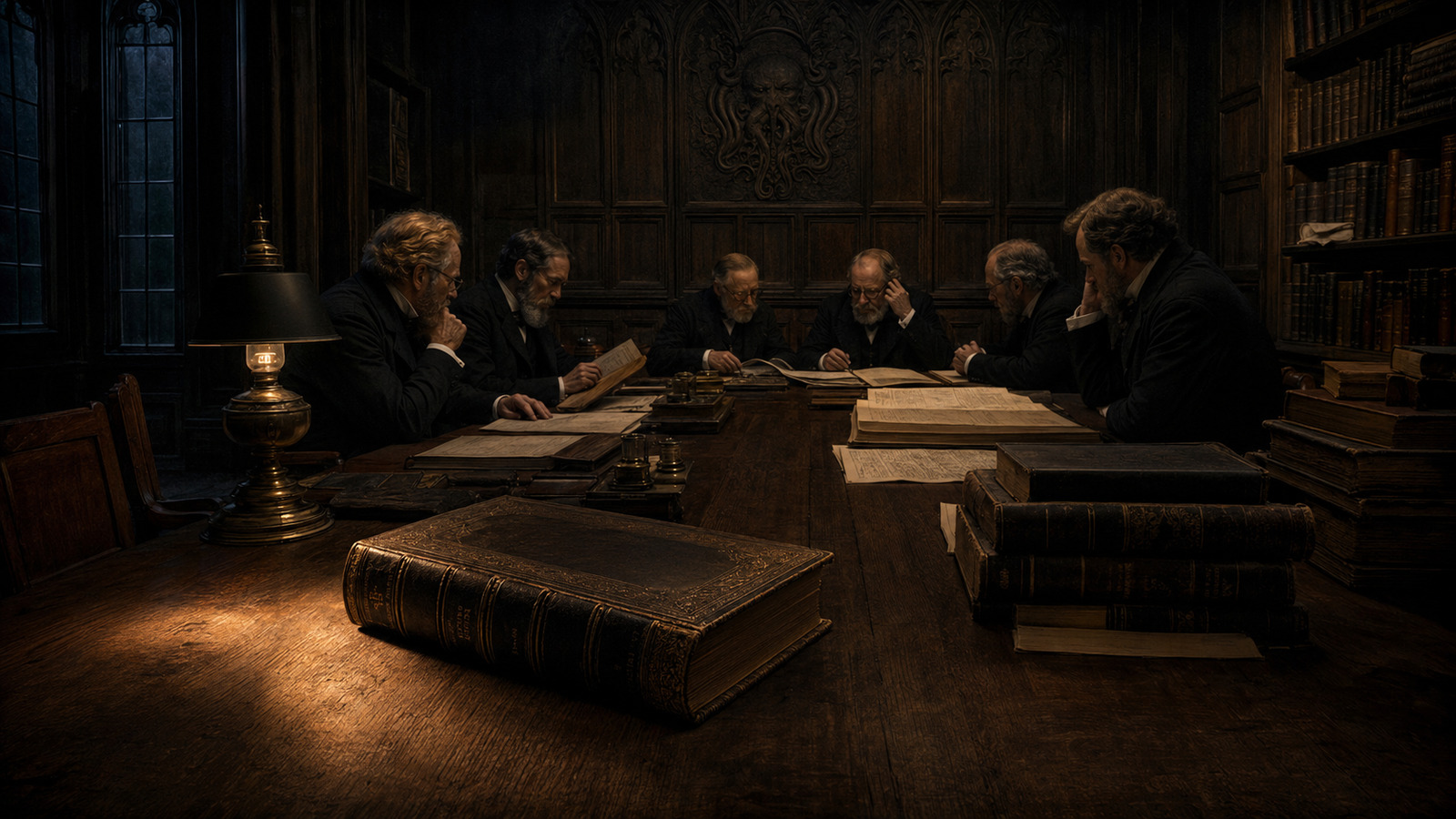
When Fenton John Anthony Hort accepted appointment to the New Testament Revision Company in May 1870, he did not come to the Jerusalem Chamber empty-handed.
For more than seventeen years, Hort and Brooke Foss Westcott had been constructing a Greek New Testament of their own. The project began in the spring of 1853. Its stereotype plates had already been in preparation for years. Its leading views, they later said, had not been abandoned during the long labor, though those views had grown clearer and more comprehensive.1
This chronology does not prove dishonesty. It proves something more basic and historically indispensable: the textual alternative that entered the Revision was not generated by the committee’s collective deliberation. It preceded the committee. Westcott and Hort brought to the work a developed reconstruction, a settled distrust of the received text, and an account of textual transmission that had matured over nearly two decades.
The Revision Company would vote. Other critics would resist. The resulting Greek basis would not be identical to Westcott and Hort’s edition. Yet the committee’s formal openness must not be confused with methodological neutrality. One of the most powerful positions in the room had been built before the room was assembled.
Before the Joint Project
Hort’s surviving correspondence shows that his rejection of the Textus Receptus was already vigorous by the end of 1851.
Writing to John Ellerton while studying Paul’s Epistles, the twenty-three-year-old Hort described his excitement over critical editions and manuscript variants. In the same letter he called the Textus Receptus “villainous” and “vile,” complained of its dependence on late manuscripts, and welcomed the availability of earlier ones.2
These are private words, not a published demonstration. They should be used with restraint.
They do not establish the character of every reading in the Textus Receptus. They do not prove that Hort had already worked out his later genealogical argument. They do not permit a biographer to turn youthful vehemence into a complete account of his motives. Most importantly, they do not answer the textual question by themselves. A harsh adjective is not evidence for or against a Greek reading.
The letter does establish disposition. Before the joint edition was conceived, Hort did not regard the received text as an authentic ecclesiastical standard awaiting careful defense. He regarded it as a defective late form from which critical editions and earlier manuscripts offered liberation.
That settled posture matters because it reverses a common picture of the history. Westcott and Hort were not driven from confidence in the received text by discoveries made during the 1870 Revision. Hort’s distrust was explicit in 1851. Their reconstructive project began in 1853. Convocation did not appoint the Revision Company until 1870.
The rejection came first.
The Walk at Umberslade
Hort’s son and biographer located the definite beginning of the joint plan during a walk in early 1853. Hort was staying at a hydropathic establishment near Knowle because of a recurring skin disorder. Westcott visited him there, and during their walk the two men agreed upon “a joint revision of the text of the Greek Testament.”3
Their own published account gives the intellectual reason. In the spring of 1853, they said, difficulties encountered in their study of Scripture led them to project a text. Students dissatisfied with the received editions then had Lachmann and an early Tischendorf text as principal alternatives, but Westcott and Hort could not accept either as a sufficiently satisfying approximation to the apostolic words. They began to form a manual text for their own use, hoping it might later serve others.4
The description is revealing in two directions.
It shows genuine scholarly labor. They were not merely copying a fashionable edition. They found existing critical texts inadequate, worked independently, compared conclusions, and repeatedly argued through differences. The enterprise demanded years of collation, classification, interpretation, and revision.
It also states the controlling premise. The “Received” texts were untrustworthy, and the apostolic words had to be approximated by a new editorial construction. The text possessed by the church was not the governing rule of the work. It was one historical form among others, liable to replacement by a reconstruction closer to the lost original.
That premise is restorationist. The authentic text is sought behind the received form as the product of critical recovery.
Seventeen Years of Preparation
The interval between 1853 and 1870 was not empty.
Westcott and Hort divided the labor in a way intended to check individual caprice. Each first worked independently. Only after reaching provisional results did they compare them. Differences were discussed in writing, sometimes repeatedly, until agreement or an acknowledged alternative remained. They later emphasized that no individual mind is free from inconsistency or idiosyncrasy and argued that the convergence of two different minds gave them greater confidence.5
This discipline deserves accurate recognition. It is a serious attempt to correct personal bias.
But two independent editors working under a shared restorationist premise do not escape that premise. Agreement between them may show that a result was not a momentary whim. It does not show that their joint method possessed authority to constitute the church’s text.
During the long preparation, their leading views remained stable enough for them to say in 1881 that they had found no reason to change them. What developed most was their appreciation of the history of transmission.6 Individual variants would be judged not only by counting manuscripts or assessing a reading in isolation, but by classifying textual relationships and identifying streams of transmission. Later articles will examine the theory itself. Here the point is chronological: its foundations and habits of judgment were cultivated before the Company began its work.
The edition had also moved beyond private notes. In July 1870, less than a month after the Company’s first sessions, Hort told a friend that the Greek text had been in preparation “for above seventeen years” and “in the press for some years.” He expected publication in the following year and said the Revision had decided them to issue the Gospels separately as soon as the stereotype plates could be reexamined.7
A text already in stereotype was not a loose collection of possibilities. It was a developed editorial product.
What They Brought into the Jerusalem Chamber
Westcott and Hort brought at least four things into the Revision Company.
They brought a complete project. The work extended across the New Testament and had occupied them for seventeen years.
They brought settled negative judgment. The received text was not presumed authentic; it was treated as an unreliable modification of the textual history.
They brought positive readings. Their plates embodied concrete decisions that could be placed before the Company as alternatives to the readings presumed to underlie the Authorized Version.
They brought a method. Even before its full published exposition, the work reflected judgments about documentary weight, textual relationship, internal probability, and the history of transmission.
None of this means the Company became a ceremonial shell. The private edition did not possess formal authority. Scrivener represented an opposing school. Members could speak and vote as they judged proper. The final Revisers’ text was more conservative and differed from Westcott and Hort at numerous places.
The point is not formal control. It is asymmetry.
A member who approached a disputed reading with only the printed apparatus before him had to assemble a judgment within the pressure of committee work. Westcott and Hort approached with seventeen years of coordinated decisions, an articulated historical account, prepared plates, and two mutually reinforcing advocates. Their position had a depth, continuity, and ready application no improvised opinion could match.
That asymmetry would become more important once the private sheets were distributed.
Development without a New Beginning
The seventeen-year chronology should not be misunderstood as though the edition stood unchanged from the first walk at Umberslade.
Westcott and Hort continued to learn. New collations became available. Tischendorf published additional work. Tregelles advanced his edition. Individual readings were reconsidered, and the editors’ account of transmission gained precision. Their eventual Introduction was not a diary entry preserved from 1853.
Yet their own retrospective description emphasizes continuity as well as development. They said they had found no reason to change any of the leading views with which they began preparing for the task. The long interval brought clarity and comprehensiveness, especially concerning textual transmission, rather than a return to the received-text premise they had rejected.8
That combination is important. The project was neither a frozen youthful opinion nor an open inquiry with no governing direction. It was a sustained reconstruction whose fundamental orientation survived years of refinement.
By 1870 the Company therefore encountered more than two scholars with private preferences. It encountered the mature stage of a program: the received editions were unreliable; manuscript witnesses had to be evaluated through their transmission history; and a new continuous text could approximate the apostolic words more satisfactorily than the ecclesiastical standard then in use.
The Revision supplied a new testing ground and accelerated publication. It did not supply the premise.
This is also why the phrase private Greek New Testament must not be reduced to unpublished opinion. A continuous text coordinates decisions across books and passages. It reveals how the editors’ principles behave when they cannot be adjusted only for one celebrated variant. By the time its portions reached the Revisers, that coordination had already been performed.
The Strongest Defense
The strongest defense of Westcott and Hort begins with an obvious truth: expertise is usually prior to appointment.
No serious committee recruits scholars on the condition that they have formed no views. Scrivener had textual principles before 1870. Tregelles, Tischendorf, Lachmann, and Burgon did not become blank slates when entering controversy. A Greek scholar asked to deliberate on thousands of variants is valuable precisely because he has studied them in advance.
Westcott and Hort’s preparation can therefore be described as a qualification, not a corruption. Their independent comparison reduced impulsive judgment. The long delay allowed reconsideration. Their edition was not formally imposed. Its readings still faced discussion and voting. The Company benefited from having a detailed alternative ready for examination.
All of that is true.
The answer is not that specialists should have arrived ignorant. The answer is that prior expertise does not make the Revision Company the origin of the method it later embodied. Nor does expertise answer the theological question of jurisdiction.
If the public is told only that a broad ecclesiastical company examined the evidence and reached corporate conclusions, it may imagine the new textual basis emerged neutrally from the collective process. The chronology shows otherwise. A principal alternative—supported by men whose influence would prove exceptional—was a private reconstruction nearly two decades in the making.
That fact does not discredit the edition by association. It locates the source of its methodological force.
No Biographical Shortcut
This history is dark enough without legends.
Westcott and Hort have sometimes been attacked through stories about occult interests, spiritualism, doctrinal fragments, or private associations. Such material is often used as if a biographical accusation could settle the text of the New Testament. It cannot.
Even when a quotation is genuine, several questions remain: What did the writer mean in context? When did he write it? Did the view persist? What connection does it have to a stated textual principle or a particular reading? Does the textual argument stand or fail on its own evidence?
The present case does not need an occult biography. It rests on primary documents about the edition itself.
Westcott and Hort said when they began. They described their procedure. Hort recorded his early hostility to the received text. He stated that the work had been in press for years before the Revision. Their published Introduction defined the project as another attempt to determine the original words.
Those facts supply the relevant indictment: not secret wickedness inferred from unrelated anecdotes, but a restorationist textual project entering an ecclesiastical revision under the authority of expert reconstruction.
The method should be judged as method.
The Historical Verdict
What did Westcott and Hort bring to the Revision Company?
They brought a private Greek New Testament begun in 1853 and already in advanced preparation by 1870. They brought a longstanding conviction that the received text was untrustworthy. They brought a collaborative process designed to reach and stabilize independent critical judgments. They brought the early form of a transmission theory that would later be published in full.
They did not bring a text already adopted by Convocation. They did not possess legal power to command the Company’s votes. They did not prevent Scrivener or other members from opposing them. Their eventual printed text was not identical to the Greek basis represented by the Revised Version.
The historically responsible conclusion lies between denial and melodrama.
The Revision Company did not create Westcott and Hort’s reconstruction. It became the first great institutional setting in which that reconstruction could operate before its full public exposition. The men entered as Revisers, but they carried a rival exemplar whose formation had begun seventeen years before their appointment.
That prior work helps explain why the Revision could change not only English phrases but the standard by which those phrases were judged.
The Confessional Analysis
Prior preparation is not itself the doctrinal problem. The object and order of the preparation are.
A ministerial textual scholar can spend decades collating witnesses to the received text. He may document agreements, isolate corruptions, compare editions, and correct a demonstrable printing accident. His learning is prior to the committee, but his authority remains posterior to Scripture. He does not approach the authentic text as an absent product to be formed.
Westcott and Hort described a different task. The received editions were untrustworthy. The apostolic words had to be approximated through a new text. Their editorial judgment therefore stood between the extant witnesses and the words the church was to receive as original.
This is not “arbitrary” in the careless sense of random. Their work was laborious, reasoned, and constrained by evidence. The more exact descriptions are editor-dependent and methodologically stipulated. The result depended on their judgments about textual history and on principles by which witnesses acquired or lost weight.
That is sufficient for the confessional objection. An authentic Scripture kept pure in all ages cannot be merely the inaccessible terminus toward which successive expert editions move. The church must possess a rule capable of judging experts, not wait for experts to constitute the rule.
Evidence has a noble ministerial use. It becomes magisterial when its editorial interpretation determines what may continue to stand as Scripture.
The Exact Doctrinal Entailment
This article establishes four propositions.
First, Westcott and Hort’s Greek text was not a by-product of the 1870–1881 Revision. Its construction began in 1853.
Second, Hort’s rejection of the Textus Receptus preceded the joint project, and the joint project began from the stated premise that the received editions were untrustworthy.
Third, the long preparation gave Westcott and Hort a developed textual alternative and methodological advantage when they entered the Company.
Fourth, neither long labor nor corporate influence supplies divine authenticity. A reasoned reconstruction remains a reconstruction.
The next question is how this private text moved from stereotype plates into the hands of the Revisers.
Ministerial Application
When an expert body announces that it has considered the evidence, ask what its principal participants had already built.
Which edition supplied the initial alternatives? Which theory classified the witnesses? Which readings were available in ready form? Which members had spent years coordinating their judgments? Was the governing theory public, complete, and open to equal scrutiny when the institution began using its results?
These questions do not presume bad faith. They disclose methodological inheritance.
Institutions often receive more than conclusions from their experts. They receive the experts’ categories: what counts as early, what counts as derivative, what demands explanation, and which form of the text needs to justify itself. Once those categories become normal, later votes may be genuinely free while remaining bounded by a framework few participants constructed.
The church must therefore test not only individual readings but the office claimed by the method that presents them. Long preparation can produce extraordinary learning. It can also give a private reconstruction the practical force of a public standard.
In 1870, the Company opened its work in the Jerusalem Chamber. Westcott and Hort entered with seventeen years already behind them.
What This Article Has and Has Not Proved
Proved: Westcott and Hort began their joint Greek New Testament in the spring of 1853; Hort’s strong distrust of the Textus Receptus was explicit by late 1851; the edition had been in preparation for more than seventeen years and in press for years when the Revision Company began; and its stated aim was to determine an approximation to the apostolic words beyond the received editions.
Not proved: That prior preparation was inherently dishonest; that Westcott and Hort possessed formal control of the Company; that their complete theory was already fixed in every detail in 1853; that their edition and the Revisers’ textual basis were identical; or that biographical rumors decide any Greek reading.
Established for the next article: A developed private text existed before the Revision. The next question is how successive portions were circulated to the Company under conditions of limited publication before the full theoretical case appeared.
- B. F. Westcott and F. J. A. Hort, Introduction to the New Testament in the Original Greek (New York: Harper and Brothers, 1882), §§20–21, Internet Archive. ↩
- Arthur Fenton Hort, ed., Life and Letters of Fenton John Anthony Hort, vol. 1 (London: Macmillan, 1896), 211, Internet Archive. ↩
- Ibid., 239–40. ↩
- Westcott and Hort, Introduction, §20. ↩
- Ibid., §21. ↩
- Ibid., §20. ↩
- Arthur Fenton Hort, ed., Life and Letters of Fenton John Anthony Hort, vol. 2 (London: Macmillan, 1896), 136–37, letter of July 7, 1870, Internet Archive. ↩
- Westcott and Hort, Introduction, §20. ↩
Notes
Bibliography
Hort, Arthur Fenton, ed. Life and Letters of Fenton John Anthony Hort. 2 vols. London: Macmillan, 1896.
The New Testament Revision Company. “The Preface.” In The New Testament of Our Lord and Saviour Jesus Christ Translated out of the Greek: Being the Version Set Forth A.D. 1611 Compared with the Most Ancient Authorities and Revised A.D. 1881. Oxford and Cambridge, 1881.
Westcott, B. F., and F. J. A. Hort. Introduction to the New Testament in the Original Greek. New York: Harper and Brothers, 1882.
The Westminster Confession of Faith. 1647.
- B. F. Westcott and F. J. A. Hort, Introduction to the New Testament in the Original Greek (New York: Harper and Brothers, 1882), §§20–21, Internet Archive. ↩
- Arthur Fenton Hort, ed., Life and Letters of Fenton John Anthony Hort, vol. 1 (London: Macmillan, 1896), 211, Internet Archive. ↩
- Ibid., 239–40. ↩
- Westcott and Hort, Introduction, §20. ↩
- Ibid., §21. ↩
- Ibid., §20. ↩
- Arthur Fenton Hort, ed., Life and Letters of Fenton John Anthony Hort, vol. 2 (London: Macmillan, 1896), 136–37, letter of July 7, 1870, Internet Archive. ↩
- Westcott and Hort, Introduction, §20. ↩
Comments
Share a question or response to this article.