

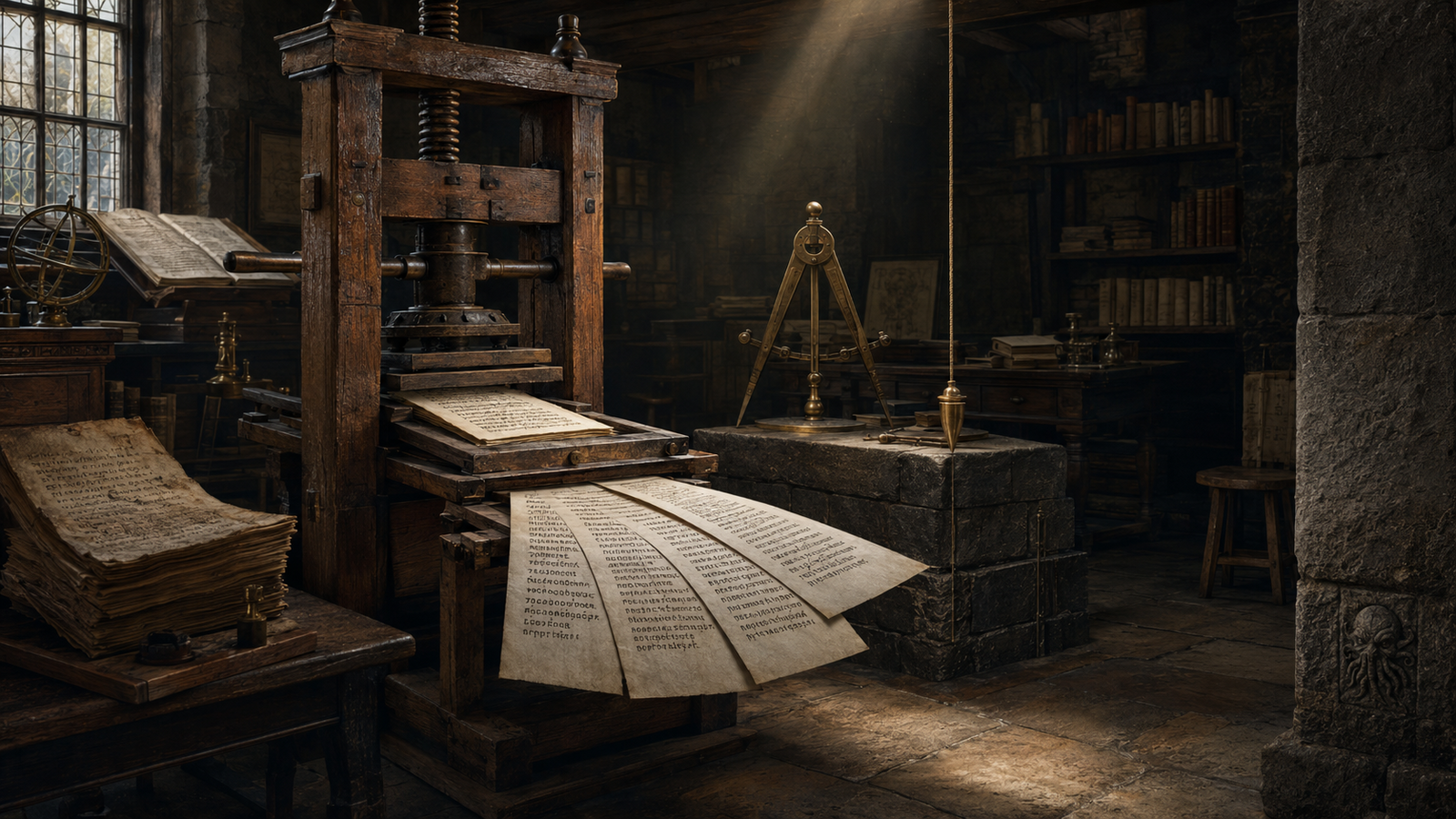
This is Part 7 of “By What Standard Is This the Text? A Presuppositional Examination of Modern Textual Criticism.”
Before the First Manuscript Is Weighed
Bahnsen's fourth test asks for the preconditions of intelligibility. What must already be true before an argument can make sense? What must be true about reality, knowledge, and ethics? What must be true about the particular subject—about X—before meaningful claims can be made concerning it?
This is not an attempt to avoid manuscript evidence by retreating into theology. It asks what makes manuscript evidence possible as evidence. A fragment of parchment does not interpret itself. A pattern of agreement does not explain itself. A scribal habit does not announce its own norm. Before a critic can date, compare, infer, prefer, correct, or reconstruct, he has already relied upon a world filled with order, meaning, truth, and duty.
The transcendental question is therefore prior to every local variant:
What must be true for textual criticism to be intelligible at all?
Preconditions in the Nature of Reality
Textual inquiry first requires an objective and ordered reality.
There must have been a real past, not merely a present collection of impressions. Authors must have written determinate words. Scribes must have copied physical exemplars. Ink, parchment, papyrus, climate, travel, storage, worship, persecution, and decay must have operated within stable causal relations. A mark made yesterday must not become a different mark merely because no one looks at it today.
The critic also assumes continuity through change. One manuscript can remain the same object while pages age and ink fades. A word can retain its identity when copied in a different hand. A proposition can remain the same when translated into another language. Cause may be inferred from effect because the created order is neither chaos nor illusion.
Universals are unavoidable. The critic classifies hands, spellings, scribal errors, readings, languages, and manuscript relationships. No two marks are physically identical, yet he recognizes them as instances of the same letter or word. He treats similarity and difference as real features that rational minds may discover.
Time itself must be ordered. Earlier and later are not editorial conventions but relations within history. A manuscript's date may be uncertain, but the act of copying either preceded or followed another act. Genealogy, contamination, ancestry, and textual flow are unintelligible unless temporal and causal order are real.
The Christian worldview accounts for these things. The triune God created and upholds a world ordered by his wisdom. The eternal Word is not the product of an irrational universe. Created things possess identities and relations because they exist within God's decree and providence. History is neither autonomous nor accidental in its ultimate constitution.
A method that brackets God may continue to use created order. It cannot make created order arise from the bracket.
Preconditions in the Nature of Knowledge
Textual inquiry also requires knowers fitted to know the world.
Human senses must be generally reliable. Memory must connect earlier observations with later conclusions. Other persons must possess minds. Testimony must be capable of transmitting truth. Language must communicate more than private sensation. Logic must hold universally rather than by local agreement.
Induction is especially important. Critics reason from observed habits to unobserved acts: scribes sometimes omit through similar endings; they sometimes harmonize parallels; they sometimes expand titles; particular hands form letters in characteristic ways. Such inferences assume that the future and the unknown past bear an intelligible relation to the observed cases.
The critic must also distinguish discovery from invention. He does not mean merely to create a useful modern text. He means to know what an earlier author wrote or what stood at the beginning of a transmission. His conclusion is accountable to a truth that exists independently of his preference.
Probability itself presupposes truth. A reading can be more probable only in relation to what actually occurred. “Most likely original” is intelligible because one reading really was written and the others really were not. If all textual judgments were only community conventions, error would become dissent from a school rather than failure to match history.
The Christian worldview again supplies the ground. Man is made in God's image. His finite mind is not omniscient or infallible, but it is designed to know God's world. The God who cannot lie gives unity to truth. Logic reflects neither human legislation nor an impersonal realm above God, but the consistency of the divine mind and the ordered creation. Testimony matters because persons are moral and rational agents under God.
This account does not make every Christian inference correct. It makes inference possible, error culpable, correction meaningful, and truth independent of the critic.
Preconditions in the Nature of Ethics
Textual criticism is saturated with obligation.
A scribe ought to copy accurately. He ought not add, omit, harmonize, or alter according to private taste. A collator ought record the evidence completely. An editor ought apply his principles consistently. A scholar ought acknowledge uncertainty, correct an error, represent rivals fairly, and refrain from hiding inconvenient witnesses. A translator ought render the source faithfully.
None of those duties can be derived from ink and parchment. A description of what scribes did cannot by itself yield a command concerning what they should have done. Majority practice does not create moral truth. Scholarly consensus cannot bind the conscience merely by being consensus.
Even the word corruption is ethical and normative. A reading is corrupt because it departs from a proper form. A correction is good because it restores conformity to a norm. Without an antecedent standard, the critic possesses change but not corruption, difference but not error.
The Christian worldview grounds these duties in the holy God who speaks truth and commands truth from his creatures. The ninth commandment governs the scribe and the scholar. The command not to add to or diminish God's Word gives special force to textual fidelity. The oracles were entrusted to God's people; stewardship is therefore part of their transmission.
The critical method often honors these duties in practice. Its practitioners labor patiently, publish vast quantities of evidence, revise their judgments, and expose errors in their own field. The argument is not that they lack moral seriousness. It is that the method considered as an autonomous historical science cannot account for the binding norms it continually employs.
The Preconditions of the Intelligibility of the Text Itself
Bahnsen's final subquestion asks what must be true about the particular object under dispute. What must be true of a biblical text before textual criticism of it makes sense?
First, there must be a determinate wording. If the authorial text was fluid without a normatively final form, then “original reading” may have no single referent. The critic could describe stages, editions, or communities, but he could not recover the wording without first identifying the divinely authoritative stage.
Second, verbal identity must persist through faithful copies. A copy is not the original piece of parchment, yet it may communicate the same words. Otherwise neither preservation nor corruption is intelligible.
Third, the inspired text must be distinguishable from its errors. A variant can be judged only because there is a right reading that does not depend upon the variant's popularity.
Fourth, God must have some providential relation to the history of the Word he inspired. A doctrine of inspiration joined to religious indifference about transmission divides God's act of speaking from the purpose for which he spoke.
Fifth, the covenant community must be able to recognize and use its rule. A text that exists only as unidentified possibilities cannot function as public law. Final appeal requires an available court record.
These are not optional devotional additions to textual work. They define its object. Without determinate words, persistent identity, a normative original, providential history, and public recognition, the words copy, variant, corruption, restoration, Bible, and authentic text lose the very contrasts that give them meaning.
Scripture States the Preconditions
Scripture does not offer a modern apparatus, but it states the truths that make an apparatus ministerially useful.
Christ says, “the scripture cannot be broken” (John 10:35). He teaches that not one jot or tittle passes from the law until all is fulfilled (Matthew 5:18). Paul says that the oracles of God were committed to the Jews (Romans 3:2), joining revelation to a historical stewardship. The written Scriptures are God-breathed and able to make the man of God complete (2 Timothy 3:15–17). Christ's words do not pass away (Matthew 24:35).
These passages do not teach that every copyist is infallible. They do teach that Scripture is a determinate, enduring, authoritative, entrusted, and usable Word. Error belongs to copies and handlers; it does not become a permanent property of the rule itself.
The Westminster Confession gathers the point with unusual precision. The Hebrew Old Testament and Greek New Testament were immediately inspired, kept pure in all ages by God's singular care and providence, and are therefore authentic, so that the church may finally appeal to them. The same section commands translation because all God's people have a right and interest in the Scriptures.
Notice the chain: inspiration, providential preservation, authenticity, final appeal, translation, public use. The doctrine answers the preconditions of textual intelligibility before it addresses any particular manuscript.
Borrowed Capital and the Evangelical Critic
A common objection says that unbelievers plainly perform excellent textual work. They can read Greek, date manuscripts, collate variants, and detect errors. Does this not show that the Christian worldview is unnecessary?
The objection confuses the ability to use a truth with the ability to account for it. The unbeliever lives in God's world, bears God's image, receives common grace, and cannot escape the created order he may verbally deny. Presuppositional argument does not say that he knows nothing. It says that the truths he knows cannot be made intelligible upon principles of autonomy.
The evangelical critic presents a more pointed case. He openly affirms God, creation, providence, revelation, logic, morality, and Scripture. His problem is not an explicit secular worldview in every field. It is methodological compartmentalization. He uses Christian preconditions everywhere the inquiry requires them but refuses to let Scripture's doctrine of preservation govern the textual method itself.
He therefore borrows from his own confession while suspending it. The method works because the world is ordered by God, men can know truth, language has stable meaning, duty is real, and God has preserved a determinate Word. It then treats the last of those truths as a conclusion to be approximated by the method rather than a precondition governing the method.
That is the presuppositional tension in its mature form.
A Constructive Confessional Method
To make Scripture the standard is not to abandon evidence. It is to give evidence its lawful office.
The confessional method begins with the self-attesting Word and receives Scripture's account of inspiration, preservation, authenticity, and ecclesiastical stewardship. It recognizes the authentic Hebrew and Greek text as a providential whole in the church's possession. It then collates manuscripts, versions, citations, editions, and printing history to serve that received text.
Evidence may expose a scribal lapse, a printer's error, a damaged page, or a difference among editions. Grammar may correct a translation. Historical research may clarify how a reading was transmitted. None of these ministerial judgments requires an editor to stand above Scripture or an English translation to be inspired.
The order is decisive:
- Autonomous criticism begins with an undefined field of witnesses and seeks to construct the text that will become authoritative.
- Confessional criticism begins with the authoritative and preserved text and uses witnesses to serve its faithful identification, transmission, and translation.
Both examine evidence. Only one supplies the preconditions under which evidence can testify without becoming the judge.
The final article will now perform the practical test. If the modern method can be repeated by competent editors using its accepted canons and can produce a different critical text, what exactly has the method established? The answer will bring all four branches of Bahnsen's checklist together.
Notes and Further Reading
- Chris Thomas, “Argument Analysis Checklist”.
- Greg L. Bahnsen, “Presuppositional Procedure”, an introduction to the transcendental method and the impossibility of autonomous reasoning.
- Greg L. Bahnsen, “The Concept and Importance of Canonicity”, on self-revelation, the authority of Scripture, and the inadequacy of autonomous wisdom.
- The Orthodox Presbyterian Church, Westminster Confession of Faith 1.4–10.
- Institut für Neutestamentliche Textforschung, “The Coherence-Based Genealogical Method”, for the method's stated account of a non-extant initial text that must be reconstructed.
- John Owen, Of the Divine Original, Authority, Self-Evidencing Light, and Power of the Scriptures, with Of the Integrity and Purity of the Hebrew and Greek Text of the Scripture, for the older Reformed integration of divine authority, self-evidence, preservation, and the use of textual evidence.
- Scripture references are quoted or summarized from the Authorized Version: Matthew 5:18; 24:35; John 10:35; Romans 3:2; and 2 Timothy 3:15–17.
Comments
Share a question or response to this article.