

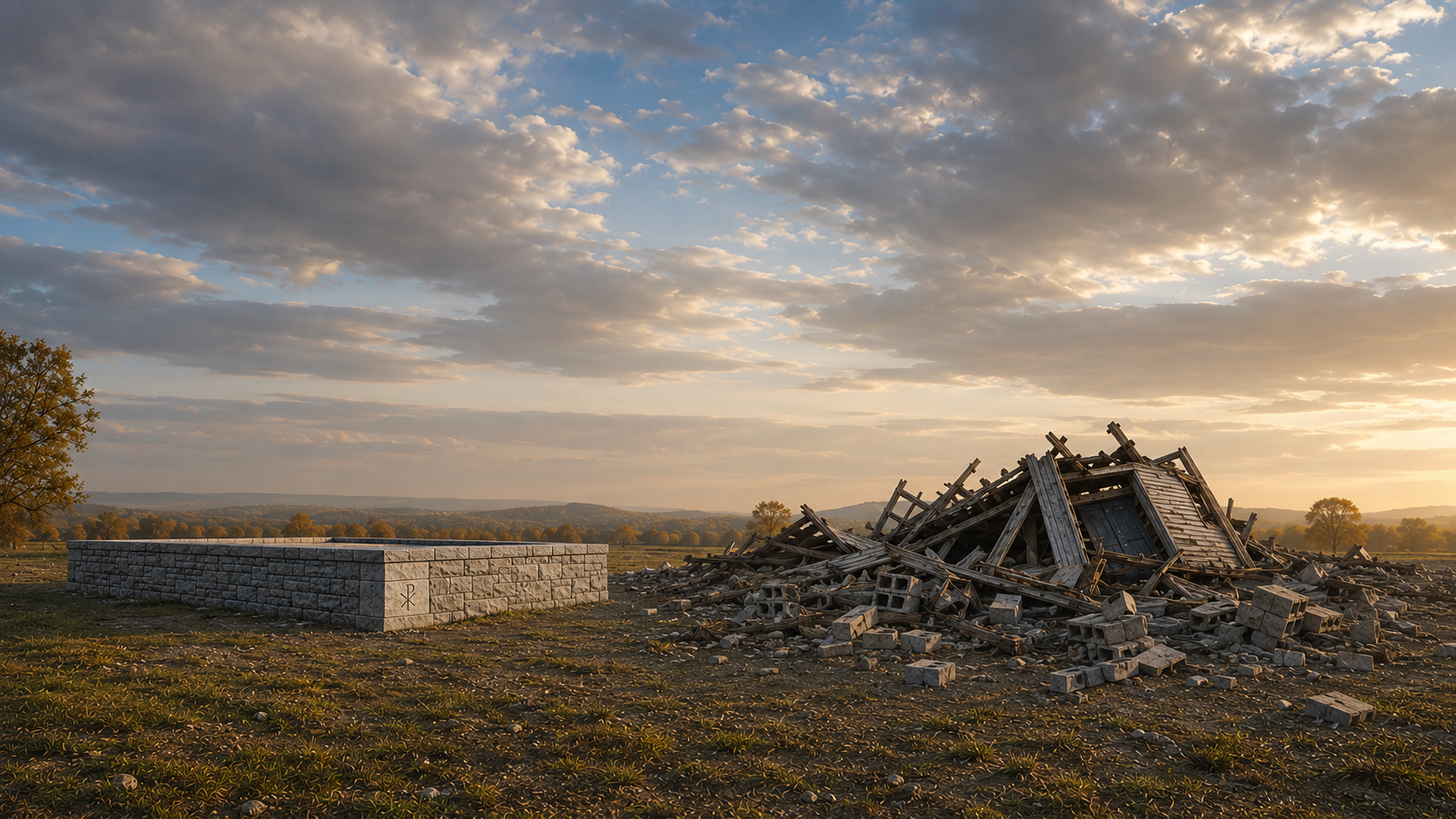
Article 6 of 6 — Bringing Down the House: The Reconstructed Text and the Foundation of the Church.
The final image contains no rebuilt church. That absence is necessary. A collapse is not repaired by pretending that it never happened, and reformation is not accomplished by replacing one slogan with another. The dust has cleared. The makeshift foundation lies in rubble. The old fitted stone remains open to the sky, its cornerstone still marked, level, and ready.
The image therefore ends with judgment and hope held together. A confessional church can surrender its textual foundation, reinterpret its constitutional words, and make itself dependent upon an authority unable to bear the office assigned to it. That is real loss. Yet the failure of the replacement cannot injure the Word it tried to displace. The authentic foundation does not derive its strength from the number of institutions currently willing to stand upon it.
This is not a claim that leather, paper, ink, manuscripts, or printed editions are physically indestructible. Copies burn. Libraries decay. Printers err. Languages change. Nor is it the claim that Christ can be reduced to a textual tradition. He is the living Lord, the Church’s only Redeemer and head. The Chi-Rho cornerstone in the image marks the relation Paul gives us: the household of God is “built upon the foundation of the apostles and prophets, Jesus Christ himself being the chief corner stone” (Eph. 2:20).
Christ remains, and His commissioned Word remains. The two truths are not competitors. The cornerstone governs the prophetic-apostolic foundation, and the foundation bears witness to the cornerstone. A church cannot return to Christ by placing the words of His apostles under a court He did not appoint. She returns by hearing His voice in the Scriptures He inspired, preserved, and entrusted to her.
The final claim of Bringing Down the House is consequently stronger than nostalgia. The old foundation remains not merely as a memory of what Protestants once believed, nor as an ideal text hidden in heaven, nor as all possible readings dispersed through an archive. It remains as an extant and identifiable Hebrew and Greek text received in the Church, capable of being studied, translated, preached, and finally appealed to. The work before us is not to invent it again. It is to build faithfully upon it.
Why the foundation outlives the builders
The permanence of Scripture begins in God rather than in the competence of its custodians. “The word of our God shall stand for ever” (Isa. 40:8). Christ declares, “Heaven and earth shall pass away, but my words shall not pass away” (Matt. 24:35). Peter describes the gospel as “the word of God, which liveth and abideth for ever” (1 Pet. 1:23). These texts must be interpreted in their contexts, but their united testimony cannot be reduced to the survival of a religious theme while the verbal rule becomes unavailable.
God speaks in order to be heard, believed, remembered, taught, and obeyed. He commands parents to teach His words, ministers to preach them, churches to read them, and saints to test doctrine by them. Those continuing duties presuppose a continuing object. A promise of authority without accessible words would give the Church a court to which she could not appeal.
The Westminster Confession makes the doctrinal consequence explicit. The immediately inspired Hebrew and Greek Scriptures were “by his singular care and providence, kept pure in all ages,” “are therefore authentical,” and remain the tribunal to which “the Church is finally to appeal.”1 Preservation is not an ornament added to inspiration. It carries the inspired Word across the centuries so that its authority continues to function.
Louis Gaussen expressed the relation between Word and Church with unusual force. God watches over His written Word because He watches over His Church; He uses His people as depositaries of the oracles and does not cease His care after inspiration. Gaussen asks how the elect can believe without preaching, how truth can be preached without the books that contain it, and how those books can be given if they are not preserved. The promise that the Church will not perish therefore includes God’s providential care for the Word that creates and sustains her.2
This does not make the Church preservation’s sovereign. God is. He can use fallible churches, disputed periods, scattered copies, translations, and even the labours of men whose doctrine of the text is defective. The efficiency belongs to Providence; the instruments retain their ordinary limitations. The survival of the foundation is thus neither a miracle of immaculate manuscripts nor a triumph of institutional infallibility.
It is also not preservation in abstraction. God’s providence operates in history. Hebrew scribes copied the Old Testament. Greek Christians copied and read the New. Lectionaries carried passages through public worship. Commentators quoted the text. Translators rendered it into other languages. Printers compared copies and multiplied editions. Reformed churches confessed the Hebrew and Greek originals as authentic. The physical means are precisely how an immaterial promise becomes visible in transmission.
For Confessional Bibliology, this historical possession is identified with the Hebrew Masoretic text and the Greek Textus Receptus received by the Reformation churches. The identification is not an assertion that one bookbinder, compositor, or edition is inspired in every accident. It names the textual tradition in which the authentic words are possessed. The Authorized Version holds an honoured place as a faithful English translation of those originals; it does not replace them as the final court.
The foundation therefore outlives particular builders because no builder caused it to be divine. An editor may represent the text well or badly. A church may receive it faithfully or neglect it. A scholar may recognize a reading or misjudge it. The text’s authority remains God’s. William Whitaker’s goldsmith did not make the gold, and his notary did not make the record true. Their dignity lay in faithful recognition and custody.3
What should be recovered from the rubble
The collapse of reconstructive authority does not require the destruction of modern textual scholarship. Much in the rubble is useful material that was simply asked to perform the wrong office.
High-resolution manuscript images remain valuable. So do accurate transcriptions, palaeographical judgments, codicological descriptions, catalogues, databases, versional studies, patristic indexes, and analyses of scribal habits. A local stemma may illuminate how readings relate even if it cannot confer divine authority. Digital tools can accelerate collation. Newly discovered witnesses can confirm the antiquity, spread, or corruption history of readings.
None of these materials is “the critical text” considered as a magisterial foundation. They are evidence concerning transmission. The confessional response should not burn the archive because others tried to build upon it. It should recover the evidence for ministerial use.
Gaussen’s formulation again provides the order. Historical and critical science should “pave the way” for faith, accompany it, and defend it. When science raises an objection, better-informed science may answer. Yet it is not required to lay the foundation, because faith is established upon God’s declarations and works.4 The distinction permits the most rigorous research without placing the Church beneath a scholarly tribunal.
This recovery also changes the aim of an apparatus. A magisterial apparatus surrounds an editorial main text whose readings are the committee’s current reconstruction; the apparatus displays alternatives to the editors’ decision. A ministerial apparatus can begin with the received text and document the witnesses, editions, variations, corrections, and arguments relevant to its transmission. It does not hide difficult evidence. It locates the evidence under an antecedently authentic rule.
The same is true of editorial work within the received tradition. Differences among TR editions should be catalogued rather than minimized. The Hebrew text should be studied with Masoretic notes, early printings, manuscripts, and versions. The history of individual readings should be traced. Claims about the Authorized Version translators’ sources should be verified from their documents rather than repeated as folklore. A confessional doctrine does not excuse lazy scholarship. It gives scholarship a stable subject and a lawful office.
Some stones in the failed base cannot be reused as foundations. The premise that the initial text is not extant must be rejected. The assumption that an editor’s probability can become the Church’s final authority must be rejected. The reinterpretation of “kept pure” as mere preservation of reconstructive materials must be rejected. The idea that expert consensus can mediate a text which is intrinsically authoritative but unavailable to ordinary ecclesiastical appeal must be rejected.
The people who used those premises are not rubble. They are neighbours, ministers, scholars, and often brothers who should be answered with evidence and theological clarity. The argument judges propositions and methods. It does not license contempt.
A rule for rebuilding
Rebuilding begins by restoring the order of authority. That work requires more than announcing a preference for the King James Bible or affixing the label Textus Receptus to every inherited opinion. Seven disciplines belong together.
First, the Church must read her confession according to its original public meaning. “Kept pure in all ages,” “authentical,” and “finally to appeal” should not be redefined by a theory developed centuries later. A minister or institution may conclude that Westminster was wrong. Integrity then requires an amendment, exception, or rejection—not a silent change of referent.
Second, the authentic text must be positively identified. It is not enough to criticize critical editions. The Church should name the Hebrew Masoretic and Greek received texts she uses, state how representative editions relate to the tradition, and explain how local differences are to be handled. A foundation must be more than an anti-critical mood.
Third, textual criticism must be placed under a ministerial charter. Its purpose is to study transmission, expose copying and printing errors, compare received editions, defend authentic readings, and improve faithful representation. It may advise the Church with reasons. It may not suspend the identity of Scripture until its inquiry is complete.
Fourth, the original languages must return to ordinary ecclesiastical competence. The final appeal cannot function if pastors cannot read the court’s instrument. Greek and Hebrew training should include grammar, exegesis, textual history, palaeography, codicology, and responsible apparatus use. The aim is not to turn every minister into a manuscript specialist; it is to prevent the Church’s final authority from becoming a password controlled by a remote guild.
Fifth, translations must be treated as derivative authorities. A faithful translation truly communicates God’s Word and binds insofar as it faithfully renders the originals. Yet no English form should be made the inspired judge of Hebrew and Greek. This protects the Authorized Version from idolatrous claims as surely as it protects it from casual displacement.
Sixth, the Church must teach preservation as a doctrine of confidence and duty. Believers should understand why variants do not entail a lost Bible, why manuscripts confirm ordinary providential transmission, why copies may err while the text remains, and why expert service does not require expert lordship. The doctrine belongs in catechesis, not only in academic controversy.
Seventh, the work must be marked by repentance and exactness. Confessional defenders should repent of exaggerated statistics, unverified historical claims, personal accusations that exceed their premises, and translation-only rhetoric. Reconstructive defenders should repent where scholarly probability has been made functionally supreme or historic confessional language has been retained after its substance was changed. Reformation begins when both truth and sin are named accurately.
These disciplines do not rebuild the Church by human power. Christ builds His Church. They describe the obedience of labourers who set stones according to the cornerstone rather than asking the cornerstone to conform to their frame.
The old foundation is not a museum piece
One final objection deserves an answer. Does returning to the received text trap the Church in the seventeenth century? Are we asked to choose between historical Protestantism and every discovery made since?
No. A foundation is not a ceiling. Stability below permits growth above. Because the authentic text is settled, new linguistic, historical, archaeological, and manuscript knowledge can be received without reopening the identity of Scripture at every discovery. Evidence enriches understanding, defends readings, corrects human representations, and exposes mistaken arguments. It does not need to become a rival canon.
The Reformation itself illustrates the point. Returning ad fontes did not mean rejecting learning. It meant subjecting tradition and authority to the prophetic and apostolic Word in the original languages. Confessional Bibliology continues that movement when it insists that the Hebrew and Greek text judge translations, editions, critics, and churches.
Nor is the received text protected from precise local study. A real foundation can be surveyed. Its stones can be distinguished from dirt deposited around them. Questions within the received tradition can be adjudicated through Scripture, reception, and historical evidence. What cannot be surrendered is the prior truth that there is a foundation to survey.
The surviving foundation is therefore a summons to future scholarship, not a refuge from it. It calls for better collations of received editions, transparent apparatuses, complete histories of readings, research into the sources available to Reformation editors and translators, skilled study of manuscripts, and faithful new translations where languages require them. Ministerial criticism can be more historically comprehensive than magisterial criticism precisely because it does not need to suppress evidence that fails to fit a reconstruction narrative.
A rebuilt church should also preserve the history of the controversy. Future ministers ought to know when and why the terminology changed, which arguments actually displaced the received text in their institutions, and whether confessional revisions were ever openly adopted. Institutional memory prevents a quiet transfer from being repeated under a new technical vocabulary. It also permits fair judgment: useful discoveries can be distinguished from philosophical assumptions, and scholars can be credited for genuine work without granting their method theological supremacy. Reformation is durable when the next generation receives not only a conclusion but the documentary trail, exegetical reasons, and doctrinal grammar by which that conclusion was reached.
Ready to be built upon again
The final image refuses an easy ending. No church descends from the sky. No crowd celebrates beside an instant restoration. The foundation waits.
Particular churches and institutions are not promised perpetual fidelity. They may prefer the authority of the age, fear scholarly disapproval, or find perpetual revision more prestigious than received truth. Christ can remove a candlestick. He can also reform a people by bringing them again to His Word.
The way back is not mysterious. Confess what God says about His speech. Receive the Hebrew and Greek Scriptures as the authentic rule. Hear the Church as witness and guardian without making her creator. Use manuscripts as providential testimony without seating them as judges. Employ scholars as ministers without treating their consensus as inspiration. Translate faithfully. Teach plainly. Correct humbly. Appeal finally to the Word.
Even if a generation persuaded every visible institution within its reach to move, it could not make the old foundation cease to exist. Even if the reconstructed base won temporary consensus, its authority would remain borrowed and its conclusions revisable. Even if the transferred house fell, the fall would not undo God’s act of inspiration or His centuries of preservation.
The cornerstone remains because Christ lives. The prophetic and apostolic foundation remains because His words do not pass away. The authentic text remains because Providence did not abandon the deposit after giving it. The Church may therefore build again—not upon a newly invented certainty, but upon the Word she should never have left.
The series ends where the work begins: “Thus saith the Lord.”
- The Westminster Confession of Faith (1647), 1.8. ↩
- Louis Gaussen, The Canon of the Holy Scriptures from the Double Point of View of Science and of Faith (London: James Nisbet, 1863), 424–32, especially propositions 416–22. ↩
- William Whitaker, A Disputation on Holy Scripture, trans. William Fitzgerald (Cambridge: Cambridge University Press, 1849), 279–84. ↩
- Gaussen, Canon of the Holy Scriptures, 426–28, propositions 418–19. ↩
Comments
Share a question or response to this article.