

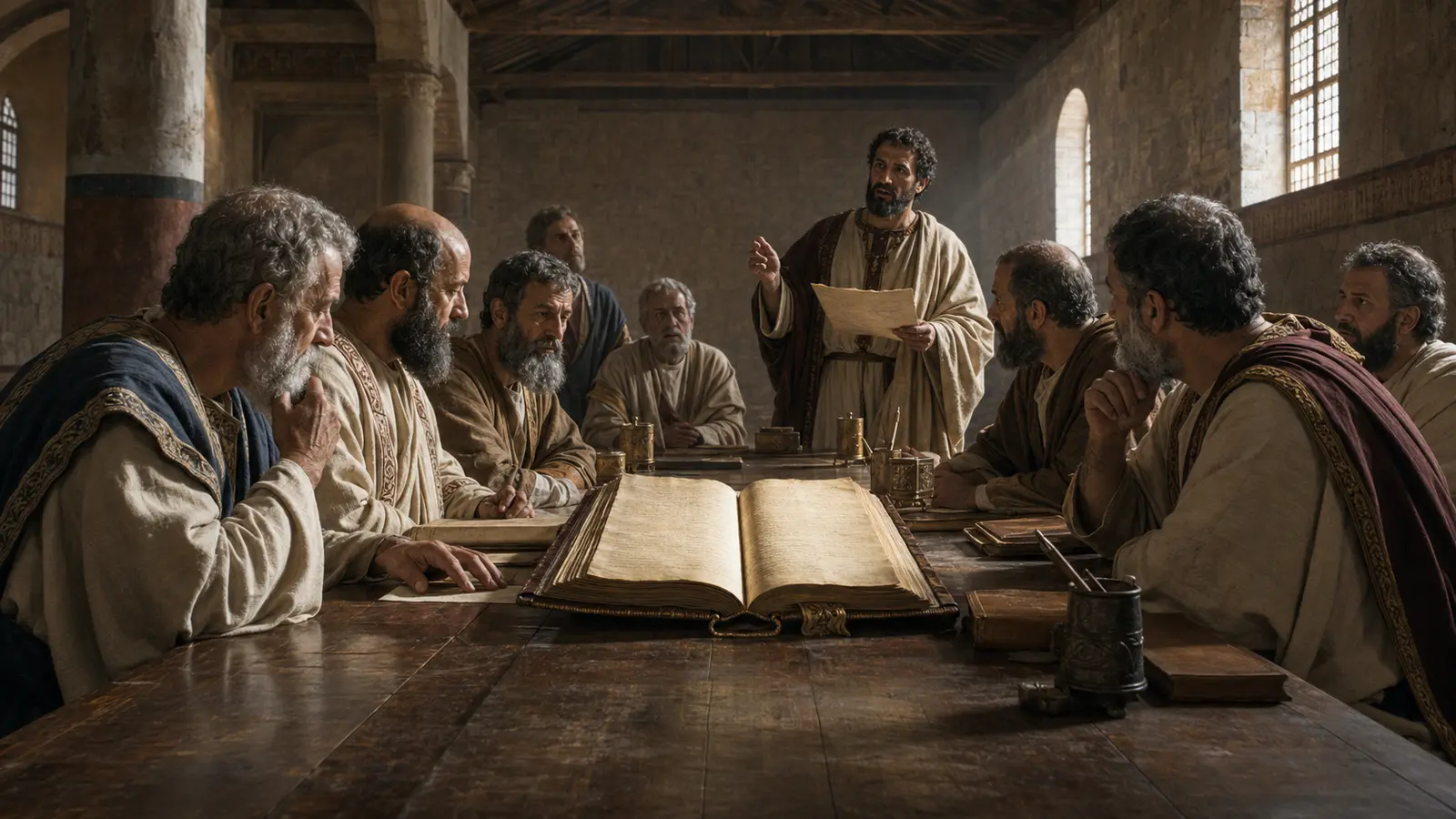
The accusation is easy to make. A disputed reading removes a familiar title of Christ, shortens a confession, or changes a sentence used in the defense of his deity. Someone calls the reading “Arian,” and the word appears to settle the case.
It settles nothing until the historical claim is defined.
Arianism was not a vague tendency to speak of the Father before the Son. It was not every distinction between the Father and the Son, every statement of Christ’s obedience, or every acknowledgment that the Son was sent. It was a connected account of who the Son is. In that account the Son began to exist, came from non-being by the Father’s will, belonged to the created order, did not possess the Father’s own essence, and therefore was not true God in the same sense as the Father.
This series will test the critical Greek and Hebrew texts against that account. It will not change the definition whenever a variant seems suspicious. The defendant must be identified before the evidence is heard.
The proposition of this article is:
A reading may be called Arian only by reference to a defined proposition historically belonging to Arius’s doctrine, and only when the indispensable elements of that proposition are present.
That rule makes the indictment harder to prove. It also makes any indictment that survives far more serious.
The Historical Record Is Uneven
Very little of Arius’s writing survives intact. His letters are preserved within later historical and polemical works. Fragments of his Thalia come chiefly through opponents, especially Athanasius. The Creed of Nicaea answers propositions that the assembled bishops judged to be the substance of the controversy.
These sources are not all the same kind of evidence.
A statement made by Arius in a letter is direct evidence of what he professed at that moment. A sentence quoted by Athanasius is a reported fragment whose locator and context must remain visible. A Nicene anathema is the council’s formal identification of the propositions it rejected. A later label such as “Arian” may cover several parties whose formulas differed from Arius and from one another.
The safest reconstruction begins with convergence. Arius’s own letter to Eusebius of Nicomedia says that the Son has a beginning and comes from non-being.1 His confession to Alexander can call the Son an exalted and unique offspring while still describing him as a perfect creature, created by the Father’s will, and neither eternal nor co-eternal with the Father.2 Athanasius reports the same controlling claims in De Synodis 15: the Word is counted among creatures, once did not exist, and is alterable.3 The Nicene anathemas answer temporal nonexistence, origin from nothing, alien essence, creaturehood, and mutability.4
The agreement is sufficient to establish the center of the doctrine even while disputed details and later Arian parties receive separate treatment.
Pious Words Can Carry Another Theology
Arius did not ordinarily speak as though Christ were unimportant. He could call the Son “God,” “only-begotten,” “perfect,” the maker of the ages, and the one through whom the Father created all other things. This is precisely why a merely verbal test fails.
The question is not whether a writer uses the word God. The question is what kind of deity he predicates of the Son.
The question is not whether he calls Christ Son. The question is whether that sonship is natural and eternal or a status bestowed upon the first creature.
The question is not whether the Son existed before the world. The question is whether he is before all created being because he is the uncreated Creator, or merely before the rest of creation because he was the first work.
Arius could preserve much biblical vocabulary by changing the relations among its terms. The Son might be called God while remaining alien in essence from the Father. He might be called begotten while his begetting was treated as an act by which one who did not exist came to exist. He might be called Creator while he remained an instrument created for the production of everything after him.
That is not a minor terminological difference. It is another doctrine of God.
The Eight Arian Propositions
Packet Zero fixed eight propositions. They are reproduced here because every later textual judgment will name one or more of them.
| ID | Exact Arian proposition | Indispensable elements | Orthodox control |
|---|---|---|---|
| AR-01 | The Son began to exist and is not eternal | the personal Son; prior nonexistence; a beginning | eternally begotten before all worlds |
| AR-02 | The Son belongs to the created order | the Son; production from nothing; creature status | begotten, not made; Creator of all |
| AR-03 | The Son is of an alien substance from the Father | Father and Son; divine essence; difference of kind | of one substance with the Father |
| AR-04 | The Son is not true God as the Father is God | the personal Son; predicate deity; denial of its truth or equality | true God of true God |
| AR-05 | The Son is ontologically inferior | comparison in divine being; inferiority | coessential, coeternal, and coequal |
| AR-06 | The Son is not the uncreated agent of all creation | the Son; all created things; denied uncreated agency | all things made through the Word |
| AR-07 | The Son is mutable in divine being | the personal Son; divine being; alterability | the Son remains the same |
| AR-08 | Sonship is adopted, honorific, or merely temporal | sonship; bestowed status; denial of natural eternal generation | only-begotten Son by nature |
These propositions form a system, but they must not be collapsed into one charge.
AR-01 and AR-02 are foundational. If the Son began to exist from nothing, he belongs to the order of works. If he belongs to the order of works, his essence is not the Father’s essence. His “deity” must then be derivative and unequal. His role in creation cannot be the work of the uncreated God. His sonship must name an appointment, privilege, or exceptional mode of creaturehood rather than eternal generation.
Yet a text may bear upon one proposition without bearing upon all eight. A reading that removes an explicit occurrence of “God” may weaken evidence relevant to AR-04 while saying nothing about AR-01, AR-02, or AR-03. A reading that calls Christ the Son does not by that fact refute AR-08, because Arius also used the title. A reading that calls Christ “God” may supply direct counterevidence to AR-04 even if its history remains disputed.
The ledger therefore prevents rhetoric from outrunning logic.
What Nicaea Denied
The original Nicene formula answers Arius with a concentrated series of boundaries. The Son is from the Father’s substance, true God, begotten rather than made, and homoousios—of one substance—with the Father. The accompanying anathemas reject the claim that he once did not exist, came from nothing, possessed another essence, was created, or could change.4
These clauses do not make the Father and the Son one person. They do not describe generation as a physical division of God. They do not deny that the Father is Father and the Son is Son. They confess personal distinction while denying a division of deity.
The terms also work together. “Begotten” by itself could be redefined, as Arius redefined it. “True God” could be reduced to an honorific title. “From the Father” could be made to mean no more than every creature’s dependence upon God. The formula closes the evasions:
- from the Father’s own essence, not from nothing;
- true God, not a promoted creature;
- begotten, not made;
- one in essence, not merely similar in will or glory;
- maker of all things, not one member of the class of things made.
The point is not that an ecclesiastical formula creates the truth. The formula identifies the scriptural propositions being confessed and the contrary propositions being denied.
The Reformed Doctrinal Control
The same boundaries appear in the Reformed confessional tradition.
The original Westminster Confession says that the three persons are “of one substance, power, and eternity” and that each is “very and eternal God” (WCF 2.3). In its account of Christ, it confesses the eternal Son as very God and then distinguishes his divine and human natures without dividing his person (WCF 8.2).
James Ussher supplies an especially useful positive register. He distinguishes the persons by relation and order, not by nature. He defines the Son as begotten from the Father from all eternity and then expressly calls Father, Son, and Spirit coessential, coequal, and coeternal. When he turns to the incarnation, he confesses Christ as “very God of very God,” begotten rather than made, while preserving the distinct properties of the divine and human natures.5
This register matters because the project is not measuring the critical text against an undefined feeling that Christ should be honored more highly. It is measuring readings against exact claims concerning identity, eternity, essence, deity, equality, creative agency, immutability, and sonship.
What Is Not Arianism
Several things must be excluded at the beginning.
Personal order is not creaturehood. The Father is not the Son. The Son is of the Father by eternal generation. To call the Father first and the Son second in personal order does not place one earlier than the other in time or higher than the other in deity.
Mission is not inferiority of essence. The Father sends the Son, and the Son accomplishes the Father’s will. Those are biblical relations in the work of redemption. They do not make the Son a lesser kind of being.
Christ’s true humanity is not Arianism. The incarnate Son hungered, suffered, obeyed, and died. A denial that these things are truly human would injure the incarnation. Their ascription to the one person of Christ does not imply that the divine essence is passible, ignorant, or mutable.
A weakened proof is not a formal denial. If a variant removes words used against Arianism, the most that has yet been shown is a loss or weakening of testimony. The remaining reading must be parsed before it can be said to favor or entail an Arian proposition.
Heretical use is not heretical origin. Arius may have quoted a reading that existed before him. An Arian scribe may have copied an orthodox reading. Historical use, textual effect, scribal motive, and transmission into an extant edition are four different claims.
These exclusions are not concessions made to the critical text. They are the controls required by truth.
The Charge the Series Will Test
Later packets will ask increasingly demanding questions.
Does a critical reading remove a received-text refutation of one Arian proposition? Does it make that proposition easier to accommodate? Does it formally assert the proposition? Is an early Arian use of the reading documented? Can alteration by a named heretical source be proved? Can the reading’s transmission into Vaticanus, Sinaiticus, or the modern critical text be demonstrated? Does the complete critical corpus continue to contradict the heresy elsewhere?
Each question has its own burden of proof.
The series will therefore use precise conclusions. A reading may be:
- doctrinally neutral;
- a weakening or removal of testimony;
- favorable or accommodating to an Arian proposition;
- a formal entailment of that proposition;
- orthodox counterevidence.
Only after the reading is classified may provenance be considered. Only after the readings are classified may the corpus be judged.
Verdict
The Arius being tested is not a caricature and not a label for any uncomfortable verse. He is the teacher whose Son had a beginning, came from non-being, belonged to the created order, was alien in essence from the Father, lacked equal and true deity, and possessed sonship in a creaturely rather than natural sense.
Those propositions are now fixed. No later article may lower the threshold merely to enlarge the indictment.
What This Does Not Prove
This definition does not prove that any reading in NA28, UBS6, BHS, BHQ, HBCE, Vaticanus, or Sinaiticus is Arian. It does not prove that Arius created any textual variant. It does not prove that a reading used by Arians originated with Arians. It does not prove that the critical corpus, considered as a whole, teaches the system defined above.
It establishes the propositions by which those claims can be tested.
Text and Edition Record
- English Scripture quotations and wording: Authorized Version.
- Received Greek control for later comparison: the Greek text underlying the Authorized Version, represented by Scrivener.
- Received Hebrew control for later comparison: Bomberg’s Second Rabbinic Bible (1524–25).
- Patristic and conciliar wording: the public-domain Nicene and Post-Nicene Fathers translations linked below; brief wording has been checked against the cited Greek where supplied.
- Doctrinal-effect vocabulary: Packet Zero, classes D0–D4.
- Historical-provenance vocabulary: Packet Zero, grades P0–P5.
Bibliography
- Arius. “Letter to Eusebius of Nicomedia.” Preserved in Theodoret, Ecclesiastical History 1.4.
- Arius and his followers. “Letter to Alexander of Alexandria.” Preserved in Athanasius, De Synodis 16.
- Athanasius. De Synodis, especially 15–16 and 41–48.
- Council of Nicaea. Creed and anathemas, A.D. 325.
- Ussher, James. A Body of Divinity. 1645, especially 79–83 and 160–165 in the supplied edition.
- Westminster Assembly. The Confession of Faith. 1647, 2.3 and 8.2.
Revision History
- 2026-07-24: First Packet One draft; Arian proposition ledger aligned with Packet Zero, Arius’s surviving letters, Athanasius, the Nicene formula, Ussher, and the original Westminster Confession.
Notes and Sources
Source-control note: Arius’s letters are treated as direct profession preserved through later witnesses (S2). Athanasius’s summaries and quotations are primary historical testimony requiring visible locators (S2). The Nicene formula is the conciliar proposition control (S2). Ussher and Westminster are the positive Reformed doctrinal controls. No claim about the origin or transmission of a biblical reading is made in this article.
Next in the series: “There Was When He Was Not.”
- Theodoret, Ecclesiastical History 1.4, Arius’s letter to Eusebius of Nicomedia, especially the statements at sections 118–119 of the online text. ↩
- Arius and his followers, “Letter to Alexander,” preserved in Athanasius, De Synodis 16; Greek and English are conveniently presented in Fourth Century Christianity, Urkunde 6. ↩
- Athanasius, De Synodis 15, “Arius’s own sentiments”. ↩
- Council of Nicaea, Creed and anathemas of A.D. 325. ↩
- James Ussher, A Body of Divinity, 79–83, 160–165 in the supplied text; compare Westminster Confession of Faith 2.3 and 8.2. ↩
Comments
Share a question or response to this article.