

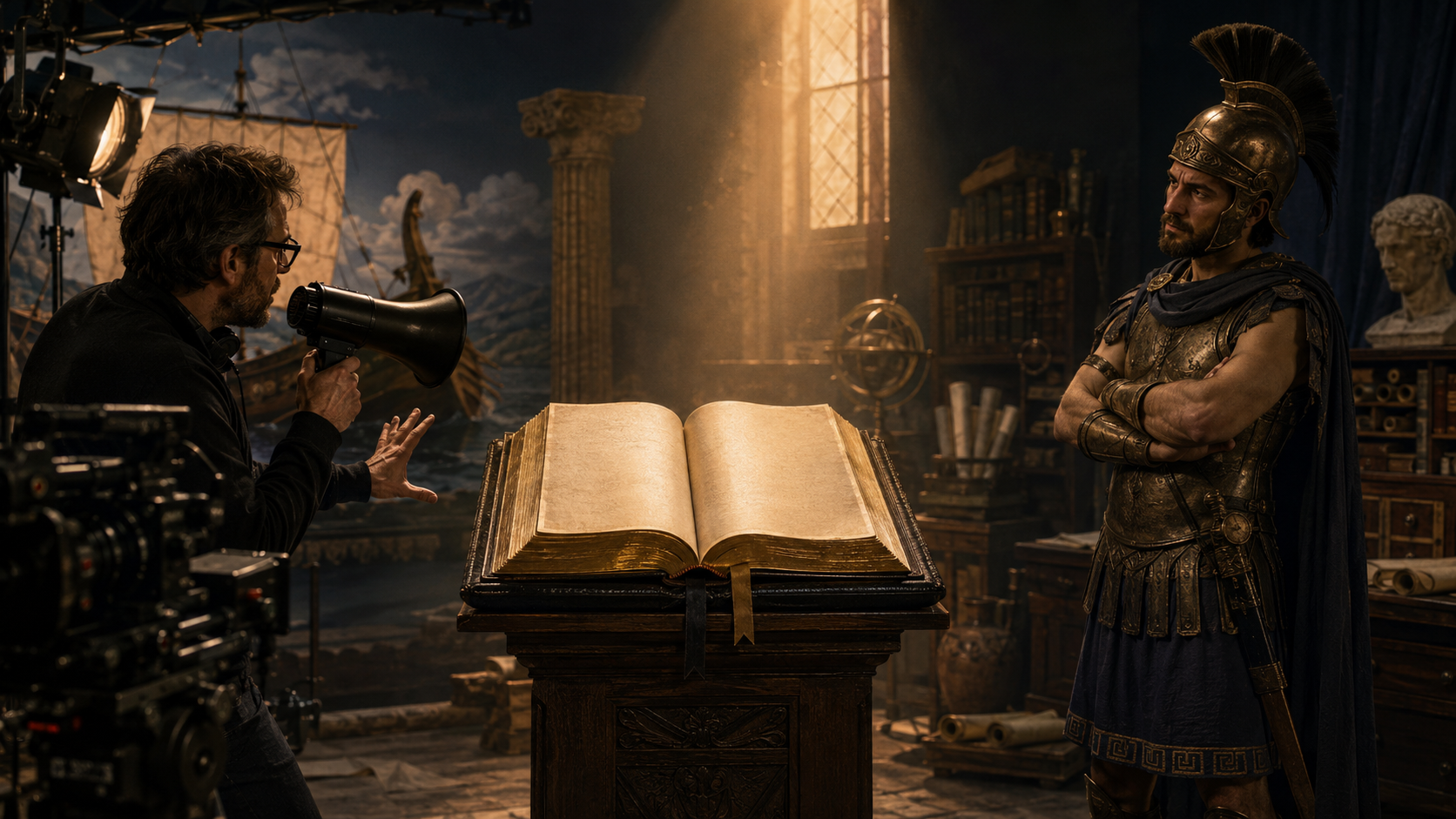
Christopher Nolan, Emily Wilson, and What Happens When the Modern Audience Becomes the Standard
Let us begin by acquitting Emily Dickinson. She did not translate The Odyssey. Dickinson had enough to occupy her with death, immortality, dashes, and that fly which would not stop buzzing. The translator in question is Emily Wilson.
The correction matters, although the mistake is understandable. Once the classics have been sufficiently updated for modern audiences, all old authors begin to look alike. Homer, Dickinson, Batman, and Oppenheimer eventually report to the same development executive.
Homer has lately passed through two conspicuous modernizing hands. Wilson produced a brisk, contemporary English Odyssey and announced its hero in a now-famous first line as “a complicated man.” Christopher Nolan then cited Wilson’s line as an inspiration for his film. Nolan wanted the ancient world to feel accessible, earthy, modern, and relatable. He succeeded in making a Christopher Nolan movie. Whether he succeeded in giving us Homer is the question that has stirred classicists.
That question gives the church a useful warning. Mark Ward also begins with an honorable concern: he wants modern readers to understand the Bible. But when the needs, habits, and expectations of “the modern audience” become the controlling standard, translation quietly becomes adaptation. The ancient work is not simply carried into new language. It is revised until it behaves like a modern work.
That may be permissible when a filmmaker adapts Homer. It is not permissible when the church translates the words of God.
A Modern Man in an Ancient Helmet
Nolan did not conceal his purpose. He said that he wanted The Odyssey to be accessible and that he wanted its world to possess an “earthy, modern, relatable tone.” The result has received immense popular and critical praise. It is evidently powerful cinema. Yet Daniel Mendelsohn, a classicist and recent translator of The Odyssey, argues that Nolan’s Odysseus has lost the cleverness, humor, and wily charm that define Homer’s hero. The trickster has become another tormented Nolan protagonist, burdened by guilt and brooding handsomely in poor lighting.[1]
Nor should the phrase critical praise be mistaken for ideologically neutral certification. Many contemporary critics and classicists read the classics—and Western civilization itself—through a power analysis whose intellectual family is broadly Marxist or post-Marxist, even when they would not accept Marxist as a personal label. Class, race, sex, empire, privilege, domination, and victimhood become the controlling categories. The Society for Classical Studies itself describes choices about which texts are read as shaped by “race, gender, power, and class,” while a candidate for its vice presidency urged the Society to investigate how the present reshapes our view of the past.[2] Within that lens, an adaptation which redistributes sympathy, reverses guilt, or subjects Homer to present moral priorities may appear not less faithful but more enlightened. This does not describe every classicist or establish the private reason any reviewer praised Nolan. It does mean that learned applause cannot settle the question. If the lens is wrong, expertise merely applies the wrong lens more skillfully. The question remains: Is this still Homer?
The changes are not confined to trimming incidents for running time. The famous “Nobody” trick in the Cyclops episode disappears. The Phaeacian court, where Odysseus proves himself a master storyteller, disappears. Calypso becomes part of an amnesia plot. Athena’s lively relationship with Odysseus is reduced. The hero who longs consciously for home is recast as a traumatized man trying to recover himself. Homer’s Odysseus has not merely been shortened. He has been placed on Nolan’s couch.
Nolan also gathers the ancient obligations of hospitality under the invented label “Zeus’s law” and presents them through the modern moral shorthand of the Golden Rule. Classicists consulted about the film have pointed out that there was no such single Greek code and that xenia imposed reciprocal duties upon both host and guest. The invention makes the moral world of the poem immediately legible to modern viewers, but it does so by replacing an ancient idea with a modern synthesis.[3] Accessibility has not only explained the old world. It has supplied that world with a new law.
Emily Wilson herself came away impressed by the spectacle but dissatisfied with the adaptation. She told the Associated Press that Nolan had missed themes essential to the poem. She objected to the diminished place of Penelope, the absence of Zeus and Poseidon as visible characters, and the conversion of Odysseus into a character more recognizably Nolan’s than Homer’s.[4]
Here the comedy becomes almost too neat. Wilson’s own translation has been criticized on strikingly similar grounds.
Richard Whitaker, emeritus professor of classics at the University of Cape Town and himself a translator of Homer, argues that Wilson repeatedly adjusts the poem to fit twenty-first-century moral expectations. His criticism does not rest on the fact that she calls the household women slaves. Wilson is right to object when English translators insert sexual slurs which the Greek does not contain. The problem is broader. According to Whitaker, her governing interpretation changes the moral weight of characters and actions throughout the poem.
At the beginning of the epic, for example, the Greek says that Odysseus desired to save his men but that they perished through their own recklessness. Wilson omits both the statement of his desire and the line assigning responsibility to the men. Elsewhere, language condemning the suitors’ violent arrogance becomes the comparatively mild “ungentlemanly.” Polyphemus loses some of the Greek terms that mark him as monstrous and pitiless. Homeric repetition and connective structure are frequently exchanged for contemporary, staccato English. Whitaker concludes that the attempt to make the poem embody modern values has produced something too tendentious to serve reliably as an academic translation.[5]
Wilson modernizes Homer. Nolan modernizes Wilson’s Homer. Wilson then complains that Nolan has lost Homer. One awaits the streaming adaptation of Nolan’s film in which Odysseus hosts a podcast about trauma, Penelope runs a lifestyle brand, and the Cyclops is misunderstood because no one respected his boundaries.
The lesson is not that Wilson and Nolan lack talent. Both plainly possess it. The lesson is that modernization is not neutral. Every time the modern audience becomes the measure of what may be retained, the old work is made to surrender another part of itself.
Mark Ward Enters the Editing Room
Mark Ward’s argument about the Authorized Version follows the same dramatic structure. He calls its language “dead English” and argues that it should no longer remain the principal Bible of the English-speaking church. Christians, he says, should read contemporary vernacular translations because the language of the Authorized Version has become too difficult and too easily misunderstood.[6]
Ward does not advocate the wildest kind of paraphrase. He frequently praises formal translation. He admits that excessive lucidity can erase meaningful ambiguity. He acknowledges the value of the King James tradition and recognizes that contemporary translations can interpret where the original leaves a question open.[7] Those concessions should be stated fairly.
Yet the controlling principle remains the presumed competence and comfort of the present reader. Forms which contemporary English no longer uses are treated as expendable unless Ward believes their information important enough for a footnote. He expressly acknowledges that the Authorized Version is more exact when it distinguishes singular and plural second-person pronouns. His answer is that context usually permits modern readers to infer the distinction and that the lost information is generally minor.[8]
This is the decisive point. Ward knows that the older biblical English carries information which ordinary contemporary English does not. He does not deny the loss. He reclassifies it as acceptable.
Christopher Nolan does much the same thing. Homer’s forms and themes do not all fit a modern blockbuster, so the director decides what is essential, what can be inferred, what can be omitted, and what must be reinvented to make the ancient world legible. A filmmaker has that liberty because his work is advertised as an adaptation. A Bible translator is a minister of a received text. He has no commission to decide that an inspired distinction has become too minor for the text and may safely be transferred to an optional note.
Biblical English Is a Tailored Garment
The language of the Authorized Version is commonly called Jacobean English. That description is chronologically convenient and linguistically misleading. There was no single thing called “the English everybody spoke in 1611.” A sermon, a legal instrument, a tavern conversation, a royal proclamation, a theological preface, and a poem occupied different registers.
The Authorized Version was not a transcript of casual speech. It inherited a biblical idiom formed through Tyndale, Coverdale, the Great Bible, Geneva, and the Bishops’ Bible. Its translators revised that tradition under the discipline of the Hebrew and Greek text. They retained older grammatical forms where those forms served the original. Read “The Translators to the Reader” beside Genesis 1 or John 1. The preface is dense seventeenth-century prose; the biblical text is something else. The same scholars wrote in one register about their work and used another register to clothe Scripture.
“Biblical English” is therefore the better name. It is not a costume placed upon the Bible to make it sound old and religious. It is a tailored garment made to fit features of the authentic Hebrew and Greek which ordinary English does not naturally possess.
Modern conversational English is comfortable, but it comes off the rack. It has one pocket marked you. Biblical English has separate places for thou, thee, ye, and you. Those are not decorative brass buttons. They carry number and grammatical relation.
Consider the Lord’s words to Peter:
And the Lord said, Simon, Simon, behold, Satan hath desired to have you, that he may sift you as wheat: But I have prayed for thee, that thy faith fail not: and when thou art converted, strengthen thy brethren.
—Luke 22:31–32
Satan desires the disciples collectively; Christ speaks of his particular intercession for Peter. The movement from plural to singular is visible in the Authorized Version. In ordinary contemporary English, every one of those pronouns becomes you or your. The reader may recover the distinction from a margin, a commentary, or the original Greek. He may also miss it entirely.
Ward himself uses John 4:48 as an example. Jesus answers one man, yet says, “Except ye see signs and wonders, ye will not believe,” widening the rebuke to a group. Ward concedes that a modern version may need a footnote or an added expression such as “you people” to disclose the number.[8] The Authorized Version needs neither rescue. Its English was already built for the distinction.
David Norton, while discussing how far an editor may modernize the Authorized Version, reaches the boundary Ward wishes to cross. Spelling can be modernized; grammatical forms and words cannot simply be exchanged without producing a new translation. Norton prefers “a difficult correct word” to an easy modernization that suggests the wrong sense. When thou shalt becomes you shall, the editor is no longer tidying the old garment. He is cutting a new one.[9]
The point is not that every form of Hebrew or Greek can be reproduced one-for-one in English. No serious translator believes that. Nor is the claim that the Authorized Version corrects the original languages, possesses a second inspiration, or stands above them. The authentic Hebrew and Greek Scriptures are the rule; the Authorized Version is valued as a faithful English translation of them. Confessional Bibliology is not Ruckmanism wearing academic robes.
The point is much simpler: because languages differ, accurate translation may require a deliberately shaped target language. If ordinary English lacks a useful distinction, the translator may teach English to carry it. He need not drop the distinction and congratulate the reader for feeling at home.
Martin Luther’s Bible did not merely reflect an already finished standard German. Its enormous circulation helped the development of a common written language. Scholars properly qualify the old claim that Luther single-handedly created modern German, but his translation unquestionably enlarged and stabilized what German could do.[10] Great translations do not always kneel before the current vernacular. Sometimes they discipline, enrich, and elevate it.
The Authorized Version performed a comparable service in English. The church should hesitate before trading a language formed around Scripture for a Scripture continually re-formed around the latest habits of English.
“But People Must Understand”
Of course they must. A translation which cannot be understood has failed. But understandable does not mean effortless, and English does not mean conversational English.
Every serious field teaches its necessary language. A child learns numerator and denominator. A mechanic learns torque. A new Christian learns justification, covenant, propitiation, sanctification, and resurrection. The church which can explain the Trinity can explain that thou is singular and ye is plural. It may even accomplish this in less time than Christopher Nolan requires to establish a subplot.
Scripture itself does not promise that every sentence will yield its full meaning at first glance. Peter says that some things in Paul’s letters are “hard to be understood” (2 Peter 3:16). He does not therefore commission a committee to make Paul less Pauline. Understanding comes through reading, hearing, preaching, comparison, meditation, and study.
Ward’s answer is that contemporary translations usually communicate enough through context. But “usually” and “enough” are strange standards for the church’s public Bible. A reader’s ability to guess correctly most of the time does not prove that an expressed distinction was disposable. It proves only that language contains redundancies. The question is not whether a modern reader can survive the loss. The question is whether the translator was authorized to impose it.
Nor does the impossibility of perfect formal correspondence settle the matter. A coat cannot reproduce the body beneath it. It can still be cut to the body rather than to the mannequin in the shop window. The fact that every translation involves judgment does not make every judgment equally faithful.
The translators of 1611 wanted Scripture heard in the mother tongue. They did not conclude that the Bible must sound like the mother’s conversation over breakfast. They preserved repetition, unfamiliar constructions, technical terms, grammatical distinctions, and the accumulated language of earlier English Bibles. They expected ministers to preach and readers to learn. Their “very vulgar” reader was given the whole Bible, not a Bible from which everything requiring instruction had been quietly removed.
An Adaptation Must Admit What It Is
Christopher Nolan is entitled to make a Christopher Nolan film. Viewers may admire it as cinema while observing that his Odysseus is no longer Homer’s Odysseus in several essential respects. Indeed, the honesty of the category protects us: the credits say written and directed by Christopher Nolan. No one believes Homer personally approved the screenplay.
The danger in Bible translation is greater because a modernized version still arrives with Holy Bible on the cover. The interpretive decisions disappear into the voice of God. What Nolan must claim as his adaptation, the modern translator can print without visible attribution inside the verse.
This danger increases when linguistic modernization is joined to a reconstructed Hebrew or Greek text. The reader is not merely receiving the same house with new paint. Walls have moved. Beams have been removed. In some rooms, the foundation itself is different. Yet the entire renovation is marketed under the mild language of readability.
The answer is not to worship old sounds because they are old. It is to preserve a biblical English capable of serving the authentic text. Obsolete spellings may be modernized. Truly unknown words may be taught, glossed, or, where necessary, carefully revised under the authority of the original. Helps can stand beside the Bible. None of this requires us to make present-day speech the judge of the form Scripture may take.
Homer can survive Nolan. Anyone dissatisfied with the film can return to the Greek or choose another translation. The church, however, should not train generations to regard the loss of biblical wording and form as the harmless price of being relatable. Once that instinct governs translation, every age will make the Bible over in its own image and call the result clarity.
Emily Wilson modernized Homer and then discovered that Christopher Nolan could modernize him further. Her complaint is instructive: a work can retain its names, incidents, and broad outline while losing the qualities that made it that work. Ward is right that language changes. He is wrong to treat modern English as a neutral vessel into which the Bible may be poured without remainder. The vessel has a shape. Whatever does not fit is spilled, paraphrased, hidden in a note, or declared minor.
The church does not need the Bible rebooted for the modern audience. It needs the authentic Hebrew and Greek Scriptures faithfully clothed in an English formed to serve them. It needs ministers who teach, readers who study, and a translation which does not apologize for carrying more than conversational English ordinarily carries.
Let us not allow Mark Ward to become the church’s Christopher Nolan.
Notes
- Daniel Mendelsohn, “Christopher Nolan’s Artfully Woven Odyssey,” The New York Review of Books, July 17, 2026.
- Society for Classical Studies, “Teaching Students to Read Latin: What Does That Mean?”, call for papers for the 154th Annual Meeting; Paul Allen Miller, candidate statement for Vice President for Program, in Society for Classical Studies, “2022 Candidate Statements,”.
- Lauren Puckett-Pope, “In The Odyssey, ‘Zeus’s Law’ Is Both Truth and Invention,” Elle, July 18, 2026.
- Hillel Italie, “Not Greek to Them: Scholars Question Christopher Nolan’s The Odyssey,” Associated Press, July 19, 2026.
- Richard Whitaker, “Homer’s Odyssey Three Ways: Recent Translations by Verity, Wilson, and Green,” Acta Classica 63 (2020): 1–15.
- Mark Ward, “Answering a Few More Objections to Authorized, Part 1,” By Faith We Understand, July 29, 2019; Mark Ward, Authorized: The Use and Misuse of the King James Bible (Lexham Press, 2018).
- Mark Ward, “Bible Translations: Wisdom in Choosing the Right One,” Bible Study Magazine, July/August 2022.
- Mark Ward, “The INCREDI-NASB: More Literal than a Speeding ESV,” By Faith We Understand, June 5, 2021.
- David Norton, A Textual History of the King James Bible (Cambridge: Cambridge University Press, 2005), 137–44.
- Anja Lobenstein-Reichmann, “Martin Luther, Bible Translation, and the German Language,” Oxford Research Encyclopedia of Religion (Oxford University Press, 2017).
Bibliography
Lobenstein-Reichmann, Anja. “Martin Luther, Bible Translation, and the German Language.” Oxford Research Encyclopedia of Religion. Oxford University Press, 2017.
Mendelsohn, Daniel. “Christopher Nolan’s Artfully Woven Odyssey.” The New York Review of Books. July 17, 2026.
Norton, David. A Textual History of the King James Bible. Cambridge: Cambridge University Press, 2005.
Ward, Mark. Authorized: The Use and Misuse of the King James Bible. Bellingham, WA: Lexham Press, 2018.
Whitaker, Richard. “Homer’s Odyssey Three Ways: Recent Translations by Verity, Wilson, and Green.” Acta Classica 63 (2020): 1–15.
Wilson, Emily, trans. The Odyssey. New York: W. W. Norton, 2018.
Comments
Share a question or response to this article.