

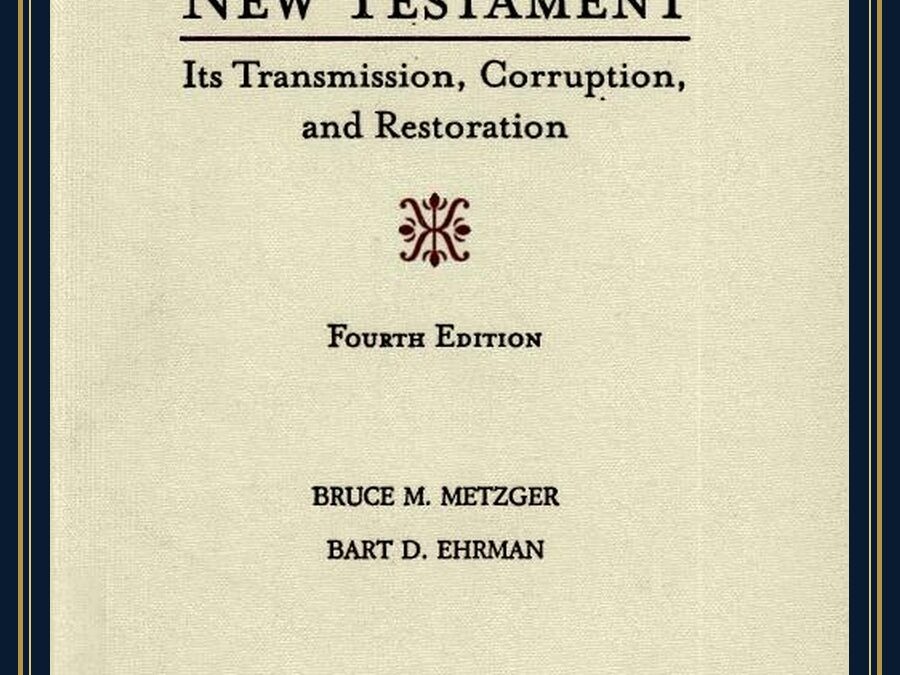

Fourth edition
The Text of the New Testament
Its Transmission, Corruption, and Restoration
Bart D. Ehrman; Bruce M. Metzger · 2005
New York and Oxford: Oxford University Press, 2005.
Overview
Metzger and Ehrman survey the physical production of ancient books, the principal Greek manuscripts, versions and Fathers, the history of printed editions, causes of accidental and intentional change, theories of transmission, and the practice of evaluating variants. The fourth edition updates Metzger's classic manual with expanded treatment of papyri, scribal culture, current methods, and selected textual problems.
The volume remains the most balanced single-volume entrance to the traditional discipline: it combines accessible narrative, precise witness descriptions, historical depth, and concrete examples. Some catalog data and methodological discussions now need supplementation by the Editio Critica Maior and CBGM literature, but the book's breadth and pedagogical clarity remain exceptional.
Overview
Metzger and Ehrman survey the physical production of ancient books, the principal Greek manuscripts, versions and Fathers, the history of printed editions, causes of accidental and intentional change, theories of transmission, and the practice of evaluating variants. The fourth edition updates Metzger's classic manual with expanded treatment of papyri, scribal culture, current methods, and selected textual problems.
The volume remains the most balanced single-volume entrance to the traditional discipline: it combines accessible narrative, precise witness descriptions, historical depth, and concrete examples. Some catalog data and methodological discussions now need supplementation by the Editio Critica Maior and CBGM literature, but the book's breadth and pedagogical clarity remain exceptional.
Editorial Evaluation
Purpose Fulfillment
Does the work accomplish what it claims to accomplish?
Brief assessment
The fourth edition fully realizes its purpose as a history of transmission, survey of corruption, and introduction to restoration.
Full rationale and supporting references
The fourth edition fully realizes its purpose as a history of transmission, survey of corruption, and introduction to restoration. Evidence reviewed: complete supplied fourth edition, including all ten chapters, plates, notes, bibliography, and indexes (PDF pp. 1–383).
Editorial Evaluation
Source Quality
Does it use the appropriate primary and secondary sources?
Brief assessment
It synthesizes manuscripts, versions, Fathers, ancient book production, printed editions, archival discoveries, and a very large specialist bibliography.
Full rationale and supporting references
It synthesizes manuscripts, versions, Fathers, ancient book production, printed editions, archival discoveries, and a very large specialist bibliography. Evidence reviewed: complete supplied fourth edition, including all ten chapters, plates, notes, bibliography, and indexes (PDF pp. 1–383).
Editorial Evaluation
Citation Accuracy
Are quotations, references, and claims verifiable and in context?
Brief assessment
Witnesses, editions, scholars, and examples are documented with precise sigla and notes suitable for follow-up research.
Full rationale and supporting references
Witnesses, editions, scholars, and examples are documented with precise sigla and notes suitable for follow-up research. Evidence reviewed: complete supplied fourth edition, including all ten chapters, plates, notes, bibliography, and indexes (PDF pp. 1–383).
Editorial Evaluation
Evidence Coverage
Does it address the relevant evidence, including contrary evidence?
Brief assessment
Every major class of textual evidence is explained and illustrated, and the final chapters demonstrate how competing considerations operate in real variants.
Full rationale and supporting references
Every major class of textual evidence is explained and illustrated, and the final chapters demonstrate how competing considerations operate in real variants. Evidence reviewed: complete supplied fourth edition, including all ten chapters, plates, notes, bibliography, and indexes (PDF pp. 1–383).
Editorial Evaluation
Historical Accuracy
Are people, dates, editions, events, and settings handled correctly?
Brief assessment
The history from ancient bookmaking through modern criticism is authoritative and nuanced, though subsequent ECM and CBGM developments require an update.
Full rationale and supporting references
The history from ancient bookmaking through modern criticism is authoritative and nuanced, though subsequent ECM and CBGM developments require an update. Evidence reviewed: complete supplied fourth edition, including all ten chapters, plates, notes, bibliography, and indexes (PDF pp. 1–383).
Editorial Evaluation
Subject Competence
Does the author demonstrate competence in the relevant disciplines?
Brief assessment
The authors' combined mastery of manuscripts, patristics, scribal culture, editorial history, and Greek textual decisions is exceptional.
Full rationale and supporting references
The authors' combined mastery of manuscripts, patristics, scribal culture, editorial history, and Greek textual decisions is exceptional. Evidence reviewed: complete supplied fourth edition, including all ten chapters, plates, notes, bibliography, and indexes (PDF pp. 1–383).
Editorial Evaluation
Logical Coherence
Do the conclusions follow from the premises and evidence?
Brief assessment
The interaction of external, transcriptional, and intrinsic probability is carefully reasoned.
Full rationale and supporting references
The interaction of external, transcriptional, and intrinsic probability is carefully reasoned; difficult cases also reveal unavoidable dependence on editorial judgment. Evidence reviewed: complete supplied fourth edition, including all ten chapters, plates, notes, bibliography, and indexes (PDF pp. 1–383).
Editorial Evaluation
Methodological Transparency
Are the method and controlling assumptions identifiable and consistent?
Brief assessment
The manual states its categories, canons, uncertainty, and competing theories plainly, while acknowledging that no mechanical method determines every reading.
Full rationale and supporting references
The manual states its categories, canons, uncertainty, and competing theories plainly, while acknowledging that no mechanical method determines every reading. Evidence reviewed: complete supplied fourth edition, including all ten chapters, plates, notes, bibliography, and indexes (PDF pp. 1–383).
Editorial Evaluation
Strongest-Form Engagement
Does the work address the strongest opposing case rather than a caricature?
Brief assessment
Major historical approaches receive fair exposition, but current Byzantine-priority and confessional received-text arguments receive less sustained strongest-form engagement.
Full rationale and supporting references
Major historical approaches receive fair exposition, but current Byzantine-priority and confessional received-text arguments receive less sustained strongest-form engagement. Evidence reviewed: complete supplied fourth edition, including all ten chapters, plates, notes, bibliography, and indexes (PDF pp. 1–383).
Editorial Evaluation
Clarity and Research Usefulness
Is it intelligible, navigable, and useful for further study?
Brief assessment
The prose, plates, tables, witness survey, methodological chapters, selected problems, bibliography, and indexes make it outstanding for teaching and reference.
Full rationale and supporting references
The prose, plates, tables, witness survey, methodological chapters, selected problems, bibliography, and indexes make it outstanding for teaching and reference. Evidence reviewed: complete supplied fourth edition, including all ten chapters, plates, notes, bibliography, and indexes (PDF pp. 1–383).
Scripture Passage Coverage
1 John 5:7–8
Substantial treatment · history of printed editions
Rejects the readingTreats the Comma Johanneum as a late addition to the Greek text.
1 Timothy 3:16
Substantial treatment · examples of intentional and accidental change
Rejects the readingPrefers the relative-pronoun reading to the traditional 'God.'
Acts 8:37
Brief treatment · examples of expansion
Rejects the readingTreats the baptismal confession as a secondary addition.
John 1:18
Substantial treatment · selected textual problems
Qualified or mixed conclusionAssesses 'only-begotten God' and 'only-begotten Son.'
John 7:53–8:11
Substantial treatment · major passages and transmission history
Rejects the readingTreats the pericope adulterae as a secondary but ancient narrative with a mobile location.
Luke 22:43–44
Substantial treatment · selected textual problems
Qualified or mixed conclusionPresents the difficult external and intrinsic evidence for the agony and bloody sweat.
Mark 1:1
Substantial treatment · selected textual problems
Qualified or mixed conclusionWeighs the disputed presence of 'Son of God' through external and internal evidence.
Mark 16:9–20
Substantial treatment · major passages and transmission history
Rejects the readingTreats the longer ending as secondary to the earliest attainable form of Mark.