

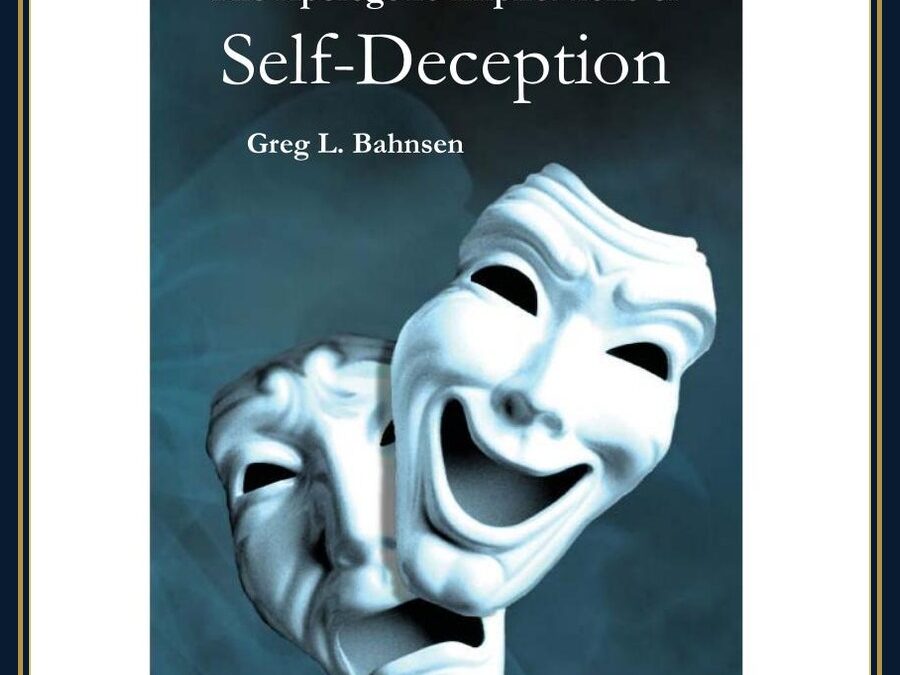

Ph.D. dissertation; later digital edition
The Apologetic Implications of Self-Deception
A Conditional Resolution of the Apparent Paradox of Self-Deception
Greg L. Bahnsen · 1978; later Covenant Media digital edition
Ph.D. dissertation, University of Southern California, 1978; later Covenant Media Foundation edition.
Overview
Bahnsen examines the apparent paradox of self-deception: how a person can in some sense know a truth while believing or professing its contrary. He evaluates influential philosophical accounts of belief, intention, motivation, awareness, and other-deception, states seven criteria for an adequate theory, and develops an account suited to the biblical claim that unbelievers know God while suppressing that knowledge. The final application connects the analysis to presuppositional apologetics and moral responsibility.
The dissertation is rigorous, unusually transparent, and broad in philosophical engagement. Its greatest strength is methodological: rival solutions are not dismissed by theological assertion but tested against an explicit adequacy framework. Some psychological literature and analytic debates are now dated, yet the core taxonomy and apologetic application remain highly useful.
Overview
Bahnsen examines the apparent paradox of self-deception: how a person can in some sense know a truth while believing or professing its contrary. He evaluates influential philosophical accounts of belief, intention, motivation, awareness, and other-deception, states seven criteria for an adequate theory, and develops an account suited to the biblical claim that unbelievers know God while suppressing that knowledge. The final application connects the analysis to presuppositional apologetics and moral responsibility.
The dissertation is rigorous, unusually transparent, and broad in philosophical engagement. Its greatest strength is methodological: rival solutions are not dismissed by theological assertion but tested against an explicit adequacy framework. Some psychological literature and analytic debates are now dated, yet the core taxonomy and apologetic application remain highly useful.
Editorial Evaluation
Purpose Fulfillment
Does the work accomplish what it claims to accomplish?
Brief assessment
Bahnsen develops a philosophically rigorous solution to self-deception and carries it through to the announced apologetic implications.
Full rationale and supporting references
Bahnsen develops a philosophically rigorous solution to self-deception and carries it through to the announced apologetic implications. Evidence reviewed: complete supplied 213-page dissertation edition, especially the seven adequacy criteria (PDF pp. 26–27), rival-theory chapters, constructive account, application, and bibliography.
Editorial Evaluation
Source Quality
Does it use the appropriate primary and secondary sources?
Brief assessment
The dissertation engages a wide field of analytic philosophy, psychology, ethics, epistemology, theology, and biblical interpretation.
Full rationale and supporting references
The dissertation engages a wide field of analytic philosophy, psychology, ethics, epistemology, theology, and biblical interpretation. Evidence reviewed: complete supplied 213-page dissertation edition, especially the seven adequacy criteria (PDF pp. 26–27), rival-theory chapters, constructive account, application, and bibliography.
Editorial Evaluation
Citation Accuracy
Are quotations, references, and claims verifiable and in context?
Brief assessment
Major interlocutors and technical claims are documented in detailed notes and a substantial bibliography.
Full rationale and supporting references
Major interlocutors and technical claims are documented in detailed notes and a substantial bibliography; citation practice reflects its 1978 dissertation context. Evidence reviewed: complete supplied 213-page dissertation edition, especially the seven adequacy criteria (PDF pp. 26–27), rival-theory chapters, constructive account, application, and bibliography.
Editorial Evaluation
Evidence Coverage
Does it address the relevant evidence, including contrary evidence?
Brief assessment
Conceptual examples, rival theories, psychological observations, and biblical cases are repeatedly tested against the stated adequacy criteria.
Full rationale and supporting references
Conceptual examples, rival theories, psychological observations, and biblical cases are repeatedly tested against the stated adequacy criteria. Evidence reviewed: complete supplied 213-page dissertation edition, especially the seven adequacy criteria (PDF pp. 26–27), rival-theory chapters, constructive account, application, and bibliography.
Editorial Evaluation
Historical Accuracy
Are people, dates, editions, events, and settings handled correctly?
Brief assessment
The history of the philosophical problem is reliable for its purpose, though later cognitive-science and analytic literature necessarily lies outside the study.
Full rationale and supporting references
The history of the philosophical problem is reliable for its purpose, though later cognitive-science and analytic literature necessarily lies outside the study. Evidence reviewed: complete supplied 213-page dissertation edition, especially the seven adequacy criteria (PDF pp. 26–27), rival-theory chapters, constructive account, application, and bibliography.
Editorial Evaluation
Subject Competence
Does the author demonstrate competence in the relevant disciplines?
Brief assessment
Bahnsen displays exceptional competence in analytic argument, epistemology, philosophy of mind, Reformed theology, and presuppositional apologetics.
Full rationale and supporting references
Bahnsen displays exceptional competence in analytic argument, epistemology, philosophy of mind, Reformed theology, and presuppositional apologetics. Evidence reviewed: complete supplied 213-page dissertation edition, especially the seven adequacy criteria (PDF pp. 26–27), rival-theory chapters, constructive account, application, and bibliography.
Editorial Evaluation
Logical Coherence
Do the conclusions follow from the premises and evidence?
Brief assessment
The treatment carefully separates belief states, motives, purposes, and levels of awareness.
Full rationale and supporting references
The treatment carefully separates belief states, motives, purposes, and levels of awareness; some readers will dispute the final theological synthesis, but its inferential structure is explicit. Evidence reviewed: complete supplied 213-page dissertation edition, especially the seven adequacy criteria (PDF pp. 26–27), rival-theory chapters, constructive account, application, and bibliography.
Editorial Evaluation
Methodological Transparency
Are the method and controlling assumptions identifiable and consistent?
Brief assessment
Seven adequacy criteria, definitions, objections, and the final test of the proposed account are laid out with exemplary clarity.
Full rationale and supporting references
Seven adequacy criteria, definitions, objections, and the final test of the proposed account are laid out with exemplary clarity. Evidence reviewed: complete supplied 213-page dissertation edition, especially the seven adequacy criteria (PDF pp. 26–27), rival-theory chapters, constructive account, application, and bibliography.
Editorial Evaluation
Strongest-Form Engagement
Does the work address the strongest opposing case rather than a caricature?
Brief assessment
Major competing accounts are reconstructed at length and criticized on their own terms before the author advances his alternative.
Full rationale and supporting references
Major competing accounts are reconstructed at length and criticized on their own terms before the author advances his alternative. Evidence reviewed: complete supplied 213-page dissertation edition, especially the seven adequacy criteria (PDF pp. 26–27), rival-theory chapters, constructive account, application, and bibliography.
Editorial Evaluation
Clarity and Research Usefulness
Is it intelligible, navigable, and useful for further study?
Brief assessment
The taxonomy and adequacy criteria remain highly useful for apologetics and interdisciplinary study, despite dated secondary literature and dissertation density.
Full rationale and supporting references
The taxonomy and adequacy criteria remain highly useful for apologetics and interdisciplinary study, despite dated secondary literature and dissertation density. Evidence reviewed: complete supplied 213-page dissertation edition, especially the seven adequacy criteria (PDF pp. 26–27), rival-theory chapters, constructive account, application, and bibliography.
Scripture Passage Coverage
1 John 1:8
Brief treatment · Chapter 1
Discusses without decidingDenial of sin is treated as a scriptural instance of self-deception.
2 Samuel 11–12
Substantial treatment · Chapter 1
Discusses without decidingDavid and Nathan illustrate motivated blindness and moral responsibility.
James 1:22–26
Substantial treatment · Chapter 1
Discusses without decidingThe hearer who deceives himself supplies an explicit New Testament example.
Psalms 51:1–19
Brief treatment · Chapter 1
Discusses without decidingDavid's repentance is related to prior self-deception.
Romans 1:18–23
Primary treatment · apologetic application
Discusses without decidingProvides the principal biblical account of knowing God while suppressing the truth.