

Early printed edition
A Short Sum of Christianity
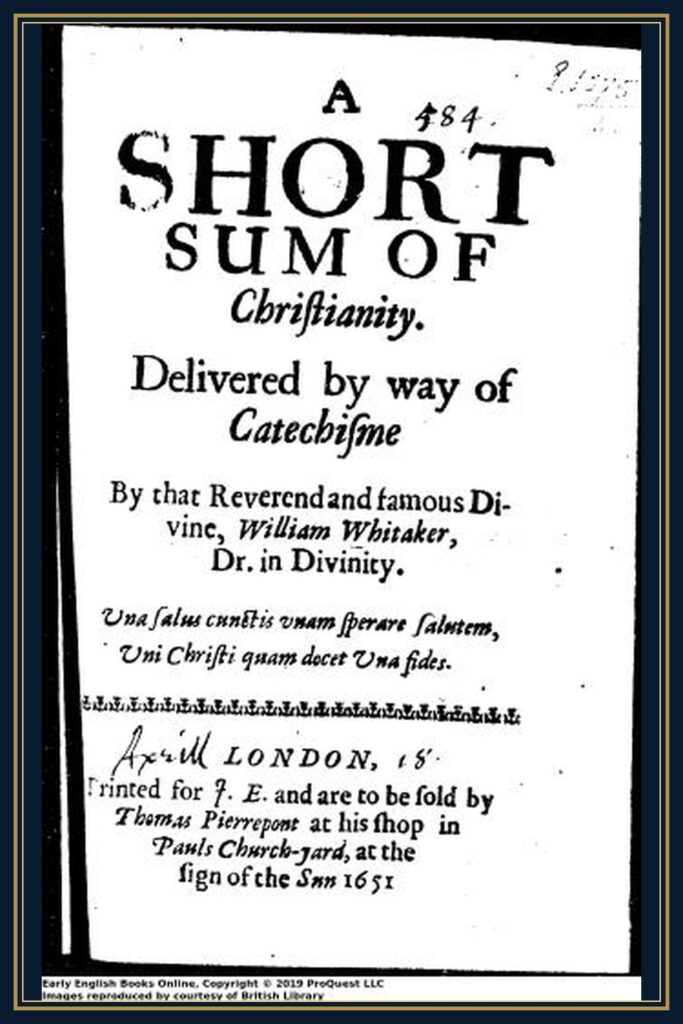
A Short Sum of Christianity, Delivered by Way of Catechisme
William Whitaker · 1651
London: printed by J. Y. for Thomas Slater, 1651.
Overview
This compact catechism presents the principal heads of Reformed Christian doctrine in a sequence of questions and answers. It begins with Scripture as the inspired and perfect rule, directs readers to the original languages, prayer, comparison of passages, and the analogy of faith, then proceeds through the Trinity, creation, fall, law, creed, Christ's work, salvation, church, sacraments, and prayer.
Its great virtue is compression without mere vagueness: doctrinal definitions are memorable and internally ordered. It is not a scholarly monograph and offers few explicit source citations, so genre-sensitive evaluation rewards catechetical purpose and clarity without pretending that it provides modern historical or evidentiary apparatus. The supplied title page attributes the work to William Whitaker; that printed attribution is recorded without claiming new authorship proof.
Overview
This compact catechism presents the principal heads of Reformed Christian doctrine in a sequence of questions and answers. It begins with Scripture as the inspired and perfect rule, directs readers to the original languages, prayer, comparison of passages, and the analogy of faith, then proceeds through the Trinity, creation, fall, law, creed, Christ's work, salvation, church, sacraments, and prayer.
Its great virtue is compression without mere vagueness: doctrinal definitions are memorable and internally ordered. It is not a scholarly monograph and offers few explicit source citations, so genre-sensitive evaluation rewards catechetical purpose and clarity without pretending that it provides modern historical or evidentiary apparatus. The supplied title page attributes the work to William Whitaker; that printed attribution is recorded without claiming new authorship proof.
Editorial Evaluation
Purpose Fulfillment
Does the work accomplish what it claims to accomplish?
Brief assessment
The work succeeds admirably as a short catechetical sum, moving from Scripture and God through salvation, sacraments, and prayer.
Full rationale and supporting references
The work succeeds admirably as a short catechetical sum, moving from Scripture and God through salvation, sacraments, and prayer. Evidence reviewed: complete supplied 19-image scan, OCR-verified from title page through the final Lord's Prayer section.
Editorial Evaluation
Source Quality
Does it use the appropriate primary and secondary sources?
Brief assessment
Its principal source is Scripture interpreted within Reformed catholic doctrine.
Full rationale and supporting references
Its principal source is Scripture interpreted within Reformed catholic doctrine; the compact genre does not supply a scholarly secondary apparatus. Evidence reviewed: complete supplied 19-image scan, OCR-verified from title page through the final Lord's Prayer section.
Editorial Evaluation
Citation Accuracy
Are quotations, references, and claims verifiable and in context?
Brief assessment
Biblical teaching is densely paraphrased and sometimes referenced, but exact chapter-and-verse citation and identification of theological sources are limited by period convention.
Full rationale and supporting references
Biblical teaching is densely paraphrased and sometimes referenced, but exact chapter-and-verse citation and identification of theological sources are limited by period convention. Evidence reviewed: complete supplied 19-image scan, OCR-verified from title page through the final Lord's Prayer section.
Editorial Evaluation
Evidence Coverage
Does it address the relevant evidence, including contrary evidence?
Brief assessment
The answers cover the principal doctrinal loci with meaningful scriptural substance, though they assert rather than demonstrate points requiring polemical defense.
Full rationale and supporting references
The answers cover the principal doctrinal loci with meaningful scriptural substance, though they assert rather than demonstrate points requiring polemical defense. Evidence reviewed: complete supplied 19-image scan, OCR-verified from title page through the final Lord's Prayer section.
Editorial Evaluation
Historical Accuracy
Are people, dates, editions, events, and settings handled correctly?
Brief assessment
The catechism is a valuable witness to seventeenth-century English Reformed teaching.
Full rationale and supporting references
The catechism is a valuable witness to seventeenth-century English Reformed teaching; the title-page attribution is preserved cautiously rather than treated as independently proven. Evidence reviewed: complete supplied 19-image scan, OCR-verified from title page through the final Lord's Prayer section.
Editorial Evaluation
Subject Competence
Does the author demonstrate competence in the relevant disciplines?
Brief assessment
Definitions and doctrinal sequencing show mature command of Reformed theology, catechesis, sacraments, and practical divinity.
Full rationale and supporting references
Definitions and doctrinal sequencing show mature command of Reformed theology, catechesis, sacraments, and practical divinity. Evidence reviewed: complete supplied 19-image scan, OCR-verified from title page through the final Lord's Prayer section.
Editorial Evaluation
Logical Coherence
Do the conclusions follow from the premises and evidence?
Brief assessment
The progression from rule of knowledge to God, creation, fall, redemption, church, and response is compact and coherent.
Full rationale and supporting references
The progression from rule of knowledge to God, creation, fall, redemption, church, and response is compact and coherent. Evidence reviewed: complete supplied 19-image scan, OCR-verified from title page through the final Lord's Prayer section.
Editorial Evaluation
Methodological Transparency
Are the method and controlling assumptions identifiable and consistent?
Brief assessment
Question-and-answer form makes claims and intended instruction plain, and the opening section explicitly states how Scripture should be read.
Full rationale and supporting references
Question-and-answer form makes claims and intended instruction plain, and the opening section explicitly states how Scripture should be read. Evidence reviewed: complete supplied 19-image scan, OCR-verified from title page through the final Lord's Prayer section.
Editorial Evaluation
Strongest-Form Engagement
Does the work address the strongest opposing case rather than a caricature?
Brief assessment
The genre summarizes positive doctrine rather than staging rival arguments, so competing Catholic, Arminian, or sectarian cases are necessarily not developed.
Full rationale and supporting references
The genre summarizes positive doctrine rather than staging rival arguments, so competing Catholic, Arminian, or sectarian cases are necessarily not developed. Evidence reviewed: complete supplied 19-image scan, OCR-verified from title page through the final Lord's Prayer section.
Editorial Evaluation
Clarity and Research Usefulness
Is it intelligible, navigable, and useful for further study?
Brief assessment
Its brevity, memorable definitions, doctrinal range, and historical language make it useful for research and adapted catechesis, with modernization aids needed for some readers.
Full rationale and supporting references
Its brevity, memorable definitions, doctrinal range, and historical language make it useful for research and adapted catechesis, with modernization aids needed for some readers. Evidence reviewed: complete supplied 19-image scan, OCR-verified from title page through the final Lord's Prayer section.
Scripture Passage Coverage
2 Timothy 3:16–17
Substantial treatment · opening Scripture section
Defends the readingSupports Scripture as inspired and sufficient for doctrine and godliness.
Exodus 20:1–17
Substantial treatment · law section
Discusses without decidingThe Ten Commandments organize the explanation of moral duty.
Genesis 1:26–27
Substantial treatment · creation and human nature
Discusses without decidingSupports the catechism's account of humanity made in God's image.
Matthew 6:9–13
Primary treatment · prayer section
Discusses without decidingThe Lord's Prayer structures the concluding catechesis.
Matthew 26:26–28
Substantial treatment · Lord's Supper section
Discusses without decidingGrounds the institution and meaning of the Supper.
Matthew 28:19
Substantial treatment · Trinity and baptism sections
Discusses without decidingSupports Trinitarian confession and the institution of baptism.
Romans 3:19–28
Substantial treatment · sin and justification sections
Discusses without decidingSupports guilt under law and justification by faith.