

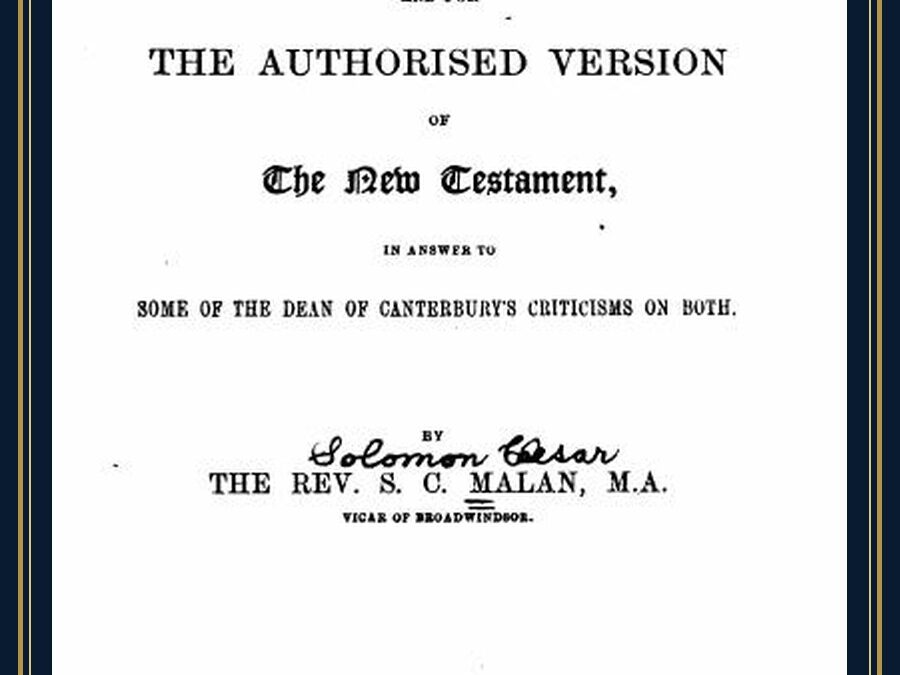

First edition
A Plea for the Received Greek Text and for the Authorised Version of the New Testament
In Answer to Some of the Dean of Canterbury's Criticisms on Both
Solomon Caesar Malan · 1869
London: Hatchards, 187 Piccadilly, W., 1869.
Overview
Malan replies to Henry Alford's critical Greek text and English revisions through detailed discussion of selected readings and renderings in Matthew 1–4 and Titus. He uses Greek grammar, classical parallels, patristic testimony, and ancient versions to defend the Received Text and the Authorized Version while acknowledging that the English translation is not perfect.
The work is strongest as a period witness and as a display of Malan's formidable linguistic learning. Its evidence is selective rather than a full defense of the Received Text, and its frequent personal criticism of Alford weakens otherwise substantive grammatical arguments.
Overview
Malan replies to Henry Alford's critical Greek text and English revisions through detailed discussion of selected readings and renderings in Matthew 1–4 and Titus. He uses Greek grammar, classical parallels, patristic testimony, and ancient versions to defend the Received Text and the Authorized Version while acknowledging that the English translation is not perfect.
The work is strongest as a period witness and as a display of Malan's formidable linguistic learning. Its evidence is selective rather than a full defense of the Received Text, and its frequent personal criticism of Alford weakens otherwise substantive grammatical arguments.
Editorial Evaluation
Purpose Fulfillment
Does the work accomplish what it claims to accomplish?
Brief assessment
The book directly answers Alford on the selected passages and consistently connects textual decisions to English revision.
Full rationale and supporting references
The book directly answers Alford on the selected passages and consistently connects textual decisions to English revision. Evidence reviewed: complete supplied scan, especially the preface (PDF pp. 7–18), Matthew 1–4 discussions, Titus 2–3 (printed pp. 189–210), and conclusion (printed pp. 210–212).
Editorial Evaluation
Source Quality
Does it use the appropriate primary and secondary sources?
Brief assessment
Malan uses Greek manuscripts as reported by Alford, ancient versions, Fathers, classical Greek authors, grammars, and English usage.
Full rationale and supporting references
Malan uses Greek manuscripts as reported by Alford, ancient versions, Fathers, classical Greek authors, grammars, and English usage; the sample is deliberately selective. Evidence reviewed: complete supplied scan, especially the preface (PDF pp. 7–18), Matthew 1–4 discussions, Titus 2–3 (printed pp. 189–210), and conclusion (printed pp. 210–212).
Editorial Evaluation
Citation Accuracy
Are quotations, references, and claims verifiable and in context?
Brief assessment
Greek and classical parallels are often precisely quoted and identified, though nineteenth-century citation conventions and unverified versional claims require modern checking.
Full rationale and supporting references
Greek and classical parallels are often precisely quoted and identified, though nineteenth-century citation conventions and unverified versional claims require modern checking. Evidence reviewed: complete supplied scan, especially the preface (PDF pp. 7–18), Matthew 1–4 discussions, Titus 2–3 (printed pp. 189–210), and conclusion (printed pp. 210–212).
Editorial Evaluation
Evidence Coverage
Does it address the relevant evidence, including contrary evidence?
Brief assessment
The close treatment of Matthew 1–4 and Titus is substantial, but it cannot by itself sustain every general claim made for the entire Received Text or Authorized Version.
Full rationale and supporting references
The close treatment of Matthew 1–4 and Titus is substantial, but it cannot by itself sustain every general claim made for the entire Received Text or Authorized Version. Evidence reviewed: complete supplied scan, especially the preface (PDF pp. 7–18), Matthew 1–4 discussions, Titus 2–3 (printed pp. 189–210), and conclusion (printed pp. 210–212).
Editorial Evaluation
Historical Accuracy
Are people, dates, editions, events, and settings handled correctly?
Brief assessment
The tract is an important contemporary response to revision, yet its broad story of declining modern scholarship is polemical rather than a balanced history.
Full rationale and supporting references
The tract is an important contemporary response to revision, yet its broad story of declining modern scholarship is polemical rather than a balanced history. Evidence reviewed: complete supplied scan, especially the preface (PDF pp. 7–18), Matthew 1–4 discussions, Titus 2–3 (printed pp. 189–210), and conclusion (printed pp. 210–212).
Editorial Evaluation
Subject Competence
Does the author demonstrate competence in the relevant disciplines?
Brief assessment
Malan's command of Greek, ancient languages, and English style is repeatedly evident in detailed lexical and syntactical analysis.
Full rationale and supporting references
Malan's command of Greek, ancient languages, and English style is repeatedly evident in detailed lexical and syntactical analysis. Evidence reviewed: complete supplied scan, especially the preface (PDF pp. 7–18), Matthew 1–4 discussions, Titus 2–3 (printed pp. 189–210), and conclusion (printed pp. 210–212).
Editorial Evaluation
Logical Coherence
Do the conclusions follow from the premises and evidence?
Brief assessment
Many local arguments identify real weaknesses in Alford's renderings.
Full rationale and supporting references
Many local arguments identify real weaknesses in Alford's renderings; the larger inference from selected mistakes to the superiority of the whole received tradition is less secure. Evidence reviewed: complete supplied scan, especially the preface (PDF pp. 7–18), Matthew 1–4 discussions, Titus 2–3 (printed pp. 189–210), and conclusion (printed pp. 210–212).
Editorial Evaluation
Methodological Transparency
Are the method and controlling assumptions identifiable and consistent?
Brief assessment
The author openly declares his attachment to the Received Text and Authorized Version and concedes that the English version has blemishes, but he seldom grades confidence among cases.
Full rationale and supporting references
The author openly declares his attachment to the Received Text and Authorized Version and concedes that the English version has blemishes, but he seldom grades confidence among cases. Evidence reviewed: complete supplied scan, especially the preface (PDF pp. 7–18), Matthew 1–4 discussions, Titus 2–3 (printed pp. 189–210), and conclusion (printed pp. 210–212).
Editorial Evaluation
Strongest-Form Engagement
Does the work address the strongest opposing case rather than a caricature?
Brief assessment
Alford's printed arguments are quoted and tested, yet modern critical methodology is often reduced to Alford's errors and motives rather than presented at its strongest.
Full rationale and supporting references
Alford's printed arguments are quoted and tested, yet modern critical methodology is often reduced to Alford's errors and motives rather than presented at its strongest. Evidence reviewed: complete supplied scan, especially the preface (PDF pp. 7–18), Matthew 1–4 discussions, Titus 2–3 (printed pp. 189–210), and conclusion (printed pp. 210–212).
Editorial Evaluation
Clarity and Research Usefulness
Is it intelligible, navigable, and useful for further study?
Brief assessment
The work remains useful for revision history, Received Text argument, and historical Greek exegesis, though readers need modern editions and tools alongside it.
Full rationale and supporting references
The work remains useful for revision history, Received Text argument, and historical Greek exegesis, though readers need modern editions and tools alongside it. Evidence reviewed: complete supplied scan, especially the preface (PDF pp. 7–18), Matthew 1–4 discussions, Titus 2–3 (printed pp. 189–210), and conclusion (printed pp. 210–212).
Scripture Passage Coverage
Matthew 1:18
Substantial treatment · pp. 1-18
Defends the readingDefends the Received Text's γεννήσις and critiques Alford's preferred reading.
Matthew 1:25
Substantial treatment · Matthew 1 discussion
Defends the readingDefends the traditional wording concerning Mary's firstborn son.
Matthew 2:11
Substantial treatment · Matthew 2 discussion
Defends the readingAssesses Greek construction and English rendering.
Matthew 4:10
Substantial treatment · Matthew 4 discussion
Defends the readingDefends the traditional form of Jesus' command to Satan.
Titus 2:13
Substantial treatment · Titus discussion
Qualified or mixed conclusionAnalyzes Greek grammar and the Authorized Version's Christological rendering.
Titus 3:5
Substantial treatment · pp. 203-206
Discusses without decidingDefends 'washing of regeneration' against Alford's 'font of regeneration.'
Titus 3:8
Brief treatment · pp. 206-207
Discusses without decidingDefends the Authorized Version's syntax and wording.