


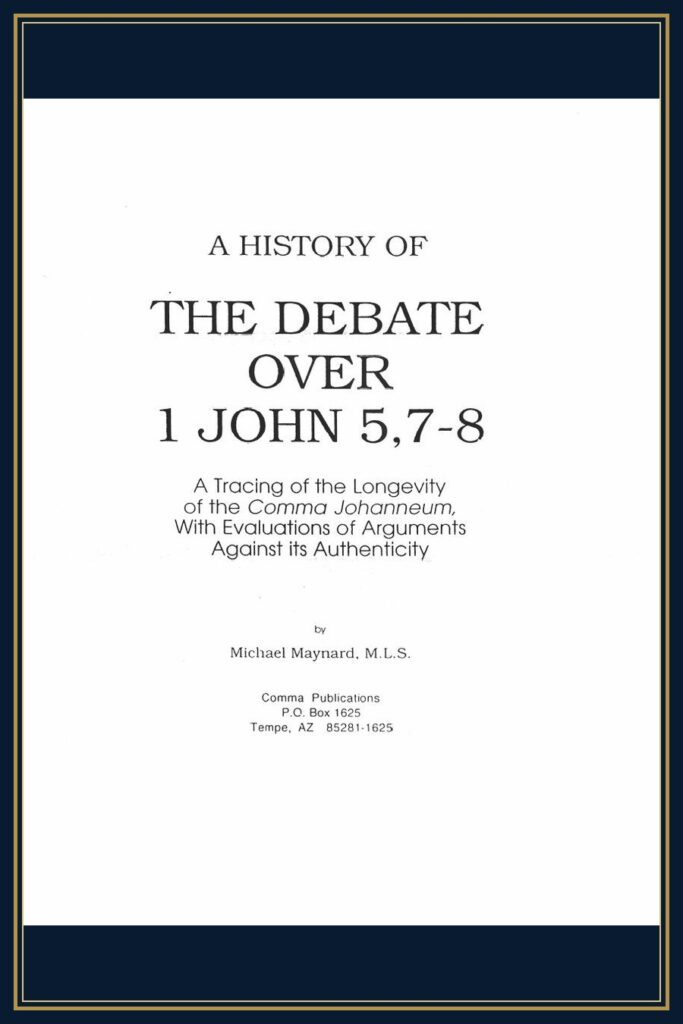
First edition
A History of the Debate over 1 John 5:7-8
A Tracing of the Longevity of the Comma Johanneum, with Evaluations of Arguments Against Its Authenticity
Michael Maynard · 1995
Tempe, Arizona: Comma Publications, 1995.
Overview
Maynard assembles a chronological and bibliographical history of the Comma Johanneum from early patristic and versional evidence through the medieval Latin tradition, Erasmus and the printed Greek text, Reformation controversy, and modern criticism. He defends the authenticity of the traditional wording of 1 John 5:7–8 and treats related disputes such as 1 Timothy 3:16, using facsimiles, long quotations, manuscript reports, theological controversy, and an extensive bibliography.
The volume is a major archive of older sources and remains valuable even to readers who reject its conclusion. Its research quality is reduced by uneven evaluation of the evidence: possible allusions are sometimes treated as direct testimony, manuscript and versional statistics require updating, and the concluding account supplements textual argument with speculative narratives about Satan, Romanism, liberalism, and the theology or character of opponents.
Overview
Maynard assembles a chronological and bibliographical history of the Comma Johanneum from early patristic and versional evidence through the medieval Latin tradition, Erasmus and the printed Greek text, Reformation controversy, and modern criticism. He defends the authenticity of the traditional wording of 1 John 5:7–8 and treats related disputes such as 1 Timothy 3:16, using facsimiles, long quotations, manuscript reports, theological controversy, and an extensive bibliography.
The volume is a major archive of older sources and remains valuable even to readers who reject its conclusion. Its research quality is reduced by uneven evaluation of the evidence: possible allusions are sometimes treated as direct testimony, manuscript and versional statistics require updating, and the concluding account supplements textual argument with speculative narratives about Satan, Romanism, liberalism, and the theology or character of opponents.
Editorial Evaluation
Purpose Fulfillment
Does the work accomplish what it claims to accomplish?
Brief assessment
Maynard delivers an exceptionally extensive history and affirmative brief focused throughout on 1 John 5:7–8.
Full rationale and supporting references
Maynard delivers an exceptionally extensive history and affirmative brief focused throughout on 1 John 5:7–8. Evidence reviewed: complete supplied 444-page scan, OCR-verified throughout, including 382 printed pages, illustrations, conclusion at printed pp. 284–291, appendices, bibliography, and indexes.
Editorial Evaluation
Source Quality
Does it use the appropriate primary and secondary sources?
Brief assessment
The volume gathers Greek and Latin manuscript reports, versions, Fathers, councils, printed editions, correspondence, polemics, facsimiles, and a very large bibliography.
Full rationale and supporting references
The volume gathers Greek and Latin manuscript reports, versions, Fathers, councils, printed editions, correspondence, polemics, facsimiles, and a very large bibliography. Evidence reviewed: complete supplied 444-page scan, OCR-verified throughout, including 382 printed pages, illustrations, conclusion at printed pp. 284–291, appendices, bibliography, and indexes.
Editorial Evaluation
Citation Accuracy
Are quotations, references, and claims verifiable and in context?
Brief assessment
Many primary and secondary sources are quoted at length with usable references, but citation form is inconsistent and some quotations or manuscript claims depend on older intermediaries.
Full rationale and supporting references
Many primary and secondary sources are quoted at length with usable references, but citation form is inconsistent and some quotations or manuscript claims depend on older intermediaries. Evidence reviewed: complete supplied 444-page scan, OCR-verified throughout, including 382 printed pages, illustrations, conclusion at printed pp. 284–291, appendices, bibliography, and indexes.
Editorial Evaluation
Evidence Coverage
Does it address the relevant evidence, including contrary evidence?
Brief assessment
Every major class of evidence is represented and the chronological archive is substantial.
Full rationale and supporting references
Every major class of evidence is represented and the chronological archive is substantial; favorable allusions and negative evidence are not always weighted by comparable standards. Evidence reviewed: complete supplied 444-page scan, OCR-verified throughout, including 382 printed pages, illustrations, conclusion at printed pp. 284–291, appendices, bibliography, and indexes.
Editorial Evaluation
Historical Accuracy
Are people, dates, editions, events, and settings handled correctly?
Brief assessment
The source recovery is valuable, but several narratives about Erasmus, ecclesiastical parties, modern criticism, and the origin or suppression of readings are speculative or outdated.
Full rationale and supporting references
The source recovery is valuable, but several narratives about Erasmus, ecclesiastical parties, modern criticism, and the origin or suppression of readings are speculative or outdated. Evidence reviewed: complete supplied 444-page scan, OCR-verified throughout, including 382 printed pages, illustrations, conclusion at printed pp. 284–291, appendices, bibliography, and indexes.
Editorial Evaluation
Subject Competence
Does the author demonstrate competence in the relevant disciplines?
Brief assessment
Maynard demonstrates deep familiarity with the history and bibliography of the Comma controversy and considerable linguistic and theological knowledge.
Full rationale and supporting references
Maynard demonstrates deep familiarity with the history and bibliography of the Comma controversy and considerable linguistic and theological knowledge. Evidence reviewed: complete supplied 444-page scan, OCR-verified throughout, including 382 printed pages, illustrations, conclusion at printed pp. 284–291, appendices, bibliography, and indexes.
Editorial Evaluation
Logical Coherence
Do the conclusions follow from the premises and evidence?
Brief assessment
Some cumulative grammatical and reception arguments are serious.
Full rationale and supporting references
Some cumulative grammatical and reception arguments are serious; movement from providence or doctrinal fitness to authenticity and from opponents' theology to textual error is not logically sufficient. Evidence reviewed: complete supplied 444-page scan, OCR-verified throughout, including 382 printed pages, illustrations, conclusion at printed pp. 284–291, appendices, bibliography, and indexes.
Editorial Evaluation
Methodological Transparency
Are the method and controlling assumptions identifiable and consistent?
Brief assessment
The received-text commitment and conclusion are explicit, but levels of confidence and distinctions among quotation, allusion, and later report are not consistently maintained.
Full rationale and supporting references
The received-text commitment and conclusion are explicit, but levels of confidence and distinctions among quotation, allusion, and later report are not consistently maintained. Evidence reviewed: complete supplied 444-page scan, OCR-verified throughout, including 382 printed pages, illustrations, conclusion at printed pp. 284–291, appendices, bibliography, and indexes.
Editorial Evaluation
Strongest-Form Engagement
Does the work address the strongest opposing case rather than a caricature?
Brief assessment
A great number of critics are cited, yet the conclusion's treatment of their theology and character often substitutes genealogy or motive for their strongest textual case.
Full rationale and supporting references
A great number of critics are cited, yet the conclusion's treatment of their theology and character often substitutes genealogy or motive for their strongest textual case. Evidence reviewed: complete supplied 444-page scan, OCR-verified throughout, including 382 printed pages, illustrations, conclusion at printed pp. 284–291, appendices, bibliography, and indexes.
Editorial Evaluation
Clarity and Research Usefulness
Is it intelligible, navigable, and useful for further study?
Brief assessment
The chronology, facsimiles, multilingual quotations, bibliography, and source leads make the book a highly useful research archive when checked against current critical resources.
Full rationale and supporting references
The chronology, facsimiles, multilingual quotations, bibliography, and source leads make the book a highly useful research archive when checked against current critical resources. Evidence reviewed: complete supplied 444-page scan, OCR-verified throughout, including 382 printed pages, illustrations, conclusion at printed pp. 284–291, appendices, bibliography, and indexes.
Scripture Passage Coverage
1 John 5:7–8
Primary treatment · entire work, esp. printed pp. 1-291
Defends the readingThe book is devoted to the history, transmission, grammar, and authenticity of the Comma Johanneum.
1 Timothy 3:16
Substantial treatment · appendices and comparative discussions
Defends the readingUses 'God was manifest in the flesh' as a parallel received reading and historical controversy.
2 Samuel 23:11–12
Brief treatment · conclusion
Discusses without decidingUsed illustratively in the appeal to defend inherited scriptural ground.
Matthew 5:18
Substantial treatment · preservation discussions
Defends the readingSupports preservation down to the smallest textual elements.
Matthew 24:35
Brief treatment · preservation discussions
Defends the readingSupports the endurance of Christ's words.
Psalms 115:3
Brief treatment · conclusion
Defends the readingUsed in the theological account of divine sovereignty over preservation.