Colines 1534 Greek New Testament

This is the Greek New Testament that Calvin used in the beginning of his commentaries.  This text has more in common with the current Critical Text than it does with the Textus Receptus.  However, Calvin later switched to the Textus Receptus.  You can listen more about this here:  John Calvin & Textual Criticism by Dr. Jeffrey Riddle

https://confessionalbibliology.com/PDFs/Colines%201534%20Greek%20NT.pdf

JCR Vol. 12 No. 02: Symposium on the Biblical Text and Literature

The symposium contained in this journal is about faithfulness.It is about the preservation of original, infallible truth as handed down through generations in the words and texts of the human language.

This book contains Dr. Theodore Letis’ Edward F. Hills’ Revival of the Ecclesiastical Text.  It can be read at Scribd or bought here:  https://chalcedon.edu/store/40073-jcr-vol-12-no-2-symposium-on-the-biblical-text-and-literature

The Identity of the New Testament Text IV

Available as a paperback for $15 and as a Kindle book for .99

There are over 5,000 known Greek manuscripts of the New Testament, over half of which are continuous text copies, the rest being lectionaries. They range in size from a scrap with parts of two verses to complete New Testaments. They range in date from the second century to the sixteenth. They come from all over the Mediterranean world. They contain several hundred thousand variant readings (differences in the text). The vast majority of these are misspellings or other obvious errors due to carelessness or ignorance on the part of the copyists—such are not proper variant readings and may be ignored. However, many thousands of variants remain which need to be evaluated as we seek to identify the precise original wording of the Text. How best to go about such a project? This book seeks to provide an answer.

The Revised Version of the 1st Three Gospels

1. In considering the points which are discussed in the Conditions of following pages, I would ask the reader to keep before his mind the conditions under which the consent of the Southern Convocation was given to the work of Revision. The first proposal was made by the late Bishop of Winchester (Dr. S. Wilberforce), and seconded by the present Bishop of Gloucester and Bristol, on the 10th of February, 1870. It was accepted by the Upper House of Convocation, and passed, the same day, in the following terms : "That a Committee of both Houses be appointed to report on the desirableness of a Revision of the Authorized Version of the Old and New Testaments, whether by mar ginal notes or otherwise, in those passages where plain and clear errors, whether in the Hebrew or Greek text originally adopted by the translators, or in the translations made from the same, shall on due investigation be found to exist."

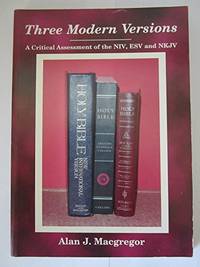
Three Modern Versions

No one can deny that we live in the midst of a propaganda war. Publishing houses aggressively promote their Bible translations to persuade the Christian reader that a given version is best. Amidst the competing claims, few stop to ask whether something is seriously wrong here.

The message bombarding us continually is that modern Bible versions are a good thing, and that the authorised Version is outdated and outmoded. “Which Bible translation is the most reliable today?” is not a question Christians tend to ask today. after all surely it is all the same whether we stick to the Authorised Version, or use its updated cousin the New King James Version, or a more modern one like the New International Version. Or, be right up to date and go over to the English Standard Version. In this book, Alan Macgregor argues that we must look again at this question.

Far from providing increased access to God’s Word, the three Bible versions mentioned above represent a departure from fundamental principles to do with the Bible itself. Why is this? Why does it matter? Why should we keep the Authorised Version? Reading this book will give you straightforward and convincing answers.

(J.P. Thackaway)

New Report

Close