

This is Part 1 of “The Line That Vanished.”
Some textual controversies survive in memory as fragments: an old codex, a faint line, a nineteenth-century scholar who swore that he had seen it. The fragments in this case are substantially true. They have merely become attached to the wrong manuscript.
The codex was not Vaticanus. Codex Vaticanus does not contain 1 Timothy. In the New Testament it runs through 2 Thessalonians, later resumes with part of Hebrews, and includes the Catholic Epistles, but the Pastoral Epistles are absent.1 No observer could have inspected Vaticanus at 1 Timothy 3:16 because that leaf does not exist in the manuscript.
Sinaiticus does contain the verse, and it matters greatly to the textual question. Its first hand reads ΟΣ, conventionally printed ὅς, “who.”2 But Sinaiticus is not the codex around which the famous English history of a fading transverse stroke developed.
That codex is Alexandrinus.
The correction may sound elementary, but it governs everything that follows. A manuscript cannot bear witness where it has no text. A clear reading in one codex cannot be substituted for a damaged reading in another. And a nineteenth-century recollection cannot be assessed until the scholar, manuscript, folio, and mark are identified. The present controversy has often been reduced to a contest between two printed words. Its actual evidence is more concrete: a particular leaf of parchment, a round uncial letter, a thin horizontal stroke, a succession of dated inspections, and an artifact that deteriorated while the controversy was being argued.
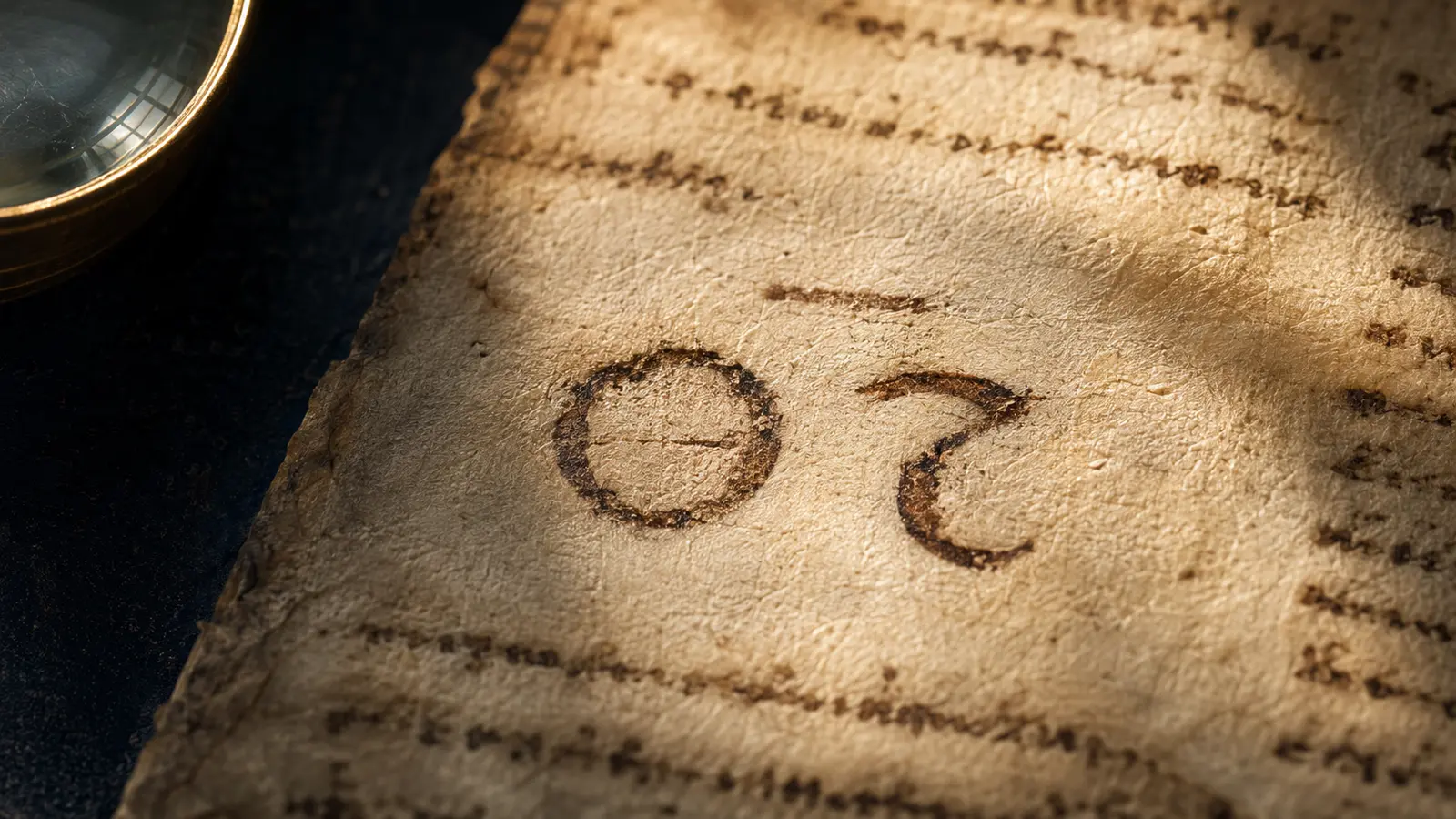
That material history is especially important because the line at issue carried lexical force. The first letter of the contracted form for θεός, “God,” is theta. If its transverse stroke becomes invisible, theta resembles omicron; the contraction ΘΣ can then look like ΟΣ, “who.” The remembered report was therefore never a quaint anecdote at the edge of the case. It concerned the very mark by which one reading is distinguished from the other.
The inquiry must begin with identification because a mistaken codex quietly produces mistaken inferences. If Vaticanus is imagined to contain the verse, its fourth-century prestige is falsely placed behind a reading it cannot attest. If Sinaiticus is imagined to be the worn codex examined in London, its unambiguous ΟΣ is falsely given the disputed physical history of Alexandrinus. Once those substitutions are removed, each manuscript can be allowed to say exactly what it says—and no more.
Three manuscripts, three different facts
Codex Alexandrinus, designated A or 02, is a fifth-century Greek Bible now held by the British Library as Royal MS 1 D VIII.3 It arrived in England in 1627. At 1 Timothy 3:16, its parchment and ink became the stage for more than two centuries of inspection, retracing, abrasion, dispute, and retrospective judgment.
The distinction matters because the three great codices do not supply interchangeable evidence:
- Vaticanus supplies no reading because it lacks the verse.
- Sinaiticus supplies an early and genuine witness to ὅς.
- Alexandrinus supplies a damaged, historically disputed witness whose earlier observers repeatedly discussed a disappearing line.
The last of these is where the remembered testimony belongs.
Vaticanus is designated B or 03 and is ordinarily dated to the fourth century. Its surviving New Testament contents run from Matthew through 2 Thessalonians, resume at Hebrews 1:1, and break off at Hebrews 9:13 before continuing with James through Jude; later hands supplied other material, but the Pastorals are not present in the ancient codex. The absence is not an editorial theory. It is a fact about the contents of the artifact.4
Sinaiticus is designated א or 01 and is also dated to the fourth century. It preserves the Pastorals, including the disputed verse, and its first hand gives ΟΣ. The reading is ancient and must be included in any adequate external-evidence discussion. Yet its value is frequently misstated in popular argument. Sinaiticus proves that ὅς existed early. It does not, by age alone, prove that ὅς was the apostolic reading; nor does it tell us what the first scribe of Alexandrinus wrote a century later. Textual witnesses have relations, but they do not merge into one another.
Alexandrinus is designated A or 02 and is ordinarily dated to the fifth century. Unlike Vaticanus, it includes 1 Timothy. Unlike Sinaiticus, its disputed letters acquired a long record of retracing, inspection, and abrasion. The Center for the Study of New Testament Manuscripts describes it as a parchment manuscript and directs readers to the British Museum facsimiles and the British Library for images.5 That description matters because parchment is neither a transparent pane nor an inert modern substrate. Ink can fade; writing on the reverse can show through; the surface can be polished by handling; later ink can strengthen an earlier form or alter it.
The three facts thus belong to three different evidential categories. Vaticanus gives an absence. Sinaiticus gives a legible reading. Alexandrinus gives a historical problem. A sound argument does not turn absence into support, a legible reading into a damaged one, or a reconstruction into a direct observation.
How the manuscripts became confused
The confusion is understandable. Vaticanus, Sinaiticus, and Alexandrinus are repeatedly named together as the great majuscule codices. In non-specialist memory, “one of the great old codices” easily contracts into “Vaticanus or Sinaiticus.” The dramatic details—the faded line, the skeptical critic, the later examiner—survive because they are memorable. The shelf mark does not.
Printed critical apparatuses encourage a different kind of compression. They designate manuscripts with letters and superscripts, efficiently recording an editor’s judgment about first hands and correctors. The reader sees A followed by a siglum and may imagine a fixed observation: an ancient scribe wrote one form, a later corrector wrote another, and modern science simply reports the layers. Sometimes the material evidence is that clear. At 1 Timothy 3:16 it is not. The page was already described as faint in the early eighteenth century and later as badly worn. The notation is therefore the end of a historical argument, not a substitute for it.
Theological debate adds a third pressure. Because θεός yields the explicit confession “God was manifest in the flesh,” the verse is regularly discussed under the deity of Christ. Defenders may gather every ancient codex under the received reading, while critics may gather every prestigious early codex under ὅς. Neither procedure respects the manuscripts. The doctrine at stake heightens the duty of precision; it does not relax it.
The safer habit is to write a one-sentence warrant for each siglum. “B is silent because the Pastorals are absent.” “א reads ΟΣ in the first hand.” “A is disputed because the decisive stroke and bar have a documented history.” Those statements cannot be traded for one another, and they force the argument to proceed from evidence rather than atmosphere.
Scrivener and the date in the margin
F. H. A. Scrivener, one of the nineteenth century’s most experienced collators, examined the disputed place in Alexandrinus on 7 February 1861. John William Burgon later recorded that Scrivener then discerned a faint trace of the transverse diameter of theta.6 Scrivener’s own mature account is still more important. He wrote that he had “examined [the codex] at least twenty times within as many years” and had always remained convinced that it read the contracted form ΘΣ, θεός.7
This is probably the testimony preserved in the memory with which our inquiry began.
Scrivener did not claim that the page was pristine. He described a leaf so thin and worn that parts were approaching perforation. Nor was he the first to discuss the line. His testimony belongs at the later end of a chain extending back through Woide, Berriman, Wotton, Wettstein, and Mill.
The distinction between Burgon’s dated report and Scrivener’s published judgment should be retained. Burgon gives the memorable date, 7 February 1861, and says that the younger Scrivener perceived a faint lingering trace. Scrivener’s fourth edition, as edited by Edward Miller, supplies the repeated-inspection statement and the mature conclusion. These are related but not identical sources. A careful article should not put every detail into Scrivener’s mouth as though it appeared in one autobiographical paragraph.
Scrivener’s discussion is also more balanced than it is sometimes represented. He acknowledged the weight of Sinaiticus for ὅς and canvassed versions and patristic evidence that inclined toward a relative pronoun. He was not unaware of the critical case. At the same time, he refused to treat the present state of Alexandrinus as if it cancelled the testimony of earlier observers. His conviction that A read ΘΣ was a judgment formed through repeated autopsy and acquaintance with the historical dispute, not a casual glance undertaken for apologetic effect.8
His competence does not make him infallible. A practiced collator can misperceive a faint mark, especially on a thin leaf where verso ink may intrude. Yet the proper consequence of fallibility is comparison, not erasure. Scrivener must be weighed with Mill, Berriman, Wettstein, Woide, Griesbach, the physical condition of the page, and the competing explanation from the reverse-side epsilon. Once he is placed in that company, his testimony becomes neither a solitary miracle nor an embarrassment to be omitted. It is one late, experienced observation in a changing evidential record.
What Sinaiticus can and cannot settle
The candid admission that Sinaiticus reads ὅς is necessary for two reasons. First, truth requires it. Second, the received reading does not need protection by a false description of a manuscript.
Sinaiticus shows that the relative reading was present by the fourth century. Any explanation of the textual history must therefore allow it to be early. A theory in which ὅς was invented by a late medieval printer cannot survive the codex. A theory in which every visible ΟΣ today is secretly ΘΣ cannot survive it either.
What Sinaiticus does not show is how its reading arose. The age of a manuscript dates the copy, not necessarily every reading in its exemplar. A fourth-century codex can preserve a second-century reading, a third-century error, or a correction that entered its ancestry long before the surviving book was made. To say this is not to evade ancient evidence; it is to describe what manuscript evidence is. Copies bear witness to antecedent texts through acts of transcription, and those acts can transmit both truth and error.
Nor can Sinaiticus adjudicate the material state of Alexandrinus. It may strengthen the external case for ὅς and make an original ΟΣ in A seem genealogically attractive. It cannot cause a line observed in A to become show-through, or a line judged to be show-through to become original ink. Those are questions about another object.
This limitation works in both directions. If Alexandrinus originally read ΘΣ, it would strengthen the early external case for θεός; it would not make the ΟΣ in Sinaiticus disappear. The witnesses must remain distinct even when they are eventually weighed together.
What correction of the memory accomplishes
Identifying Alexandrinus does not decide the reading by itself. It does something more elementary and indispensable: it puts every witness, date, and physical claim in the proper file.
A discussion that begins with Vaticanus begins with a non-existent page. A discussion that treats Sinaiticus as the damaged English codex conflates an unambiguous witness to ὅς with a different manuscript whose physical history is contested. Once Alexandrinus is restored to the center, the right questions emerge:
- What did its letters look like to its earliest collators?
- Which observers actually described the transverse stroke?
- When did the stroke become difficult or impossible to see?
- Were the darker marks a later invention of θεός or a restoration of fading original ink?
- Could a similarly fading sacred contraction in an exemplar give rise to ὅς elsewhere?
These are historical questions before they are confessional conclusions.
The correction also establishes an order of proof. First comes manuscript identity. Then comes the anatomy of the letters. Then the dated observation record. Only after those steps should one discuss transmissional direction, grammar, canonical coherence, or confessional reception. Reversing that order makes it too easy to recruit a codex for a conclusion before learning what the codex contains.
That order does not require a fiction of religious neutrality. A confessional Christian approaches Scripture as the Word of God and expects no autonomous scholarly court to create its authority. Yet a confession of providence never licenses a false shelf mark. The ministerial use of historical evidence begins by handling each historical particular truthfully. If the page is absent, say it is absent. If the rival reading is visible, say it is visible. If the decisive mark is disputed, describe the dispute.
Such candor is not a concession to a magisterial critical method. It is an expression of the ninth commandment applied to manuscripts. A received-text defense loses moral and argumentative force when it overstates its witnesses. Conversely, it gains force when it can grant every genuine datum and still show that the modern conclusion is not compelled.
The first rule of this inquiry
The first rule is simple: do not allow the authority of a printed apparatus to collapse three manuscripts into one generalized “oldest-text” impression. A critical apparatus is useful because it compresses evidence. Its compression is also its danger. The symbol A with superscripts can conceal a long material history: faint ink, later retouching, repeated handling, witnesses who disagreed, and a surface that did not remain unchanged between 1657 and 1861.
The article series that follows will not claim that Sinaiticus secretly reads θεός. It will not put 1 Timothy into Vaticanus. It will make the narrower and stronger case: the principal material objection to Alexandrinus as a witness for θεός cannot be responsibly discussed without the observers who saw the page before it reached its present state.
The remembered witness was Scrivener. The codex was Alexandrinus. The line was the transverse stroke of theta. And by the time modern confidence hardened around the reading ὅς, that line had already been fading for generations.
The remainder of the series will test that final sentence rather than assume it. The next article will reduce the problem to its material elements: two contracted letters, an inner stroke, and an upper bar. Later articles will follow the observers chronologically, allow Wettstein’s contrary explanation its full weight, and ask what the fading mechanism can establish about the transmission of ὅς. The inquiry will then turn to the purpose of nomina sacra, the grammar and theology of the verse, and the proper relation between an apparatus and a received text.
For now, the gain is foundational. We know which artifact requires examination. We know which codex is silent, which one plainly reads the relative, and which one bears the disputed line. The historical problem has a name and shelf mark. It is Codex Alexandrinus, Royal MS 1 D VIII, at 1 Timothy 3:16.
- Center for the Study of New Testament Manuscripts, “GA 03,” manuscript contents and description, https://manuscripts.csntm.org/manuscript/Group/GA_03. ↩
- Center for the Study of New Testament Manuscripts, “GA 01,” manuscript description and images, https://manuscripts.csntm.org/manuscript/Group/GA_01. ↩
- British Library, “Royal MS 1 D VIII,” Archives and Manuscripts Catalogue, https://searcharchives.bl.uk/catalog/040-002353500; CSNTM, “GA 02,” https://manuscripts.csntm.org/manuscript/Group/GA_02. ↩
- CSNTM, “GA 03,” which describes the contents as Matthew–2 Thessalonians, Hebrews 1:1–9:13, and James–Jude and expressly notes the absence of the Pastorals, Philemon, and Revelation. ↩
- CSNTM, “GA 02,” manuscript description, material, date, shelf mark, and contents. ↩
- John William Burgon, The Revision Revised (London: John Murray, 1883), discussion of 1 Timothy 3:16, https://ccel.org/ccel/burgon/revisionrevised/revisionrevised.viii.xix.html. ↩
- F. H. A. Scrivener, A Plain Introduction to the Criticism of the New Testament, 4th ed., ed. Edward Miller (London: George Bell & Sons, 1894), discussion of 1 Timothy 3:16, https://www.gutenberg.org/cache/epub/36549/pg36549-images.html. ↩
- Scrivener, Plain Introduction, 2:390–95. Scrivener states both his continued conviction concerning A and the substantial versional and early manuscript evidence he believed inclined toward a relative reading. ↩
Comments
Share a question or response to this article.