

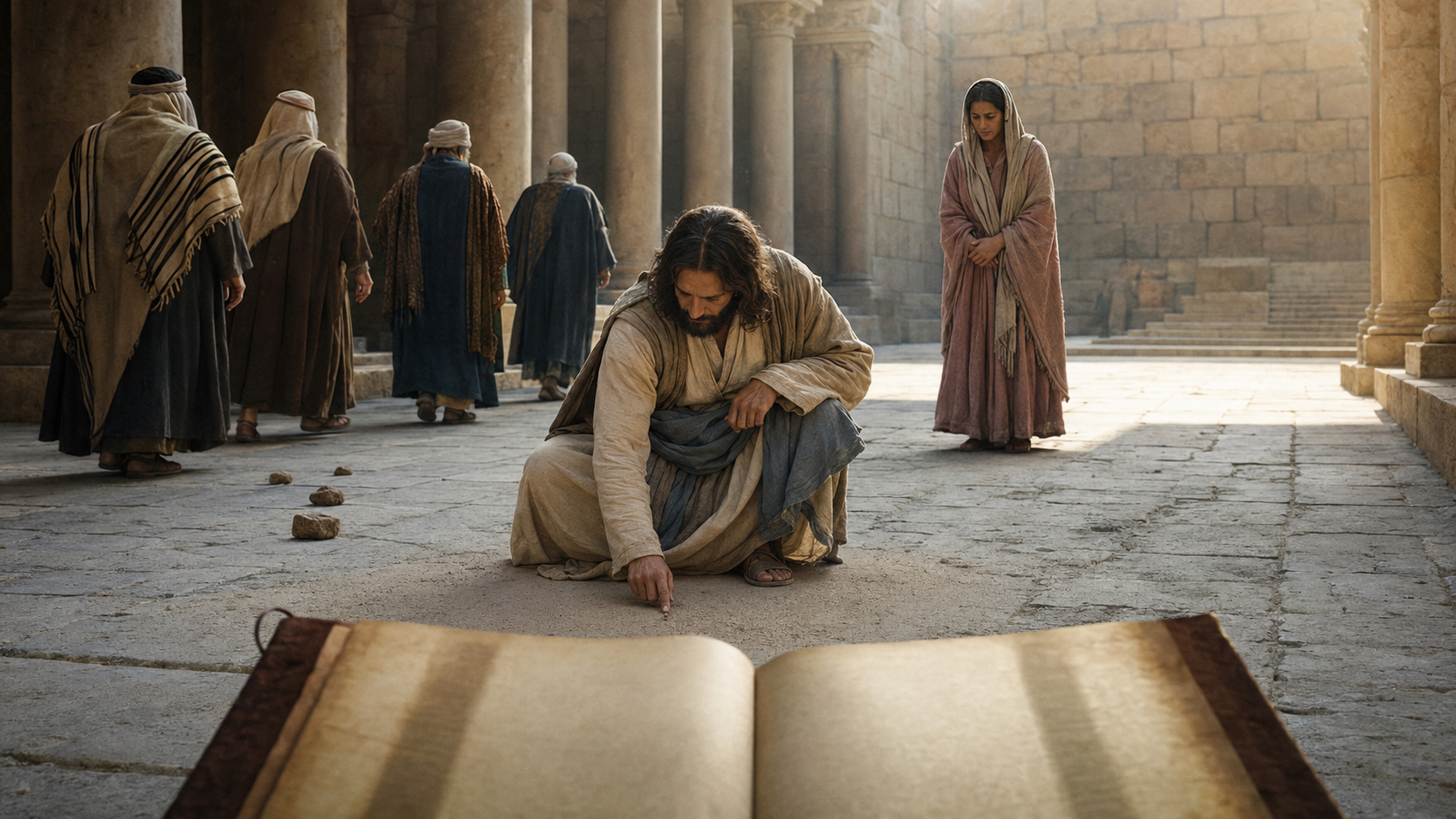
The story is known even by people who cannot place it in John. A woman is brought into the temple. Her accusers say she was taken in adultery. They ask whether the law of Moses requires her to be stoned, and they do so to trap Jesus. He bends down and writes on the ground. When they persist, he answers that the sinless man among them should cast the first stone. One by one they leave. Jesus refuses to condemn the woman and commands her to sin no more.
Modern Greek editions do not handle this narrative as they handle an ordinary paragraph of John. They print John 7:53–8:11 in double brackets, the editorial sign for material regarded as ancient but not part of the original text at that location. English editions often retain it with a warning. The church is thus invited to read a story placed in the Bible under a notice that it does not belong to the Bible.1
Wesley Huff groups the passage with Mark 16:9–20 as one of the “extra passages” included in the text followed by the King James translators but absent from older manuscripts. Here again the adjective performs the verdict. If the narrative is extra, the woman’s appearance before Christ is not a canonical event, his words are not words of Scripture, and centuries of preaching from the passage have mistaken an ancient Christian story for the voice of the Holy Ghost.2
The critical case is serious. Papyrus 66 and Papyrus 75 pass from John 7:52 to 8:12. Sinaiticus and Vaticanus do the same. The story appears in different locations in a minority of later witnesses, and its vocabulary and style have been judged less Johannine than the surrounding discourse. No defense of the received text should conceal those facts.
But the story’s history is also older and wider than the phrase extra passage suggests. Patristic witnesses know the episode. Augustine and Jerome discuss its presence and omission. Its traditional location became dominant in the Greek church and was received by the Reformed churches as part of John. The evidence presents a canonical dispute, not a clerical curiosity.
The question is not whether Jesus could have acted this way. The question is whether God gave this event to the church as Scripture.
What the manuscripts prove—and what their movement does not
The earliest surviving continuous Greek witnesses containing this part of John omit the narrative. That is direct evidence for an early form in which John 7:52 was followed by 8:12. It is not merely a claim repeated in modern introductions; it can be seen in the artifacts and reported in the apparatus.
The external evidence against the traditional location is strengthened by displacement. Family 1 places the story after John 21:25. Family 13 puts it after Luke 21:38. Other witnesses place it after different points in John 7, and some mark it with signs of doubt. A unit that travels is easier to explain as a story seeking a textual home than as a paragraph copied continuously from its original place.
That explanation has force, but it is not the only possible account of the movement. Lectionary practice divided the Gospel readings around Pentecost. John 7:37–8:12 was handled in a way that could leave the adulteress narrative outside the appointed sequence or copy it at another liturgically convenient point. A passage omitted from public reading may acquire marks, marginal placement, or relocation even if its original place was known. John Burgon made this a central part of his defense. The existence of movement therefore establishes instability; the cause and direction of that instability still require argument.3
Internal evidence is similarly real but not self-interpreting. The vocabulary of the passage contains expressions rare or absent elsewhere in John. “The scribes” appear here in a way unusual for the Fourth Gospel. The movement from John 7:52 to 8:12 reads smoothly without the story: the dispute over a prophet from Galilee gives way to Jesus’s declaration that he is the light of the world. Critics argue that the narrative interrupts that sequence.
Yet a smooth transition after omission does not prove that the omitted material was absent from the author’s text. Ancient narratives can insert an episode between connected discourses. Nor does distinct vocabulary compel distinct authorship. A courtroom scene involving scribes, adultery, Mosaic penalty, and public accusation may require words absent from John’s other material. Stylistic evidence can contribute to a judgment; it cannot be allowed to make every hapax legomenon a warrant for excision.
The critical case is cumulative: early omission, varying location, textual marking, style, and contextual flow reinforce one another. Its conclusion is that the story is ancient but did not originally stand in John. The received case is also cumulative: broad later Greek transmission at the traditional location, early versional and patristic knowledge, lectionary explanation of omission and displacement, intrinsic fitness in the narrative, and ecclesiastical reception reinforce one another.
What the artifacts directly prove is narrower than either reconstruction. Some early Greek copies omit the story. Many later copies include it. Some copies move or mark it. The episode was known in late antiquity, and the church eventually read it overwhelmingly at John 7:53–8:11. The claim that it began outside John is an inference from those facts, not a note left by its first author.
The fathers remember more than a late insertion
The patristic evidence prevents the manuscript list from becoming a history by itself. Didymus the Blind, writing in fourth-century Alexandria, refers to a story found “in certain gospels” in which a woman accused of many sins is brought before Jesus and dismissed when no accuser remains. His form is not a verbatim quotation of the received Johannine paragraph, and his plural reference does not settle its location. It does show that a recognizable version of the episode was known in the very region associated with prominent Greek witnesses that omit it.4
The Didascalia Apostolorum, in a form generally assigned to the third century and preserved in Syriac, appeals to the Lord’s treatment of a sinful woman in order to exhort bishops to receive the repentant. The precise relation between that allusion and John 8 is debated. Again, the evidence is not a photographic copy of the received paragraph. It weakens the notion that the story suddenly appeared in the fifth-century Greek manuscript tradition.
Jerome later says that the account was found in many Greek and Latin codices. Augustine offers an explanation for its absence: men of weak faith removed it because they feared that Christ’s forgiveness would encourage adultery. Their testimony does not end the inquiry. Jerome may be reporting the manuscript field of his own time, and Augustine’s motive may be a pastoral explanation rather than a documented genealogy. But the testimony is historical evidence that Christians close to the surviving early codices knew both the story and its omission, and did not unanimously understand omission as originality.5
The traditional defense sometimes overstates these fathers. Augustine’s accusation is not proof that every early omission arose from moral panic. Jerome’s “many” cannot be converted into a complete fourth-century census. Didymus does not identify the received wording line by line. The critical account commits the opposite error when it treats Greek codices as the only history that counts and the fathers as late witnesses to an already secondary tale. Manuscripts and citations are both surviving effects of an earlier transmission. Neither class is exempt from interpretation.
The Reformed reception is also relevant, though it is not ancient manuscript evidence. William Whitaker lists the history of the woman taken in adultery among New Testament materials once disputed and then distinguishes such received material from works that were never canonical. He rejects the claim that the church creates canonicity by decree, but he does not therefore surrender the passage. His argument records a Protestant judgment: historical doubt did not give a Roman critic or an individual scholar authority to redraw the received canon.6
That point becomes sharper under Westminster Confession 1.8. The Assembly confessed an inspired Greek New Testament kept pure in all ages and authentic in religious controversies. Its members inherited a printed Greek text containing the pericope at John 7:53–8:11. To say that the confession can equally describe a critical edition that declares the paragraph non-original is to assign the divines a text they did not mean. Historical meaning does not decide whether their textual judgment was correct. It decides what must be denied or revised if their judgment is rejected.
The passage therefore raises two burdens. The received-text advocate must explain the earliest Greek omissions and the movement of the story. The critical-text advocate must explain its ancient knowledge, patristic defense, dominant reception, and confessional status. Neither burden disappears because modern readers like the narrative.
The event cannot be reconstructed from a theme
The doctrinal discussion often takes a reassuring form. No major doctrine depends upon the pericope. Jesus forgives sinners elsewhere. He opposes hypocrisy elsewhere. He teaches repentance elsewhere. Those statements are true, but the conclusion commonly attached to them—that nothing essential is lost if the story is removed from John—is not. The received passage asserts a historical complex, not merely a theme. It says that Jesus taught in the temple early in the morning; that scribes and Pharisees set a woman before him; that they claimed she had been caught in the act; that they invoked Moses while testing Christ; that Jesus wrote on the ground; that he challenged the sinless accuser to cast first; that the accusers departed in an order; and that he neither condemned the woman nor excused her sin.
None of that event can be reconstructed from the proposition “Jesus forgives sinners.” A concordance may collect parallel mercies, but no other text tells this story. If John 7:53–8:11 is non-canonical, the church does not know by divine testimony that Jesus wrote on the ground or spoke these words on this occasion.
The Martin ledger must therefore be local and exact, distinguishing doctrines available elsewhere from the unrepeatable event and sayings asserted only in this disputed unit.
| Exact proposition | Result without John 7:53–8:11 |
|---|---|
| Jesus forgives repentant sinners | Cumulatively established elsewhere |
| Jesus condemns hypocrisy and false judgment | Cumulatively established elsewhere |
| Mercy does not grant permission to continue in sin | Cumulatively established elsewhere |
| The accusers brought this woman to Jesus in the temple | Not established |
| Jesus wrote on the ground during this accusation | Not established |
| Jesus gave the first-stone challenge | Not established |
| Jesus said, “Neither do I condemn thee: go, and sin no more” | Not established as canonical speech |
| The passage alone proves that no civil penalty may ever be imposed for adultery | Not entailed even by the received text |
| Omission destroys the doctrines of forgiveness or repentance | Contradicted by the wider corpus |
| Omission removes a complete canonical narrative and its propositions | Necessarily entailed |
The last two rows belong together. Removing the passage does not destroy the gospel of forgiveness. It removes this inspired exhibition of forgiveness and holiness—if the passage is inspired. The loss is neither a confessional collapse nor a non-event.
This distinction also protects the passage from misuse. Jesus does not declare adultery harmless. He exposes accusers who have produced the woman without the man, turned a judicial matter into a trap, and presumed to stand as clean executors of the law. His final command names her conduct as sin and ends the episode with moral demand. The text cannot be reduced to the modern maxim that no sinner may judge any act.
Nor does the episode alone settle the relation of Mosaic judicial penalties to the new covenant. Jesus’s refusal to act as the accusers demand occurs within a corrupt proceeding and a messianic confrontation. The Martin Rule will not permit a full doctrine of church, state, mercy, and punishment to be imported into the sentence “Neither do I condemn thee.” Defending the passage includes refusing to make it say more than it says.
The proper doctrinal verdict is consequently exact. The critical corpus retains every central soteriological proposition illustrated here. It does not retain the event, the sayings, or the canonical instance. A claim of doctrinal survival is true at one level and misleading when used to make a twelve-verse excision sound semantically empty.
Brackets cannot carry ecclesiastical authority
Double brackets are an editorial compromise. They acknowledge that the story is ancient, beloved, and deeply embedded in Christian use while marking the judgment that it was not part of John’s original Gospel. The form is pastorally understandable. It is constitutionally unstable.
If the passage is Scripture, brackets place inspired words under an adverse human verdict. If it is not Scripture, brackets leave uninspired words inside the biblical text where ordinary readers will continue to hear them as the speech of Christ. The apparatus preserves evidence either way, but evidence in an apparatus is not the same thing as canonical text.
This is why “it is still in your Bible” does not answer the dispute. A paragraph may remain materially printed while losing its authority. A museum can preserve a deposed king’s seal; preservation of the object does not preserve the office. When an editor says that John did not write the passage, a note at the bottom of the page does not give it back to John.
The critical evidence should nevertheless correct careless traditional rhetoric. The story’s authenticity cannot be proved by popularity, emotional power, or the fact that preachers have used it well. The early Greek omissions and varying positions require a reasoned answer. A confessional doctrine of preservation must identify how the passage was kept and received despite those disruptions, not merely announce that providence guarantees the preferred outcome.
Huff’s description needs correction in the other direction. The passage is not responsibly summarized as one of several extras that older discoveries enabled scholars to remove. That wording conceals ancient patristic knowledge, early controversy over omission, widespread traditional location, and the ecclesiastical judgment represented by Whitaker and Westminster. It also hides the consequence: the woman’s encounter with Christ ceases to be an event known from Scripture.
The three judgments should be stated separately. Textually, early Greek omission, displacement, and internal considerations make a strong cumulative case against Johannine origin. Historically, a recognizable form of the story was known early; its transmission cannot be reduced to a late medieval insertion, and its precise path into or out of John is not directly observed. Doctrinally, the central teachings remain elsewhere while the complete narrative does not. These limits do not remove the need for judgment. They clarify what is being judged.
The church cannot forever preach a passage as though the brackets mean nothing and defend its Bible as though the brackets settle everything. Either Christ gave these words to his church in John, or the church received an ancient story under the wrong name. The critical edition chooses the second. The received text chooses the first. The distance between them is the distance between a moving tradition and a canonical event.
That is the canonical cost. It cannot be paid with the assurance that the same general lesson may be taught somewhere else.
Notes and Further Reading
Series navigation: Previous: “Where Does Mark End?” · Part 6 of 14 · Next: “God or He Who?”
- Bruce M. Metzger, A Textual Commentary on the Greek New Testament, 2nd ed. (Stuttgart: Deutsche Bibelgesellschaft, 1994), entry on John 7:53–8:11; Novum Testamentum Graece, 28th rev. ed., apparatus at John 7:53–8:11; The Greek New Testament, 6th rev. ed. Both critical editions retain the passage under double brackets while judging it secondary. ↩
- Wesley Huff, “One Bible, Many Versions”, October 13, 2020, under “History of the Text.” Huff refers to the story as John 8:1–11; the full received unit begins at John 7:53. ↩
- John William Burgon, The Causes of the Corruption of the Traditional Text of the Holy Gospels, ed. Edward Miller (London: George Bell, 1896), Appendix I, “The Woman Taken in Adultery”. Burgon’s lectionary argument is a proposed historical explanation and should be weighed alongside the manuscript evidence, not treated as an artifact. ↩
- Jennifer Knust and Tommy Wasserman, To Cast the First Stone: The Transmission of a Gospel Story (Princeton: Princeton University Press, 2019), especially their treatment of Didymus and the early forms of the story. Didymus’s account witnesses to knowledge of the episode, not necessarily to every word or to its present Johannine location. ↩
- Jerome, Dialogue Against the Pelagians 2.17; Augustine, De Adulterinis Conjugiis 2.6–7. Augustine’s explanation of deliberate omission is conveniently collected with source identification at Text & Translation. ↩
- William Whitaker, A Disputation on Holy Scripture, trans. William Fitzgerald (Cambridge: Parker Society, 1849), First Controversy, Question 1, chapter 16, and the later discussion of writings described by Stapleton as once doubtful. See also the Confessional Bibliology Research Center’s source dossier for John 7:53–8:11, which keeps critical rationale, Burgon’s counter-case, Whitaker’s reception evidence, and doctrinal entailment distinct. ↩