

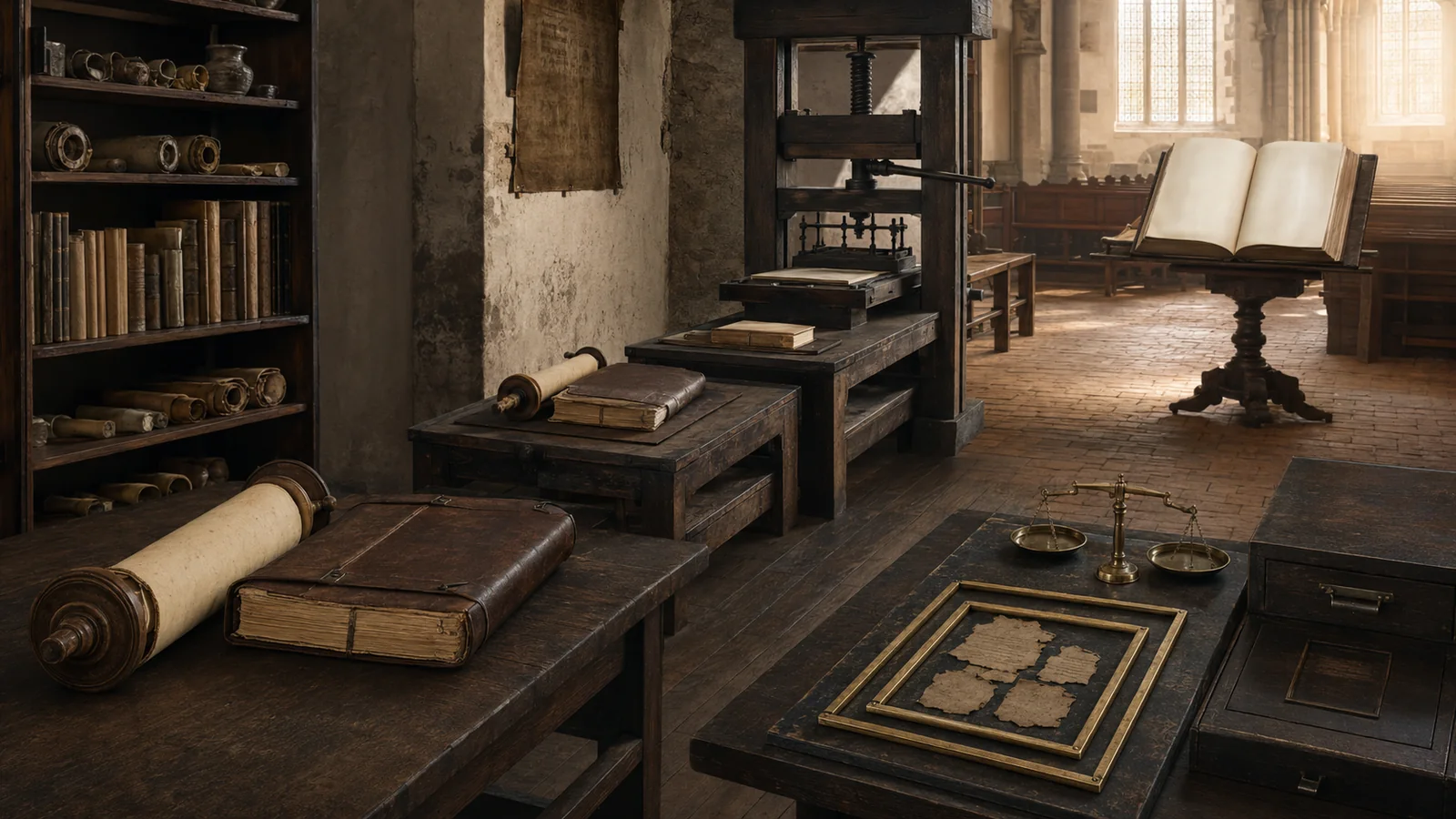
Revision note: Substantially revised July 20, 2026. The argument has been reordered according to the classical rhetorical movement, compressed where necessary, and given one consolidated Notes and Further Reading section.
The Hebrew Scriptures Kept Pure: The Masoretic Textual Tradition
Thesis 17
The Hebrew and Aramaic Old Testament entrusted to the covenant community and preserved in the Masoretic textual tradition constitutes the authentic textual tradition of the Old Testament. This position does not rest upon the claim that the Masoretes were inspired, or that any one Masoretic manuscript is without error. It rests upon the covenant faithfulness of God manifested through the continuous, public, ecclesiastical reception of the Hebrew text.
A doctrine of preservation that cannot identify the preserved text remains incomplete. It may affirm that God inspired certain words, that providence protected Scripture in some general sense, and that the original text can be approximately reconstructed. Yet the church still must ask: Where, concretely, is the Old Testament God gave? In what textual tradition should it be read, preached, translated, and defended?
The answer of confessional Protestantism was not an unknown text concealed among all surviving witnesses. It was not the Greek Septuagint, the Latin Vulgate, or a hypothetical form of the Hebrew text awaiting reconstruction. The authentic Old Testament was the Hebrew and Aramaic text received from the covenant community and transmitted in the Masoretic tradition.
That claim must be stated carefully. The Masoretes were not prophets. Their marginal observations were not inspired. Their vocalization systems did not constitute a new act of revelation. No one surviving codex possesses an independent promise of scribal impeccability. Nor does the term Masoretic Text designate one immaculate manuscript or one mechanically uniform line of copies.
It names a publicly transmitted textual tradition: the consonantal Hebrew and Aramaic text, its received reading, its patterns of vocalization and accentuation, and the meticulous apparatus by which Jewish scribes recorded and guarded what had been handed down. The Masoretes did not create the Old Testament. They inherited it. Their work represents the mature scribal custody of a text whose history long preceded them. The doctrinal argument for receiving that text therefore begins neither with the personal authority of the Masoretes nor with the age of the oldest complete Masoretic codex. It begins with God’s covenantal commitment to his Word.
The Oracles Entrusted to Israel
Paul asks in Romans 3:1, “What advantage then hath the Jew?” His first answer is unequivocal:
“Much every way: chiefly, because that unto them were committed the oracles of God.”
The word translated “committed” communicates entrustment. Israel received the logia tou Theou—the oracles or utterances of God—as a covenantal deposit. Israel did not produce these oracles by natural religious genius. The Jewish people were not their source. They were their appointed custodians.
This entrustment included more than the original moment of revelation. Something entrusted must be guarded, transmitted, taught, read, and handed down. The law was deposited beside the ark and publicly read to the covenant assembly. Priests and Levites were charged with teaching it. Kings were required to possess and read copies of it. Later generations heard Moses read in the synagogues. The Scriptures belonged to the covenant community as a received divine deposit.
Paul’s next words are especially important:
“For what if some did not believe? shall their unbelief make the faith of God without effect? God forbid” (Romans 3:3–4).
Jewish unbelief did not nullify divine faithfulness. That principle applies first to God’s covenant promises, but it also illuminates the custody Paul has just described. Israel’s sins did not transform God’s oracles into merely human religious literature. Nor did the unbelief of particular custodians eliminate the providential reality of the deposit entrusted to the people.
This does not make every Jewish scribe infallible. Paul is not promising that no copyist would ever misspell a word, repeat a line, omit a phrase, or correct a damaged exemplar improperly. Entrustment does not confer inspiration upon every custodian. It does, however, establish a covenantal location for the Old Testament text. God did not scatter his Word into history without appointing a people among whom it would be publicly known.1
Romans 9:4–5 places this textual custody within the larger economy of redemption. To the Israelites belonged “the adoption, and the glory, and the covenants, and the giving of the law, and the service of God, and the promises.” From them came the fathers and, according to the flesh, the Messiah.
The Hebrew Scriptures cannot be detached from that history. They came through Israel, were kept among Israel, were read in Israel’s worship, and supplied the vocabulary by which Israel awaited the Christ. The church receives the Old Testament from this covenantal history. She does not receive it as an archaeological stranger approaching a newly discovered religious archive.
The Jewish custody of Scripture is therefore neither a guarantee of Jewish theological correctness nor a concession that the synagogue possesses authority over the Christian church. Israel’s scribes could preserve words whose fulfillment many of them refused to acknowledge. Custodial faithfulness and spiritual understanding are not identical. Caiaphas could prophesy better than he understood; unbelieving hearers could preserve Moses while rejecting the Prophet of whom Moses wrote. God’s providence is not defeated by the sins of those whom he employs.
What the Masoretic Tradition Is
The term Masorah refers to what has been handed down. The Masoretic tradition is the mature form of Jewish scribal labor devoted to transmitting the Hebrew and Aramaic Scriptures. Its most basic element is the consonantal text. Hebrew manuscripts were traditionally written primarily with consonants, though certain consonants also served as vowel indicators. The words were not meaningless until later scribes supplied vowel signs. Ancient readers possessed a living linguistic and liturgical tradition by which the written words were pronounced and understood.
Between roughly the seventh and tenth centuries, several schools developed systems for recording that traditional pronunciation. The Tiberian system eventually became dominant. Its dots and strokes indicated vowels, syllabic features, accentuation, and patterns of cantillation. These signs sought to preserve how the inherited consonantal text was to be read; they did not create a different Old Testament.
The Masoretes also supplied the Masorah: marginal and terminal notes concerning unusual spellings, the number and location of particular forms, rare words, repeated phrases, and other textual phenomena. Such notes functioned as a system of scribal quality control. They enabled copyists to detect alterations that might otherwise escape attention.
The familiar ketiv and qere distinction further illustrates their conservative habits. The ketiv records what is written in the consonantal text, while the qere supplies a traditional reading. These notes raise their own interpretive questions, and not every proposed reading must be treated as inspired. Nevertheless, the practice often reveals an unwillingness simply to erase the inherited written form. The scribes recorded both the received consonantal text and the conventional manner of reading it.
This entire apparatus must be distinguished from inspiration. Vowel points, accent marks, paragraph indicators, marginal notes, and scribal statistics have different textual functions. The doctrine of preservation does not require the church to declare every Masoretic note infallible or every graphic sign original to the prophetic autographs.2
It does require us to recognize the apparatus for what it is: the work of custodians laboring over an already received sacred text. The inspired Hebrew language always included vowels as spoken linguistic realities. A word cannot be spoken without them merely because an early writing system did not mark them with later Tiberian signs. The question is therefore not whether the prophets used modern-looking vowel points. They did not. The relevant question is whether the Masoretic vocalization substantially records the received reading of the preserved consonantal text. As a whole, it does.
The Masoretic tradition is consequently larger than any one witness within it. The Aleppo Codex and Leningrad Codex are prominent representatives, but neither exhausts the tradition. Neither the loss of part of the Aleppo Codex nor a copying error in another manuscript would imply the loss of Scripture. Manuscripts exist within a public, comparative, and ecclesiastically received tradition.
From Manuscript Tradition to the Bomberg Hebrew Bible
Printing gave the Masoretic tradition a new degree of stability and public accessibility. The second Rabbinic Bible printed by Daniel Bomberg, edited by Jacob ben Hayyim ibn Adonijah in Venice in 1524–25, gathered the Hebrew biblical text and its Masoretic helps into a monumental printed form. Its surrounding Targums, rabbinic commentaries, editorial notes, and Masorah were not thereby inspired. Receiving the Hebrew biblical text does not canonize everything bound beside it. The edition matters because it gave mature printed expression to a textual tradition already copied, read, and guarded.
The Ben Hayyim–Bomberg text became a standard reference for Protestant Hebraists and belonged to the textual world inherited by early modern translators, including the translators of the King James Bible. That does not mean they followed one physical copy mechanically or ignored other Hebrew editions and ancient versions. David Norton’s A Textual History of the King James Bible is useful precisely because it distinguishes the inherited Hebrew base from individual editorial and translational decisions.
This series therefore receives the Ben Hayyim–Bomberg Bible as the mature ecclesiastical printed form of the authentic Old Testament text within the broader Masoretic tradition. The authority belongs to the inspired text, not to Ben Hayyim, Bomberg, one printing, or its supplementary apparatus.
“Kept Pure in All Ages”
Westminster Confession of Faith 1.8 states:
“The Old Testament in Hebrew (which was the native language of the people of God of old), and the New Testament in Greek (which, at the time of the writing of it, was most generally known to the nations), being immediately inspired by God, and, by his singular care and providence, kept pure in all ages, are therefore authentical.”
- Romans 3:1–2; Deuteronomy 17:18–20; 31:9–13; and Acts 15:21 describe Israel’s custody, copying, public reading, and transmission of the Hebrew oracles. ↩
- Westminster Assembly, The Humble Advice of the Assembly of Divines (1647), chapter 1, section 8, identifies the Old Testament in Hebrew as immediately inspired, kept pure in all ages, and therefore authentic. ↩
Every phrase matters.
The Old Testament “in Hebrew” is the object immediately inspired. The confession does not transfer immediate inspiration to the Septuagint, Vulgate, or any vernacular translation. Those versions possess real but derivative authority insofar as they faithfully represent the originals. The same Hebrew Old Testament has been “kept pure in all ages.” The confession does not say that it was pure only in the autographs, substantially recoverable in the Middle Ages, and probabilistically reconstructible by future criticism. The authentic text is the text inspired and preserved.
In its seventeenth-century setting, “the Old Testament in Hebrew” was not an abstract linguistic category. The divines did not possess an unspecified Hebrew text floating above all actual manuscripts and editions. They knew the Old Testament through the received Masoretic Hebrew Bibles of their day, among which the Bomberg tradition held a formative place.3
WCF 1.8 does not formally canonize the 1524–25 Bomberg edition by name. The confession is not a bibliographical catalog. But neither can its historical referent be detached from the Hebrew text the Reformed churches actually possessed. To interpret “Hebrew” as a future eclectic reconstruction is to import a later textual model into the confession.
This becomes clearer when the confession says that these original-language Scriptures are “therefore authentical.” Authenticity here concerns final judicial authority. In doctrinal controversy, the church appeals ultimately to the Hebrew and Greek originals. The original-language text is not one evidence among several to be subordinated to a translation, ecclesiastical decree, or conjectural reconstruction. It is the final textual norm.
Reformed theologians repeatedly defended this point.
William Whitaker argued against the Roman elevation of the Vulgate by directing the church back to the Hebrew and Greek fountains. Francis Turretin defended the integrity of the extant originals while distinguishing the preservation of the text from the perfection of every copy. John Owen tied the continuing purity of Scripture to God’s providential purpose for the church, even while engaging the historical and philological disputes of his own day.
The Buxtorfian tradition similarly reflects the importance Protestant orthodoxy placed upon direct access to the Hebrew Scriptures. The prefatory material in John Buxtorf’s [A Short Introduction to the Hebrew Tongue]() commends Hebrew because it opens the “fountains” of the law and prophets to Christian readers.
These writers did not agree on every historical question. The antiquity and status of the vowel points became a subject of serious dispute. Some defended their great antiquity; others maintained that the written signs were added by the medieval Masoretes. That dispute should not be hidden, but neither should it be allowed to obscure the deeper agreement: the Hebrew Old Testament received in the Masoretic tradition was the church’s authentic original-language Scripture.
This thesis does not require us to reproduce every seventeenth-century argument about the graphic vowel points. The divine authority of the Hebrew text does not depend upon proving that Isaiah wrote Tiberian pointing marks. What matters is that the later signs ministerially preserve the received reading of an ancient consonantal text.
The Strongest Objections
“The complete Masoretic codices are too late”
The oldest substantially complete Masoretic codices are medieval, while many Dead Sea Scrolls and ancient translations are much earlier. Why should a medieval manuscript be preferred to an older witness? Because the date of a manuscript is only one kind of evidence. Earlier generally means closer in time to composition, but it does not automatically mean more accurate. A second-century copy may reproduce an early mistake; an eleventh-century copy may preserve a much older and carefully controlled exemplar.4
Moreover, the authentic text is not identified by selecting the oldest surviving artifact at every location. Such a method would produce an unstable patchwork assembled from witnesses that never existed together as one Bible. It would also assume, without scriptural warrant, that preservation occurred principally through archaeological survival rather than covenantal transmission. The Masoretic tradition’s later complete codices are supported by earlier partial witnesses, an elaborate system of scribal control, widespread public use, and historical continuity. Their medieval material date does not make their text medieval.
“The Dead Sea Scrolls disprove a single preserved Hebrew tradition”
The scrolls undeniably show plurality. A simplistic claim that every ancient Hebrew manuscript was identical to the later Masoretic Text cannot survive the evidence. But that simplistic claim is not this thesis. Preservation does not require the absence of all textual variation. It requires that God keep his Word within the reach of his people and prevent the textual tradition as a whole from losing its identity. Errant copies can exist without becoming the church’s canonical norm.
The Dead Sea Scrolls show several textual forms, but they also show the early existence of the textual tradition that would later receive Masoretic stabilization. The relevant question is not merely, “Did variants exist?” They did. The question is, “Which tradition passed through the covenant community into continuous public and ecclesiastical reception as its Hebrew Scripture?”
The answer remains the Masoretic tradition.
“The New Testament often quotes the Septuagint”
The apostles frequently use Greek wording resembling the Septuagint, sometimes where it differs from the later Masoretic wording. Does apostolic practice identify the Greek Old Testament as equally or more authentic? No. First, “the Septuagint” is not a single uniform manuscript or edition. The Greek Old Testament itself possesses a complex textual history. Appeals to “the LXX” can conceal substantial diversity among books and witnesses.
Second, an inspired apostle may quote, translate, paraphrase, or apply an Old Testament passage according to the purposes of the Holy Spirit. When that wording is incorporated into the New Testament, it possesses the authority of the newly inspired New Testament context. It does not follow that every reading found anywhere in the Greek Old Testament receives blanket apostolic authorization.
Third, the use of a translation does not make that translation the original-language standard. A preacher may faithfully quote an English Bible without declaring English the authentic language of Moses. The apostles addressed Greek-speaking hearers and could employ familiar Greek formulations while the Hebrew remained the original textual fountain.
Finally, New Testament quotations do not all stand in the same relation to surviving Greek and Hebrew witnesses. Some closely follow known Greek forms; some align more nearly with the Hebrew; some reflect interpretive rendering; and some correspond exactly to no surviving version. The phenomenon must be examined passage by passage. It cannot sustain a wholesale transfer of authenticity from the Hebrew Scriptures to one reconstructed form of the Septuagint.
“The vowel points were added too late”
The graphic Tiberian vowel signs are late relative to the biblical authors. That fact becomes a problem only if one assumes that the Hebrew text could have possessed a determinate reading solely by means of those particular marks. It did not. Biblical Hebrew was spoken, heard, memorized, chanted, and read before the Tiberian system existed. Its words contained vowels as linguistic realities even when most vowels were not represented by separate signs. The Masoretic points recorded a received reading tradition; they did not breathe pronounceability into previously meaningless consonants.5
This does not make every Masoretic vocalization beyond criticism. Some consonantal forms permit more than one possible reading, and particular pointing decisions may involve interpretation. The consonantal text has a more direct and ancient manuscript history than the complete graphic vocalization. But the distinction must not be exaggerated into a separation. A purely consonantal sequence abstracted from every received reading tradition is not how Scripture existed in the worship of Israel. The Masoretic vocalization is an important historical witness to how the inherited text was publicly read and understood.
“The confession says ‘Hebrew,’ not ‘Masoretic’ or ‘Bomberg’”
True—but “Hebrew” was not historically empty.
The Westminster divines were referring to an actual Hebrew Old Testament available in manuscripts and printed editions. That text was Masoretic. It possessed consonants, vowel points, accentuation, paragraph divisions, ketiv/qere notes, and a long scribal history. The divines did not imagine that “the Hebrew” meant whatever collection of readings a future critical committee might judge most probable.
The confession does not bind the church to every editorial feature of one printing. But it does bind the church to the authentic Hebrew text that had been kept pure and was then possessed. The language of preservation and authenticity is incompatible with treating the confession’s textual object as unidentified until modern reconstruction.
“Modern critical editions use better and older evidence”
Modern editions provide enormous scholarly value. Photographs, manuscript collations, ancient versions, linguistic analysis, and the Dead Sea Scrolls have increased our historical knowledge. Confessional bibliology need not fear facts or discourage expertise. The question is one of authority and operation. Modern diplomatic editions commonly print the text of a selected codex—often Leningrad—while recording alternatives in an apparatus. Eclectic or reconstructionist approaches may then recommend departures on the basis of other manuscripts, ancient translations, conjecture, or theories about scribal development. Each judgment must be evaluated on its merits.
But evidence does not interpret itself. “Earlier,” “shorter,” “more difficult,” and “more geographically diverse” are not divinely revealed laws capable of identifying the authentic reading automatically. They are defeasible scholarly considerations. When such considerations ministerially illuminate the received text, they are useful. When they become a magisterial power by which the church’s Scripture is continuously replaced with the academy’s latest preferred reconstruction, the authority relation has been reversed.
A Concise Confession
We confess that God entrusted his Old Testament oracles to the covenant community and, by his singular care and providence, preserved them in the Hebrew Masoretic textual tradition. We receive the consonantal Hebrew and Aramaic text together with its historically transmitted reading, while distinguishing the inspired text from the uninspired labors of its scribes, annotators, editors, and printers. We receive the Ben Hayyim–Bomberg Hebrew Bible as the mature printed form of that ecclesiastically received tradition, without attributing inspiration or independent impeccability to Ben Hayyim, Bomberg, any particular codex, or any individual printing.
The Masoretes did not give the Old Testament its authority. The Reformation did not create its authenticity. The church does not confer its canonicity. God spoke the words. God entrusted the oracles. God preserved the text. The church receives what her covenant Lord has kept. The next thesis will apply the same confessional principles to the New Testament and defend the Greek Received Text tradition as its authentic textual form.
Notes and Further Reading
- Romans 3:1–2; Deuteronomy 17:18–20; 31:9–13; and Acts 15:21 describe Israel’s custody, copying, public reading, and transmission of the Hebrew oracles. ↩
- Westminster Assembly, The Humble Advice of the Assembly of Divines (1647), chapter 1, section 8, identifies the Old Testament in Hebrew as immediately inspired, kept pure in all ages, and therefore authentic. ↩
- Johannes Buxtorf, A Short Introduction to the Hebrew Tongue; the supplied project PDF was consulted for the received Hebrew reading and grammatical tradition. ↩
- The second Bomberg Rabbinic Bible, edited by Jacob ben Hayyim (Venice, 1524–25), became the principal printed Masoretic reference inherited by Protestant Hebrew Bibles. ↩
- James Ussher, A Body of Divinity, and Francis Turretin, Institutes of Elenctic Theology, topic 2, on the authenticity and providential purity of the Hebrew source. ↩
Comments
Share a question or response to this article.