

Revision note: Substantially revised July 20, 2026. The argument has been reordered according to the classical rhetorical movement, compressed where necessary, and given one consolidated Notes and Further Reading section.
“When ye received the word of God which ye heard of us, ye received it not as the word of men, but as it is in truth, the word of God.” — 1 Thessalonians 2:13
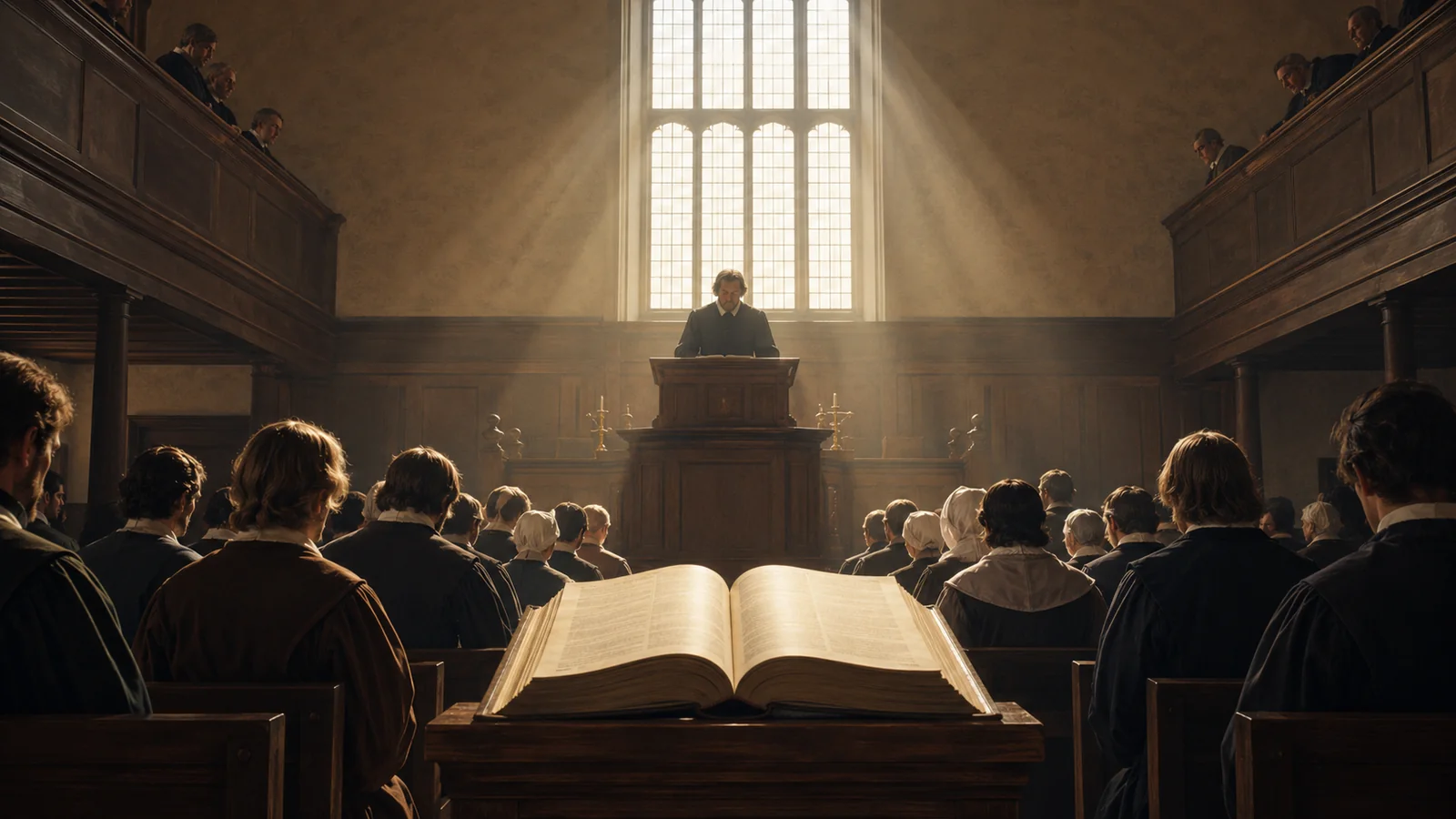
God gives his Word; the Holy Ghost bears witness to that Word; and the church receives it. That order is neither accidental nor reversible.
The Holy Ghost does not wait for the church to make Scripture divine. The church does not wait for the academy to make Scripture credible. And the Christian does not wait for a private voice to tell him that the public Word of God has finally become authoritative. God speaks with authority in Scripture. The Spirit who inspired that Scripture makes its divine character evident and effectually persuades his people to receive it. The church, created and governed by that Word, recognizes, confesses, preserves, proclaims, and defends what God has given.
Part Nine distinguished four questions: what constitutes Scripture’s authority, what objectively manifests it, what brings men to full persuasion, and what ministerial witnesses transmit and defend it. Divine authorship constitutes authority. Scripture’s own light manifests it. The Holy Ghost produces full persuasion. The church performs a ministerial office.
The present article develops the last two claims. It asks how the Spirit’s witness and the church’s recognition are related to the identification of the biblical text. This is essential because two opposite errors arise whenever the relation is left undefined.
On one side, the church can be made magisterial. Its reception, councils, confessions, or traditional use are treated as though they created the canon or inspired a particular reading. On the other side, the church can be made irrelevant. The text is reconstructed by an expert class operating outside the church’s confession, worship, preaching, and history, while the people of God are reduced to consumers of an academic product.
The Reformed doctrine rejects both errors. The church neither creates the Word nor stands apart from its recognition. The Holy Ghost has joined Word and church without confusing their offices.
The Confessional Order
The Westminster Confession of Faith assigns a real but subordinate place to the church’s testimony. Chapter 1.5 first says that the testimony of the church may move and induce us to a high and reverent esteem of Scripture. It then names the divine excellencies by which Scripture abundantly evidences itself. Finally, it locates “full persuasion and assurance” in the inward work of the Holy Spirit “bearing witness by and with the Word in our hearts.”
The order is deliberate.
The church testifies. The Word evidences itself. The Spirit persuades.
The church’s testimony is not dismissed as useless. It is an appointed means by which men are introduced to the Scriptures, instructed in their contents, and summoned to receive them as God’s Word. Yet the church does not supply Scripture with an authority or divinity it otherwise lacks.
The Word’s excellencies are objective. They belong to Scripture whether a reader perceives them or not. Its majesty, harmony, holiness, efficacy, perfection, and redemptive scope are not sentiments projected upon the text by a believing community.
The Spirit’s inward work is necessary because fallen man does not judge spiritual things rightly. The defect is not in the light but in the eye. The Spirit does not repair an evidential insufficiency in Scripture; he repairs the sinner’s incapacity and hostility.
These three offices—ecclesiastical testimony, objective self-evidence, and spiritual persuasion—converge upon one public object: the written Word. They must never be collapsed into one another.
The Spirit Does Not Create A Second Revelation
The phrase testimony of the Holy Ghost is often misunderstood as though the Reformed doctrine rested upon a private religious experience. A Christian reads a book, experiences an inward impression, and then declares the book inspired. Applied to textual variants, the same error would permit a reader to select a reading because he feels inwardly assured that it is authentic.
That is not the confessional doctrine.
Westminster says that the Spirit bears witness by and with the Word. The prepositions establish a boundary. The Spirit’s testimony is not independent information delivered alongside Scripture. It does not add a secret canon to the public canon, reveal lost sentences, or identify readings through an inward voice detached from evidence. The same Confession immediately denies that anything may be added to Scripture by “new revelations of the Spirit.”1
John Owen makes the same distinction. The testimony in question is not a “private whisper” given to favored individuals. It is the Holy Ghost’s public testimony in and through the Word he inspired. The Spirit is the immediate divine author of Scripture; he has impressed upon it the characters of divine truth, authority, light, and power. He also works effectually in the minds of believers so that they receive what is objectively present.
Thus, two aspects may be distinguished without being separated.
There is the objective testimony of the Spirit in Scripture. As its divine author, he speaks through its words and manifests its origin through its properties and power.
There is also the subjective work of the Spirit in believers. He illumines their minds, subdues their hostility, and produces faith in response to the testimony he has given.
The Spirit does not tell the believer that a merely human object is divine. He enables the believer to recognize the divine object for what it is.
This excludes enthusiasm without surrendering spiritual knowledge. The choice is not between a private oracle and autonomous criticism. The Reformed alternative is public revelation spiritually received.
For Itself Alone, But Not By Itself Alone
Owen expresses the church’s office in a formula of exceptional precision: “We believe the Scripture to be the word of God for itself alone, but not by itself alone.”
The first half protects Scripture’s authority. We believe it for itself alone because God’s truth and authority manifest themselves in it. No human witness becomes the formal ground of divine faith.
The second half protects the appointed means. We ordinarily do not encounter Scripture by itself alone. The church copies it, translates it, carries it across generations, reads it publicly, preaches it, teaches it to children, defends it against corruption, and confesses its doctrine. Faith comes by hearing. Hearing ordinarily requires a herald.
A man may discover a Bible in an unusual providence and read it without first hearing a minister. That exception does not abolish the ordinary order. Christ entrusted his Word to a visible people and appointed a ministry of proclamation. Scripture is not an esoteric document delivered separately to disconnected individuals.
The church’s ministry is therefore necessary in an instrumental sense without becoming necessary in a constitutive sense. A messenger may be necessary for delivering a royal proclamation without becoming the source of the king’s authority. A lampstand may be necessary for holding forth a lamp without generating its flame.
This distinction also prevents a common abuse of sola Scriptura. The doctrine never meant solo Scriptura: the Bible detached from preaching, confessions, teachers, church history, the communion of saints, or the ordinary means of grace. It meant that Scripture alone is the infallible rule by which all subordinate authorities are judged.
The church serves Scripture precisely by refusing to stand over it.
The Church As Pillar And Ground Of The Truth
Paul calls the church “the pillar and ground of the truth” in 1 Timothy 3:15. Rome has sometimes treated this language as though the church were the foundation from which revealed truth receives its authority. But a pillar does not create what it holds forth. The church supports, displays, confesses, and defends the truth committed to it.
The image contains both dignity and limitation.
The dignity is substantial. Christ did not appoint the academy, the archaeological society, the state, or the publishing corporation to be the pillar of the truth. He appointed his church. The church is entrusted with the oracles of God. Its public worship, preaching, sacramental life, discipline, confessions, translations, and catechesis form the ordinary historical setting in which Scripture is known.
The limitation is equally substantial. The church is the pillar of the truth; it is not the lord of truth. Its authority is derivative and ministerial. When it contradicts Scripture, it contradicts the authority that called it into existence.
This is why the historic testimony of the church cannot be treated as either infallible or irrelevant. Westminster 31.3 says that councils since the apostles’ time may err. Ecclesiastical recognition is therefore not inspiration continued. Yet the fallibility of a witness does not make the witness worthless. Parents are fallible, but their testimony about a family inheritance matters. Courts hear fallible witnesses because public, converging testimony can establish facts.2
The church’s testimony has a unique importance because it is not the response of an unrelated observer. It is the testimony of the community to which the Scriptures were entrusted, by which that community was created, and within which those Scriptures were publicly used through the ages.
Recognition Is Not Constitution
The word recognition is useful because it describes an act directed toward an existing reality. A man recognizes a king; he does not make him king. A child recognizes his father; the recognition does not create the relationship. The church recognizes the Word because God has already spoken.
Four relations should be kept distinct.
God constitutes the canon and text by inspiration and providential preservation.
Scripture manifests its divine character through its self-attesting properties.
The Holy Ghost persuades believers by and with that Word.
The church recognizes and publicly confesses the Word it has received.
These are not four competing sources of authority. They describe the action of the triune God and the subordinate response of his people.
Recognition is epistemic rather than creative: it concerns how the church comes to know and confess the identity of the Word, not how the Word acquires its being or authority. Yet this does not reduce recognition to arbitrary opinion. The church is morally obligated to recognize what God has given, just as those who heard the prophets were obligated to receive their message.
Failure to recognize Scripture is therefore not a neutral absence of information. It may involve ignorance, weakness, inherited error, or sinful resistance. These conditions must be distinguished pastorally, but none grants man jurisdiction over divine speech.
Canon And Text: The Same Logic At Different Scales
The recognition of canonical books and the recognition of authentic readings are analogous, though they are not identical.
The canonical question asks which books belong to the rule of faith. The textual question asks which words constitute those books. Inspiration necessarily concerns both. God did not inspire an abstract message without determinate verbal form, and the church cannot possess a canon while remaining indifferent to its wording.
In both cases, the authority is prior to recognition. Matthew did not become canonical when a council listed it. The words of Matthew did not become inspired when an editor printed them. Councils and editors recognize; they do not constitute.
In both cases, recognition occurs through public means. Apostolic origin, canonical harmony, ecclesiastical reception, liturgical use, manuscript transmission, ancient versions, patristic citations, and the relations among readings may all supply relevant evidence.
But the analogy has limits. The church may possess settled certainty concerning the twenty-seven-book New Testament while continuing to examine a comparatively small number of textual variations within those books. Disagreement over a particular reading does not reopen the canon, nor does it prove that God failed to preserve his Word.
The scale of the judgment must therefore be respected. Confidence in the identity of the canonical text as a whole is not identical to a claim that every copy is perfect or that every difficult variant is equally plain. Conversely, the existence of difficult variants cannot be inflated into the claim that the church possesses only a hypothetical or perpetually unfinished Bible.3
The Text The Spirit Witnesses To Is Extant
Westminster 1.8 joins inspiration, preservation, authenticity, and final appeal. The Hebrew Old Testament and Greek New Testament, immediately inspired and “kept pure in all ages,” are therefore authentic; the church is finally to appeal to them in religious controversies.
The grammar will not permit authenticity to be relocated exclusively to lost artifacts. The church’s final appeal must be made to an available rule. A vanished autograph cannot be opened in controversy, read in worship, translated, preached, or searched.
This does not mean the material sheets penned by Moses, Paul, or John survived. It means the inspired textual content was preserved through copies under God’s singular care. Copies are genuine witnesses because they transmit the words given, though individual copies may contain scribal faults.
The Spirit consequently bears witness to an extant Word. He does not direct the church past its existing Hebrew and Greek inheritance toward a theoretical text whose final identity remains indefinitely suspended. Textual comparison has a legitimate office because copies differ. But that office operates within preservation, not in place of it.
The church does not create a Bible from textual debris. It receives a transmitted Word and ministers within that inheritance to distinguish authentic readings from the corruptions that accompanied transmission.
Ecclesiastical Reception Is Evidence, Not A Vote
To affirm ecclesiastical reception does not mean that truth is established by counting churches, lectionaries, or printed editions. Catholicity cannot be reduced to arithmetic.
A reading does not become inspired when it receives fifty-one percent of ecclesiastical votes. Nor does an error become authentic because it enjoyed a period of widespread use. The church is fallible, local traditions may become corrupted, and reception can be uneven.
Nevertheless, long, broad, and public use by the church is real evidence within a doctrine of providence. If Christ preserves his church by his Word, then the actual textual inheritance used in preaching, worship, controversy, translation, and confession cannot be dismissed as though it were merely one late witness among others. A method that assigns little weight to the church’s historical possession of Scripture has separated textual history from redemptive history.
Ecclesiastical reception should therefore be evaluated qualitatively. How early is the reading witnessed? How broadly was it transmitted? Was its use continuous or isolated? Did it appear in the public life of the church? Is it coherent with the grammar, context, author, and canonical whole? What historical explanation best accounts for both its presence and its rivals? Does the proposed judgment assume that the church’s received text was substantially displaced for centuries?
No single question functions mechanically. Together they express a ministerial inquiry governed by inspiration and preservation.
Gaussen And The Danger Of A Dead Christ Method
Louis Gaussen’s The Canon of the Holy Scriptures distinguished the method of historical science from the method of faith. He did not reject historical study. He devoted hundreds of pages to it. But he insisted that historical arguments are auxiliary and defensive rather than the foundation of divine faith.
Gaussen warned that criticism becomes spiritually destructive when it reasons about Scripture as it would about a merely human composition. Such a method performs an artificial abstraction: inspiration, providence, Christ’s promises, and the Spirit’s work are excluded so that the investigator can operate upon supposedly neutral ground.4
The abstraction soon becomes a habit. What was provisionally ignored for methodological purposes comes to be treated as though it were unreal. Gaussen described the result memorably: criticism proceeds “as if Jesus Christ was as dead as Mohammed or Confucius.”
That is the academy game in concentrated form.
The living Christ gave gifts to his church, sent his Spirit, and promised to remain with his people. He has not abandoned the writings through which the church is gathered, governed, sanctified, and preserved. A textual method that can function only by excluding those facts is not merely incomplete. It has adopted a view of history in which Christ’s present reign makes no interpretive difference.
Faith does not fear historical inquiry. It refuses to conduct that inquiry in a universe emptied of God’s covenant faithfulness.
How Ministerial Textual Recognition Proceeds
A confessional approach to textual recognition can now be summarized.
First, it begins with the identity of the object. The manuscripts are witnesses to the inspired and preserved Word of God, not religious artifacts from which an unknown text must be created.
Second, it receives the church’s extant Hebrew and Greek inheritance as the arena of inquiry. The investigation begins from possession, not from total loss.
Third, it examines public evidence. Manuscripts, versions, citations, transcriptional relations, grammar, context, authorial usage, and canonical harmony all have genuine ministerial value.
Fourth, it gives serious weight to the church’s historic use without treating use as inspiration. Reception is a providential datum, not an infallible vote.
Fifth, it distinguishes certainty at different levels. The church possesses the authentic Scriptures with confessional certainty while particular difficult readings may require patient judgment. A local uncertainty does not become universal skepticism.
Sixth, it submits every conclusion to correction by Scripture and better evidence. Confessional commitment does not make the critic infallible. It identifies the authority under which he must labor.
This approach is neither Romanist nor individualistic, neither traditionalist nor rationalist. It does not ask an institution to create certainty by decree. It does not ask an autonomous expert to reconstruct authority by probability. It receives God’s public Word through the ordinary ministry of the Spirit in the church.
The Supreme Judge Is The Spirit Speaking In Scripture
Westminster 1.10 brings the entire order to its conclusion. Councils, ancient writers, doctrines of men, and private spirits must all be examined. The supreme judge is “the Holy Spirit speaking in the Scripture.”
That expression excludes every rival tribunal.
It excludes ecclesiastical absolutism because councils are judged by Scripture.
It excludes private enthusiasm because private spirits are judged by Scripture.
It excludes academic autonomy because scholarly opinions are doctrines of men and therefore remain subject to Scripture.
It also excludes a false opposition between the Spirit and the text. The supreme judge is not the Spirit apart from Scripture or Scripture apart from the Spirit. It is the Spirit speaking in Scripture.
The final appeal is consequently public, textual, divine, and living. It is public because Scripture is placed before the whole church. It is textual because the Spirit speaks in determinate words. It is divine because those words carry God’s authority. It is living because the Spirit continues to make the Word effectual without adding new revelation to it.
The church’s proper response is reception: “Speak, LORD; for thy servant heareth.” Its proper labor is stewardship: guard the good deposit, hold fast the faithful Word, contend for the faith once delivered, and transmit the Scriptures faithfully to the next generation.
The academy may assist that stewardship. It may not redefine it.
Conclusion
The Holy Ghost, the church, and the text do not stand in a contest for authority.
The Holy Ghost is the divine author and witness. The Scripture is the public, self-attesting Word in which he speaks. The church is the servant created by that Word and appointed to receive, preserve, proclaim, and defend it.
The Spirit’s inward testimony does not create private revelation. The church’s public testimony does not create canonical authority. Historical reception does not create inspired readings. Each serves the recognition of what God has already given.
This is why the church must not surrender textual judgment to a supposedly neutral academy. Christ did not preserve his Word in order that his church might eventually receive it back as a provisional scholarly reconstruction. He preserved it so that his sheep would hear his voice.
The sheep hear that voice through the Word, by the Spirit, within the church. Their hearing does not make the Shepherd’s voice genuine. It recognizes the voice because it is his.
The church does not vote the Word of God into existence. Under the illumination of the Holy Ghost, it answers the Word already spoken: This is the voice of our Shepherd.
Notes and Further Reading
- Westminster Confession of Faith 1.5 describes full persuasion and assurance as the inward work of the Holy Spirit bearing witness by and with the Word. ↩
- John Calvin, Institutes 1.7.4–5, distinguishes the Spirit’s inward testimony from ecclesiastical authorization of Scripture. ↩
- Louis Gaussen, The Canon of the Holy Scriptures Examined in the Light of History, especially the preface and the concluding treatment of the church’s historical witness; supplied PDF and EPUB. ↩
- John 10:3–5, 27; 1 Corinthians 2:10–14; 1 Timothy 3:15; 1 John 2:20–27. ↩
Comments
Share a question or response to this article.