

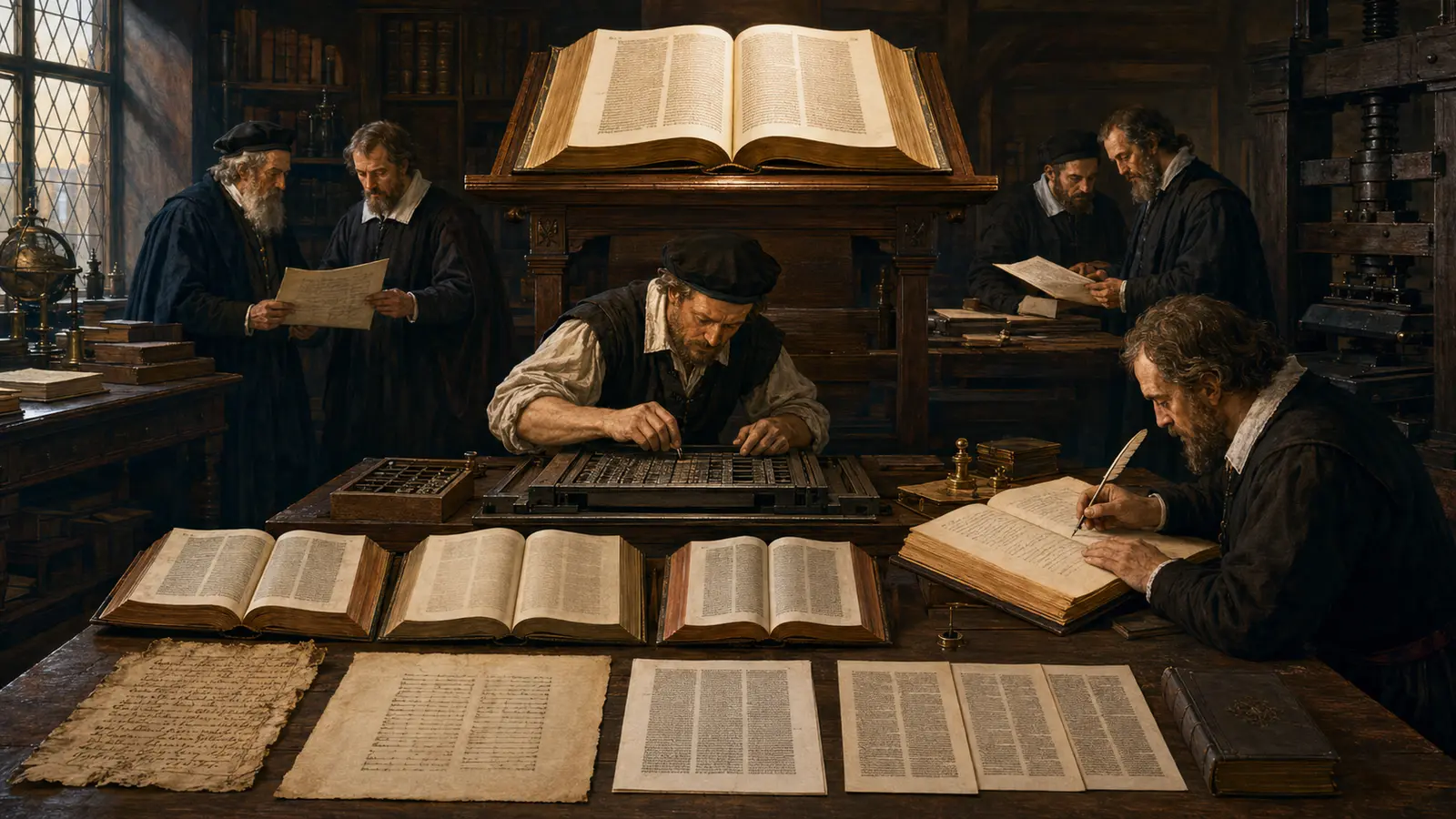
Revision note: Substantially revised July 21, 2026. The argument has been reordered according to the classical rhetorical movement, compressed where necessary, and given one consolidated Notes and Further Reading section.
The Word Itself, the Copies That Attest It, and the Editions That Present It
Thesis 21
The inspired text is the verbal content given by God. Manuscripts are historical witnesses to that text. Printed editions are editorial presentations of the text based upon selected witnesses and judgments. A manuscript may contain errors without causing the text itself to be lost. An edition may require correction without causing the received textual tradition to become unknowable. A textual tradition may remain stable and identifiable even though its witnesses do not exhibit absolute graphical uniformity. Failure to distinguish these categories produces false dilemmas and exaggerated claims on all sides of the controversy.
Many arguments over Scripture’s text are confused before the evidence is examined because the parties use the same words for different things. “The text” may mean a manuscript, “the Received Text” may mean Scrivener’s edition, the Greek New Testament may be identified with a current KJV printing, and a modern critical edition may be treated as the text rather than an editorial hypothesis about it.
These are not harmless shortcuts. When the text, its witnesses, and its editions are confused, every scribal error appears to become an error in Scripture; every correction to an edition appears to prove that the Bible was previously lost; and every disagreement among editors appears to make the text unknowable.
The previous thesis denied that the Received Text can be reduced to one independently immaculate edition. The authentic text, its historical witnesses, and its editorial presentations are closely related without being identical.
Category: The text
What it is: The Hebrew, Aramaic, and Greek verbal content given by God
Proper status: Inspired, infallible, preserved, and authentic
Category: A witness
What it is: A manuscript or other historical source attesting the wording of the text
Proper status: Evidentiary and ministerial; capable of local error
Category: An edition
What it is: An editor’s organized presentation of the text based upon witnesses and judgments
Proper status: Derivative and useful; capable of correction
Maintaining these distinctions allows us to confess a perfect text without claiming perfect copyists, inspired printers, or infallible editors.
The Text Is the Verbal Content Given by God
By text we mean the actual words of Holy Scripture in the languages in which God gave them.
The text is not merely a collection of theological ideas. Verbal inspiration means that God inspired words—not only general concepts later expressed by the biblical authors according to their unaided judgment. The vocabulary, grammar, clauses, sentences, and canonical writings belong to the revelation God gave.
At the same time, the text must not be confused with the material upon which those words happen to be written.
The text of Romans is not identical to one sheet of papyrus, one parchment codex, one printed book, or one digital file. Those objects may contain and communicate the text, but the inspired verbal content does not cease to exist when one physical object is damaged or destroyed.
Nor is the text identical to such incidental graphical features as:
- The shape of a particular scribe’s handwriting
- The number of columns on a manuscript page
- The division of words across lines
- The use of majuscule or minuscule script
- Conventional abbreviations such as the nomina sacra
- The font chosen by a printer
- Modern chapter and verse numbers
- Running headings and page numbers
- An editor’s paragraph divisions
- Later typographical punctuation
Some graphical features may preserve useful interpretive information. Spelling and punctuation must sometimes be examined carefully because they can affect meaning. But graphical presentation and verbal content must not simply be equated. The same word may be written in different hands, typefaces, conventional abbreviations, or page arrangements without becoming a different word.
The distinction is logical, not separational. The text does not float in an invisible realm detached from actual books. It is materially instantiated in faithful copies, editions, translations, readings, sermons, and recitations. But the thing instantiated must still be distinguished from each individual instance.
When two ministers read the same Psalm from two separate Bibles, there are two physical books but not two Psalms. When one reads and a congregation hears, the same verbal content is communicated through written and oral forms. The multiplicity of physical instances does not multiply the inspired text.
“From a Child Thou Hast Known the Holy Scriptures”
Second Timothy 3:15 provides a crucial biblical example:
“And that from a child thou hast known the holy scriptures, which are able to make thee wise unto salvation through faith which is in Christ Jesus.”
Paul says that Timothy had known the sacred writings from childhood. Timothy did not possess the original physical manuscripts written by Moses, David, Isaiah, and the other Old Testament authors. He knew the Scriptures through copies, instruction, reading, and recitation.
Yet Paul did not say that Timothy possessed merely fallible religious artifacts from which the original Hebrew text might someday be reconstructed. He said Timothy knew “the holy scriptures.”
The faithful copies available to Timothy could properly be called Scripture because they contained and communicated the inspired text. Their authority was not created by the copyists. It was derived from the divine words they faithfully reproduced.
The following verse strengthens the point:
“All scripture is given by inspiration of God.”
Inspiration properly belongs to the God-given Scripture. A copy participates in that authority insofar as it faithfully presents the inspired verbal content. An accidental copying error does not become God-breathed merely because it appears in an otherwise faithful manuscript.
This guards against two errors.
The first says that only the physical autographs could properly be called Scripture. Paul’s description of Timothy’s Scriptures will not permit that restriction.
The second says that every mark found in every biblical manuscript must therefore be inspired. Paul’s doctrine of inspiration will not permit that conclusion either.
Faithful copies are truly Scripture, but they are Scripture by virtue of the inspired text they contain—not by virtue of an independent inspiration granted to every copyist.
The Same Text across Copies and Proclamation
Second Peter 3:15–16 recognizes Paul’s epistles as a definite body of writings and places them with “the other scriptures.” Those epistles retained textual identity while copies circulated among churches. Several physical copies of Romans did not create several competing books of Romans, and the unstable reader who “wrests” a passage does not alter the Word he abuses.
makes the same distinction through public worship: “Blessed is he that readeth, and they that hear the words of this prophecy, and keep those things which are written therein.” A written exemplar is read aloud, many hearers receive the words, and all remain subject to what John wrote. The material and communicative forms differ; the verbal content remains identifiable.
The warning against adding to or taking from “the words of the book of this prophecy” () presupposes the same order. An alteration may enter a copy, but it does not thereby become part of the authoritative text. Otherwise the warning would destroy its own distinction between God’s words and the human act that corrupts them.
Jeremiah’s Scroll and “All the Former Words”
Jeremiah 36 provides an illuminating historical example. Baruch wrote the words of Jeremiah upon a scroll. King Jehoiakim cut the scroll and burned it. God then commanded Jeremiah:
“Take thee again another roll, and write in it all the former words that were in the first roll.”
The first physical witness was destroyed. The words were not thereby annihilated. Another scroll could contain “all the former words.”
The first scroll and the second scroll were distinct material objects. The verbal content written upon them could nevertheless be identified as the same words. God also directed that further words be added, but those additions were given by divine revelation—not invented by Baruch in an attempt to reconstruct what he imagined Jeremiah might have said.
This narrative prevents the physical artifact from being equated with the text. Burning one scroll did not destroy God’s revelation because the revelation was not ontologically identical to that one roll of material.
The same principle applies, without requiring a continuing prophetic gift, to the ordinary transmission of completed Scripture. The destruction of one manuscript does not destroy the text when the same words remain in other witnesses.
Manuscripts Are Historical Witnesses
A manuscript is a physical historical artifact that bears testimony to the wording of the text.
Calling it a witness does not demean it. A faithful manuscript may be a precious instrument through which God preserved and communicated His Word for centuries. It may have nourished churches, supplied public reading, instructed ministers, and served as the source of subsequent copies.
“Witness,” however, identifies its proper relation to the text. A witness testifies; it does not create the reality to which it testifies.
A Greek manuscript may directly witness the Greek wording of the New Testament. A translation may indirectly witness the reading found in its source. A patristic citation may provide secondary testimony to the form of a passage known to an ancient writer. A lectionary may attest the public ecclesiastical use of a reading.
These forms of testimony do not all possess identical evidentiary value. A full Greek manuscript is not the same kind of witness as a loose quotation from memory. A literal translation does not disclose its Greek exemplar as precisely as a surviving Greek copy. A church father may paraphrase a passage rather than quote it exactly.
The evidence must therefore be classified and weighed. But none of these witnesses possesses authority over the text. Their legitimate function is ministerial.
A Witness May Err without the Text Being Lost
A manuscript may omit a word through homoeoteleuton, repeat a phrase through dittography, transpose words, substitute a familiar expression, or contain an ordinary spelling mistake. Such an error is an error in the witness’s representation of the text. It is not an error in the text as God gave it.
This distinction does not allow every inconvenient reading to be dismissed as a scribal error. The error must be demonstrated rather than assumed. A confession of preservation does not eliminate the responsibility to examine actual evidence.
But neither may a known scribal mistake be attributed to the inspired text merely because it appears in an ancient artifact.
Suppose ten witnesses reproduce a sentence correctly while one accidentally omits a line because two successive lines ended with the same words. The omission tells us something about the history of that manuscript. It does not prove that the sentence itself has become indefinite.
The witness has failed locally. The text has not failed.
John Owen made this distinction while defending the integrity of the Hebrew and Greek Scriptures. He acknowledged the existence of “various lections,” typographical errors, and mistakes in particular copies while insisting that the original-language Scriptures remained the church’s “chiefest treasure” and “public possession.” John Owen, Works, vol. 16
Owen did not infer from local failures in individual witnesses that the church had lost the text. Nor did he make every observable manuscript difference part of the authentic text.
Graphical Variation Is Not Necessarily Textual Variation
Ancient manuscripts do not exhibit the absolute graphical uniformity expected from modern digital duplication.
A word might be written in a conventional abbreviated form in one manuscript and in full in another. One scribe might employ majuscule script and another minuscule. Accents, breathings, punctuation, line divisions, and spacing may differ. A name may appear with an orthographic variation that does not alter its lexical identity.
These matters must be handled intelligently. Some differences are purely graphical. Some are orthographic but verbally insignificant. Some affect grammar or meaning and therefore represent genuine textual questions.
The categories must not be collapsed.
If two manuscripts present the same words in different handwriting, they do not contain different texts. If two printed editions use different typefaces or paragraph divisions, they do not thereby present different verbal content. If one edition includes modern punctuation not found in an ancient witness, the punctuation reflects editorial interpretation without becoming part of the original sequence of inspired words.
Conversely, a difference that changes a word, clause, or grammatical relationship cannot be dismissed merely as typography. Accurate classification must precede evaluation.
The existence of visible differences does not tell us, by itself, what kind of differences they are.
Printed Editions Are Editorial Presentations
A printed Greek New Testament is not simply a manuscript enlarged and mechanically reproduced. It is an editorial presentation.
An editor must determine:
- Which witnesses will be consulted
- Which exemplar or earlier edition will serve as the base
- How obvious scribal and typographical errors will be handled
- Which readings will appear in the text
- Which readings will appear in an apparatus or margin
- How spelling will be standardized
- How punctuation and paragraphing will be supplied
- How doubtful or disputed places will be displayed
These decisions may be wise or unwise, faithful or unfaithful. They remain human judgments.
This does not mean that an edition is merely a private opinion. A sound edition may represent a stable textual tradition with remarkable fidelity. It may become the ordinary instrument through which churches, ministers, translators, and students access the original-language text.
Its authority remains derivative. It is authoritative insofar as it presents the authentic text.
Scrivener’s Greek New Testament illustrates the nature of an edition. Its title page identifies the text of Stephanus 1550 as its base and announces that variant readings from Beza, the Elzevirs, and other editors are supplied. Scrivener also explains editorial decisions concerning punctuation, orthography, and obvious printing errors. Scrivener’s Greek New Testament and preface
The edition is therefore neither the creation of the Greek New Testament nor a neutral photographic transcript of every witness. It is an informed presentation of an already existing text.
An Edition May Be Corrected without the Tradition Becoming Unknowable
Once an edition is distinguished from the text, the correction of an edition no longer threatens the doctrine of preservation.
A printer may accidentally omit a word. An editor may discover that a reading in his base edition resulted from a press error. A subsequent edition may regularize inconsistent spelling or correct punctuation. None of these actions creates a new Bible.
This principle applies even when the correction concerns a genuine difference in wording. If an edition has presented a less-supported reading at one place, correcting that reading does not mean that the entire textual tradition had previously disappeared. It means that one editorial presentation has been improved at a particular location.
The text possesses priority over the edition. The edition must conform to the text, not the text to the edition.
The opposite principle would make error permanent. Once a printer’s mistake entered a favored edition, defenders would be required to protect it lest its correction undermine their doctrine. Historical accident would thereby become an authority over Scripture.
Confessional Bibliology can never allow the preservation of an editor’s reputation to take precedence over the preservation of God’s words.
The Westminster Confession’s Final Appeal
Westminster Confession 1.8 declares that the Hebrew Old Testament and Greek New Testament, having been immediately inspired and kept pure by God’s singular care and providence, are “therefore authentical.” In controversies of religion, the church must finally appeal to them. Westminster Confession of Faith 1.8
Notice what occupies the place of final authority.
The Confession does not direct the church finally to appeal to:
- The antiquity of a particular manuscript
- The numerical majority of surviving artifacts considered in abstraction
- A sixteenth-century editor
- A seventeenth-century printing house
- An English translation
- A modern critical committee
- The latest scholarly consensus
It directs the church to the authentic Scriptures in Hebrew and Greek.
Manuscripts are used because they witness those Scriptures. Editions are used because they present those Scriptures. Translations are used because they communicate those Scriptures to nations that do not know the original languages.
The text governs all three. None governs the text.
How Category Confusion Produces False Dilemmas
Several familiar arguments collapse once the proper distinctions are maintained.
“If a manuscript contains an error, Scripture contains an error”
This confuses the witness with the text. A witness can misrepresent the text locally. The mistake possesses no divine authority merely because it was written on old parchment.
“If no two manuscripts are graphically identical, there is no identifiable text”
This confuses graphical uniformity with verbal identity. Different hands, scripts, abbreviations, layouts, and incidental spelling forms can present the same words.
“If an edition requires correction, the church did not possess Scripture before the correction”
This confuses possession of the text with perfection of every editorial presentation. A church may possess the authentic Scriptures through an edition that contains a correctable typographical or editorial defect.
“If a translation is the Word of God, every wording of that translation must be perfect”
This confuses derivative authority with immediate inspiration. A faithful translation is truly the Word of God insofar as it accurately conveys the authentic text. Translation errors remain human errors.
“If Scrivener differs from Stephanus, one of them cannot belong to the Received Text tradition”
This confuses a textual tradition with the absolute identity of all its editorial representatives. Editions can differ locally while presenting the same stable tradition.
“If scholars must compare witnesses, scholars become the creators of the text”
This confuses recognition with constitution. Proper textual inquiry discovers and confirms what God preserved. It does not create the object of its investigation.
The Translation Is Not the Original-Language Text
The distinction among text, witness, and edition also clarifies the status of translations.
The King James Version is not the Greek New Testament. It is an English translation of the Greek New Testament. Its authority is real but derivative. Where it faithfully translates the authentic text, English readers truly hear the Word of God. Where any translation is inaccurate, the original-language text remains the final court of appeal.
A translation may also function as an indirect historical witness. Its wording can sometimes disclose which Hebrew or Greek reading its translators followed. Yet the translation cannot, by itself, establish the exact form of its source at every place. Translators may paraphrase, follow idiomatic requirements, incorporate an interpretive judgment, or render more than one possible source reading in the same way.
For this reason, Scrivener’s reconstruction of the Greek readings underlying the Authorized Version remains an editorial work. It does not transform the English translation into the inspired source of a new Greek text.
The direction of authority must remain clear:
Authentic original-language text → faithful edition → faithful translation
Reversing this order and correcting the Greek by the English makes the derivative authority the source of the original. That is incompatible with Westminster Confession 1.8.
Neither the Favorite Printer nor the Critical Committee
The failure to distinguish these categories produces rival forms of magisterial authority.
One party identifies the text with a favorite printing. Whatever appears in that edition becomes immune from correction because admitting an editorial defect is thought to endanger preservation.
The other party identifies the text with the current output of the critical guild. The committee’s edition becomes the practical Bible, while the text itself remains perpetually open to reconstruction through new evidence and changing methodological judgments.
These positions appear opposed, but they share a structural mistake. Both allow a human editorial product to occupy the place that belongs to the authentic text.
The confessional position submits both products to the Word God preserved.
The Received Text is not authoritative because Erasmus, Stephanus, Beza, the Elzevirs, or Scrivener printed it. Their editions possess authority insofar as they faithfully present the authentic Greek text.
Likewise, a modern critical edition does not become authentic because its editors possess academic credentials, cite ancient manuscripts, or represent the current scholarly consensus. Every editorial decision must be tested beneath Scripture’s prior authority and within the doctrine of providential preservation.
The text is the norm. Witnesses supply evidence. Editions serve the church.
Distinction without Skepticism
These categories must not be used to introduce a hidden form of textual skepticism.
It would not be enough to say that a perfect text exists as an abstract object while denying that it remains identifiable in the extant witnesses. That would preserve a theoretical text while depriving the church of its actual use.
Confessional Bibliology affirms more.
The authentic text has been materially preserved and publicly possessed within the Hebrew Masoretic and Greek Received Text traditions. It is not an invisible ideal residing behind all surviving evidence. The witnesses substantially and collectively present the text that God preserved. Their limited differences call for local adjudication, not wholesale reconstruction.
Nor does the distinction authorize conjectural emendation. We may not invent a reading absent from the preserved tradition merely because it seems to us what an author should have written. The text must be received from God’s providentially preserved witnesses, not supplied by autonomous scholarly imagination.
The distinction among text, witnesses, and editions protects the text from being imprisoned in one artifact. It does not remove the text from all artifacts.
A Confessional Summary
We therefore confess:
The text is the divinely inspired verbal content of Holy Scripture in Hebrew, Aramaic, and Greek.
Manuscripts are historical witnesses that contain and attest that text. They are precious instruments of providence but were copied by fallible men.
Printed editions are editorial presentations constructed from witnesses, earlier editions, and human judgments. They may present the authentic text faithfully without acquiring independent inspiration.
Translations possess derivative authority insofar as they accurately communicate the authentic text in another language.
An error in a witness is not an error in the inspired text; a correction to an edition is not a reconstruction of a lost Bible; and graphical diversity need not constitute verbal diversity. These distinctions let the church correct human work, compare witnesses, use editions, and receive faithful translations without placing any of them above the Hebrew and Greek originals.
The next thesis will explain the proper character and limits of the work by which witnesses and editions are examined:
Thesis 22. Textual Criticism Is Legitimate Only as a Ministerial Discipline.
Notes and Further Reading
- Westminster Confession of Faith 1.8 identifies the Hebrew Old Testament and Greek New Testament as the authentic final court while affirming the necessity and derivative authority of translations.
- William Whitaker, A Disputation on Holy Scripture, First Controversy, Question II, especially chapters 1–4, distinguishes the authentic originals from versions and makes the Hebrew and Greek the standard by which versions are approved.
- John Owen, “Of the Integrity and Purity of the Hebrew and Greek Text of the Scripture,” in Works, vol. 16, treats particular copies and variant readings as subordinate to the publicly possessed authentic text.
- F. H. A. Scrivener, The New Testament in the Original Greek according to the Text Followed in the Authorised Version, preface, offers a concrete example of an edition constructed through comparison of prior editions and editorial decisions.
- David Norton, A Textual History of the King James Bible (Cambridge University Press, 2005), introduction and chapters 1–3, traces how presswork and later editing changed particular printed forms of the KJV without making every form a new translation.