

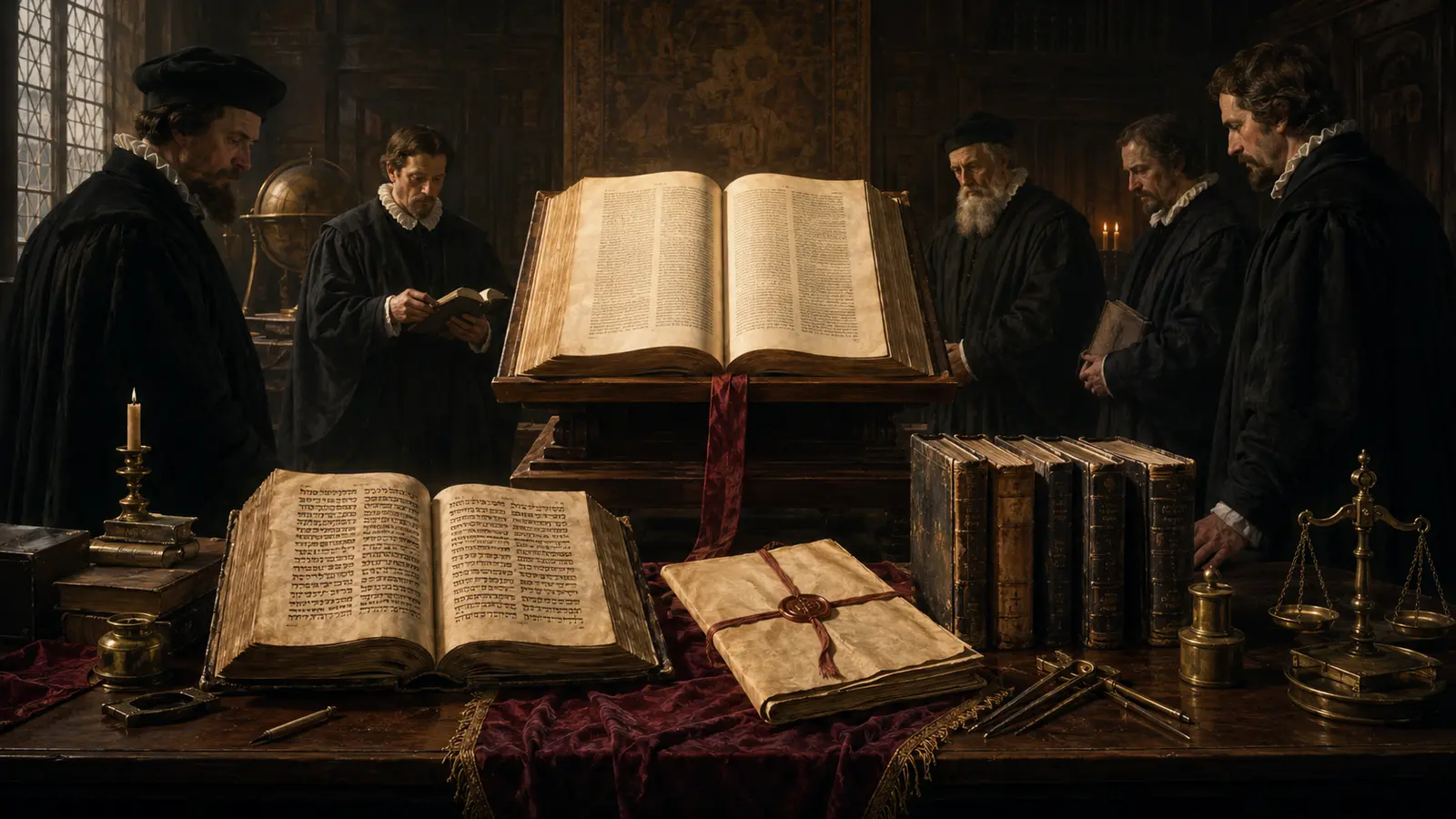
Revision note: Substantially revised July 21, 2026. The argument has been reordered according to the classical rhetorical movement, compressed where necessary, and given one consolidated Notes and Further Reading section.
“Casting down imaginations, and every high thing that exalteth itself against the knowledge of God, and bringing into captivity every thought to the obedience of Christ.” —
The confessional Christian must reason with unbelievers and heretics. He must answer objections, examine manuscripts, expose falsehood, defend the faith, and call men to repentance. Refusing neutrality does not mean refusing conversation.
The problem is not that Christians enter argument. The problem is that they often enter it after accepting the opponent’s court, rules, and standard of judgment. Scripture’s testimony concerning itself is bracketed. Providential preservation is removed from consideration. The Bible is treated as religious literature whose words must be established by methods authorized by autonomous historical reason. Only after the critical process has concluded is the Christian permitted to attach theological meaning to its results.
By then the decisive concession has already been made. The unbeliever has been granted what he most needs: the right to judge God’s Word without first submitting to the God who speaks.
The alternative is neither silence nor fideism. It is a distinctly Christian mode of argument. The believer presents the biblical position openly, uses evidence ministerially, exposes the presuppositions governing the rival method, demonstrates the rival system’s internal instability, and summons the opponent to abandon rebellion against divine authority.
He reasons with the unbeliever without reasoning as an unbeliever. He answers the heretic without temporarily joining the heresy. He enters the controversy without surrendering the court.
The First Question Is: Who Is Judge?
Every controversy requires a standard by which competing claims are judged. In textual criticism, the surface questions concern manuscripts, dates, variants, scribal behavior, versions, and citations. Beneath them stands the question of final authority.
May God’s Word testify authoritatively concerning its own origin, identity, and preservation? Or must every such claim be suspended until authenticated by an allegedly neutral method?
Westminster answers without hesitation. Scripture’s authority depends wholly upon God, its author, and not upon the testimony of any man or church. The church’s testimony and Scripture’s excellencies are genuine subordinate evidences, but full persuasion comes from the Spirit bearing witness by and with the Word. The supreme judge in religious controversy is “the Holy Spirit speaking in the Scripture.”[1]
This is not one authority claim waiting beside other equal claims. If Scripture is the speech of God, no higher court exists. To submit it to an independent tribunal would be to deny the very authority supposedly under examination. Calvin therefore insisted that the church is founded upon the prophetic and apostolic Word; Scripture does not receive its authority from the church’s judgment.[2]
The textual critic does not escape this issue by calling his procedure historical rather than theological. He still makes decisions about what kinds of explanations are admissible, whether divine providence may govern historical inference, whether the authentic wording may have disappeared, and what degree of authority the church’s inherited text possesses. These decisions reveal a philosophy of history and knowledge.
The Christian should therefore ask early: What is being treated as final? Is Scripture’s doctrine governing the historical inquiry, or is historical method deciding what Scripture may be allowed to teach about itself?
Until that question is exposed, discussion of individual variants can become an endless exchange within assumptions already hostile to the Christian position.
No Neutrality Does Not Mean No Common Ground
The unbeliever and believer inhabit the same world, inspect the same manuscripts, employ the same laws of logic, and can make many identical observations. An unbelieving paleographer may date a manuscript accurately. A heretical grammarian may parse a verb correctly. A secular historian may discover a useful patristic citation.
The Christian need not deny these facts to preserve the antithesis.
Common ground exists because every person is God’s creature living in God’s creation. All men know God through what has been made, although the unrighteous suppress that truth (Rom. 1:18–23). The work of the law is written upon the heart (Rom. 2:14–15). Human reasoning remains possible because unbelievers cannot consistently escape the order, truth, and revelation of the God they reject.
The common ground is therefore metaphysical and revelational, not religiously neutral. Men share facts because the facts belong to God. They share rational capacities because they bear God’s image. They can identify truth because they live within a divinely ordered reality. Their correct observations are borrowed from, and dependent upon, what their professed autonomy cannot finally explain.
This distinction prevents two opposite errors.
One error says there is no meaningful contact between believer and unbeliever. That collapses into irrational isolation and contradicts the biblical practice of reasoning, disputing, and preaching.
The other says contact requires a neutral territory on which both parties suspend their ultimate commitments. That grants autonomy at the outset.
Christian apologetics neither destroys common ground nor misidentifies its owner. It meets the opponent upon God’s ground and tells him whose ground it is.
and the Double Movement of Argument
Proverbs gives two adjacent commands: “Answer not a fool according to his folly, lest thou also be like unto him. Answer a fool according to his folly, lest he be wise in his own conceit” (Prov. 26:4–5).
The commands are not contradictory. Together they describe the double movement required in presuppositional argument.
First, do not answer according to folly. Do not adopt the fool’s principle of autonomy, treat God as a hypothesis, or reason as though Scripture were merely a human witness awaiting authorization. The believer must not become like the opponent in order to answer him.
Second, answer according to folly. Enter the opponent’s position for the purpose of internal critique. Ask what follows if his principles are granted for the sake of argument. Show their inconsistency, arbitrariness, and inability to account for the very reasoning by which he attacks Christianity.
This is not surrender. It is an ad hominem argument in its classical sense: an argument directed to what the opponent himself has granted. The Christian does not confess the rival premises. He demonstrates where those premises lead.
Applied to textual criticism, the procedure may look like this: Suppose the biblical text is treated exactly like every other ancient text. Suppose total loss of an original reading is possible. Suppose conjecture may restore words absent from every witness. Suppose ecclesiastical reception possesses no special providential significance. What, then, entitles the critic to speak of a presently identifiable, stable, canonical text rather than a revisable scholarly hypothesis? How can a church confess the authority of words whose identity is always subject to reconstruction by a changing guild?
The critic may offer pragmatic confidence, high probabilities, or doctrinal reassurance. But those answers do not yield the thing Christianity claims: a presently authentic divine rule to which the church finally appeals.
The internal critique exposes the price of the rival principles. The positive argument then shows that the Christian doctrine of revelation and providence supplies what textual study requires: an authoritative Word, preserved in the apographic inheritance, publicly available to the church, and capable of correcting defective witnesses.
State the Christian Position Before Chasing Objections
Christians often allow the opponent to define their position as a collection of reactions: opposition to certain codices, resistance to modern editions, preference for old translations, or discomfort with variants. That framing should be rejected.
The positive confession comes first.
The triune God has spoken in the prophetic and apostolic Scriptures. Those writings were immediately inspired and therefore infallible. God, by singular care and providence, kept the Hebrew and Greek Scriptures pure in all ages. These extant Scriptures are authentic and remain the church’s supreme standard. Textual variants arise from fallible transmission in particular witnesses, but they do not imply the loss of the divine text from the providential inheritance. Textual criticism has a real but ministerial task: to compare witnesses and recognize the preserved wording, not to reconstruct a lost canon.[3]
This statement immediately clarifies what evidence can and cannot establish. A manuscript can show that a reading existed in a particular witness. It can expose a copying error or support a history of transmission. It cannot prove that God never promised preservation, because that is a theological conclusion about divine revelation. Nor can the survival of an old codex establish that the church lacked Scripture for centuries until the codex was given modern priority.
Stating the position first also prevents the debate from becoming merely tribal. The question is not whether one prefers “our manuscripts” to “their manuscripts.” It is whether the evidence will be interpreted under revealed providence or under an ordinary-literature model that has excluded providence methodologically.
Expose the Rival Presuppositions
An effective argument identifies the assumptions doing the hidden work.
Ask whether the method permits an inspired reading to disappear from every extant witness. Ask whether conjectural emendation is admitted in principle. Ask whether “preservation” means the continued possession of the authentic text or merely the survival of materials from which a close approximation may be constructed. Ask whether the church’s reception has evidential weight arising from covenant providence. Ask whether any present critical edition is the authentic text or only the best provisional reconstruction.
These questions should be asked accurately and without theatrical accusation. A scholar may personally affirm providence while using a method that gives it no governing function. Another may reject conjecture in practice while retaining a theory that permits it. A third may speak of preservation while defining it as recoverability. The task is to identify the operational principles, not to caricature professions of faith.
The critic should also be asked to account for his standards. Why should the oldest surviving witness normally receive priority? Why should the shorter or harder reading be preferred? How were the relevant scribal habits established? Does the method derive those habits from a favored textual group and then use the habits to prove that group’s superiority? What could falsify the genealogical model?
None of these questions implies that age, brevity, difficulty, or genealogy is irrelevant. They require that subordinate criteria justify their use rather than masquerade as neutral laws.
The aim is not to discover a secret villainy behind every conclusion. It is to make governing commitments visible. Once they are visible, the disagreement can be addressed at its real level.
Use Evidence as Witness, Not as Lord
Presuppositional argument does not allow careless handling of evidence. Because every fact belongs to God, every fact must be represented truthfully.
The Christian should know the readings under dispute, the witnesses cited, the limits of their dates, the difference between a manuscript and a textual family, the difficulties of retroversion, the character of patristic quotation, and the distinction between fact and reconstruction. He should concede correct observations immediately.
If an unbeliever correctly identifies an omission, the observation does not become false because of its source. If a critical editor exposes a printing error in a received-text edition, confessional bibliology does not require defending the error. The preserved Hebrew and Greek inheritance remains the rule by which particular copies and editions are corrected.
Evidence functions as a witness within God’s court. It does not convene a new court above him.
This means the Christian can argue both positively and negatively from evidence. Positively, broad transmission, continuity of use, manuscript support, versions, fathers, and internal coherence may confirm a received reading. Negatively, he may demonstrate that a proposed reading depends upon a narrow group, an unstable genealogy, a speculative account of scribal behavior, or assumptions that simply restate the critical conclusion.
What he may not do is pretend that facts interpret themselves. “This manuscript is earlier” does not entail “this reading is original.” “This reading is shorter” does not entail “a scribe expanded it.” Between observation and conclusion stands an inference governed by broader beliefs.
The Christian should press that distinction patiently. Often the apparent authority of the academy game depends upon presenting an inference as though it were an artifact lying visibly on the page.
Reasoning with the Unbeliever
The openly unbelieving textual critic does not confess Scripture as the Word of God. The Christian should not ask him to pretend otherwise. He should expose the impossibility of neutrality and press the unbeliever’s dependence upon the Christian worldview.
The unbeliever uses logic, expects regularity, trusts memory, distinguishes truth from error, assigns moral value to honesty, and believes historical testimony can communicate knowledge across time. Yet a naturalistic or autonomous account of reality cannot supply an ultimate foundation for universal logical norms, moral obligation, or the purposive correspondence between the human mind and an intelligible world.
The Christian argument is not merely that unbelievers occasionally make logical mistakes. Christians do also. The argument is that the unbeliever’s professed worldview cannot justify the norms he necessarily employs. He must reason within God’s world even to argue against God.
At the textual level, ask why historical reconstruction should produce obligation. Even if the critic could identify the earliest attainable wording of a Christian document, why should that wording bind conscience as divine speech? Historical probability cannot generate divine authority. The unbeliever can study the Bible as an artifact; he cannot, from autonomous premises, arrive at the Bible as the self-attesting Word of God.
The Christian therefore presents more than manuscript arguments. He proclaims the God who speaks, the sin that suppresses his truth, the Christ who commands repentance, and the Spirit who opens blind eyes. Paul at Athens did not begin with religious neutrality. He declared the Creator, interpreted pagan worship as culpable ignorance, proclaimed resurrection and judgment, and commanded repentance ().
The encounter is apologetic and evangelistic at once.
Reasoning with the Heretic or Inconsistent Professor
The professing Christian who denies Scripture’s self-attestation or providential preservation presents a different situation. He claims authorities the unbeliever rejects: Scripture, Christ, perhaps a Reformed confession, and the church’s duty to submit to the Word.
The argument should therefore press his stated commitments.
If Scripture is supreme, why must its testimony concerning preservation be suspended before textual method? If the Westminster Confession is sincerely received, what do “kept pure in all ages,” “authentic,” and final appeal to the Hebrew and Greek mean? If the church presently possesses a sufficient Bible, where is the principled boundary against total loss and conjectural restoration? If the Holy Spirit speaking in Scripture is the supreme judge, why does the critical guild determine which words are eligible to function as that judge?[1]
This is again an internal critique, but now it is ecclesiastically sharper. The opponent is asked to reconcile his textual method with his profession.
The term heretic must nevertheless be used carefully. Material error, formal heresy, ignorance, inconsistency, and obstinate propagation are not identical categories. A mistaken textual judgment does not by itself prove that a man is a formal heretic. Nor does a lay writer possess authority to pronounce an ecclesiastical sentence upon every scholar.
One may identify a proposition as contrary to Scripture and confession without claiming secret knowledge of the speaker’s heart. One may demonstrate that a method functionally subordinates Scripture without asserting that every practitioner consciously intends to overthrow Scripture. Doctrinal judgment is required; mind-reading is forbidden.
When error becomes persistent and fundamental, Scripture supplies ecclesiastical procedures for admonition and discipline (; 3:10). Argument should serve that moral end: not merely exposing inconsistency, but recovering the person if God grants repentance.
Self-Deception and the Limits of Motive Claims
Romans 1 teaches a universal moral diagnosis: fallen men suppress the truth in unrighteousness. Unbelief is not the product of innocent neutrality. Greg Bahnsen’s analysis of self-deception helps explain how a person may encounter adverse evidence, manipulate its emphasis, and rationalize it away while maintaining an appearance of rational procedure.[4]
That doctrine is essential, but it must not be abused.
The Christian may say that sinful suppression characterizes fallen reasoning generally because Scripture says so. He may show that an argument omits evidence, treats contrary cases inconsistently, or changes standards when challenged. He may even identify a stated motive when the speaker supplies it.
He should not casually claim to know why a particular scholar selected a reading. “He hates this doctrine,” “he wants academic advancement,” or “he knows this reading is true and deliberately corrupts it” are motive claims requiring evidence. They are not established merely by the falsity of his conclusion.
The site’s necessary safeguard is therefore threefold: distinguish fact, inference, and motive.
A manuscript’s wording is a fact. A proposed genealogical relationship is an inference. A claim that a scholar rejected a reading in order to please the academy is a motive attribution. The three may be related, but they do not carry the same evidential burden.
This restraint strengthens the polemic. It keeps the argument directed at what can be proved, prevents legitimate criticism from being dismissed as personal attack, and honors the ninth commandment.
The Objection: “This Makes Conversation Impossible”
The strongest practical objection says that presuppositional argument ends discussion. If the Christian begins by declaring Scripture supreme and the opponent sinful, no meaningful reasoning remains. The method allegedly becomes a sermon protected from falsification.
That objection confuses acknowledged authority with the absence of argument.
Every participant has ultimate commitments. The neutralist also excludes conclusions in advance: divine revelation cannot authenticate itself, providence cannot constrain historical reconstruction, and religious claims must submit to autonomous criteria. His method is no less governed by presuppositions because he leaves them unnamed.
The Christian framework, by contrast, makes extensive argument possible. Manuscripts are examined, historical claims checked, internal coherence tested, consequences traced, and rival explanations compared. The Christian can learn from an opponent, correct mistakes, and revise fallible judgments. What he cannot revise is God’s authority in response to a creature’s demand for a higher court.
Nor does the doctrine of sinful suppression excuse failure to answer. Peter joins the sanctification of Christ as Lord in the heart with readiness to give a reason, and he requires meekness and fear (1 Pet. 3:15). Paul instructs the Lord’s servant to correct opponents with gentleness, in hope that God may grant repentance and acknowledgment of the truth (2 Tim. 2:24–26).
Presuppositional faithfulness should make conversation more honest, not less. Both sides’ ultimate commitments are placed upon the table. Evidence is no longer forced to bear conclusions it does not entail. The moral dimension of unbelief is acknowledged, while personal accusations remain disciplined by proof.
A Practical Pattern for the Encounter
A faithful textual-apologetic exchange can ordinarily proceed through eight movements.
1. Define the claim
Identify the precise reading, doctrine, or methodological principle in dispute. Do not argue against “modern criticism” as an undefined mass.
2. State the Christian confession
Affirm inspiration, self-attestation, preservation, authenticity, and the ministerial role of criticism before addressing isolated evidence.
3. Ask for the opponent’s governing standard
Determine what he regards as final and what possibilities his method permits: total loss, conjecture, indefinite revision, or merely ordinary correction among extant witnesses.
4. Establish the public facts
List the readings and witnesses accurately. Concede correct observations. Separate documentary facts from genealogical and motivational claims.
5. Test the inferences
Ask whether age, number, internal probability, or scribal habits actually entail the conclusion. Expose circular standards and unproved transitions.
6. Perform the internal critique
For the unbeliever, show the dependence of rational and historical inquiry upon the God he rejects. For the professing Christian, show the tension between his method and his stated biblical or confessional authority.
7. Present the positive coherence of the confessional position
Show how divine inspiration, providential preservation, extant apographs, ecclesiastical reception, and ministerial comparison form one coherent account.
8. Call for repentance and submission
The conclusion is not merely “our model explains more data.” The issue concerns obedience to the God who speaks. The proper response is faith, correction, and submission to his Word.
This pattern is neither a script nor a trick for instant victory. It is an ordering of loyalties. It prevents the Christian from becoming an autonomous critic for the first seven steps and a confessional theologian only at the eighth.
This Is Not Fideism, Anti-Scholarship, or KJV-Onlyism
Fideism separates faith from reason. Confessional apologetics insists that reason is possible and properly ordered only under God. It offers arguments, evaluates evidence, and exposes contradiction.
Anti-scholarship despises learning. Ministerial criticism requires languages, history, collation, logic, and accurate representation. It opposes the unlawful authority of scholarship, not scholarship itself.
KJV-onlyism makes an English translation immediately or practically supreme. Confessional bibliology appeals finally to the preserved Hebrew and Greek texts. The King James Version possesses derivative authority as a faithful translation; its printers and translators were fallible. Refusing the academy’s court does not establish an English magisterium.
These distinctions matter apologetically. The Christian cannot rebuke the modern critic for placing a human guild above Scripture and then place a translator, printer, or private intuition in the same office.
Conclusion
The Christian must reason with unbelievers and heretics, but he must do so as a Christian from the first premise to the final appeal.
He does not deny common ground; he identifies it as God’s ground. He does not refuse evidence; he receives it as testimony within revealed providence. He does not avoid the opponent’s system; he enters it conditionally to expose its consequences. He does not confuse error with motive or private judgment with ecclesiastical sentence. He does not seek merely to embarrass an adversary; he calls him to repentance and submission to Christ.
The academy game demands that Scripture leave the bench before the hearing begins. Faithful apologetics refuses. The Holy Spirit speaking in Scripture remains the supreme judge. Manuscripts, versions, fathers, historians, critics, churches, and confessions all occupy subordinate places. Their testimony may be valuable, their judgments may be corrected, and their labors may serve the truth. None may constitute the Word or authorize the God who speaks it.
The Christian therefore enters the controversy with open eyes and an unsurrendered court. He listens carefully, argues honestly, handles evidence precisely, exposes autonomy, and presses the antithesis. His confidence does not rest in rhetorical dominance or scholarly status. It rests in the self-attesting Word that the sovereign God has given and kept.
Notes and Further Reading
- The Westminster Confession of Faith, 1.4–5, 1.8, and 1.10.
- John Calvin, Institutes of the Christian Religion, book 1, chapter 7, especially sections 1–5.
- John Owen, The Works of John Owen, vol. 9 (Philadelphia, 1865), The Divine Original of Scripture, pp. 18–21, and The Integrity and Purity of the Hebrew and Greek Text, pp. 68–78 and 138–39.
- Greg L. Bahnsen, The Apologetic Implications of Self-Deception, especially chapter 5, pp. 145–50, and chapter 7, pp. 193–200.