

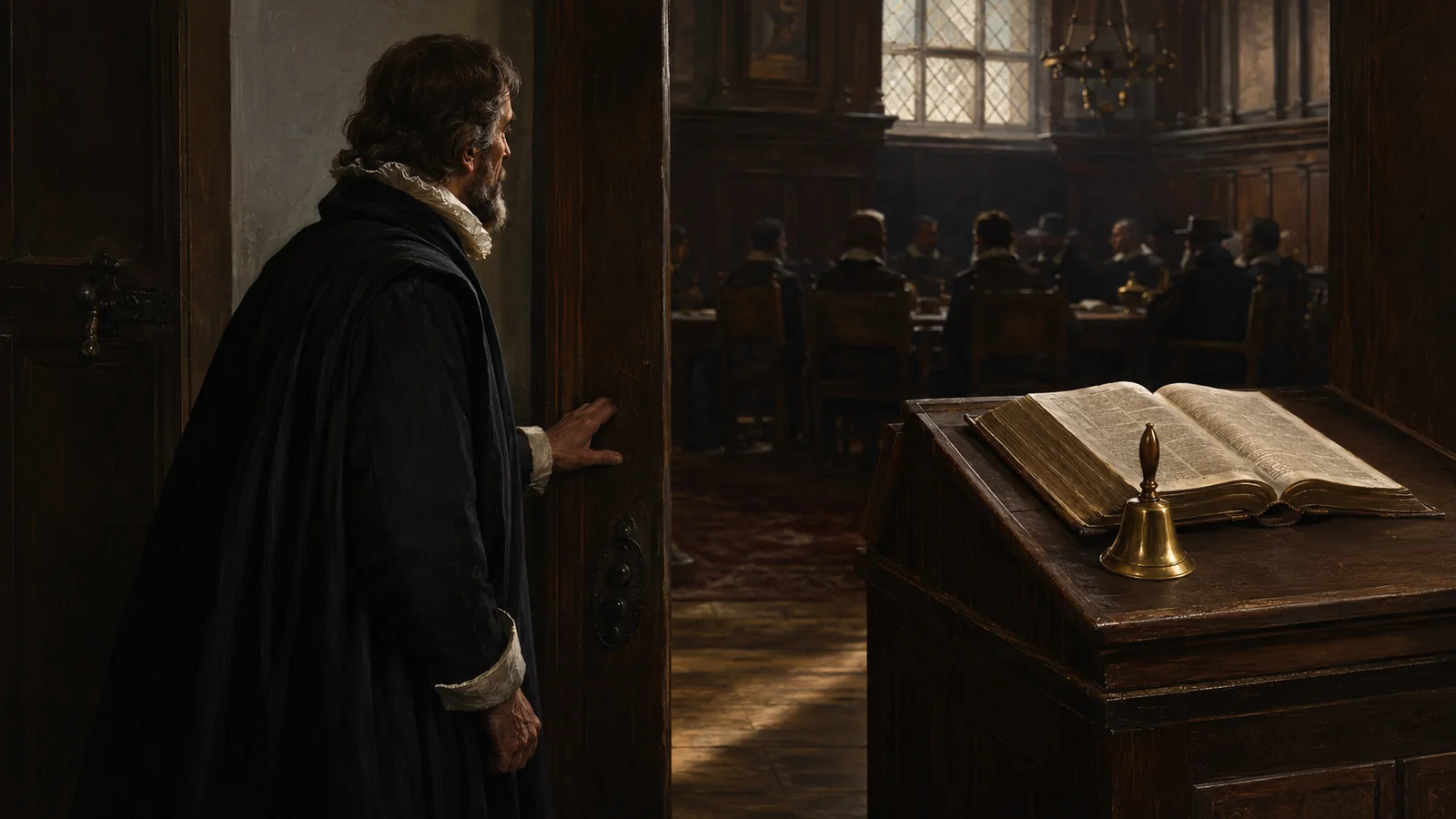
Revision note: Substantially revised July 20, 2026. The argument has been reordered according to the classical rhetorical movement, compressed where necessary, and given one consolidated Notes and Further Reading section.
Fear of Man, Pastoral Courage, and the Duty to Warn
“There is a time to keep silence, and a time to speak” ().
Scripture does not command Christians to speak about everything at all times. Silence can be an expression of wisdom, patience, humility, self-control, or trust in God. Our Lord himself sometimes refused to answer his accusers. Proverbs repeatedly commends the man who restrains his words. A person who does not yet understand a controversy should ordinarily listen and learn before attempting to teach others.
Yet Scripture also recognizes a sinful silence. There are circumstances in which refusing to speak is not prudence but disobedience. There are truths that must be confessed, dangers that must be identified, errors that must be answered, and brothers who must be warned. In such cases, silence may protect a man’s reputation while exposing others to harm.
The question, therefore, is not simply whether someone has spoken. The proper question is whether God, through his Word and the responsibilities of that person’s calling, required him to speak.
Silence is not always cowardice. But neither is it always innocence.
The Confessional Condemnation of “Undue Silence”
The Westminster Larger Catechism gives an especially useful treatment of this subject under the ninth commandment.
The ninth commandment requires not merely that Christians refrain from lying, but that they preserve and promote the truth. The Larger Catechism includes among our duties “appearing and standing for the truth” and speaking it sincerely, freely, clearly, and fully.
It then includes among the sins forbidden:
“Concealing the truth, undue silence in a just cause, and holding our peace when iniquity calleth for either a reproof from ourselves, or complaint to others.”
That statement is remarkably direct. There is such a thing as “undue silence.” There are occasions when iniquity itself calls for a response. Depending upon our place and opportunity, that response may take the form of direct reproof or a proper complaint to someone possessing the authority to act.
But the catechism immediately guards the other side. It also condemns:
“Speaking the truth unseasonably, or maliciously to a wrong end,”
as well as slandering, backbiting, rash and harsh censuring, misconstruing intentions, aggravating smaller faults, and unnecessarily exposing infirmities.
These two sides must be held together. The ninth commandment forbids both cowardly silence and reckless accusation. It forbids concealing necessary truth, but it also forbids using truth as a weapon for malice, humiliation, or self-exaltation.
That balance should govern any Christian publication. A website devoted to theological controversy must not retreat into silence merely because truth is costly. Neither may it treat every true statement as necessarily righteous merely because it is true. Truth must be spoken at the proper time, for a proper reason, with sufficient evidence, in a manner proportionate to the matter.
Nevertheless, the existence of possible abuses does not cancel the duty to speak. The command to avoid slander cannot be converted into a prohibition against necessary criticism. The command to speak graciously cannot be converted into a requirement that every rebuke be painless. The requirement of carefulness cannot be made a pretext for permanent silence.
When Silence Is Wise
Before identifying sinful silence, we must acknowledge several legitimate reasons a Christian may refrain from speaking.
A person may remain silent because he does not possess enough information. He may be waiting to hear both sides of a dispute. He may recognize that another person is better qualified to address the matter. He may judge that a private conversation should precede a public statement. He may delay speaking until emotions have cooled or until he can express himself more precisely.1
A pastor may also decide that he cannot respond publicly to every error circulating on the internet. No elder is responsible for answering every book, podcast, article, or social-media post. He has duties to his congregation, family, and ordinary vocation. Human limitations are real, and the mere fact that someone has not addressed a particular controversy does not prove moral failure.
Silence may therefore arise from:
- insufficient knowledge;
- uncertainty about the facts;
- lack of a meaningful relationship to the matter;
- the need to investigate;
- concern for proper timing;
- a desire to avoid needlessly enlarging a controversy;
- the existence of more pressing duties;
- or a reasonable judgment that another person should answer.
None of these is necessarily cowardice.
Prudence asks, “How and when should I obey?” Cowardice asks, “How can I avoid the cost of obedience?”
The two can sometimes appear similar from the outside, which is why Christians must be careful when judging motives. But they are not morally identical.
When Silence Becomes Culpable
James writes:
“Therefore to him that knoweth to do good, and doeth it not, to him it is sin” ().
- ; 33:1–9; ; . These passages join warning to covenantal stewardship rather than personal appetite for controversy. ↩
Sin consists not only in doing what God forbids but also in refusing to do what God requires. The Christian tradition has consequently distinguished sins of commission from sins of omission. A man may sin with his mouth, but he may also sin by closing his mouth when love and duty require him to speak.
connects necessary reproof with love for one’s neighbor:
“Thou shalt not hate thy brother in thine heart: thou shalt in any wise rebuke thy neighbour, and not suffer sin upon him.”
- ; 33:1–9; ; . These passages join warning to covenantal stewardship rather than personal appetite for controversy. ↩
Silence can sometimes look kinder than correction. Yet God warns that refusing necessary reproof may conceal something very different from love. A man may keep quiet because speaking would be uncomfortable, might damage a friendship, or could cost him influence. He calls his silence charity, but the person left unwarned bears the consequences.
Silence becomes culpable when several circumstances converge:
- The truth or duty is sufficiently clear.
- The person knows, or by virtue of his calling should know, that others are being endangered or misled.
- He has a meaningful responsibility or genuine opportunity to respond.
- The matter is serious enough to warrant intervention.
- He lacks a sufficient reason for remaining silent.
- He withholds necessary speech because of fear, self-interest, institutional loyalty, reputation, or some other improper consideration.
Not every one of these circumstances will be equally apparent to an outside observer. We may often be able to judge that a warning was needed without knowing precisely why a particular man failed to give it. That distinction matters.
We can sometimes establish a failure of duty more confidently than we can establish the secret motive behind it.
Fear of Man and the Love of Approval
“The fear of man bringeth a snare” ().
Fear of man does not always appear as panic or open denial. It often appears as calculated respectability. A Christian learns which conclusions are permitted, which questions may be asked, and which convictions will cost him access to influential circles. He then adjusts his speech accordingly.
John records that some rulers believed in Christ but would not confess him:
“For they loved the praise of men more than the praise of God” ().
- ; 33:1–9; ; . These passages join warning to covenantal stewardship rather than personal appetite for controversy. ↩
Their silence was not caused by a lack of information. Nor was it an exercise in patient investigation. They understood enough to confess, but they also understood what confession might cost them.
Peter’s conduct at Antioch gives another example. He withdrew from table fellowship with Gentile believers because he feared the circumcision party. Paul opposed him openly because Peter’s conduct was public and threatened the truth of the gospel (). Peter’s position did not place his conduct beyond examination. Nor did his prior faithfulness make his present inconsistency harmless.
Courage is not the absence of fear. It is obedience to God despite fear. Cowardice, in the relevant moral sense, is the culpable surrender of a known duty because faithfulness carries a feared cost.
That cost may involve:
- loss of friendships;
- denominational disapproval;
- damage to an academic career;
- exclusion from conferences or publications;
- loss of access to influential people;
- accusations of extremism;
- reduced professional opportunities;
- or the discomfort of opposing a respected colleague.
These pressures are real. Christians should not pretend otherwise. But the reality of the pressure does not release us from obedience.
The Academy and Its Demands
Scholarship is not sinful. Technical learning, historical investigation, linguistic study, and interaction with specialists can all serve the church. A Christian should not reject an argument merely because it originated in a university or was advanced by someone outside his confessional tradition.
But the academy is not religiously neutral. Like every human institution, it operates according to standards, authorities, assumptions, incentives, and penalties. Some of these are legitimate; others are not.
The Christian may participate in scholarly discussion, but he may not grant the scholarly guild authority to determine what he is permitted to believe or confess. He may learn from academic specialists, but he may not treat their consensus as a court of final appeal above Scripture. He may employ historical and textual evidence, but he may not adopt a method that requires him to suspend Christian commitments as though God had not spoken.2
If the price of academic credibility is concealing what a Christian believes Scripture requires him to say, then that price cannot lawfully be paid.
If the rules of scholarly acceptance require a confessional Christian to describe an unbelieving or religiously autonomous method as neutral, those rules are themselves objectionable. If remaining respectable requires him to confess one doctrine before the church while reasoning according to contrary principles before the academy, the resulting inconsistency must be exposed.
Measured language is not cowardice. Careful qualification is not compromise. Listening to objections is not surrender. But silence chosen primarily to preserve academic respectability is not Christian prudence.
The decisive question is not whether an argument sounds scholarly. It is whether its principles and conclusions are faithful to the Word of God.
The Greater Responsibility of Shepherds
All Christians have duties to confess truth, resist error, and warn one another. Elders, however, bear an additional responsibility arising from their office.
Paul says that an elder must hold fast the faithful Word:
“That he may be able by sound doctrine both to exhort and to convince the gainsayers” ().
The ability and willingness to answer contradiction are not optional decorations added to the pastoral office. They belong to its stated qualifications and work.
Paul charged the Ephesian elders to watch over the flock because grievous wolves would enter among them. He reminded them that for three years he had not ceased warning every one night and day with tears (). He could declare himself innocent of their blood because he had not shunned to proclaim the whole counsel of God.
Christ contrasts the good shepherd with the hireling. The hireling sees the wolf coming and leaves the sheep because he does not truly care for them as the shepherd does (). This passage should not be wielded casually against every pastor who makes a different prudential judgment. Nevertheless, the principle is unavoidable: the shepherd’s faithfulness is revealed particularly when protecting the flock becomes costly.
Isaiah condemns watchmen who are blind and “dumb dogs” that cannot bark (). A watchdog is not required to bark at every moving shadow. But a dog that will not bark when danger arrives is failing at the very task for which it was placed.
The same is true of shepherds. No elder can answer everything. But an elder cannot defend his refusal to answer a serious and proximate danger merely by repeating that he possesses pastoral authority. His authority creates responsibility; it does not provide immunity from it.
Indeed, the Larger Catechism teaches that sins may be aggravated when committed by those who possess greater experience, gifts, profession, place, or office, particularly when they serve as guides whose example is likely to be followed. Ordination does not make failure less serious. In certain circumstances, it makes failure more serious.
Not Every Failure Should Immediately Be Called Cowardice
Because cowardice concerns a man’s response to fear, the accusation should not be made without care.
An elder may remain silent because he genuinely believes no serious error has occurred. His judgment may be mistaken. His theology may be inconsistent. His understanding of the evidence may be inadequate. But if he sincerely does not perceive the danger, “cowardice” may not be the most accurate description of his failure.3
Likewise, an elder may agree that a problem exists but reasonably judge that he should address it privately, delegate it to someone more qualified, or wait for better information. Such a judgment can be evaluated, but disagreement over prudence does not by itself prove fear of man.
The website should therefore distinguish among several claims:
- “This argument is false.”
- “This argument contradicts the speaker’s confession.”
- “This argument has harmful consequences.”
- “This teacher should have addressed those consequences.”
- “This teacher failed to perform a responsibility.”
- “This teacher remained silent because he feared men.”
Each claim requires its own evidence. The first several may be demonstrable from public writings alone. The final claim ordinarily requires additional evidence concerning motive.
Patterns of conduct may sometimes justify a cautious inference. A man may privately acknowledge a problem while publicly refusing to address it. He may expressly cite reputational, professional, or institutional consequences. He may speak forcefully against obscure opponents while becoming conspicuously delicate around influential allies. Such facts may support a conclusion about fear of man.
Even then, criticism should identify the evidence and distinguish inference from established fact. “This conduct displays a failure of pastoral courage” may sometimes be warranted when “this man is a coward” would claim more than we can know.
Biblical courage does not require careless accusation.
When Silence Is Joined to the Silencing of Others
There is an important difference between declining to address a controversy and attempting to prohibit others from addressing it.
An elder may truthfully say, “I cannot personally answer every public argument.” That is an acknowledgment of human limitation.
But suppose an elder leaves a public argument unanswered while attempting to prevent a competent church member from examining it—not because the examination is false, unjust, disorderly, or slanderous, but because the member is not ordained or because the criticism creates institutional discomfort. The issue is no longer merely the elder’s silence. His authority is now being used to extend that silence to another Christian.
Ordination is not a licensing system for truth.
An elder may correct a layman’s facts, exegesis, tone, or conduct. He may require proper order within the local church. He may warn against pride, obsession, rash judgment, or divisiveness. But “You are not an elder” is not, by itself, an answer to a biblical argument. Nor does it establish that a Christian may not publish a careful criticism of public teaching.
If the response is wrong, demonstrate the error. If it misrepresents another man, identify the misrepresentation. If it violates Scripture, state the command violated. If it is factually and biblically sound, the author’s lack of office does not make it unlawful.
The situation becomes especially serious when an office-bearer will neither answer public error nor permit others to answer it. If the objection is not to falsehood, slander, or disorder, but merely to the fact that an ordinary Christian spoke, ecclesiastical authority is being confused with control over Christian judgment.
An elder’s failure does not confer ecclesiastical office upon a layman. But neither does it cancel the layman’s ordinary Christian duties.
What a Lay Christian May Do
When office-bearers remain silent, an ordinary Christian may still:
- study the matter carefully;
- compare public teaching with Scripture and the church’s confession;
- ask elders for clarification;
- identify contradictions and logical consequences;
- publish documented criticism of public arguments;
- warn other Christians about demonstrable theological dangers;
- request correction from appropriate ecclesiastical authorities;
- and receive correction when his own work is shown to be wrong.
He may not pronounce ecclesiastical censure, claim pastoral jurisdiction, or treat his private judgment as infallible. He must not presume to know secret motives. He must distinguish serious doctrinal corruption from ordinary error. He must remain willing to retract false claims and correct careless language.4
But none of those limitations produces a general command to silence.
The Christian does not need ordination to say that an argument is invalid, that a conclusion conflicts with a confession, or that a method rests upon assumptions contrary to Scripture. He needs evidence, sound reasoning, biblical fidelity, and a manner consistent with Christian love.
When a layman supplies a careful and necessary warning that shepherds neglected to give, the embarrassment does not consist in the layman having spoken. The shame lies in the possibility that those specially charged to guard the flock left the necessary work to someone without their training, standing, or office—and then objected to his lack of office rather than answering his argument.
Peace Is Not the Mere Absence of Controversy
Appeals to peace are often used to justify silence. Scripture certainly commands Christians to pursue peace. Yet biblical peace is not maintained by concealing substantial error or forbidding necessary correction.
Paul says, “If it be possible, as much as lieth in you, live peaceably with all men” (). The words “if it be possible” recognize that peace has moral boundaries. Christians may not purchase an appearance of unity by abandoning truth or duty.
The prophets condemned those who cried, “Peace, peace,” when there was no peace (). Such speech did not heal the wound. It covered the wound and allowed it to worsen.
A church may appear peaceful because honest questions are answered patiently. It may also appear peaceful because members have learned that certain questions will be punished. These are not the same kind of peace.
Truth can be spoken contentiously. But necessary truth does not become contentious merely because someone resents hearing it.
Safeguards for Judging Silence
Because accusations concerning silence and cowardice can easily become unjust, this website should observe several safeguards.
First, we should establish the underlying error before condemning someone for failing to oppose it. No one can be obligated to denounce a conclusion that has not been shown to be false or dangerous.
Second, we should establish a meaningful responsibility. The fact that a man is an elder somewhere does not make him responsible for every controversy everywhere.
Third, we should account for human limitations. A person may lack time, information, competence, or opportunity.
Fourth, we should distinguish the act from the motive. We may establish that a warning was absent without knowing why it was absent.
Fifth, we should consider whether the person has addressed the issue in some other legitimate manner.
Sixth, we should weigh the seriousness and proximity of the danger. Silence concerning a minor technical disagreement is not equivalent to silence concerning teaching that directly unsettles a confessed doctrine.
Seventh, we should be particularly attentive when silence is combined with the suppression of legitimate criticism. That combination raises concerns that mere nonparticipation does not.
Finally, we must apply the same standard to ourselves. A writer who condemns the fear of man can still be governed by the praise of his own audience. Boldness can become a performance. Controversy can become a source of identity. A man can speak loudly against prominent teachers because he enjoys the attention while remaining silent about sins closer to home.
Faithfulness is not measured by volume, aggression, or the number of opponents one has acquired. It is measured by obedience to God.
The Duty That Remains
The church needs prudent men. It also needs courageous men. These are not competing virtues.
Prudence determines the right means, time, and manner of obedience. Courage bears the cost of obedience once the duty is clear. Prudence without courage becomes an elaborate explanation for doing nothing. Courage without prudence becomes reckless and destructive.
A shepherd is not required to bark at every sound. But when he sees a wolf, recognizes the danger, and remains silent because warning the flock might cost him standing, access, friendship, or academic respectability, his silence is no longer neutral. It has become a failure of pastoral courage.
And if an ordinary Christian sees the danger and can demonstrate it from Scripture, confession, evidence, and sound reasoning, his lack of ordination does not require him to pretend that he sees nothing.
He must speak carefully. He must speak justly. He must remain correctable. He must refuse slander and vindictiveness. But when iniquity calls for reproof, silence cannot be baptized as submission merely because the man who speaks is a layman.
The Word of God binds them both: the elder who has been charged to guard and the Christian who has been commanded to confess.
Neither office nor lack of office gives a man permission to fear men more than God.
Notes and Further Reading
- ; 33:1–9; ; . These passages join warning to covenantal stewardship rather than personal appetite for controversy. ↩
- Westminster Larger Catechism 144–145, OPC text, treats both truthful speech and ‘undue silence’ under the ninth commandment. ↩
- ; ; ; 15:12–14. Scripture commands speech and silence according to person, occasion, duty, and probable fruit. ↩
- ; ; on the fear of man, divine accountability, and faithful proclamation. ↩