

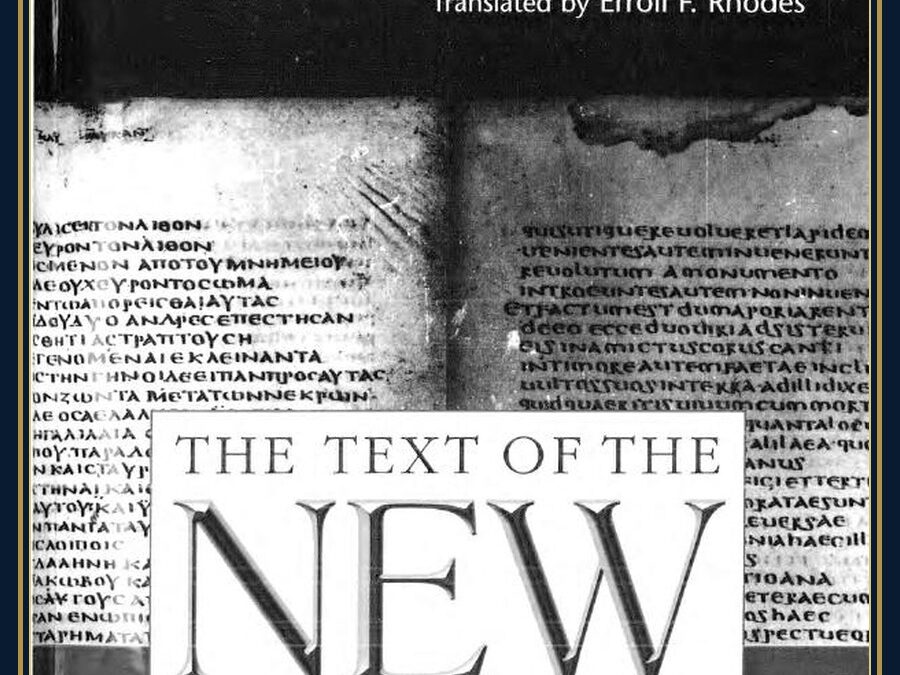

Second edition, revised and enlarged
The Text of the New Testament
An Introduction to the Critical Editions and to the Theory and Practice of Modern Textual Criticism
Barbara Aland; Erroll F. Rhodes; Kurt Aland · 1989
Grand Rapids: Eerdmans, 1989; translated from the German second edition.
Overview
Kurt and Barbara Aland provide a comprehensive manual to critical editions, Greek manuscript classification, papyri, uncials, minuscules, lectionaries, ancient versions, patristic citation, and the practical evaluation of variants. The book combines reference tables and manuscript profiles with a concise statement of editorial method, culminating in twelve rules that require the critic to weigh external and internal evidence rather than count witnesses mechanically.
Although some manuscript descriptions and statistical categories have been superseded by later cataloging and the CBGM, the manual remains extraordinarily useful. Its major limitation is not lack of competence but the confidence with which the editor is authorized to identify a single original reading using a historically reconstructed system whose own genealogical categories have since been revised.
Overview
Kurt and Barbara Aland provide a comprehensive manual to critical editions, Greek manuscript classification, papyri, uncials, minuscules, lectionaries, ancient versions, patristic citation, and the practical evaluation of variants. The book combines reference tables and manuscript profiles with a concise statement of editorial method, culminating in twelve rules that require the critic to weigh external and internal evidence rather than count witnesses mechanically.
Although some manuscript descriptions and statistical categories have been superseded by later cataloging and the CBGM, the manual remains extraordinarily useful. Its major limitation is not lack of competence but the confidence with which the editor is authorized to identify a single original reading using a historically reconstructed system whose own genealogical categories have since been revised.
Editorial Evaluation
Purpose Fulfillment
Does the work accomplish what it claims to accomplish?
Brief assessment
The manual comprehensively introduces critical editions, witnesses, transmission, and the theory and practice announced in its subtitle.
Full rationale and supporting references
The manual comprehensively introduces critical editions, witnesses, transmission, and the theory and practice announced in its subtitle. Evidence reviewed: complete supplied second edition, especially the surveys of editions and witnesses (PDF pp. 20–279) and the praxis and twelve rules (PDF pp. 280–310).
Editorial Evaluation
Source Quality
Does it use the appropriate primary and secondary sources?
Brief assessment
Its manuscript, versional, patristic, and edition data reflect direct institutional expertise and an exceptionally broad command of the evidence.
Full rationale and supporting references
Its manuscript, versional, patristic, and edition data reflect direct institutional expertise and an exceptionally broad command of the evidence. Evidence reviewed: complete supplied second edition, especially the surveys of editions and witnesses (PDF pp. 20–279) and the praxis and twelve rules (PDF pp. 280–310).
Editorial Evaluation
Citation Accuracy
Are quotations, references, and claims verifiable and in context?
Brief assessment
Sigla, catalog numbers, editions, tables, and bibliography generally permit verification.
Full rationale and supporting references
Sigla, catalog numbers, editions, tables, and bibliography generally permit verification; some compressed claims require consultation of fuller handbooks. Evidence reviewed: complete supplied second edition, especially the surveys of editions and witnesses (PDF pp. 20–279) and the praxis and twelve rules (PDF pp. 280–310).
Editorial Evaluation
Evidence Coverage
Does it address the relevant evidence, including contrary evidence?
Brief assessment
The work surveys every principal witness class and then demonstrates how evidence is weighed in practice, with unusually dense reference data.
Full rationale and supporting references
The work surveys every principal witness class and then demonstrates how evidence is weighed in practice, with unusually dense reference data. Evidence reviewed: complete supplied second edition, especially the surveys of editions and witnesses (PDF pp. 20–279) and the praxis and twelve rules (PDF pp. 280–310).
Editorial Evaluation
Historical Accuracy
Are people, dates, editions, events, and settings handled correctly?
Brief assessment
The transmission history is authoritative for its date, though later manuscript discoveries, catalog changes, and CBGM analysis have revised several classifications and relationships.
Full rationale and supporting references
The transmission history is authoritative for its date, though later manuscript discoveries, catalog changes, and CBGM analysis have revised several classifications and relationships. Evidence reviewed: complete supplied second edition, especially the surveys of editions and witnesses (PDF pp. 20–279) and the praxis and twelve rules (PDF pp. 280–310).
Editorial Evaluation
Subject Competence
Does the author demonstrate competence in the relevant disciplines?
Brief assessment
Few introductions equal the authors' combined mastery of the Institut's manuscript resources, editions, versions, Fathers, and editorial practice.
Full rationale and supporting references
Few introductions equal the authors' combined mastery of the Institut's manuscript resources, editions, versions, Fathers, and editorial practice. Evidence reviewed: complete supplied second edition, especially the surveys of editions and witnesses (PDF pp. 20–279) and the praxis and twelve rules (PDF pp. 280–310).
Editorial Evaluation
Logical Coherence
Do the conclusions follow from the premises and evidence?
Brief assessment
The twelve rules form a coherent reasoned-eclectic method, but claims that readings are best explained by a particular textual history can become circular when genealogy depends on prior editorial choices.
Full rationale and supporting references
The twelve rules form a coherent reasoned-eclectic method, but claims that readings are best explained by a particular textual history can become circular when genealogy depends on prior editorial choices. Evidence reviewed: complete supplied second edition, especially the surveys of editions and witnesses (PDF pp. 20–279) and the praxis and twelve rules (PDF pp. 280–310).
Editorial Evaluation
Methodological Transparency
Are the method and controlling assumptions identifiable and consistent?
Brief assessment
The authors explicitly state their rules, presumptions, preference for local decisions, and the need to resist mechanical witness counting.
Full rationale and supporting references
The authors explicitly state their rules, presumptions, preference for local decisions, and the need to resist mechanical witness counting. Evidence reviewed: complete supplied second edition, especially the surveys of editions and witnesses (PDF pp. 20–279) and the praxis and twelve rules (PDF pp. 280–310).
Editorial Evaluation
Strongest-Form Engagement
Does the work address the strongest opposing case rather than a caricature?
Brief assessment
Alternative readings are regularly registered, but received-text and Byzantine-priority arguments are generally treated as obsolete rather than reconstructed at their strongest.
Full rationale and supporting references
Alternative readings are regularly registered, but received-text and Byzantine-priority arguments are generally treated as obsolete rather than reconstructed at their strongest. Evidence reviewed: complete supplied second edition, especially the surveys of editions and witnesses (PDF pp. 20–279) and the praxis and twelve rules (PDF pp. 280–310).
Editorial Evaluation
Clarity and Research Usefulness
Is it intelligible, navigable, and useful for further study?
Brief assessment
Detailed lists, manuscript profiles, tables, rules, bibliography, and indexes make the volume one of the most useful single-volume reference works in the field.
Full rationale and supporting references
Detailed lists, manuscript profiles, tables, rules, bibliography, and indexes make the volume one of the most useful single-volume reference works in the field. Evidence reviewed: complete supplied second edition, especially the surveys of editions and witnesses (PDF pp. 20–279) and the praxis and twelve rules (PDF pp. 280–310).
Scripture Passage Coverage
1 John 5:7–8
Substantial treatment · discussion of later additions
Rejects the readingTreats the Comma Johanneum as a late reading absent from the early Greek tradition.
1 Timothy 3:16
Substantial treatment · praxis of criticism
Rejects the readingPrefers the relative-pronoun reading over the traditional 'God was manifested.'
Acts 8:37
Brief treatment · variant examples
Rejects the readingClassifies the confession as a secondary expansion.
John 7:53–8:11
Substantial treatment · major textual variants
Rejects the readingTreats the pericope adulterae as a secondary passage with a complex transmission.
Luke 22:43–44
Brief treatment · variant examples
Qualified or mixed conclusionReviews the external and internal evidence concerning the agony and sweat.
Mark 16:9–20
Substantial treatment · major textual variants
Rejects the readingTreats the longer ending as secondary to the earliest recoverable Markan text.
Matthew 6:13
Brief treatment · variant examples
Rejects the readingDiscusses the doxology of the Lord's Prayer as secondary.