The Believing Bible Study

“lf I truly believe in God, then God is more real to me than anything else I know, more real even than my faith in Him. For if anything else is more real to me than God Himself, then I am not believing but doubting. I am real, my experiences are real, my faith is real, but God is more real. Otherwise I am not believing but doubting. I cast myself therefore on that which is most real, namely, God Himself. I take God and Jesus Christ His Son as the starting point of all my thinking." - Edward F. Hills

Edward Hills’ definition of the difference between believing and doubting informed his life and was the foundation of his life's work in defense of the Scriptures as found in the Textus Receptus and the King James Version of the Bible.

Treatise of the Holy Scriptures by John Jewel

Starting on p.1161

Among all his creatures in heaven or earth God hath not made any like unto the sun in the firmament, the beams whereof are beautiful and pleasant, and do give 2 comfort in all places to all things. It rejoiceth the whole, and relieveth the sick : it causeth birds to sing, fishes to play, cattle to stir, worms to creep, grass to grow, and trees to bring fruit : it reneweth the face of the whole earth. Yet a blind man hath no pleasure in the beauty thereof, because he is blind, and cannot see it : yet a dead man hath no warmth by the heat thereof, because he is dead, and feeleth it not. Adam was placed in paradise, in perfect estate, and in the company of God's angels. God walked and did talk with him. He heard the voice and beheld the presence of God. The rivers yielded waters abundantly : the trees brought him food of life. He had plenty without travail ; he had pleasures, joy, and his heart's desire. But Adam was unthankful, he knew not God the worker of his happiness, he knew not the place in which he was, he knew not his own estate3 and blessedness ; there fore the wrath of the Lord grew against him : he fell into the snares of the devil, he became mortal, and returned to dust.

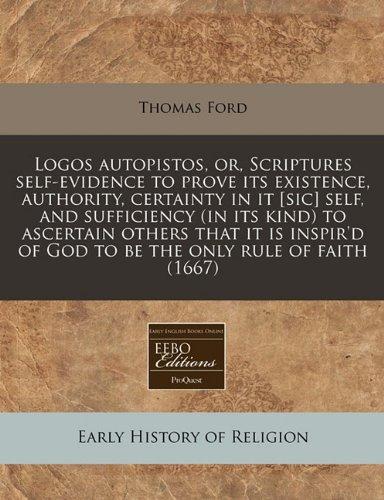
LOGOS AUTOPISTOS, OR, SCRIPTURES SELF-EVIDENCE BY THOMAS FORD

Thomas Ford's book demonstrates Scripture's self-attesting nature is from God and divinely inspired.  Ford's book will help deal with the attacks of those who “lie in wait to undermine you and turn up the foundations of your faith.” In his book, Ford shows that what we believe is to be founded upon the Holy Scriptures, as they are given to us by God.  2 Peter 1:3, “According as his divine power hath given unto us all things that pertain unto life and godliness, through the knowledge of him that hath called us to glory and virtue.”

The Ecclesiastical Text

This is a collection of essays written by Theodore Letis, the Director of the Institute of Renaissance and Reformation Studies, over a period between 1987-1997 and published in journals both popular and academic, while he was a doctoral candidate at the University of Edinburgh. Some are popular, most are rather technical studies treating translation philosophy, text criticism, the Protestant orthodox dogmatic traditions of the seventeenth-century. It also contains four important book reviews and two appendices.In these essays, Letis presents a rigorous defense of the use of the Textus Receptus, or the Ecclesiastical Text, over the various critical texts which have been heavily used since the time of B.B. Warfield. Letis challenges the prevailing notion that Biblical authority is to be found in the original autographs of Scripture by demonstrating a theological shift in the later nineteenth into early twentieth centuries, and consequently arguing that authority is to be found in the apographa, or the text preserved in the church.

Excerpt:

Possibly receiving a much needed reprint
This is a collection of essays written by the Director of the Institute over a period between 1987-1997 and published in journals both popular and academic, while he was a doctoral candidate at the University of Edinburgh. Some are popular, most are rather technical studies treating translation philosophy, text criticism, the Protestant orthodox dogmatic traditions of the seventeenth-century. It also contains four important books reviews and two appendices. Some of these essays first appeared in the early series of the Bulletin.

READ MORE

Table of Contents
Essays
I.    B.B. Warfield, Common-Sense Philosophy and Biblical Criticism.
II.    The Protestant Dogmaticians and the Late Princeton School on the Status of the Sacred Apographa.
III.    The Language of Biblical Authority: From Protestant Orthodoxy to Evangelical Equivocation.
IV.    Brevard Childs and the Protestant Dogmaticians: A Window to a New Paradigm.
V.    John 1:18 and the Egyptian Manuscripts: A Case Study in the Canonical Approach.
VI.    The Protestant Reformation and the Philosophy of Bible Translations.
VII.    The Ecclesiastical Text Redivivus?
VIII.    The Revival of the Ecclesiastical Text and the Claims of the Anabaptists.
Book Reviews
(four)
Appendices
(two)

COLLAPSE

Codex B & Its Allies Vol 1 & 2

Book Cover: Codex B & Its Allies Vol 1 & 2
Editions:PDF
Pages: 352

The Revision Revised.

Three Articles Reprinted

From The “Quarterly Review.”

I. The New Greek Text.
II. The New English Version.
III. Westcott and Hort's New Textual Theory.

To Which is Added A
Reply to Bishop Ellicott's Pamphlet
In Defence Of
The Revisers and Their Greek Text of the New Testament:
Including a Vindication of the Traditional Reading of 1 Timothy III. 16.
By John William Burgon, B.D.
Dean of Chichester.
“Little children,—Keep yourselves from idols.”—1 John v. 21.
<- Download both Volumes here
Reviews:Frederick on Goodreads wrote:

This is a very important work for students of the transmission of Bible manuscripts. One quote, on page 468, can sum up all of the complicated study of Greek, Latin, Syriac, and other language manuscripts and the modern Bible versions which are based on them which, of course, are not mentioned but are by extension referenced. "The text printed by Westcott and Hort has been accepted as 'the true text,' and grammars, works on the synoptic problem, works on higher criticism, and others, have been grounded on this text. If the Hort text makes the evangelists appear inconsistent, then such and such an evangelist errs. Those who accept the W-H text are basing their accusations of untruth as to the Gospellists upon an Egyptian revision current 250 to 450AD and abandoned between 500 to 1881, merely revived in our day and stamped as genuine."


New Report

Close