

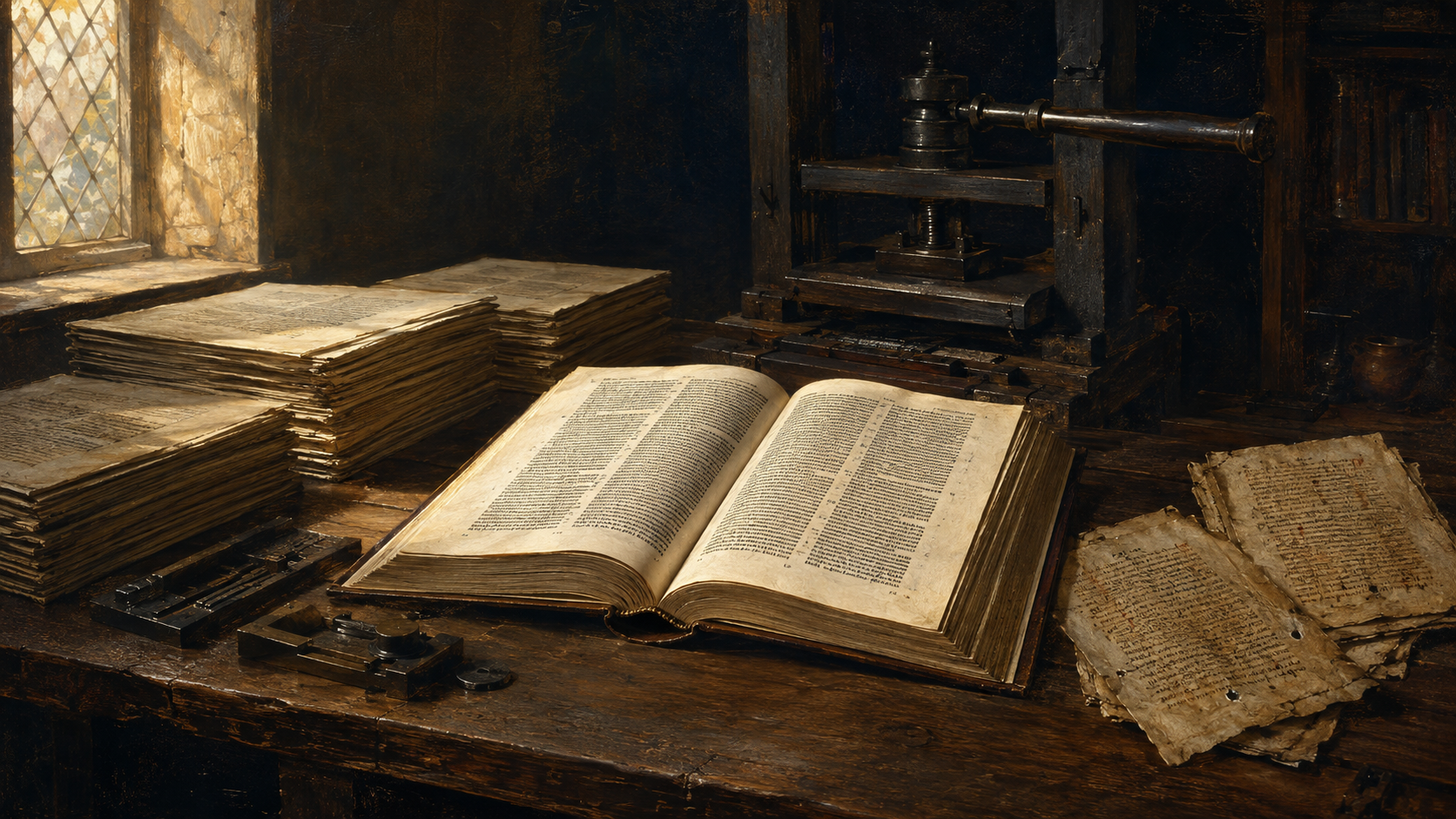
Printing did not create the New Testament. Nor did it turn a fallible editor into an apostle. Those claims would be absurd, and no confessional doctrine of preservation requires them. But it would be equally absurd to deny that printing changed the public condition of the text.
Before printing, a book could be widely known only as widely as it was copied by hand. A manuscript could be precious, but it could also be isolated, difficult to inspect, vulnerable to local loss, or unknown beyond a small circle. Printing did not abolish handwriting overnight, but it made it possible for a received text to become public in a new way: reproducible at scale, compared across copies, distributed across nations, translated, preached, and fixed in the common life of the churches.
That change matters when someone argues that a manuscript surviving today must be capable of overruling the Greek text the Reformation churches received in print.
What printing did—and did not—do
The Reformation-era Greek editions were not acts of new inspiration. Erasmus, Stephanus, Beza, and the later editors worked as servants, not masters, of the text. Their work involved editorial judgments, comparison of sources, and in some places revision. The Received Text therefore should not be reduced to “the first book that came off a press,” much less to an infallible printer's proof sheet.
Yet the opposite error is no better. The printed Received Text was not merely a provisional scholarly draft that remained constitutionally dependent upon the later survival of every manuscript consulted in its making. It became the stable and public form of the Greek New Testament inherited by the Protestant churches. It was printed repeatedly, compared, translated into the vernacular, used in doctrinal controversy, and received as the authentic Greek text of the New Testament.
The distinction is between an instrumental process and a permanent condition. Manuscripts were instruments in the transmission and collation of the text. The church's possession of a stable, public text is the condition to which that process ministered.
The fallacy of transferred necessity
Here is the logical mistake: because a particular manuscript may have been useful in bringing a reading into a printed edition, it is assumed that the same manuscript must remain extant in order for that reading to remain available or justified.
The form of the argument is:
- Manuscript M was used, directly or indirectly, in the history of a printed text.
- Therefore, unless M survives, the printed text lacks a secure basis.
This is a fallacy of transferred necessity. A means necessary at one point in a process is not necessarily required to remain present after the result has been achieved and publicly preserved.
A seed is necessary for the growth of a tree; it need not remain intact beside the mature tree. A witness may be necessary to establish a public legal record; the later destruction of the witness does not erase the record. In the same way, a manuscript can serve in the historical transmission of Scripture without becoming a perpetual condition for the church's possession of Scripture.
The analogy is not meant to make the Bible a merely human record. It makes the opposite point: because God preserves His Word by ordinary means, the means are real and important, but they are not confused with the end God promised to preserve.
A public text cannot be privately revoked
Once the Received Text existed in an established and widely disseminated printed form, its identity was not kept in a private archive. It was open to the churches. It stood before translators, pastors, printers, theologians, and laymen. Its readings were embodied in Bibles read aloud in worship and in confessions that appealed to the Hebrew and Greek originals as the authentic rule.
That public character has theological force. The Word promised to the church cannot be made to depend on a future expert's access to a newly recovered fragment or on the survival of a manuscript that only a few scholars can inspect. A manuscript may provide information. It cannot make the church's Bible disappear until it is rediscovered.
This is why the loss of a manuscript used by an early editor is not a crisis for the doctrine of preservation. The text did not die with the artifact. The editor's work had entered a public, multiply attested, ecclesially received form. The manuscripts had done their ordinary work; God was not obliged to preserve each one forever.
The necessary qualification
This conclusion does not mean that printed texts are beyond examination. An obvious printer's slip is not sanctified by ink and type. Nor does the existence of a public text prohibit ministerial comparison of editions or historical witnesses. The Protestant doctrine is not, “Whatever an early printer happened to set is inspired.” It is, “God has preserved the authentic Scriptures and given them to His church.”
That distinction rules out two equal and opposite errors:
- Printing absolutism: treating a particular edition as inspired merely because it is an early printed edition.
- Manuscript absolutism: treating an extant manuscript as a superior rule merely because it survives outside the printed tradition.
The first confuses a providential means with an inspired source. The second does the same thing in the opposite direction.
The point at issue
The issue is not whether manuscripts were ever important. Of course they were. The issue is whether the continued survival of any one of them is necessary in order for the church to possess the Word that God promised to preserve. Once the text had been received, printed, multiplied, and used publicly by the churches, the answer is no.
Therefore, an appeal to an extant manuscript must do more than point to its survival. It must demonstrate why the church's received reading is wrong without assuming, at the outset, that the survivor has a higher authority merely because it remains on the shelf. That assumption is precisely what must be examined next.
Sources and notes
- Westminster Confession of Faith 1.8; Second London Baptist Confession 1.8.
- William Whitaker, A Disputation on Holy Scripture, Question II, on the authentic Hebrew and Greek Scriptures as the standard by which versions are judged.
- David Norton, A Textual History of the King James Bible, for the ordinary historical reality of printing, revision, and transmission; historical complexity does not erase the distinction between a received text and one isolated artifact.