

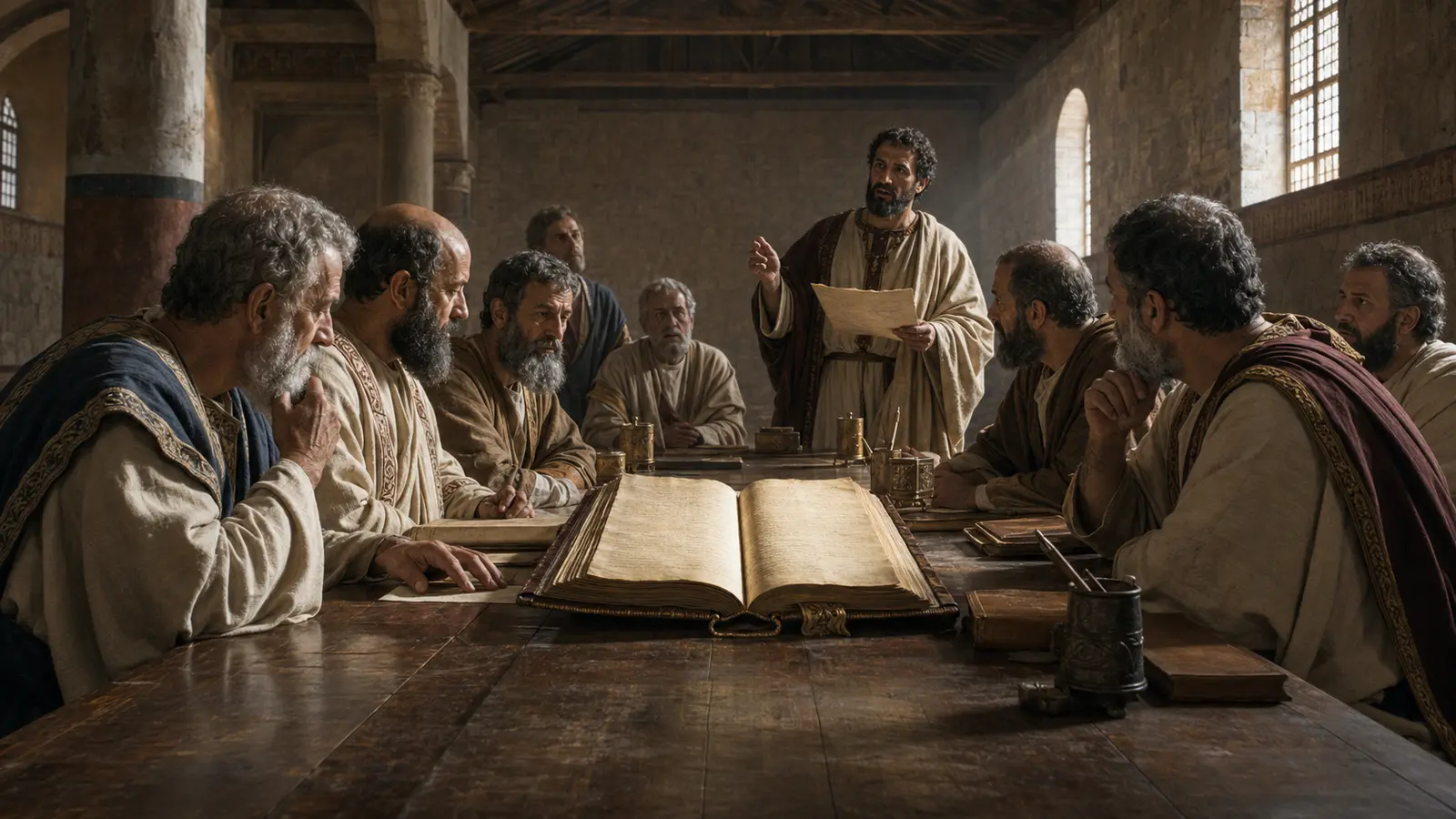
The phrase “begotten Son” sounds sufficient until one discovers that Arius used it.
He could call Christ the only-begotten Son, place him before the ages, distinguish him from ordinary creatures, and ascribe to him the making of everything that followed. Yet he also said that the Son came to be by the Father’s will and was a perfect creature. In his system, begotten did not exclude made. It named the unique production of the first and highest work.
The Nicene confession answered with four words: “begotten, not made.”
The phrase was not an exercise in metaphysical decoration. It closed a deliberate equivocation. The church confessed that the Son is truly from the Father while denying that he belongs to the class of things the Father made.
The proposition of this article is:
The Son’s eternal generation is a personal relation within the one uncreated Godhead; creation is the production of beings outside the divine essence from non-being. To identify the two is AR-02.
This distinction is indispensable to the textual audit. A form of beget, make, or create cannot be classified by an English gloss alone. The subject, nature, object, and context must all be established.
Arius Joined What Nicaea Divided
In Arius’s confession to Alexander, the Son is both begotten and created. He is described as unlike ordinary creatures, yet still as a creature who receives life and being from the Father’s will. Arius can therefore say that the Father truly begot the Son while denying that the Son shares the Father’s eternity and essence.1
This was not carelessness. It was the structure of the doctrine.
For Arius, the Father alone was without beginning. The Father willed the Son into existence before the ages. The Son was called Son because no other creature was produced in the same immediate and exalted manner. He then served as the instrument by which the Father produced the remaining creation.
The Son was therefore not “one of the creatures” in rank, but he remained one of the creatures in nature.
That qualification matters. A theologian can deny that Christ is an ordinary creature while still denying his deity. “Not like the other creatures” does not mean “not a creature.” A first work remains a work. A creature placed above every other creature remains on the creaturely side of the line.
Nicaea therefore did not answer merely that the Son is uniquely begotten. It confessed that he is from the Father’s own substance, true God, and of one substance with the Father. Then it placed the denial beside the affirmation: begotten, not made.2
What It Means to Make
Creation is God’s free production of what is not God.
The creature does not share the Creator’s essence. It receives being by will. It may resemble God, bear his image, execute his command, or display his glory, but it remains dependent, finite, and mutable in itself. Its existence is not necessary to God’s being.
Scripture describes the created order as that which comes to be through the Word:
“All things were made by him; and without him was not any thing made that was made” (John 1:3).
- Arius and his followers, “Letter to Alexander,” preserved in Athanasius, De Synodis 16; see the parallel Greek and English presentation in Fourth Century Christianity, Urkunde 6. ↩
- Council of Nicaea, Creed and anathemas of A.D. 325; compare Eusebius of Caesarea’s account of the council’s explanation in his letter to the church at Caesarea. ↩
John’s statement is exhaustive. Whatever belongs to the class “made” comes to be through the Word. The Word cannot be one member of the class without making the sentence self-defeating. If he made himself, he would have to act before he existed. If another created him, then not all made things came through him.
Paul draws the same boundary in Colossians 1:16–17. Things in heaven and earth, visible and invisible, thrones, dominions, principalities, and powers were created by Christ and for Christ. He is before all things, and by him all things consist. The repeated all leaves no superior order of creatures from which the Son is quietly exempted.
Hebrews likewise says that God made the worlds by the Son and then applies to the Son the words of Psalm 102 concerning the Lord who laid the foundation of the earth, remains when creation perishes, and does not change (Hebrews 1:2, 10–12).
The biblical distinction is not between creatures made directly and creatures made indirectly. It is between the unchanging Lord and all the works of his hands.
What It Means to Be Begotten
The Son is from the Father, but not as a work is from a maker.
Begotten identifies a personal relation. The Father communicates the one undivided divine essence to the Son without partition, passion, change, or temporal succession. The Son is not a portion cut from God. He is not a second deity made beside God. He is not the Father under another name. He is the natural and eternal Son, personally distinct and truly possessing the same divine being.
Human generation supplies a limited analogy. A human son possesses the same kind of nature as his father, whereas a house does not possess the nature of its builder. But human generation also misleads if pressed into time, bodily division, sexual process, material loss, or numerical multiplication of essence.
Athanasius therefore uses several scriptural images together: Son, Word, Wisdom, Radiance, and express Image. Each guards something the others might leave exposed.
- Son signifies natural relation rather than external manufacture.
- Word signifies inseparability and rational self-expression.
- Wisdom excludes a Father who once lacked wisdom.
- Radiance excludes light existing before its brightness.
- Image signifies the true expression of the Father’s being.
None of the images explains the manner of divine generation. Together they prevent it from being reduced to creaturely production.3
Ussher makes the same distinction in Reformed form. The Son is the only-begotten because he alone is begotten of the Father’s nature and substance. His generation contains neither corruption, alteration, nor time. He was never made into the Son; he is begotten from eternity. Ussher then concludes that Father and Son are coessential, coequal, and coeternal.4
“Of One Substance” Does Not Mean One Person
The Nicene word homoousios was needed because Arius could say “from God” in the sense in which all things are from God. The council said “of the substance of the Father” to confess natural sonship rather than creaturely dependence.
The phrase does not teach that Father and Son are one person. Fatherhood and sonship are relations between distinct persons. Nor does it teach that the Son is a detached portion of the Father. God is not a material body capable of division.
It teaches identity of divine essence.
Ussher’s definition is useful: the persons possess “one individual essence or deity common to them all, and the self-same in them all.” The Westminster Confession expresses the same truth by saying that Father, Son, and Holy Ghost are of one substance, power, and eternity (WCF 2.3).
AR-03 denies this identity of essence. AR-02 and AR-03 therefore support each other:
- if the Son is made, his essence is creaturely and alien from the Father;
- if the Son is truly of the Father’s essence, he is not made from nothing.
The phrases “not made” and “of one substance” protect the same boundary from opposite sides.
The Scriptural Uses of Making and Begetting
Words do not carry their entire doctrine apart from context.
Scripture can call God the Father who “made” Israel (Deuteronomy 32:6). Paul can say that he begot believers through the gospel (1 Corinthians 4:15). The incarnate Son is “made of a woman” (Galatians 4:4). The Word “was made flesh” (John 1:14). None of these statements says that the divine person of the Son was created from nothing.
The referent and relation control the meaning.
In Deuteronomy, making concerns God’s formation and covenantal establishment of a people. In Paul, begetting is ministerial and spiritual. In Galatians and John, making concerns the assumption of true human nature by the already-existing Son. The Word who was in the beginning does not begin to be when he becomes flesh.
The same discipline applies to disputed readings.
A form meaning created may be theologically decisive if the subject is the personal, preincarnate Son and the act gives him creaturely being. It may be irrelevant to AR-02 if the subject is Christ’s human body, his mediatorial appointment, a created effect in believers, or poetic personification whose referent has not yet been established.
No lexicon can replace the argument.
Proverbs 8 Does Not Permit a Shortcut
Proverbs 8:22 will receive a complete dossier in Article 30. It is introduced here only to show why method matters.
The received Hebrew reads, “The LORD possessed me in the beginning of his way.” The old Greek tradition renders the verb with a form ordinarily translated “created.” Arians used that Greek wording of the Son. The historical and doctrinal questions are real.
But several steps must remain distinct:
- What does the Hebrew verb mean in its context?
- What did the Greek translator understand or produce?
- Is Wisdom in Proverbs 8 a direct personal identification of the Son, a poetic personification of a divine attribute, or language accommodated to him by theological analogy?
- Does the relevant reading speak of eternal generation, the beginning of God’s works, the incarnate economy, or creaturely origination?
- Is a Greek version being used to displace the preserved Hebrew?
If those questions are answered by assumption, “created” becomes a slogan rather than evidence. If they are answered in order, the passage can be classified without evasion.
The preliminary rule is simple: a reading that says “created” is not automatically Arian; a reading that says the personal divine Son was created as to his being is.
Four Objections
“Every begetting has a beginning”
Every creaturely begetting occurs in time because creatures exist in time and change. The conclusion cannot be transferred to the eternal God without first proving that divine generation is a creaturely process. Scripture’s own conjunction of Son, Word, Creator, eternity, and immutability forbids that transfer.
“If the Son is from the Father, God has been divided”
That objection imagines essence as matter. Eternal generation is without partition. The whole indivisible deity is the deity of Father and Son. Personal distinction does not cut God into pieces.
“If only the Father is unbegotten, only the Father is uncreated”
The terms answer different questions. Unbegotten distinguishes the Father’s personal property. Uncreated distinguishes God from creatures. The Son is begotten as person and uncreated as God.
“The Bible does not use the Nicene formula”
The Bible supplies the propositions the formula protects: the Word is God; all made things come through him; the Son is the express image of the Father’s person; he remains when creation perishes; he is before all things. “Begotten, not made” states the necessary boundary among those texts and blocks the Arian redefinition of biblical words.
The Textual Classification Rule
AR-02 has three indispensable elements:
- the referent is the personal Son;
- the predicate concerns his being, not merely his assumed humanity or office;
- he is placed within the created order or produced from non-being.
When those elements are absent, the reading does not formally entail AR-02.
This yields several possible judgments:
- Removal of “only begotten Son” may weaken a local testimony to natural sonship: D1.
- Wording that can more easily be read as creaturely production, while permitting an orthodox reading, may be D2.
- An assertion that the personal Son was created from non-being is D3.
- A declaration that all made things came through the Word is D4.
- A grammatical alteration with no bearing on creaturehood is D0.
The same reading can bear differently upon different propositions. A text may be D4 against denial of Christ’s deity while remaining weaker on natural sonship. The database must preserve that resolution rather than force one slogan over the entire verse.
Verdict
Arius could say begotten because he made begetting the unique creation of the first work. Nicaea answered that the Son is begotten and not made: personally of the Father, eternally possessing the one divine essence, and standing outside the complete class of things made through him.
The distinction is scriptural before it is terminological. The Word is not the first item in “all things.” He is the one through whom all things came to be.
What This Does Not Prove
This article does not settle the textual or exegetical history of Proverbs 8:22. It does not prove that every occurrence of create, make, or beget carries a technical Nicene meaning. It does not decide the authenticity of John 1:18 or any other variant involving only-begotten.
It establishes the exact creator-creature boundary required to classify those readings.
Text and Edition Record
- English Scripture: Authorized Version.
- Greek doctrinal terms: homoousios is used in its Nicene sense, “of one substance.”
- Received Hebrew and old Greek wording at Proverbs 8:22 are mentioned provisionally; full edition and apparatus control is reserved for Article 30.
- No reading is assigned a final provenance grade in this article.
- AR-02 and AR-03 follow the Packet Zero proposition ledger.
Bibliography
- Arius and his followers. “Letter to Alexander of Alexandria.” Preserved in Athanasius, De Synodis 16.
- Athanasius. De Decretis, especially 6–12 and 19–25.
- Athanasius. De Synodis, especially 15–16 and 41–48.
- Council of Nicaea. Creed and anathemas, A.D. 325.
- Ussher, James. A Body of Divinity, 79–83 and 160–165.
- Westminster Assembly. The Confession of Faith. 1647, 2.3 and 8.2.
Revision History
- 2026-07-24: First Packet One draft; AR-02 and AR-03 distinguished, creator-creature test fixed, and Proverbs 8:22 retained as a controlled pilot rather than prematurely adjudicated.
Notes and Sources
Source-control note: The Arian combination of “begotten” and “created” is direct historical data from Arius’s confession. The creator-creature distinction and eternal-generation account are doctrinal conclusions drawn from the cited scriptural and confessional controls. Proverbs 8:22 remains a pilot record, not a closed verdict.
Previous in the series: “There Was When He Was Not.”
Next in the series: “Subordination Without Arianism?”
- Arius and his followers, “Letter to Alexander,” preserved in Athanasius, De Synodis 16; see the parallel Greek and English presentation in Fourth Century Christianity, Urkunde 6. ↩
- Council of Nicaea, Creed and anathemas of A.D. 325; compare Eusebius of Caesarea’s account of the council’s explanation in his letter to the church at Caesarea. ↩
- Athanasius, De Decretis 11–12 and 19–25, online text. ↩
- James Ussher, A Body of Divinity, 79–83 and 160–165 in the supplied edition. ↩
Comments
Share a question or response to this article.