

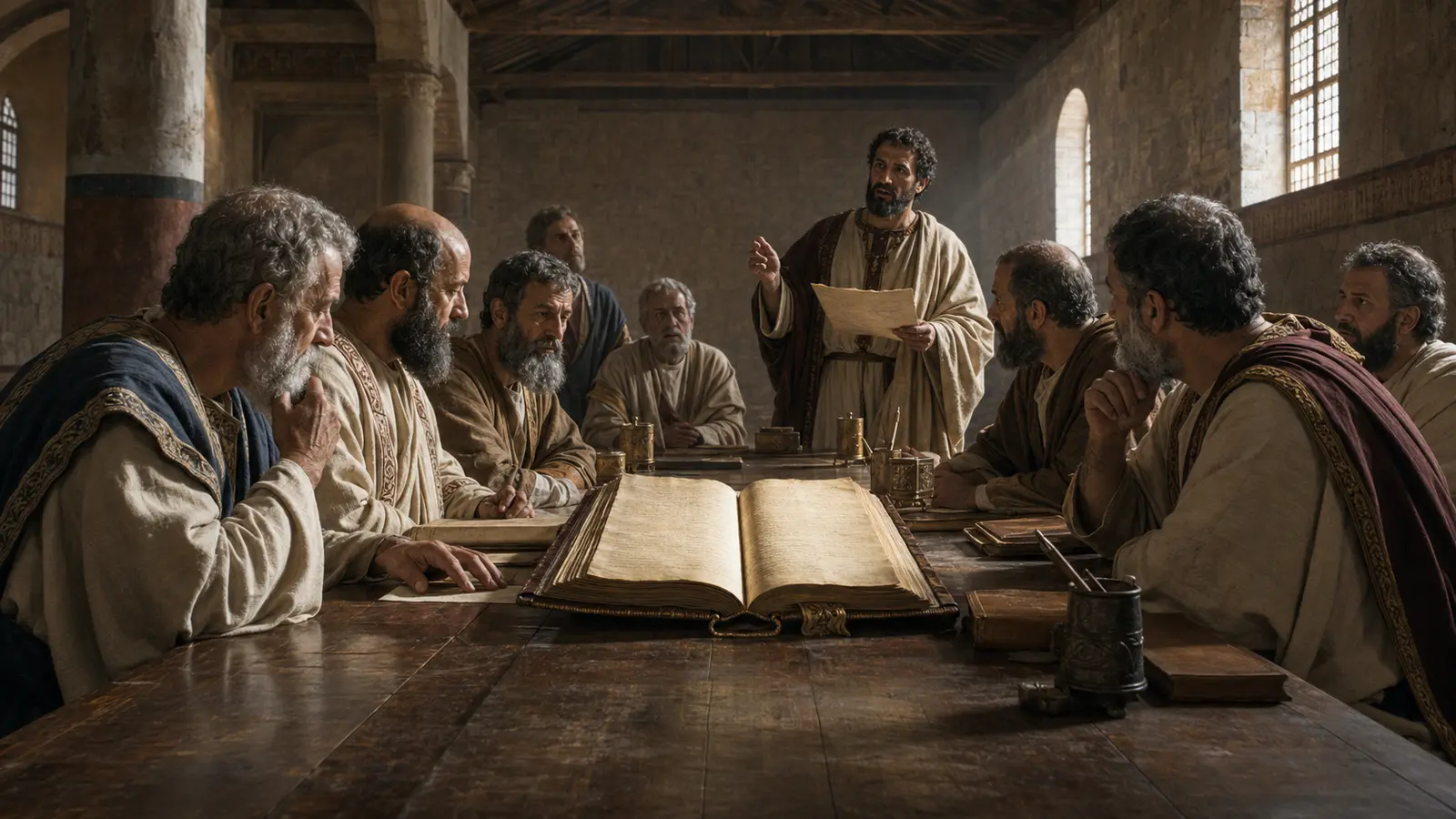
Arius did not teach that Jesus began in Bethlehem.
That fact is important because a shallow refutation of Arianism can prove too little. If the only answer is that Christ existed before Abraham, before David, before the angels, or even before the present world, Arius could agree. He placed the Son before the ages and made him the instrument through whom the rest of creation came to be. He still denied that the Son is eternal.
The difference between the orthodox confession and the Arian system is therefore not the difference between a late Christ and an early Christ. It is the difference between the uncreated Word who always is and the first creature who once was not.
The proposition of this article is:
AR-01 is the claim that the personal Son had a beginning after prior nonexistence; it is not refuted merely by assigning him existence before the world or before measurable time.
That distinction will govern every later appeal to “the beginning,” “before the ages,” “firstborn,” “begotten,” or “created.”
Arius Put a Beginning Before Time
In his letter to Eusebius of Nicomedia, Arius says that the Son subsisted before time and the ages. In the same statement, however, he denies that the Son always existed and affirms that the Son has a beginning. His confession to Alexander likewise speaks of a begetting apart from time while denying that the Son is eternal or co-eternal with the Father.1
The position is coherent once its terms are understood. “Before time” does not mean “without beginning” in Arius’s system. It means that the Father produced the Son before producing the ages measured through him. The Son stands at the head of the created sequence, but he remains within that sequence.
This explains why Athanasius repeatedly returns to the Arian formula that the Son once did not exist. The controversy is not solved by moving the act of creation beyond the reach of clocks. If the Son came from non-being by an act of will, there is an ontological before and after even if no sun, motion, or created measure yet existed.
The Nicene anathema therefore rejects both forms of the claim: that there was a time when the Son was not and that he was not before he was begotten.2 The second clause closes the escape that places creaturely origination “before time” and then calls it eternal.
Eternity Is Not Extreme Antiquity
In ordinary speech, eternal is often reduced to “lasting for a very long time” or “continuing forever.” Neither definition is adequate here.
The eternal Son has no beginning of personal existence. He does not arise within a duration that was already passing. He is not the oldest inhabitant of the created order. He is with God in the beginning because he is God, and the beginning of all created things occurs through him.
John’s opening words are exact:
“In the beginning was the Word, and the Word was with God, and the Word was God.”
- Arius’s two professions are preserved in Theodoret, Ecclesiastical History 1.4, online text, and Athanasius, De Synodis 16; Greek and English for the latter appear in Urkunde 6. ↩
- Council of Nicaea, Creed and anathemas of A.D. 325. ↩
When the beginning begins, the Word already was. John then places every made thing on the other side of the Creator-creature boundary: “All things were made by him; and without him was not any thing made that was made” (John 1:1–3).
The grammar does not depict the Word coming into existence at the beginning. It distinguishes his continuing being from the coming-to-be of all things through him. The prologue therefore answers both AR-01 and AR-06. The Word does not begin, and the entire class of made things comes to be through him.
Other passages fill out the same confession.
- Christ says, “Before Abraham was, I am” (John 8:58).
- He asks to be glorified with the glory he had with the Father “before the world was” (John 17:5).
- Paul says, “he is before all things, and by him all things consist” (Colossians 1:17).
- Hebrews places the making of the worlds through the Son beside the declaration that the Son remains when heaven and earth perish (Hebrews 1:2, 10–12).
- The same epistle says, “Jesus Christ the same yesterday, and to day, and for ever” (Hebrews 13:8).
- Micah speaks of the ruler from Bethlehem whose “goings forth have been from of old, from everlasting” (Micah 5:2).
No one text has to bear the entire doctrine alone. Together they distinguish the Son from every thing that begins, changes, and passes away.
Eternal Generation Does Not Create a First Moment
The word begotten is often made to carry a temporal assumption. Human fathers exist before their sons. Human generation occurs through change, bodily division, and succession. If that creaturely pattern is transferred without qualification to God, an eternal Son appears impossible.
But Scripture does not teach that the divine nature reproduces as a body reproduces. The Father is eternally Father; the Son is eternally Son. The personal relation is real, but it is not an event by which God changes from not-Father to Father.
Athanasius makes the point by asking when light existed without its radiance or God without his Wisdom and Word. The analogy is limited, but its force is plain. If the Father once lacked his proper Word, then the supposed eternal and unchangeable God passed from wordlessness to possessing the Word. Arianism does not preserve divine immutability. It moves change into the being of God.3
Ussher states the Reformed form of the distinction with precision. The Son and the Holy Ghost have no beginning “of time or continuance,” but an order of personal subsistence from all eternity. He defines co-eternal to mean that one person was not before another in time and that all share the same everlasting continuance.4
The language of eternal generation therefore confesses four truths at once:
- the Father is Father and not Son;
- the Son is Son and not Father;
- the Son is personally of the Father;
- there never was a Father without the Son.
The fourth truth is the direct denial of AR-01.
Four Inadequate Refutations
Because Arianism places the Son before the ordinary created world, several common arguments do not reach the actual proposition.
“Christ existed before his human birth”
True, but insufficient. Arius confessed a preexistent Son. The question is whether the preexistent Son always is or began to exist.
“Christ existed before the ages”
That wording can be orthodox, but Arius also used it. Unless ages includes the whole created order and the Son is explicitly placed outside that order, the phrase may describe only the first work.
“Christ is the firstborn of every creature”
The Authorized Version accurately preserves the title in Colossians 1:15. In context, firstborn names supremacy and heirship, not first-created status, because the next verses say that all created things were made by him, for him, and consist by him. The title must be read with its inspired explanation.
“Christ is called the Son of God”
Arius called him Son. The historical question is whether Son names eternal, natural generation from the Father’s essence or a unique creaturely status conferred by will.
The lesson is not that these biblical statements are weak. It is that the Arian system survived by retaining them while altering their relations. The refutation must restore the whole scriptural grammar.
The Exact Test for AR-01
Under the Martin Rule, a reading formally entails AR-01 only when three indispensable elements are established:
- the subject is the personal Son, not his human nature, mediatorial office, resurrection, manifestation, or enthronement;
- a state of prior nonexistence is asserted or necessarily implied;
- the Son’s personal being is given a beginning.
All three matter.
A passage saying that Christ was “made of a woman” concerns the assumption of human nature, not the origin of the divine person (Galatians 4:4). A passage speaking of the day on which the Son is publicly declared or enthroned does not, without further argument, say that he first began to exist on that day. A variant removing one explicit phrase of preexistence may weaken a local witness without asserting prior nonexistence.
The classification must match the evidence:
- If a reading simply lacks an eternal title present in the received text, it may be D1, a weakening.
- If a reading naturally places the Son inside the class of things that began, it may be D2, favorable or accommodating.
- If it explicitly says that the personal Son did not exist and then began, it is D3 for AR-01.
- If it affirms that the Son already is when creation begins or that he remains unchangeably forever, it is D4 counterevidence.
This scale prevents every omission from being called a denial and every strong title from being ignored.
Objections
One objection says that only the Father is unbegotten; therefore the Son must have a beginning.
The conclusion confuses a personal relation with creaturely origin. Unbegotten identifies the Father as not from another person. Begotten identifies the Son as of the Father. Neither term places the Son among things made from nothing. The Father’s unbegottenness and the Son’s eternal generation distinguish persons within the one uncreated Godhead.
Another objection says that if the Son is “from” the Father, the Father must be earlier.
That follows for temporal and bodily generation. It does not follow for an eternal relation in the simple, immutable God. Priority of order is not priority of time. A cause within creation may precede its effect; the confession of the eternal Son is not an account of two events inside a larger timeline.
A third objection says that “eternal generation” is a philosophical device added to Scripture.
The phrase summarizes scriptural facts: the Word is God; the Word is with God; the Word is Son; the Son is of the Father; all made things come through him; he is before all things; he does not change. A formula may be extra-biblical in wording while remaining ministerial in function. Its legitimacy depends upon whether it states the scriptural entailment exactly.
What the Textual Audit Must Do
The textual investigation cannot ask only whether a reading sounds less exalted. It must ask whether the reading crosses the boundary between eternal being and originated being.
The audit will therefore record:
- the exact subject of each clause;
- whether the clause concerns the divine person, the assumed humanity, or the mediatorial economy;
- whether it asserts existence, preexistence, eternity, immutability, or origination;
- whether words are present, absent, or merely punctuated differently;
- whether the complete context supplies what a local variation appears to remove;
- whether other critical readings provide orthodox counterevidence.
A text may lose a weapon without handing the enemy his creed. That loss matters. It must be named honestly as loss, not inflated into a proposition the words do not contain.
Verdict
Arius placed the Son before the worlds and still denied his eternity. AR-01 is therefore not the claim that Christ is younger than creation in general. It is the claim that the personal Son passed from non-being to being and consequently has a beginning.
The scriptural answer is stronger than preexistence. In the beginning the Word already is. All things that come to be come through him. The heavens grow old; he remains. The Son is not the first date in created history. He is the eternal Lord of history.
What This Does Not Prove
This article does not prove that a particular textual variant asserts the Son’s prior nonexistence. It does not decide the punctuation of John 1:3–4, the reading of John 1:18, or the interpretation of Proverbs 8:22. It does not treat every “begetting” or enthronement text as a statement about eternal generation.
It fixes the indispensable elements that a later reading must contain before it can be classified as D3 for AR-01.
Text and Edition Record
- English Scripture: Authorized Version.
- Primary Arian controls: Arius’s letters to Eusebius of Nicomedia and Alexander of Alexandria.
- Nicene control: the A.D. 325 creed and anathemas.
- Patristic control: Athanasius, De Synodis, De Decretis, and Orations Against the Arians.
- Reformed control: Ussher, A Body of Divinity; Westminster Confession of Faith 2.3 and 8.2.
- No Greek or Hebrew variant is adjudicated in this article.
Bibliography
- Arius. “Letter to Eusebius of Nicomedia.” Preserved in Theodoret, Ecclesiastical History 1.4.
- Arius and his followers. “Letter to Alexander of Alexandria.” Preserved in Athanasius, De Synodis 16.
- Athanasius. De Decretis, especially 11–12 and 27.
- Athanasius. De Synodis, especially 15–16.
- Athanasius. Orations Against the Arians 1.9–14.
- Council of Nicaea. Creed and anathemas, A.D. 325.
- Ussher, James. A Body of Divinity, 79–83.
- Westminster Assembly. The Confession of Faith. 1647, 2.3 and 8.2.
Revision History
- 2026-07-24: First Packet One draft; AR-01 separated from mere preexistence and aligned with Arius’s letters, the Nicene anathemas, Athanasius, Ussher, and the Authorized Version proof register.
Notes and Sources
Source-control note: The existence of Arius’s “before the ages” language and his simultaneous denial of co-eternity are direct historical data preserved through primary witnesses. The theological relation between eternity, generation, and immutability is the doctrinal analysis being defended. No textual provenance claim is made.
Previous in the series: “The Arius We Are Testing.”
Next in the series: “Begotten, Not Made.”
- Arius’s two professions are preserved in Theodoret, Ecclesiastical History 1.4, online text, and Athanasius, De Synodis 16; Greek and English for the latter appear in Urkunde 6. ↩
- Council of Nicaea, Creed and anathemas of A.D. 325. ↩
- Athanasius, De Decretis 15 and 27, online text; compare Orations Against the Arians 1.9–14, online text. ↩
- James Ussher, A Body of Divinity, 79–87 in the supplied text, especially the definitions of personal order, eternal generation, and co-eternity. ↩
Comments
Share a question or response to this article.