


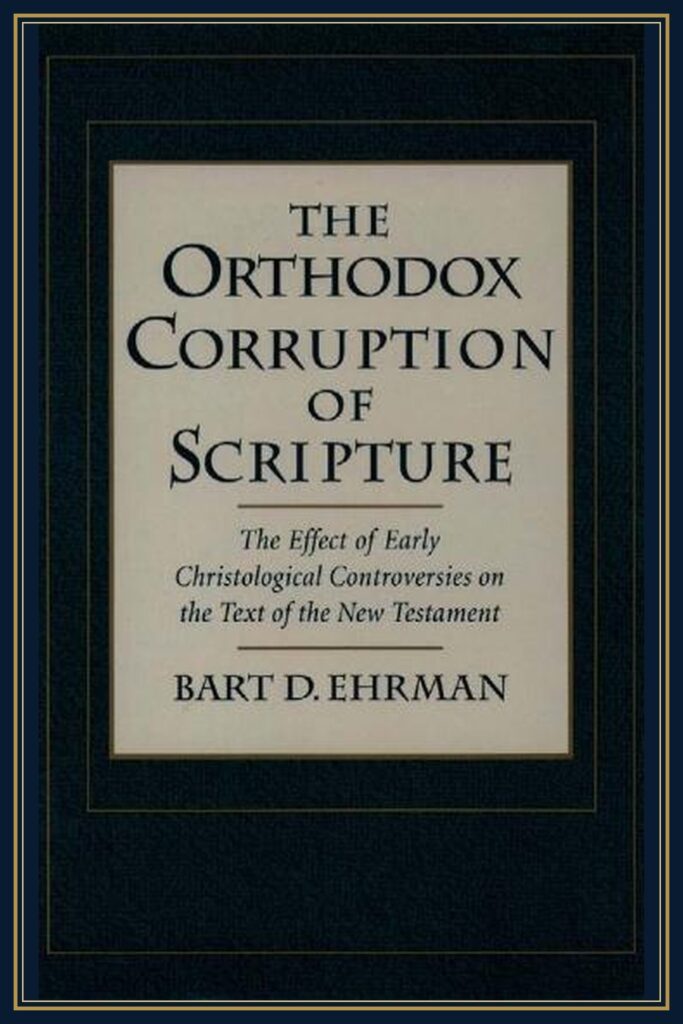
First edition; paperback issue
The Orthodox Corruption of Scripture
The Effect of Early Christological Controversies on the Text of the New Testament
Bart D. Ehrman · 1993; paperback 1996
New York: Oxford University Press, 1993; paperback 1996.
Overview
Ehrman argues that some scribal changes in the New Testament arose from second- and third-century Christological controversy. After establishing the diversity of early Christian groups and the fluidity of manuscript transmission, he organizes variants by their apparent anti-adoptionist, anti-separationist, anti-docetic, and anti-patripassian functions. The book combines manuscript evidence, patristic citation, early versions, transcriptional probability, and the rhetoric of heresiological debate.
This remains a major and generative study because it made theological motivation central to the study of scribal change. Its strongest cases show converging textual and historical evidence; weaker cases infer intention where harmonization, clarification, accident, or multiple motives remain possible. Its high research score is independent of its magisterial classification.
Overview
Ehrman argues that some scribal changes in the New Testament arose from second- and third-century Christological controversy. After establishing the diversity of early Christian groups and the fluidity of manuscript transmission, he organizes variants by their apparent anti-adoptionist, anti-separationist, anti-docetic, and anti-patripassian functions. The book combines manuscript evidence, patristic citation, early versions, transcriptional probability, and the rhetoric of heresiological debate.
This remains a major and generative study because it made theological motivation central to the study of scribal change. Its strongest cases show converging textual and historical evidence; weaker cases infer intention where harmonization, clarification, accident, or multiple motives remain possible. Its high research score is independent of its magisterial classification.
Editorial Evaluation
Purpose Fulfillment
Does the work accomplish what it claims to accomplish?
Brief assessment
Ehrman executes the announced thesis through a sustained typology of Christologically motivated variants and a synthetic conclusion.
Full rationale and supporting references
Ehrman executes the announced thesis through a sustained typology of Christologically motivated variants and a synthetic conclusion. Evidence reviewed: complete supplied edition, especially the methodological introduction (PDF pp. 13–50), four controversy sections (PDF pp. 65–289), and conclusion (PDF pp. 290–294).
Editorial Evaluation
Source Quality
Does it use the appropriate primary and secondary sources?
Brief assessment
The study draws expertly on Greek manuscripts, versions, patristic citations, heresiological literature, and specialist scholarship across dozens of test cases.
Full rationale and supporting references
The study draws expertly on Greek manuscripts, versions, patristic citations, heresiological literature, and specialist scholarship across dozens of test cases. Evidence reviewed: complete supplied edition, especially the methodological introduction (PDF pp. 13–50), four controversy sections (PDF pp. 65–289), and conclusion (PDF pp. 290–294).
Editorial Evaluation
Citation Accuracy
Are quotations, references, and claims verifiable and in context?
Brief assessment
Ancient texts and manuscript witnesses are normally cited with exact locators and a full scholarly apparatus.
Full rationale and supporting references
Ancient texts and manuscript witnesses are normally cited with exact locators and a full scholarly apparatus; spot checks support the quoted uses. Evidence reviewed: complete supplied edition, especially the methodological introduction (PDF pp. 13–50), four controversy sections (PDF pp. 65–289), and conclusion (PDF pp. 290–294).
Editorial Evaluation
Evidence Coverage
Does it address the relevant evidence, including contrary evidence?
Brief assessment
Multiple classes of evidence are compared for each major variant, though the surviving record cannot always establish a scribe's conscious motive.
Full rationale and supporting references
Multiple classes of evidence are compared for each major variant, though the surviving record cannot always establish a scribe's conscious motive. Evidence reviewed: complete supplied edition, especially the methodological introduction (PDF pp. 13–50), four controversy sections (PDF pp. 65–289), and conclusion (PDF pp. 290–294).
Editorial Evaluation
Historical Accuracy
Are people, dates, editions, events, and settings handled correctly?
Brief assessment
The reconstruction of second- and third-century controversy is learned and largely careful.
Full rationale and supporting references
The reconstruction of second- and third-century controversy is learned and largely careful; its Bauer-influenced map of proto-orthodoxy and dissent remains contested. Evidence reviewed: complete supplied edition, especially the methodological introduction (PDF pp. 13–50), four controversy sections (PDF pp. 65–289), and conclusion (PDF pp. 290–294).
Editorial Evaluation
Subject Competence
Does the author demonstrate competence in the relevant disciplines?
Brief assessment
The book displays exceptional command of textual criticism, patristics, Greek, early Christology, and the mechanics of transmission.
Full rationale and supporting references
The book displays exceptional command of textual criticism, patristics, Greek, early Christology, and the mechanics of transmission. Evidence reviewed: complete supplied edition, especially the methodological introduction (PDF pp. 13–50), four controversy sections (PDF pp. 65–289), and conclusion (PDF pp. 290–294).
Editorial Evaluation
Logical Coherence
Do the conclusions follow from the premises and evidence?
Brief assessment
The cumulative argument is strong, but several cases move from a variant's theological usefulness to a specific intentional cause more confidently than the evidence permits.
Full rationale and supporting references
The cumulative argument is strong, but several cases move from a variant's theological usefulness to a specific intentional cause more confidently than the evidence permits. Evidence reviewed: complete supplied edition, especially the methodological introduction (PDF pp. 13–50), four controversy sections (PDF pp. 65–289), and conclusion (PDF pp. 290–294).
Editorial Evaluation
Methodological Transparency
Are the method and controlling assumptions identifiable and consistent?
Brief assessment
Ehrman clearly states his thesis, criteria, degrees of confidence, and broader implications, and regularly distinguishes stronger from weaker examples.
Full rationale and supporting references
Ehrman clearly states his thesis, criteria, degrees of confidence, and broader implications, and regularly distinguishes stronger from weaker examples. Evidence reviewed: complete supplied edition, especially the methodological introduction (PDF pp. 13–50), four controversy sections (PDF pp. 65–289), and conclusion (PDF pp. 290–294).
Editorial Evaluation
Strongest-Form Engagement
Does the work address the strongest opposing case rather than a caricature?
Brief assessment
Alternative textual explanations are frequently discussed, but orthodox theological readings and non-intentional scribal causes do not always receive their strongest cumulative presentation.
Full rationale and supporting references
Alternative textual explanations are frequently discussed, but orthodox theological readings and non-intentional scribal causes do not always receive their strongest cumulative presentation. Evidence reviewed: complete supplied edition, especially the methodological introduction (PDF pp. 13–50), four controversy sections (PDF pp. 65–289), and conclusion (PDF pp. 290–294).
Editorial Evaluation
Clarity and Research Usefulness
Is it intelligible, navigable, and useful for further study?
Brief assessment
The organization by controversy, extensive notes, indexes, and case studies make the book an enduring research tool even for readers who reject its larger thesis.
Full rationale and supporting references
The organization by controversy, extensive notes, indexes, and case studies make the book an enduring research tool even for readers who reject its larger thesis. Evidence reviewed: complete supplied edition, especially the methodological introduction (PDF pp. 13–50), four controversy sections (PDF pp. 65–289), and conclusion (PDF pp. 290–294).
Scripture Passage Coverage
1 John 4:2–3
Substantial treatment · anti-separationist chapter
Qualified or mixed conclusionExamines competing forms of the confession that Jesus Christ came in the flesh.
1 Timothy 3:16
Substantial treatment · christological discussions
Qualified or mixed conclusionExamines the shift between relative-pronoun and 'God' readings.
Hebrews 2:9
Substantial treatment · anti-patripassian chapter
Defends the readingArgues for 'apart from God' and explains alteration to 'by the grace of God.'
John 1:18
Substantial treatment · anti-adoptionistic chapter
Qualified or mixed conclusionAssesses 'only-begotten God' and 'only-begotten Son' within early Christological dispute.
John 19:5
Substantial treatment · anti-docetic chapter
Discusses without decidingUses the passion narrative in studying changes emphasizing Jesus' embodied suffering.
Luke 3:22
Substantial treatment · anti-adoptionistic chapter
Defends the readingArgues for the form 'Today I have begotten you' and studies its later suppression.
Luke 22:43–44
Substantial treatment · anti-docetic chapter
Defends the readingTreats the agony and bloody sweat as original and vulnerable to doctrinal omission.
Mark 1:1
Substantial treatment · anti-adoptionistic chapter
Qualified or mixed conclusionAssesses the presence or absence of 'Son of God' in light of christological controversy.