

Revision note: Substantially revised July 20, 2026. The argument has been reordered according to the classical rhetorical movement, compressed where necessary, and given one consolidated Notes and Further Reading section.
The Proper Place of Reason, Evidence, the Church, and Scholarship
Once the self-attesting authority of Scripture has been affirmed, an objection almost immediately arises: Does not every Christian have to judge for himself whether Scripture is true? Did not the church have to decide which writings belonged to the canon? Must not translators judge the meaning of Hebrew and Greek words? Must not textual scholars compare copies and determine which readings are authentic? If such judgments are unavoidable, does this not mean that human reason is ultimately authoritative after all?
The objection rests upon an equivocation concerning the word judgment.
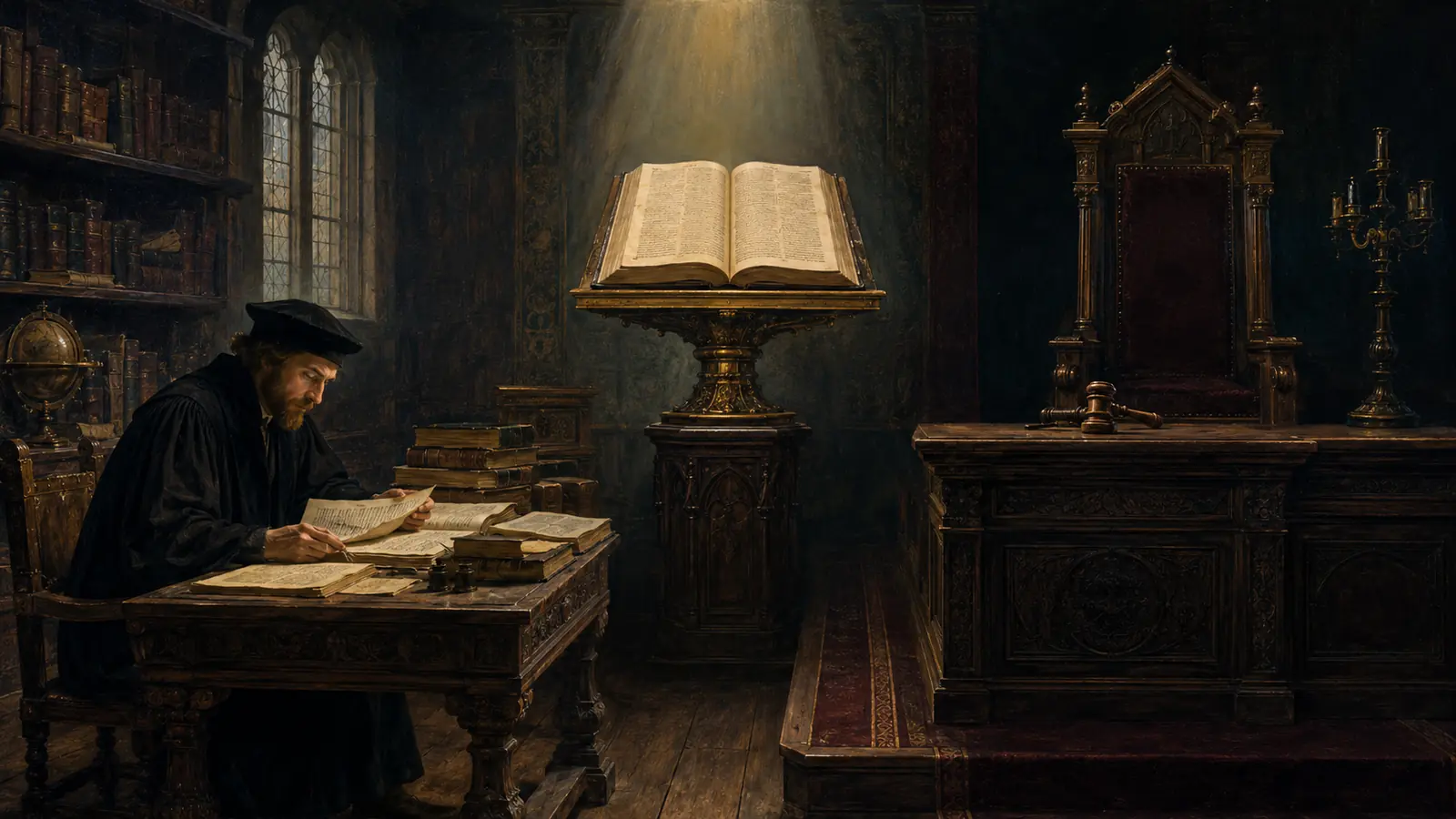
There is an enormous difference between recognizing an authority and creating that authority. There is an equally important difference between exercising judgment under an acknowledged standard and judging whether that standard will be permitted to possess authority. The first is ministerial judgment. The second is magisterial judgment.
Reformed theology has never taught that Christians should cease reasoning, examining evidence, interpreting Scripture, or making judgments. Such a position would be impossible. The commands to read, understand, search, compare, discern, prove, teach, and defend the truth all require the exercise of the mind. A man cannot receive a statement as true without rendering some kind of judgment concerning it.
The Reformed contention is not that judgment must be eliminated. It is that all human judgment must remain subordinate to God’s judgment. Reason must act as a servant of revelation rather than as its sovereign. The church must recognize the canon rather than create it. Scholars must examine the witnesses to the text rather than imagine themselves empowered to reconstruct a Word that divine providence failed to preserve.
Man may judge ministerially concerning the Word of God. He may never judge magisterially over it.
Understanding that distinction is essential to every controversy involving canon, preservation, textual criticism, translation, interpretation, and church authority.
Judgment Is Unavoidable
No one approaches Scripture without using his mind. Even the statement “I simply believe the Bible” expresses a rational judgment. The believer has heard certain words, understood their grammatical meaning, recognized them as the Word of God, and assented to their truth.
The same necessity applies to the church corporately. Churches must distinguish Scripture from apocryphal writings. Ministers must distinguish sound doctrine from heresy. Translators must choose words that communicate the meaning of the original. Elders must decide whether a teaching agrees with Scripture. Readers must determine whether a particular interpretation follows from the text.
The question therefore cannot be whether judgment occurs. The question must be what kind of judgment it is, what standard governs it, and what authority is claimed for it.
Consider the difference between a subject recognizing his king and a council of electors choosing who will become king. The subject’s recognition is a genuine judgment. He may examine the king’s identity, credentials, and lawful claim. But his recognition does not confer kingship. The king does not become king because the subject has reached a favorable conclusion.
Similarly, the church renders a real judgment when it recognizes a book as canonical. The Christian renders a real judgment when he receives Scripture as God’s Word. A textual scholar renders real judgments when comparing witnesses to the text. But none of these acts creates the authority being recognized. Neither can any of them lawfully place that authority on probation before a higher human court.
The crown is received because it already belongs to the king. Scripture is received because it already proceeds from God.
Three Levels of Judgment
Reformed theology allows us to distinguish three levels of judgment.
First, there is God’s supreme and infallible judgment expressed in Scripture. This judgment is final because God is truth itself. No appeal can be made from God to a higher authority.
Second, there is the church’s public and ministerial judgment. Christ has appointed officers to preach the Word, preserve sound doctrine, refute error, exercise discipline, and govern his church. Their judgments possess genuine ecclesiastical authority, but that authority is derived, limited, and subordinate. Church courts may speak authoritatively, but they may not speak infallibly. Their decisions bind only insofar as they agree with Scripture.
Third, there is the individual Christian’s private judgment of discretion. Every believer must hear, read, examine, and discern. He may not transfer the responsibility of believing God to a priest, scholar, confession, institution, or ecclesiastical court. His conscience must finally be bound to God’s Word.
These three judgments must neither be confused nor separated.
The private Christian may not declare himself an ecclesiastical court merely because he possesses the right to examine doctrine. The church may not claim divine infallibility merely because it possesses public ministerial authority. Neither the individual nor the church may sit as sovereign judge over the Holy Ghost speaking in Scripture.
Scripture is the supreme judge. The church judges publicly under Scripture. The individual judges personally under Scripture.
This is the proper order.
Reason as Minister
The Reformed distinction avoids rationalism, which makes reason the master of revelation, and fideism, which treats faith as an unintelligible leap. Reason is God’s gift and an indispensable instrument of theology, but not its originating principle. Turretin therefore describes reason as the instrument by which revealed truths are understood, compared, defended, and applied—not the court that decides what God may reveal.1
Westminster requires this ministerial work. The whole counsel of God is either expressly set down in Scripture or deduced from it “by good and necessary consequence” (WCF 1.6).2 Necessary consequence requires grammar, comparison, valid inference, and the rejection of contradiction. The doctrine of the Trinity, for example, joins everything Scripture teaches about the one God, the Father, the Son, and the Holy Ghost.
Reason may examine history and manuscripts, distinguish faithful translations, answer objections, and apply general commands. It exceeds its office when it claims the right to decide whether revealed doctrine is credible. The issue is not whether logic and evidence are used, but which authority governs their use.
Ministerial reason asks, “What follows from what God has spoken?”
Magisterial reason asks, “Which portions of what God is said to have spoken satisfy my independent standards?”
The first receives its principles from revelation. The second supplies its own principles and compels revelation to answer to them.
The Myth of Neutral Reason
“The fear of the LORD is the beginning of knowledge” (). Knowledge does not begin on neutral ground and add God later. Romans 1 says that fallen men possess genuine revelation while suppressing it; contrasts thought ordered by human tradition with thought ordered “after Christ.” Every thought is to be brought captive to him.3
This does not mean unbelievers know nothing. They bear God’s image, live in his world, and use faculties he gives. They may discover valuable facts in grammar, history, paleography, and codicology. A Christian may learn from an unbelieving scholar without accepting a method that excludes providence. The facts need not be denied; their interpretation must be restored to the God whose facts they are.
The academy may possess expertise. It does not possess neutrality.
Private Judgment Is Not Autonomy
The Reformers defended the Christian’s right and duty to judge doctrine by Scripture. Private judgment, however, is not private sovereignty. The Bereans tested Paul’s preaching by writings they already received as authoritative; Isaiah directs hearers “to the law and to the testimony”; John says to try the spirits; Paul says, “Prove all things.”4
These commands guard against both ecclesiastical tyranny and individual arrogance. An officer may not demand implicit faith in his opinions, and a council may err. The believer may not treat his present understanding as infallible. His duty includes hearing teachers, receiving demonstrated correction, respecting lawful church authority, and admitting his limitations.
“I must obey Scripture rather than men” is a necessary Protestant confession.
“Whatever I presently think Scripture means must be correct” is not.
The conscience is free from merely human doctrines and commandments contrary to or beside the Word in matters of faith and worship. It is not free from the Word itself. Christian liberty is liberty from human lordship so that the believer may serve God.
The Reformation did not replace one pope in Rome with millions of private popes. It placed pope, council, minister, scholar, and private Christian beneath the same supreme judge.
The Church as Witness and Keeper
The church occupies a necessary place in the recognition, preservation, interpretation, and proclamation of Scripture.
God did not ordinarily deliver the canonical books to isolated individuals detached from the covenant community. He committed his oracles to his people. The books were read publicly, copied, circulated, translated, expounded, defended, and transmitted within the historical church.
The church’s testimony therefore possesses real evidential importance. Westminster Confession 1.5 says believers may be “moved and induced by the testimony of the Church to an high and reverent esteem of the Holy Scripture.” To make each individual rediscover the canon from nothing would be neither Reformed nor reasonable.5
Yet the church is a witness and keeper of Scripture, not its creator.
John Cosin states the distinction precisely. The Testaments were delivered to the church, and their particular books are known through her public voice; yet “their essential or intrinsical authority they have from God alone.”6
Both parts must be retained.
The radical individualist wants the canon without the church’s historical witness. Rome wants the canon’s authority to depend upon the church’s decree. The Reformed position rejects both errors. The church publicly receives and identifies books whose intrinsic authority comes from God alone.
The same order governs councils and confessions. Westminster 31.3 says synods and councils may err and have erred; they serve as helps, not as the rule of faith.5 Their authority is real and ministerial.
Gaussen accordingly distinguishes two modes of verifying the canon: “science,” appealing to history and sacred criticism, and faith, appealing to revealed doctrine.7 Historical inquiry traces apostolic origin, reception, circulation, and preservation. It can expose a false history of the canon. It cannot ascend above God and confer authority upon his speech. The evidence serves the doctrine of the canon; it does not replace it.
Evidence as Witness, Not Judge
This same order must govern every use of evidence concerning Scripture.
Evidence is never meaningless. Manuscripts, ancient translations, lectionaries, patristic citations, printed editions, ecclesiastical decisions, and historical records are all facts of divine providence. They may testify to the preservation and reception of Scripture.
But evidence never interprets itself.
A manuscript does not arrive carrying an inspired label explaining its age, genealogy, reliability, ecclesiastical use, or theological importance. Scholars must render judgments about these things. They must decide which features matter, how various kinds of evidence should be weighed, and what account of textual history best explains the surviving witnesses.
Those decisions are governed by prior beliefs.
A scholar who begins by treating Scripture as he would treat any other ancient text has already rendered a theological judgment. He has decided that inspiration, providence, canonical status, ecclesiastical use, and divine preservation will not control his method. Calling this decision “scientific neutrality” does not make it neutral.
A scholar who assumes that the authentic text disappeared and must be restored through modern reconstruction has not derived that assumption from the manuscripts themselves. He has adopted a particular account of preservation—or the failure of preservation—before completing his analysis.
Likewise, the Reformed Christian does not approach textual evidence without presuppositions. He confesses that God inspired the Hebrew and Greek Scriptures, committed them to his church, and by his singular care and providence kept them pure in all ages. He then examines the historical witnesses within that revealed account of what God has done.
The issue is not presuppositions versus no presuppositions. The issue is faithful presuppositions versus unfaithful ones.
There is nothing inherently magisterial about comparing manuscripts. A ministerial examination of the text may identify copying mistakes, printing errors, marginal intrusions, or other peculiarities belonging to particular witnesses. No single manuscript or printed edition must be treated as independently perfect.
The error arises when textual judgment is separated from the doctrine of preservation and placed under supposedly neutral principles borrowed from the treatment of uninspired literature. At that point, the method no longer asks how God preserved his Word among the witnesses. It asks whether the surviving evidence permits the church to continue believing that God preserved it.
The evidence has ceased being a witness and has become the judge.
The Academy Is Not a Fourth Court
Alongside Scripture, the church, and the individual believer, modern theology has increasingly created a fourth tribunal: the academy.
The academy consists of institutions, guilds, journals, credentialing systems, conferences, publishers, and professional networks. These may preserve genuine learning and reward careful scholarship. They can provide valuable correction against ignorance, carelessness, and incompetent argument.
Nevertheless, academic authority is neither divine nor ecclesiastical.
A scholar may possess greater expertise than most Christians in a narrow field. He may read ancient languages, date manuscripts, study scribal practices, or investigate historical events. His specialized knowledge deserves serious consideration. It does not make his philosophical and theological judgments infallible.
Expertise in paleography does not grant sovereignty over the doctrine of preservation. Knowledge of Greek grammar does not authorize a scholar to redefine inspiration. Familiarity with manuscripts does not confer the right to treat Scripture as though it were religious literature of merely human origin.
Nor does scholarly consensus transform fallible conclusions into revelation. Consensus may reflect extensive knowledge, but it may also reflect shared presuppositions, institutional pressures, professional incentives, methodological exclusions, or generations of scholars repeating inherited assumptions.
The Christian should neither despise learning nor bow before it.
The danger becomes especially severe when theologians treat academic respectability as a condition of responsible belief. They may continue affirming confessional language while quietly surrendering the doctrines that the academy regards as inadmissible. Preservation becomes an undefined providence that guarantees no identifiable text. Authenticity becomes an approximation. Certainty becomes probability. The church’s historic reception becomes merely one datum among many, usually assigned less weight than the latest scholarly reconstruction.
The vocabulary remains Christian while the controlling method has become autonomous.
The proper Reformed scholar welcomes every genuine fact because every fact belongs to God. But he refuses to pretend that an unbelieving method becomes neutral merely because it is academically respectable. He submits his scholarship to Christ, openly acknowledges his theological principles, and allows Scripture to correct the methods of his discipline.
The academy may advise the church. It may never become the supreme court of the church.
How to Identify Magisterial Judgment
The difference between ministerial and magisterial judgment can often be exposed by asking several questions.
What is treated as the unquestioned starting point?
Can revealed doctrine correct the scholarly method, or must doctrine always be revised to accommodate the method?
Is providential preservation allowed to govern the interpretation of textual history, or is preservation defined only after critical reconstruction has finished its work?
Does the church receive a Word already preserved, or must it wait upon scholars to determine provisionally what the Word probably was?
Is historical ecclesiastical reception treated as an act of providence or merely as evidence of what premodern Christians happened to prefer?
When evidence appears incomplete, does faith rest upon God’s promise, or is certainty suspended until further discoveries are made?
What authority renders the final judgment?
These questions do not eliminate the need for careful evidence. They determine whether evidence is being used faithfully.
Neither should a charge of epistemic autonomy be made merely because a scholar reaches a conclusion with which we disagree. Men may reason ministerially and still make mistakes. They may misread evidence, misunderstand a passage, overlook a witness, or draw a defective conclusion without consciously rejecting Scripture’s authority.
A serious accusation must therefore examine the governing principle of the method, not merely an isolated conclusion. It must distinguish what a man explicitly affirms, what his method necessarily assumes, and what consequences appear to follow from his position.
But when a man expressly teaches that Scripture’s truth or authenticity depends upon autonomous human verification, the issue is no longer a minor disagreement. He has reversed the proper order of authority.
The Servant Must Remain a Servant
Reason is necessary. Evidence is valuable. The church’s public testimony is indispensable. Historical scholarship is useful. Private judgment is a Christian duty.
None is supreme.
Reason must receive its first principles from revelation. Evidence must be interpreted within the providence of God. The church must confess a canon whose authority comes from God alone. Scholars must serve the Word rather than reconstruct Christianity according to the standards of their guilds. Private Christians must test every doctrine while remaining teachable and subject to lawful ecclesiastical order.
The Christian does not choose between thought and faith. He chooses between faithful thought and rebellious thought.
Ministerial judgment says:
God has spoken; therefore, let us labor carefully to understand, recognize, defend, and obey what he has spoken.
- Francis Turretin, Institutes of Elenctic Theology, topic 1, question 8, on reason’s ministerial rather than magisterial use. Turretin treats reason as an instrument for receiving and ordering revealed truth, not the first principle of theology. ↩
- Westminster Confession of Faith 1.6. See also 1.10 on the Holy Ghost speaking in Scripture as supreme judge. ↩
- ; ; ; ; . ↩
- ; ; ; . The acts of receiving, searching, trying, and proving are real judgments governed by a prior divine rule. ↩
- Westminster Confession 1.5 and 31.3; see the original text linked in note 2. ↩
- John Cosin, A Scholastical History of the Canon of the Holy Scripture, “A Table, and a Summary of the Chapters,” chapter 1, sections 6–8. Cosin places the church’s public recognition beside the books’ intrinsic authority “from God alone.” A scanned 1683 edition is available through the Internet Archive. ↩
- Louis Gaussen, The Canon of the Holy Scriptures from the Double Point of View of Science and of Faith, introduction, sections 1–5, especially p. 2. ↩
Magisterial judgment says:
God is said to have spoken; therefore, let us determine whether his alleged Word satisfies the conditions under which we are willing to believe it.
- Francis Turretin, Institutes of Elenctic Theology, topic 1, question 8, on reason’s ministerial rather than magisterial use. Turretin treats reason as an instrument for receiving and ordering revealed truth, not the first principle of theology. ↩
- Westminster Confession of Faith 1.6. See also 1.10 on the Holy Ghost speaking in Scripture as supreme judge. ↩
- ; ; ; ; . ↩
- ; ; ; . The acts of receiving, searching, trying, and proving are real judgments governed by a prior divine rule. ↩
- Westminster Confession 1.5 and 31.3; see the original text linked in note 2. ↩
- John Cosin, A Scholastical History of the Canon of the Holy Scripture, “A Table, and a Summary of the Chapters,” chapter 1, sections 6–8. Cosin places the church’s public recognition beside the books’ intrinsic authority “from God alone.” A scanned 1683 edition is available through the Internet Archive. ↩
- Louis Gaussen, The Canon of the Holy Scriptures from the Double Point of View of Science and of Faith, introduction, sections 1–5, especially p. 2. ↩
The first is the work of a servant. The second is the claim of a sovereign.
This distinction brings us directly to the question of church office. An elder must interpret Scripture, reason from Scripture, apply Scripture, and defend Scripture. He must constantly exercise judgment. But every one of those judgments must remain ministerial.
The moment he claims the right to determine whether God’s Word is true, he ceases acting as a steward of revelation and begins acting as its magistrate.
The church does not need men who stand above the Word and explain which portions may still be believed. It needs men who stand beneath the Word, tremble at it, hold it fast, and proclaim the whole counsel of God.
That subordinate posture is not incidental to church office. It belongs to the very nature of stewardship under Christ.
Notes and Further Reading
- Francis Turretin, Institutes of Elenctic Theology, topic 1, question 8, on reason’s ministerial rather than magisterial use. Turretin treats reason as an instrument for receiving and ordering revealed truth, not the first principle of theology. ↩
- Westminster Confession of Faith 1.6. See also 1.10 on the Holy Ghost speaking in Scripture as supreme judge. ↩
- ; ; ; ; . ↩
- ; ; ; . The acts of receiving, searching, trying, and proving are real judgments governed by a prior divine rule. ↩
- Westminster Confession 1.5 and 31.3; see the original text linked in note 2. ↩
- John Cosin, A Scholastical History of the Canon of the Holy Scripture, “A Table, and a Summary of the Chapters,” chapter 1, sections 6–8. Cosin places the church’s public recognition beside the books’ intrinsic authority “from God alone.” A scanned 1683 edition is available through the Internet Archive. ↩
- Louis Gaussen, The Canon of the Holy Scriptures from the Double Point of View of Science and of Faith, introduction, sections 1–5, especially p. 2. ↩